


 |
市場調查報告書
商品編碼
2099084
中東地區人工智慧能源管理軟體:市場佔有率分析、行業趨勢和統計數據以及成長預測(2026-2031 年)Middle East AI-powered Energy Management Software - Market Share Analysis, Industry Trends & Statistics, Growth Forecasts (2026 - 2031) |
||||||

※ 本網頁內容可能與最新版本有所差異。詳細情況請與我們聯繫。
根據 Mordor Intelligence 預測,中東地區人工智慧能源管理軟體的市場規模預計將從 2025 年的 2.2012 億美元和 2026 年的 2.6013 億美元成長到 2031 年的 6.7013 億美元,2026 年至 2031 年的年複合成長率(CAGR)為 20.4%。
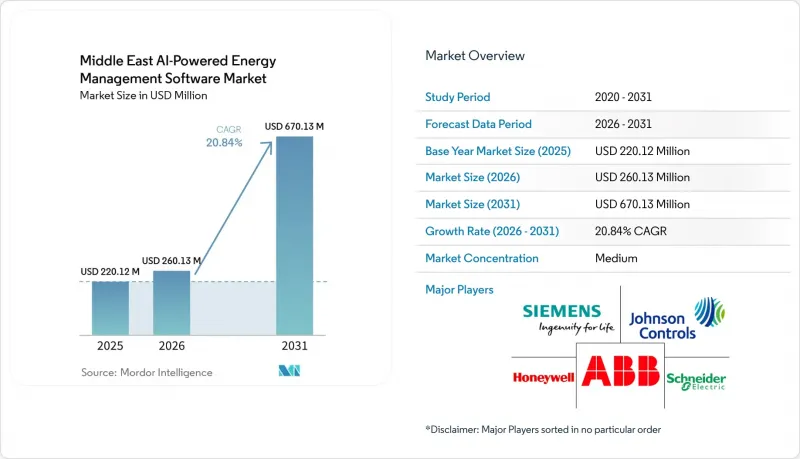
本報告按元件(軟體和服務)、部署類型(雲端、本地部署、混合部署)、應用(例如,能源消耗和需求最佳化、資產性能和預測性維護)、最終用戶(例如,商業建築、工業設施)和地區進行細分。市場預測以貨幣價值(美元)表示。
中東人工智慧能源管理軟體市場趨勢與洞察
加速波灣合作理事會(GCC)成員國智慧電網和公共產業數位化建設
中東地區人工智慧能源管理軟體市場正受惠於公共產業的數位轉型專案。這是因為電網營運商需要的軟體不僅要收集高頻運行數據,更要能夠解讀這些數據。沙烏地阿拉伯和阿拉伯聯合大公國(阿拉伯聯合大公國)正積極推動電網現代化,將預測分析、自動化和數位化營運工具更緊密地融入核心公共產業流程,而非僅僅作為試點計畫。 2025年10月,阿布達比能源局與Google雲端簽署協議,將人工智慧和機器學習應用於電網管理、需求預測和預測性維護。這顯示電網數位化與軟體採購緊密相連。類似的轉變正在拓展人工智慧的應用範圍,使其從後勤部門報告擴展到為發電廠、可再生能源資產和配電系統提供即時營運支援。隨著電力公司建構大規模的數位化控制環境,能夠將預測、維護和能源最佳化整合到單一營運層的供應商預計將在中東人工智慧能源管理軟體市場獲得競爭優勢。此外,海灣合作理事會(GCC)各國的採購範圍也不斷擴大。這是因為軟體需求同時源自於對系統可見度、運作彈性和平衡可再生能源的需求。
商業建築對人工智慧驅動的負載預測的需求日益成長
在中東人工智慧能源管理軟體市場,商業建築的需求日益成長,因為辦公大樓、零售設施、飯店和綜合用途物業的能源消耗與冷凍負載、合規目標和公用事業成本管理之間的聯繫越來越緊密。業主不再僅僅需要監控儀錶板,他們越來越傾向於使用預測工具來管理高峰需求、安排能源消耗並改善營運控制,而無需更換整個建築系統。隨著阿拉伯聯合大公國自2026年起大力推動能源透明度和排放課責,能夠將設施級性能數據轉化為可執行決策的數位化能源平台所帶來的商業效益也日益凸顯。 2026年5月,Schneider Electric在阿拉伯聯合大公國的26家Brands For Less門市部署了其EcoStruxure Building平台,這表明軟體主導的建築最佳化正在從旗艦物業擴展到多地點商業地產組合。這對中東人工智慧能源管理軟體市場具有重大意義。這是因為與大規模客製化項目相比,中型物業業者需要更快的投資回報和最小的營運影響。因此,能夠提供模組化預測功能、遠端最佳化以及與現有建築系統輕鬆整合的供應商,在該地區獲得了更廣泛的基本客群。
對資料主權的擔憂正在減緩向雲端的過渡。
由於數據主權問題,中東地區人工智慧能源管理軟體市場面臨許多限制。許多買家處理高度敏感的電網資料、工廠遙測資料、建築控制系統資料和基礎設施資訊。沙烏地阿拉伯的在地化法規增加了跨境雲設計的成本,而且由於全部區域的居住要求不同,情況仍然不均衡。儘管沙烏地阿拉伯的「全球人工智慧中心法」草案表明未來可能會建立更靈活的框架,但供應商目前在為區域市場設計服務時仍需應對合規性的不確定性。這減緩了企業採用該技術的速度,因為企業通常選擇混合部署或特定國家/地區的部署,雖然這些部署在法律上安全,但效率低於單一的區域雲環境。小規模專業公司受到的影響比大型成熟企業更大,因為建立符合主權要求的基礎設施和認證層需要資金、本地資源和長期銷售支援。因此,雖然需求不會崩壞,但中東人工智慧能源管理軟體市場向完全雲端原生模式過渡的速度正在放緩。
細分市場分析
到2025年,軟體將在中東人工智慧能源管理軟體市場佔據68.22%的佔有率。這凸顯了買家仍優先考慮能夠集中進行分析、預測、最佳化和控制的工作流程平台。軟體的主導地位也反映出該地區偏好可擴展的平台,這些平台能夠滿足大規模公共產業、商業專案和工業網路的需求,而不是局限於單點部署。平台廣度在中東人工智慧能源管理軟體產業的重要性源於客戶日益成長的需求,即需要一個能夠同時支援需求管理、維護計劃、可再生能源平衡和報告等功能的單一營運層。這解釋了為什麼在採購決策與企業許可證、整合式儀表板和長期數位轉型計畫掛鉤,而非與有限的應用工具掛鉤的領域,對軟體的需求仍然強勁。這也意味著,在買家評估供應商時,產品深度、易於整合和合規性與核心分析能力同等重要。
預計到2031年,服務業將以20.91%的複合年成長率成長,這意味著在許多部署中,整合、模型調優、變更管理和持續最佳化仍然需要外部支援。這種成長模式表明,中東人工智慧能源管理軟體市場正超越軟體部署的初始階段,進入更長期的調整、站點擴展和營運支援週期。同行評審的研究表明,多智慧體框架在自動化建築負載預測模型開發方面非常有效,這為供應商未來幾年可以將其納入軟體訂閱服務的一個服務密集型用例提供了範例。企業合約中也出現了類似的趨勢,買家越來越重視專家支持,以幫助其內部團隊從數據收集轉向可衡量的營運改善。 C3.AI於2026年6月擴展了與殼牌的契約,將基於人工智慧代理的根本原因分析納入其中,用於超過13,000台設備,這表明在平台部署後,長期服務契約可以如何進一步深化。
預計到2025年,中東人工智慧能源管理軟體市場中,雲端部署將佔58.14%的佔有率,這表明,在法規允許的情況下,買家仍然優先考慮可擴展性、快速更新和較低的初始基礎設施成本。雲端部署在需要管理多個資產並實現跨多個營運地點集中可視性的企業中最為常見。這種模式對中東人工智慧能源管理軟體產業極具吸引力,因為它有助於標準化跨建築、電網、工業設施和高能耗服務環境的效能追蹤。它也符合企業採購趨勢,即尋求訂閱模式、遠端管理功能和更快的平台升級,而這些通常是傳統本地部署環境所不支援的。然而,即使在2025年以雲端主導主導的環境中,法規也不再是障礙,因為部署選項仍然很大程度上取決於營運資料的儲存位置以及資料的敏感度。
預計到2031年,混合部署將以21.02%的複合年成長率成長,凸顯了該地區在雲端效率和主權要求之間尋求平衡點的努力。混合設計的吸引力在於,它能夠在將敏感遙測數據靠近資產的同時,實現更廣泛的企業級分析、最佳化和投資組合報告。 Phaidra AI於2026年2月開展的一項先導計畫,由阿拉伯聯合大公國能源和基礎設施部、Khazna資料中心和Agility共同參與,展示瞭如何在合規的本地運營架構下而非純粹的離岸雲環境中實現能源最佳化。隨著買家越來越需要柔軟性,同時又不希望承擔不必要的監管風險,這種架構在中東人工智慧驅動的能源管理軟體市場中正變得具有重要的戰略意義。因此,將混合功能整合到其核心產品的供應商,如今比那些試圖在雲端優先產品中添加有限的本地部署功能的供應商更具優勢。
其他好處:
- Excel格式的市場預測(ME)表
- 3個月的分析師支持
目錄
第1章:引言
- 研究假設和市場定義
- 調查範圍
第2章:調查方法
第3章執行摘要
第4章 市場狀況
- 市場概覽
- 市場促進因素
- 加速海灣合作理事會(GCC)成員國智慧電網和公共產業的數位化進程
- 商業建築對人工智慧驅動的電力需求預測的需求日益成長。
- 根據各國的脫碳計畫制定強制性能源效率目標
- 雲端原生企業能源平台的擴展
- 高能耗資產對預測性維護的需求日益成長
- 在大型設施中推廣分錶計量和物聯網感測器網路的應用
- 市場限制因素
- 對資料主權的擔憂正在減緩向雲端的過渡。
- 與傳統建築系統和工業控制系統整合的複雜性。
- 終端用戶缺乏人工智慧技能和實施能力
- 全部區域公用事業收費和法律規範分散
- 宏觀經濟因素對市場的影響
- 產業價值鏈分析
- 監理情勢
- 技術展望
- 波特五力分析
第5章 市場規模與成長預測
- 按組件
- 軟體
- 服務
- 部署模式
- 基於雲端的
- 現場
- 混合
- 透過使用
- 最佳化能源消耗和需求
- 資產性能和預測性維護
- 智慧電網和分散式能源(DER)管理
- 可再生能源預測與整合
- 能源交易、定價和市場訊息
- 最終用戶
- 公用事業
- 商業建築
- 工業設施
- 住宅大樓
- 按地區
- 沙烏地阿拉伯
- 阿拉伯聯合大公國
- 卡達
- 其他中東國家
第6章 競爭情勢
- 市場集中度
- 策略趨勢
- 市佔率分析
- 公司簡介
- Schneider Electric SE
- Siemens Aktiengesellschaft
- Honeywell International Inc.
- ABB Ltd
- Johnson Controls International plc
- IBM Corporation
- Cisco Systems, Inc.
- Oracle Corporation
- SAP SE
- Eaton Corporation plc
- Rockwell Automation, Inc.
- Emerson Electric Co.
- Enel X Srl
- GridPoint, Inc.
- Bidgely, Inc.
- C3.ai, Inc.
- Verdigris Technologies, Inc.
- eSight Energy Ltd.
- Spacewell International NV
- BrainBox AI Inc.
第7章 市場機會與未來展望
According to Mordor Intelligence, the Middle East AI-powered energy management software market size is projected to expand from USD 220.12 million in 2025 and USD 260.13 million in 2026 to USD 670.13 million by 2031, registering a CAGR of 20.84% between 2026 and 2031.
This report is Segmented by Component (Software, and Services), Deployment Mode (Cloud-Based, On-Premises, and Hybrid), Application (Energy Consumption and Demand Optimization, Asset Performance and Predictive Maintenance, and More), End User (Commercial Buildings, Industrial Facilities, and More), and Geography. The Market Forecasts are Provided in Terms of Value (USD).
Middle East AI-powered Energy Management Software Market Trends and Insights
Accelerated Smart Grid and Utility Digitization in Gulf Cooperation Council States
The Middle East AI-powered Energy Management Software Market is gaining direct support from utility digitization programs because grid operators now need software that can interpret high-frequency operational data rather than simply collect it. Saudi Arabia and the UAE are moving ahead with grid modernization agendas that place predictive analytics, automation, and digital operating tools closer to core utility processes rather than in pilot-stage experimentation. Abu Dhabi's Department of Energy signed an agreement with Google Cloud in October 2025 to apply AI and machine learning to grid management, demand forecasting, and predictive maintenance, which shows how grid digitization is translating into software procurement. The same shift is expanding AI's role from back-office reporting to real-time operational support across power plants, renewable assets, and distribution systems. As utilities build larger digital control environments, vendors that can integrate forecasting, maintenance, and energy optimization into a single operating layer are likely to gain an advantage in the Middle East AI-powered Energy Management Software Market. Procurement is also becoming broader across the GCC because software requirements now come from system visibility, operating resilience, and renewable balancing needs simultaneously.
Rising Demand for AI-Driven Load Forecasting in Commercial Buildings
The Middle East AI-powered Energy Management Software Market is seeing stronger demand from commercial buildings because energy use in offices, retail sites, hospitality assets, and mixed-use properties is increasingly tied to cooling loads, compliance targets, and utility cost management. Building owners are no longer looking only for monitoring dashboards, and they increasingly want forecasting tools that can help manage peak demand, schedule consumption, and improve operational control without replacing entire building systems. The UAE's push toward broader energy visibility and emissions accountability from 2026 is strengthening the commercial case for digital energy platforms that can organize site-level performance data into usable decisions. Schneider Electric expanded its EcoStruxure Building platform across 26 Brands For Less stores in the UAE in May 2026, demonstrating that software-led building optimization is moving beyond flagship properties into multi-site commercial portfolios. This matters for the Middle East AI-powered Energy Management Software Market because mid-market property operators usually need faster payback and less disruption than large custom projects can offer. As a result, vendors that provide modular forecasting, remote optimization, and easier integration with existing building systems are gaining a wider addressable base in the region.
Data Sovereignty Concerns Slowing Cloud Migration
The Middle East AI-powered Energy Management Software Market faces a real constraint due to data sovereignty, as many buyers handle sensitive grid data, plant telemetry, building controls, and infrastructure information. Saudi Arabia's localization rules have increased the cost of cross-border cloud design, and the broader GCC environment remains uneven because residency expectations differ by country and by application. The draft Global AI Hub Law in Saudi Arabia suggests that more flexible structures may emerge over time, but the current period still leaves vendors navigating compliance uncertainty when they architect regional offerings. This slows adoption because enterprises often choose hybrid or country-specific deployments that are legally safer but less efficient than a single regional cloud environment. Smaller specialists are affected more than incumbents because building sovereign-compliant infrastructure and certification layers requires capital, local presence, and longer sales support. The result is not a collapse in demand, but a slower transition path for fully cloud-native models in the Middle East AI-powered Energy Management Software Market.
Other drivers and restraints analyzed in the detailed report include:
- Mandatory Energy Efficiency Targets Under National Decarbonization Programs
- Expansion of Cloud-Native Enterprise Energy Platforms
- Integration Complexity With Legacy Building and Industrial Control Systems
For complete list of drivers and restraints, kindly check the Table Of Contents.
Segment Analysis
Software held 68.22% of the Middle East AI-powered Energy Management Software Market share in 2025, which confirms that buyers still place the greatest value on platforms that can centralize analytics, forecasting, optimization, and control workflows. The leading role of software also reflects the region's preference for scalable platforms that can serve large utilities, commercial portfolios, and industrial networks without being confined to a single site deployment. In the Middle East AI-powered energy management software industry, platform breadth matters because customers increasingly want one operating layer that can support demand management, maintenance planning, renewable balancing, and reporting requirements at the same time. This explains why software demand remains strongest where procurement decisions are tied to enterprise licenses, integrated dashboards, and long-term digital transformation programs rather than narrow application tools. It also means that product depth, ease of integration, and compliance fit are becoming as important as core analytics performance when buyers evaluate suppliers.
Services is projected to expand at a 20.91% CAGR through 2031, which shows that many deployments still need outside support for integration, model tuning, change management, and ongoing optimization. This growth pattern suggests the Middle East AI-powered Energy Management Software Market is moving beyond first-stage software rollout and toward a longer cycle of recalibration, site expansion, and operational support. A peer-reviewed study validated a multi-agent framework for automating building load forecasting model development, which points to the kind of service-intensive use cases vendors can package around software subscriptions in coming years. The same logic is visible in enterprise contracts, where buyers increasingly value expert support that helps internal teams move from data collection to measurable operational improvement. C3.AI's June 2026 expansion of its agreement with Shell, including AI agent-based root cause analysis across more than 13,000 pieces of equipment, illustrates how long-term service engagement can deepen once the platform is already embedded.
Cloud-based deployment accounted for 58.14% of the Middle East AI-powered Energy Management Software Market in 2025, indicating that buyers still favor scalability, update speed, and lower upfront infrastructure costs where regulation allows. Cloud adoption has been strongest where organizations manage multiple assets and need centralized visibility across large operating footprints. In the Middle East AI-powered energy management software industry, this model is attractive because it helps standardize performance tracking across buildings, grids, industrial sites, and energy-intensive service environments. It also aligns with procurement preferences among enterprises that want subscription models, remote management capability, and quicker platform upgrades than older on-premises environments can usually support. At the same time, cloud leadership in 2025 does not mean regulation is no longer a barrier, because deployment choices still depend heavily on where operational data sits and how sensitive that data is deemed to be.
Hybrid deployment is projected to expand at a 21.02% CAGR through 2031, underscoring how the region is settling on a middle path between cloud efficiency and sovereignty requirements. The appeal of hybrid design lies in its ability to keep sensitive telemetry close to the asset while still enabling broader analytics, optimization, and portfolio reporting across a wider enterprise. The February 2026 Phaidra AI pilot involving the UAE Ministry of Energy and Infrastructure, Khazna Data Centers, and Agility showed how energy optimization can be advanced within a compliant local operating structure rather than through a purely offshore cloud setup. This architecture is becoming increasingly strategically important in the Middle East AI-powered Energy Management Software Market, as buyers increasingly seek flexibility without incurring unnecessary regulatory exposure. Vendors that built hybrid capability into the core product are therefore better placed than those now trying to retrofit limited on-premises features onto a cloud-first offering.
Complete Report Scope:
- By Component
- Software
- Services
- By Deployment Mode
- Cloud-Based
- On-Premises
- Hybrid
- By Application
- Energy Consumption and Demand Optimization
- Asset Performance and Predictive Maintenance
- Smart Grid and Distributed Energy Resource (DER) Management
- Renewable Energy Forecasting and Integration
- Energy Trading, Pricing and Market Intelligence
- By End User
- Utilities
- Commercial Buildings
- Industrial Facilities
- Residential Buildings
- By Geography
- Saudi Arabia
- United Arab Emirates
- Qatar
- Rest of Middle East
List of Companies Covered in this Report:
- Schneider Electric SE
- Siemens Aktiengesellschaft
- Honeywell International Inc.
- ABB Ltd
- Johnson Controls International plc
- IBM Corporation
- Cisco Systems, Inc.
- Oracle Corporation
- SAP SE
- Eaton Corporation plc
- Rockwell Automation, Inc.
- Emerson Electric Co.
- Enel X S.r.l.
- GridPoint, Inc.
- Bidgely, Inc.
- C3.AI, Inc.
- Verdigris Technologies, Inc.
- eSight Energy Ltd.
- Spacewell International N.V.
- BrainBox AI Inc.
Additional Benefits:
- The market estimate (ME) sheet in Excel format
- 3 months of analyst support
TABLE OF CONTENTS
1 INTRODUCTION
- 1.1 Study Assumptions and Market Definition
- 1.2 Scope of the Study
2 RESEARCH METHODOLOGY
3 EXECUTIVE SUMMARY
4 MARKET LANDSCAPE
- 4.1 Market Overview
- 4.2 Market Drivers
- 4.2.1 Accelerated Smart Grid and Utility Digitization in Gulf Cooperation Council States
- 4.2.2 Rising Demand For AI-Driven Load Forecasting in Commercial Buildings
- 4.2.3 Mandatory Energy Efficiency Targets Under National Decarbonization Programs
- 4.2.4 Expansion of Cloud-Native Enterprise Energy Platforms
- 4.2.5 Increasing Need For Predictive Maintenance Across Energy-Intensive Assets
- 4.2.6 Greater Deployment of Submetering and IoT Sensor Networks in Large Facilities
- 4.3 Market Restraints
- 4.3.1 Data Sovereignty Concerns Slowing Cloud Migration
- 4.3.2 Integration Complexity With Legacy Building and Industrial Control Systems
- 4.3.3 Limited AI Skills and Implementation Capacity Among End Users
- 4.3.4 Fragmented Utility Tariff and Regulatory Structures Across The Region
- 4.4 Impact of Macroeconomic Factors On The Market
- 4.5 Industry Value-Chain Analysis
- 4.6 Regulatory Landscape
- 4.7 Technological Outlook
- 4.8 Porter's Five Forces Analysis
- 4.8.1 Bargaining Power of Buyers
- 4.8.2 Bargaining Power of Suppliers
- 4.8.3 Threat of New Entrants
- 4.8.4 Threat of Substitutes
- 4.8.5 Intensity of Competitive Rivalry
5 MARKET SIZE AND GROWTH FORECASTS (VALUE)
- 5.1 By Component
- 5.1.1 Software
- 5.1.2 Services
- 5.2 By Deployment Mode
- 5.2.1 Cloud-Based
- 5.2.2 On-Premises
- 5.2.3 Hybrid
- 5.3 By Application
- 5.3.1 Energy Consumption and Demand Optimization
- 5.3.2 Asset Performance and Predictive Maintenance
- 5.3.3 Smart Grid and Distributed Energy Resource (DER) Management
- 5.3.4 Renewable Energy Forecasting and Integration
- 5.3.5 Energy Trading, Pricing and Market Intelligence
- 5.4 By End User
- 5.4.1 Utilities
- 5.4.2 Commercial Buildings
- 5.4.3 Industrial Facilities
- 5.4.4 Residential Buildings
- 5.5 By Geography
- 5.5.1 Saudi Arabia
- 5.5.2 United Arab Emirates
- 5.5.3 Qatar
- 5.5.4 Rest of Middle East
6 COMPETITIVE LANDSCAPE
- 6.1 Market Concentration
- 6.2 Strategic Moves
- 6.3 Market Share Analysis
- 6.4 Company Profiles (includes Global Level Overview, Market Level Overview, Core Segments, Financials as available, Strategic Information, Market Rank/Share, Products and Services, Recent Developments)
- 6.4.1 Schneider Electric SE
- 6.4.2 Siemens Aktiengesellschaft
- 6.4.3 Honeywell International Inc.
- 6.4.4 ABB Ltd
- 6.4.5 Johnson Controls International plc
- 6.4.6 IBM Corporation
- 6.4.7 Cisco Systems, Inc.
- 6.4.8 Oracle Corporation
- 6.4.9 SAP SE
- 6.4.10 Eaton Corporation plc
- 6.4.11 Rockwell Automation, Inc.
- 6.4.12 Emerson Electric Co.
- 6.4.13 Enel X S.r.l.
- 6.4.14 GridPoint, Inc.
- 6.4.15 Bidgely, Inc.
- 6.4.16 C3.ai, Inc.
- 6.4.17 Verdigris Technologies, Inc.
- 6.4.18 eSight Energy Ltd.
- 6.4.19 Spacewell International N.V.
- 6.4.20 BrainBox AI Inc.
7 MARKET OPPORTUNITIES AND FUTURE OUTLOOK
- 7.1 White-Space and Unmet-Need Assessment

 2034年人工智慧市場在發電領域的預測-按組件、部署模式、人工智慧技術、電源、應用、企業規模、最終用戶和地區分類的全球分析
 人工智慧在能源市場的應用:市場規模、佔有率、成長、全球產業分析、區域趨勢及2026-2034年預測電力產業人工智慧市場規模、佔有率、成長、全球產業分析、區域趨勢以及2026-2034年的預測
 全球能源電力領域人工智慧(AI)市場:機會與策略展望(至2035年)
 中國人工智慧能源管理軟體:市場佔有率分析、產業趨勢與統計及成長預測(2026-2031)中東和非洲人工智慧能源管理軟體:市場佔有率分析、行業趨勢和統計數據以及成長預測(2026-2031 年)南美洲人工智慧能源管理軟體:市場佔有率分析、行業趨勢和統計數據以及成長預測(2026-2031 年)印度人工智慧能源管理軟體:市場佔有率分析、行業趨勢和統計數據以及成長預測(2026-2031 年)德國人工智慧能源管理軟體:市場佔有率分析、行業趨勢和統計數據以及成長預測(2026-2031 年)新加坡人工智慧能源管理軟體:市場佔有率分析、行業趨勢和統計數據以及成長預測(2026-2031 年)