


 |
市場調查報告書
商品編碼
2099150
中國IT服務管理(ITSM):市場佔有率分析、產業趨勢與統計及成長預測(2026-2031年)China ITSM - Market Share Analysis, Industry Trends & Statistics, Growth Forecasts (2026 - 2031) |
||||||

※ 本網頁內容可能與最新版本有所差異。詳細情況請與我們聯繫。
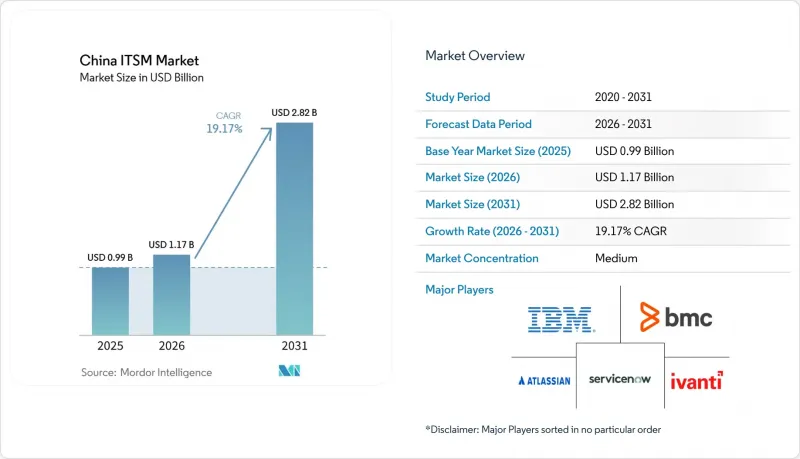
根據 Mordor Intelligence 預測,中國 IT 服務管理市場規模預計到 2025 年將達到 9.9 億美元,到 2026 年將達到 11.7 億美元,到 2031 年將達到 28.2 億美元,2026 年至 2031 年的複合年成長率為 19.17%。
本報告按元件(解決方案和服務)、部署方式(雲端、本地部署、混合部署)、應用領域(服務台和事件管理、資產和配置管理等)、最終用戶行業(銀行、金融服務和保險、製造業等)以及企業規模(大型企業、中小企業)進行細分。市場預測以美元計價。
中國IT服務管理市場的趨勢與洞察
在中國當地遷移到雲端原生IT服務管理平台
中國的IT服務管理市場正受惠於企業營運向雲端化轉型的趨勢。中國2026年的政策組合將持續支持創新、數位化和國家「人工智慧+」策略,使企業技術升級成為經營團隊的首要任務。一家跨國公司中國總部的案例研究表明,該公司在嚴格的合規期限內成功完成了在地化的IT服務管理轉型,這表明雲端化、在地化的交付模式如今已成為大型企業更為現實的選擇。隨著企業進一步將業務系統部署到可擴展的數位基礎架構上,對能夠連接到這些環境而無需繁瑣手動配置的服務平台的需求日益成長。這縮短了傳統本地部署工具的替換週期,並提高了訂閱式部署的吸引力。能夠提供快速部署、本地語言支援以及與國內企業工具輕鬆整合的供應商具有顯著優勢。
在整個企業範圍內實現人工智慧驅動的服務自動化
在中國的IT服務管理市場,人工智慧正在改變IT服務管理的角色,使其從工作流程管理轉向更自動化的維運支援。在2026年世界行動通訊大會(MWC 2026)上,華為發布了AUTINOps,這是一款原生AI智慧運維解決方案,它將人類工程師與「數位員工」連接起來,以支援更主動的維運。中國建設銀行2025年年度報告展示了涵蓋所有業務職能的398個AI應用場景,反映出隨著AI成為企業日常營運不可或缺的一部分,所需的服務管治規模日益擴大。在中國的IT服務管理市場,這意味著買家不再只是追求工單處理的效率,他們還需要一個能夠吸收營運知識、支援更快問題解決並提升大規模支援團隊一致性的平台。因此,相比僅僅添加通用AI功能的供應商,那些建立更強大的企業級過程模式的供應商更有可能在長期內留住客戶。
遷移舊有系統。
舊有系統的遷移仍是中國IT服務管理市場面臨的一大障礙。許多大型企業仍然依賴高度客製化的工單管理環境和過時的流程結構,這些環境和結構與ERP、人力資源和資產管理系統整合在一起。在中國IT服務管理市場,真正的挑戰不僅在於軟體替換,還在於重新設計多年來圍繞遺留系統所建構的嵌入式流程。這延長了實施週期,並增加了擁有複雜管治結構的收購公司的擁有成本。此外,由於大型企業客戶更重視證明遷移能夠最大限度地減少對營運的影響,而不是產品本身的定位,因此遷移往往會延遲大規模企業客戶簽訂新契約的進程。
細分市場分析
到2025年,解決方案將佔據中國IT服務管理市場61.62%的佔有率,其收入來源將繼續專注於整合軟體套件,而非單純的服務交付。這些平台通常將事件管理、變更管理、服務目錄功能和配置可見性整合到單一環境中,這也解釋了為什麼企業仍然將相當一部分支出用於軟體主導的部署。此外,由於買家要求對工作流程設計、策略一致性和長期流程標準化擁有更大的控制權,供應商在中國IT服務管理市場佔據主導地位。這種趨勢在大型客戶中尤其明顯,因為這些客戶的服務營運與審計合規性和業務永續營運措施密切相關。在這種情況下,即使採購中包含服務,軟體仍然至關重要。
然而,預計到2031年,服務業將以21.62%的複合年成長率成長,成為中國IT服務管理市場成長最快的細分領域。這一轉變反映出市場對實施支援、託管營運、人工智慧諮詢服務以及實施後最佳化服務的需求日益成長。對於那些希望更快實現價值,且自身內部IT服務管理(ITSM)架構不足以獨立完成整個實施流程的買家而言,這一點尤其重要。 Atlassian於2025年10月發布的「服務集合」表明,產品供應商在企業服務交付中扮演的角色日益重要,進一步模糊了軟體價值和服務價值之間的界線。因此,中國IT服務管理產業正呈現出一種持續收入來源不斷成長的趨勢,即在核心平台部署後,服務擴大支持客戶維繫和業務拓展。
預計到2025年,雲端運算將佔中國IT服務管理市場規模的58.62%,並將在2031年之前維持21.34%的複合年成長率,成為成長最快的產業之一。這表明,主流的雲端運算模式尚未完全成熟,但仍在快速發展中。在中國IT服務管理市場,雲端運算對那些尋求更快部署、更便利更新、減少對本地基礎設施管理依賴的企業極具吸引力。它也適用於那些希望跨多個地點和使用者群體實現服務流程標準化的組織。因此,雲端運算不僅吸引了新用戶,也融入了現有企業的更新換代週期。
在國防相關環境、敏感的政府網路以及一些金融機構中,本地部署仍然發揮著至關重要的作用,因為實體管理和嚴格的身份驗證仍然至關重要。混合模式則繼續被那些在本地運行業務關鍵型環境,同時將不太敏感的工作流程遷移到雲端系統的公司所採用。 2026年4月,Freshworks透過持續發現和跨雲端、混合和本地環境的依賴關係映射擴展了Freshservice,這表明混合服務管理仍然需要積極主動的產品開發,而不僅僅是部署的柔軟性。從實際角度來看,中國IT服務管理市場更重視能夠幫助管理混合環境的供應商,而不是強迫買家進行徹底的、非此即彼的遷移。因此,儘管中國IT服務管理產業正朝著以雲端為中心的部署模式轉變,但這種轉變是透過分階段的營運整合來實現的,而不是與傳統環境徹底決裂。
其他好處:
- Excel格式的市場預測(ME)表
- 3個月的分析師支持
目錄
第1章:引言
- 研究假設和市場定義
- 調查範圍
第2章:調查方法
第3章執行摘要
第4章 市場狀況
- 市場概覽
- 市場促進因素
- 在中國當地遷移到雲端原生IT服務管理平台
- 人工智慧驅動的企業IT營運服務自動化
- 面向混合雲和多重雲端環境的整合服務管理
- 低程式碼和無程式碼編配的興起加速了工作流程設計。
- 將FinOps和GreenOps報告功能整合到ITSM工作流程中
- 在邊緣運算和 5G 營運中擴展 ITSM 部署
- 市場限制因素
- 遷移舊有系統。
- ITSM和ITOM專業人員短缺
- 資料居住要求、安全性和合規性障礙
- 可觀測性資料成本的不斷上升導致各種工具的湧現。
- 產業價值鏈分析
- 宏觀經濟因素的影響
- 監理情勢
- 技術展望
- 波特五力分析
第5章 市場規模與成長預測
- 按組件
- 解決方案
- 服務
- 不同的發展
- 雲
- 現場
- 混合
- 透過使用
- 服務台和事件管理
- 資產和配置管理
- 變更和發布管理
- 服務請求管理
- 知識管理
- 其他ITSM應用
- 按最終用戶行業分類
- BFSI
- 製造業
- 政府/公共部門
- IT/通訊
- 零售與電子商務
- 衛生保健
- 旅遊與飯店
- 其他終端用戶產業
- 按公司規模
- 大公司
- 中小企業
第6章 競爭情勢
- 市場集中度
- 策略趨勢
- 市佔率分析
- 公司簡介
- ServiceNow, Inc.
- International Business Machines Corporation
- BMC Software, Inc.
- Atlassian Corporation Plc
- Ivanti, Inc.
- Freshworks Inc.
- Zoho Corporation Private Limited
- Broadcom Inc.
- OpenText Corporation
- SolarWinds Corporation
- Hewlett Packard Enterprise Company
- TopDesk BV
- EasyVista SA
- SysAid Technologies Ltd.
- Hornbill Service Management Limited
- Matrix42 AG
- InvGate SRL
- Cloudwise Technology Co., Ltd.
- Shenzhen Uniware Technology Co., Ltd.
- Huawei Technologies Co., Ltd.
- Lenovo Group Limited
- BCC Group Co., Ltd.
- Yonyou Network Technology Co., Ltd.
第7章 市場機會與未來展望
According to Mordor Intelligence, the China iT service management market size is projected to be USD 0.99 billion in 2025, USD 1.17 billion in 2026, and reach USD 2.82 billion by 2031, growing at a CAGR of 19.17% from 2026 to 2031.
This report is Segmented by Component (Solutions and Services), Deployment (Cloud, On-Premise, and Hybrid), Application (Service Desk and Incident Management, Asset and Configuration Management, and More), End-User Industry (BFSI, Manufacturing, and More), and Enterprise Size (Large Enterprises, and Small and Medium Enterprises). The Market Forecasts are Provided in Terms of Value (USD).
China ITSM Market Trends and Insights
Shift To Cloud-Native ITSM Platforms In Mainland China
The China IT service management market is benefiting from a broad move toward cloud-ready enterprise operations. China's 2026 policy mix continues to support innovation, digitalization, and the national AI Plus agenda, which keeps enterprise technology upgrades high on management agendas. A documented case from a multinational company's China headquarters showed that a localized ITSM migration could be completed within a strict compliance timeline, indicating that cloud-ready, locally adapted delivery models are now more practical for large organizations. As enterprises deploy more business systems on scalable digital infrastructure, they want service platforms that can connect to those environments without lengthy manual configuration cycles. That shortens the replacement window for older on-premise tools and increases the appeal of subscription-based deployment. It also favors vendors that can deliver fast implementation, local language support, and easier integration with domestic enterprise tools.
AI-Driven Service Automation Across Enterprises
AI is changing the role of IT service management from workflow administration to more automated operational support in the China IT service management market. Huawei introduced AUTINOps at MWC 2026 as an AI-native intelligent operations solution that places digital employees beside human engineers and supports more proactive operations. China Construction Bank's 2025 annual report also showed 398 AI application scenarios across business functions, reflecting the scale of service governance needed as AI becomes part of everyday enterprise activity. In the China IT service management market, this means buyers are no longer looking only for ticket handling efficiency. They are also looking for platforms that can absorb operational knowledge, support faster resolution, and improve consistency across large support teams. Vendors that build stronger enterprise-specific process models are therefore likely to hold customers longer than vendors that only add generic AI features.
Legacy Migration Complexity and High Switching Costs
Legacy migration remains a meaningful drag on the China IT service management market. Many large organizations still rely on deeply customized ticketing environments and older process structures that are tied to ERP, HR, and asset systems. In the China IT service management market, the real difficulty is not only software replacement but also redesigning embedded processes that have grown up around old systems over the years. This lengthens implementation timelines and increases ownership costs for buyers with complex governance structures. It also slows new contract conversion in the largest enterprise accounts, where proof of low-disruption migration matters more than product positioning alone.
Other drivers and restraints analyzed in the detailed report include:
- Unified Service Management For Hybrid and Multi-Cloud Environments
- Rise Of Low-Code and No-Code ITSM Orchestration
- Shortage of Skilled ITSM And ITOM Professionals
For complete list of drivers and restraints, kindly check the Table Of Contents.
Segment Analysis
Solutions commanded 61.62% of the China IT service management market share in 2025, which kept the revenue base centered on integrated software suites rather than pure service delivery. These platforms usually combine incident management, change management, service catalog functions, and configuration visibility in a single environment, which explains why enterprises still allocate most spending to software-led rollouts. The China IT service management market has also favored solution vendors, as buyers seek greater control over workflow design, policy alignment, and long-term process standardization. That pattern remains strongest in large accounts where service operations are tied to audit readiness and business continuity practices. In that setting, software remains the anchor, even when services are included in the purchase.
Services, however, are projected to expand at a 21.62% CAGR through 2031, making them the fastest-growing component of the China IT service management market. The shift reflects rising demand for implementation support, managed operations, AI advisory work, and post-deployment optimization. This is especially relevant when buyers want faster time-to-value but do not yet have sufficient internal ITSM depth to manage a full rollout on their own. Atlassian's October 2025 launch of Service Collection showed how product vendors are broadening their role around enterprise service delivery, which further blurs the line between software and service value. The China IT service management industry is therefore seeing a more recurring revenue mix, where services increasingly support retention and expansion after the core platform is deployed.
Cloud deployment held 58.62% of the China IT service management market size in 2025, and it is also projected to record the fastest 21.34% CAGR through 2031. That combination shows that the leading deployment model is still gaining strength rather than reaching maturity. In the China IT service management market, cloud deployment appeals to enterprises seeking faster rollouts, easier updates, and reduced reliance on local infrastructure management. It also suits organizations that are trying to standardize service processes across multiple offices and user groups. This is why cloud adoption is moving beyond new buyers and into replacement cycles among established enterprises.
On-premise deployment still matters in defense-linked environments, classified government networks, and selected financial institutions where physical control and strict certification remain important. The hybrid model continues to serve enterprises that run production-critical environments on-site while moving less sensitive workflows to cloud-based systems. Freshworks expanded Freshservice in April 2026 through continuous discovery and dependency mapping across cloud, hybrid, and on-premises environments, demonstrating that hybrid service management still needs active product development rather than just simple deployment flexibility. In practical terms, the China IT service management market is rewarding vendors that can help buyers manage mixed estates rather than force a full one-step migration path. The China IT service management industry is therefore moving toward cloud-centered deployment, but it is doing so through staged operational convergence rather than a clean break from legacy environments.
Complete Report Scope:
- By Component
- Solutions
- Services
- By Deployment
- Cloud
- On-Premise
- Hybrid
- By Application
- Service Desk and Incident Management
- Asset and Configuration Management
- Change and Release Management
- Service Request Management
- Knowledge Management
- Other ITSM Applications
- By End-User Industry
- BFSI
- Manufacturing
- Government and Public Sector
- IT and Telecommunications
- Retail and E-Commerce
- Healthcare
- Travel and Hospitality
- Other End-User Industries
- By Enterprise Size
- Large Enterprises
- Small and Mid-Size Enterprises (SME)
List of Companies Covered in this Report:
- ServiceNow, Inc.
- International Business Machines Corporation
- BMC Software, Inc.
- Atlassian Corporation Plc
- Ivanti, Inc.
- Freshworks Inc.
- Zoho Corporation Private Limited
- Broadcom Inc.
- OpenText Corporation
- SolarWinds Corporation
- Hewlett Packard Enterprise Company
- TopDesk B.V.
- EasyVista S.A.
- SysAid Technologies Ltd.
- Hornbill Service Management Limited
- Matrix42 AG
- InvGate S.R.L.
- Cloudwise Technology Co., Ltd.
- Shenzhen Uniware Technology Co., Ltd.
- Huawei Technologies Co., Ltd.
- Lenovo Group Limited
- BCC Group Co., Ltd.
- Yonyou Network Technology Co., Ltd.
Additional Benefits:
- The market estimate (ME) sheet in Excel format
- 3 months of analyst support
TABLE OF CONTENTS
1 INTRODUCTION
- 1.1 Study Assumptions and Market Definition
- 1.2 Scope of the Study
2 RESEARCH METHODOLOGY
3 EXECUTIVE SUMMARY
4 MARKET LANDSCAPE
- 4.1 Market Overview
- 4.2 Market Drivers
- 4.2.1 Shift to Cloud-Native ITSM Platforms in Mainland China
- 4.2.2 AI-Driven Service Automation Across Enterprise IT Operations
- 4.2.3 Unified Service Management for Hybrid and Multi-Cloud Environments
- 4.2.4 Rise of Low-Code and No-Code Orchestration for Faster Workflow Design
- 4.2.5 FinOps and GreenOps Reporting Embedded in ITSM Workflows
- 4.2.6 Growing Adoption of ITSM for Edge Computing and 5G Operations
- 4.3 Market Restraints
- 4.3.1 Legacy Migration Complexity and High Switching Costs
- 4.3.2 Shortage of Skilled ITSM and ITOM Professionals
- 4.3.3 Data Residency, Security, and Compliance Friction
- 4.3.4 Rising Observability Data Costs Causing Tool Sprawl
- 4.4 Industry Value Chain Analysis
- 4.5 Impact of Macroeconomic Factors
- 4.6 Regulatory Landscape
- 4.7 Technological Outlook
- 4.8 Porter's Five Forces Analysis
- 4.8.1 Bargaining Power of Suppliers
- 4.8.2 Bargaining Power of Buyers
- 4.8.3 Threat of New Entrants
- 4.8.4 Threat of Substitutes
- 4.8.5 Intensity of Competitive Rivalry
5 MARKET SIZE AND GROWTH FORECASTS (VALUE)
- 5.1 By Component
- 5.1.1 Solutions
- 5.1.2 Services
- 5.2 By Deployment
- 5.2.1 Cloud
- 5.2.2 On-Premise
- 5.2.3 Hybrid
- 5.3 By Application
- 5.3.1 Service Desk and Incident Management
- 5.3.2 Asset and Configuration Management
- 5.3.3 Change and Release Management
- 5.3.4 Service Request Management
- 5.3.5 Knowledge Management
- 5.3.6 Other ITSM Applications
- 5.4 By End-User Industry
- 5.4.1 BFSI
- 5.4.2 Manufacturing
- 5.4.3 Government and Public Sector
- 5.4.4 IT and Telecommunications
- 5.4.5 Retail and E-Commerce
- 5.4.6 Healthcare
- 5.4.7 Travel and Hospitality
- 5.4.8 Other End-User Industries
- 5.5 By Enterprise Size
- 5.5.1 Large Enterprises
- 5.5.2 Small and Mid-Size Enterprises (SME)
6 COMPETITIVE LANDSCAPE
- 6.1 Market Concentration
- 6.2 Strategic Moves
- 6.3 Market Share Analysis
- 6.4 Company Profiles (includes Global Level Overview, Market Level Overview, Core Segments, Financials as available, Strategic Information, Market Rank/Share, Products and Services, Recent Developments)
- 6.4.1 ServiceNow, Inc.
- 6.4.2 International Business Machines Corporation
- 6.4.3 BMC Software, Inc.
- 6.4.4 Atlassian Corporation Plc
- 6.4.5 Ivanti, Inc.
- 6.4.6 Freshworks Inc.
- 6.4.7 Zoho Corporation Private Limited
- 6.4.8 Broadcom Inc.
- 6.4.9 OpenText Corporation
- 6.4.10 SolarWinds Corporation
- 6.4.11 Hewlett Packard Enterprise Company
- 6.4.12 TopDesk B.V.
- 6.4.13 EasyVista S.A.
- 6.4.14 SysAid Technologies Ltd.
- 6.4.15 Hornbill Service Management Limited
- 6.4.16 Matrix42 AG
- 6.4.17 InvGate S.R.L.
- 6.4.18 Cloudwise Technology Co., Ltd.
- 6.4.19 Shenzhen Uniware Technology Co., Ltd.
- 6.4.20 Huawei Technologies Co., Ltd.
- 6.4.21 Lenovo Group Limited
- 6.4.22 BCC Group Co., Ltd.
- 6.4.23 Yonyou Network Technology Co., Ltd.
7 MARKET OPPORTUNITIES AND FUTURE OUTLOOK
- 7.1 White-Space and Unmet-Need Assessment

 IT服務管理平台市場:全球市場預測,2026-2032年
 中東歐IT服務管理:市場佔有率分析、產業趨勢與統計及成長預測(2026-2035)德國IT服務管理:市場佔有率分析、產業趨勢與統計、成長預測(2026-2035)東協IT服務管理:市場佔有率分析、產業趨勢與統計及成長預測(2026-2035)英國IT服務管理:市場佔有率分析、產業趨勢與統計、成長預測(2026-2035)IT 服務管理市場:按組件、部署類型、組織規模和產業分類-2026-2032 年全球市場預測IT服務管理:市場佔有率分析、產業趨勢與統計、成長預測(2026-2031年)中東和非洲的IT服務管理:市場佔有率分析、行業趨勢和統計數據以及成長預測(2026-2031年)亞太地區IT服務管理:市場佔有率分析、產業趨勢與統計及成長預測(2026-2031年)北美IT服務管理(ITSM):市佔率分析、產業趨勢與統計及成長預測(2026-2031年)