


 |
市場調查報告書
商品編碼
2117971
中東歐IT服務管理:市場佔有率分析、產業趨勢與統計及成長預測(2026-2035)Central and Eastern Europe ITSM - Market Share Analysis, Industry Trends & Statistics, Growth Forecasts (2026 - 2035) |
||||||

※ 本網頁內容可能與最新版本有所差異。詳細情況請與我們聯繫。
根據 Mordor Intelligence 預測,中東歐的 ITSM 市場規模預計將從 2025 年的 3.357 億美元成長到 2026 年的 3.9063 億美元,到 2035 年將達到 8.653 億美元,2026 年至 2035 年的複合年成長率為 17.24%。
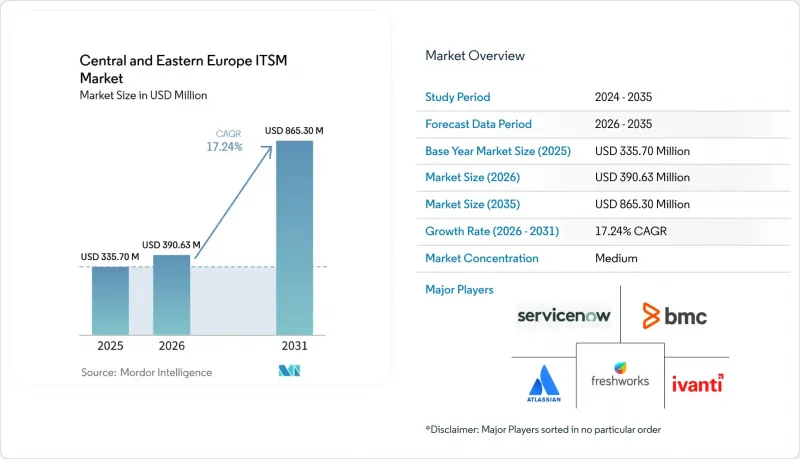
本報告按組件(解決方案、服務)、部署方式(雲端、本地部署、混合部署)、應用領域(服務台、資產和配置管理、其他)、最終用戶行業(銀行、金融服務和保險 (BFSI)、製造業、其他)以及企業規模(大型企業、中小企業)進行細分。市場預測以美元 (USD) 為單位。
中東歐IT服務管理(ITSM)市場趨勢與洞察
中型企業對雲端的IT服務管理平台的採用率不斷提高。
基於雲端的交付模式降低了對本地基礎設施的需求,並縮短了引進週期,使得中型企業成為中東歐IT服務管理(ITSM)市場新需求的主要來源。波蘭已擁有強大的雲端基礎設施,可用於業務服務營運;根據ABSL發布的2025年產業報告,93.8%的IT中心使用Microsoft Azure,81.3%使用AWS。這種超大規模資料中心業者的部署基礎使得基於SaaS的ITSM更容易實施,因為許多公司無需建置單獨的基礎架構即可新增服務管理軟體。同一份ABSL報告指出,75%的波蘭IT中心已經在使用企業級ITSM平台,這顯示雲端主導的營運模式已成為該地區的主流交付模式。由於買家尋求的是現代化的工作流程工具,同時又不想承擔大規模企業部署帶來的成本和延誤,因此能夠提供低部署成本和快速上線服務的供應商在中型市場中獲益最多。這一趨勢正在擴大中東歐 ITSM 市場的目標客戶群,使其不再局限於大型企業,並改善全部區域新客戶的獲取流程。
對工作流程自動化和服務標準化的需求日益成長。
中東歐IT服務管理(ITSM)市場的擴張部分源自於共享服務中心在不同國家、團隊和內部系統間實現一致工作流程的需求。 ABSL的一份報告顯示,波蘭74.1%的共享服務中心在2024年實施了智慧流程自動化(IPA),高於前一年的65.2%。平均任務自動化率達22.4%。隨著自動化的普及,ITSM平台正逐漸成為一個控制層,用於記錄事件、路由異常並提供業務流程核准情況的可見性。 Freshworks在第一季進一步強化了這一趨勢,當時Freshservice報告稱,他們整合了Device42用於基礎設施發現,FireHydrant用於事件回應,從而創建了一個統一的服務營運環境。此類整合至關重要,因為買家不再僅僅從工單處理的角度評估ITSM。他們正在利用ITSM來控制涵蓋資產、事件和服務流程的更廣泛工作流程的自動化。因此,在中東歐的 ITSM 市場,隨著與自動化管治相關的平台更換變得越來越困難,合約續約的需求也在增加。
由於遺留基礎設施和工具激增,導致平台整合延遲。
在中東歐地區,傳統環境仍是IT服務管理(ITSM)市場發展的一大障礙,因為許多公司仍同時運作多個重疊的服務、監控和資產管理工具。這種情況在製造業、公共產業和政府機構中尤其突出,這些產業的傳統系統已經經歷了多個技術週期。預計到2025年,光是製造業就將占到ITSM收入的19%,這相當可觀,因為營運技術(OT)環境通常不在標準ITSM設計範圍內,需要單獨的整合工作。此外,不完整或不準確的配置管理資料庫(CMDB)記錄會拖慢遷移項目,因為在新的平台能夠提供買家期望的可見性之前,通常需要對資產資料進行整理。雖然供應商提供了發現和遷移工具來解決這個問題,但這些額外的工具會增加本已面臨預算限制的買家的整體擁有成本。即使長期商業案例清晰可見,這些限制仍阻礙著中東歐ITSM市場部分需求的轉換。
細分市場分析
到2025年,該解決方案將佔據中東歐IT服務管理(ITSM)市場62%的佔有率,顯示買家仍將軟體平台置於其服務管理支出的核心位置。這種需求主要源自於服務台工具、組態管理資料庫(CMDB)功能、知識模組和自助服務層,企業更傾向於將這些功能整合到自身的營運模式中,而不是透過外包管理交付合約來實現。從實際角度來看,這種趨勢在內部IT能力較強的國家最為顯著,尤其是在共享服務中心已經管理大量工作負載的地區。波蘭在這方面表現突出,到2025年,其75%的IT業務服務中心已經部署了企業級ITSM平台。
在中東歐IT服務管理(ITSM)市場,服務領域依然強勁,預計到2031年將以18.65%的複合年成長率成長。這一成長反映了缺乏專門ITSM團隊的買家對部署、工作流程設計、人工智慧配置和持續支援的需求日益成長。 Freshworks在第一季推出的整合平台清楚展現了這項服務領域的機會。該平台涵蓋了工單管理、資產管理、事件管理、服務管理和工作流程,並透過Freshservice、Device42和FireHydrant等產品實現。羅馬尼亞、斯洛伐克和匈牙利的中型企業在這方面尤其重要,因為它們需要合規的工作流程,但往往更傾向於獲得供應商和合作夥伴的支持,以確保營運順暢。因此,儘管解決方案仍然是收入支柱,但隨著部署變得越來越複雜,並且與合規性和自動化緊密相關,服務領域正成為一個成長更快的細分市場。
到2025年,雲端運算將佔據中東歐IT服務管理(ITSM)市場64%的佔有率,成為遙遙領先的部署模式。其優勢顯而易見:SaaS平台減輕了對本地基礎設施的需求,支援持續的功能更新,並允許單一租戶同時覆蓋多個國家。這種模式與波蘭、捷克、羅馬尼亞和斯洛伐克共享服務中心的營運實際情況相符,這些國家的支援團隊通常跨境運營,需要通用的服務層級。雲端基礎設施的優勢在波蘭尤為顯著,到2025年,波蘭93.8%的IT服務中心將使用微軟Azure,81.3%將使用AWS。
此外,預計到2031年,雲端運算市場將以19.30%的複合年成長率成長,這將推動中東歐IT服務管理(ITSM)市場在採用率和成長率方面持續成長。這一雙重優勢表明,轉型遠未完成,許多組織仍在從本地部署或混合環境中遷移。政府機構和國防相關產業對本地部署解決方案的需求仍然存在,因為資料管理和採購週期減緩了向公共雲端的過渡。同時,製造商和金融機構仍在使用混合模式,繼續在私人基礎設施上維護高度敏感的工作負載。隨著資料儲存框架的標準化以及供應商人工智慧功能透過雲端交付領先交付,這些混合環境可能會逐漸減少。因此,我們看到,雲端運算正在中東歐ITSM市場建立營運標準,同時仍保留著一些傳統和過渡形式。
其他好處
- Excel格式的市場預測(ME)表
- 3個月的分析師支持
目錄
第1章:引言
- 研究假設和市場定義
- 調查範圍
第2章:調查方法
第3章執行摘要
第4章 市場狀況
- 市場概覽
- 市場促進因素
- 中型企業對雲端的IT服務管理平台的採用率不斷提高。
- 對工作流程自動化和服務標準化的需求日益成長。
- 對混合辦公和自助服務支援的需求日益成長。
- 監管壓力影響審計性、存取控制和服務可追溯性。
- 透過人工智慧驅動的工單優先排序和知識發現來提高問題解決效率。
- 在中歐和東歐地區擴展跨境共享服務中心
- 市場限制因素
- 由於遺留基礎設施和工具激增,導致平台整合延遲。
- 中小企業的預算敏感性
- ERP、身分管理和監控系統整合的複雜性。
- 公共部門和受監管行業的居住要求和採購限制
- 產業價值鏈分析
- 監理情勢
- 技術展望
- 波特五力分析
第5章 市場規模與成長預測
- 按組件
- 解決方案
- 服務
- 不同的發展
- 雲
- 現場
- 混合
- 透過使用
- 服務台
- 資產和配置管理
- 變更和發布管理
- 服務請求管理
- 知識管理
- 其他用途
- 按最終用戶行業分類
- BFSI
- 製造業
- 政府
- 資訊科技/通訊
- 零售與電子商務
- 衛生保健
- 旅遊與飯店
- 其他行業
- 按公司規模
- 大公司
- 小型企業
- 按地區
- 波蘭
- 捷克共和國
- 匈牙利
- 羅馬尼亞
- 斯洛伐克
- 其他中歐和東歐國家
第6章 競爭情勢
- 市場集中度
- 策略趨勢
- 市佔率分析
- 公司簡介
- ServiceNow, Inc.
- BMC Software, Inc.
- Ivanti, Inc.
- Atlassian Corporation Plc
- Freshworks Inc.
- ManageEngine, a division of Zoho Corporation Pvt. Ltd.
- Microsoft Corporation
- Broadcom Inc.
- OpenText Corporation
- SolarWinds Corporation
- IBM Corporation
- DXC Technology Company
- Accenture plc
- Atos SE
- Tietoevry Oyj
- Asseco Poland SA
- Comarch SA
- Efecte Oyj
- TOPdesk Holding BV
第7章 市場機會與未來展望
According to Mordor Intelligence, the central and Eastern Europe ITSM market size is expected to grow from USD 335.70 million in 2025 to USD 390.63 million in 2026 and is forecast to reach USD 865.30 million by 2035 at 17.24% CAGR over 2026-2035.
This report is Segmented by Component (Solutions, Services), Deployment (Cloud, On-Premises, Hybrid), Application (Service Desk and Incident Management, Asset and Configuration Management, and More), End-User Industry (BFSI, Manufacturing, and More), and Enterprise Size (Large Enterprises, Small and Medium Enterprises). The Market Forecasts are Provided in Terms of Value (USD).
Central and Eastern Europe ITSM Market Trends and Insights
Rising Adoption Of Cloud-Based ITSM Platforms Across Midmarket Enterprises
Midmarket organizations are becoming a major source of new demand in the Central and Eastern Europe ITSM market because cloud delivery has lowered the need for local infrastructure and shortened deployment cycles. Poland already has a strong cloud foundation inside business services operations, with 93.8% of IT-focused centers using Microsoft Azure and 81.3% using AWS as of the 2025 ABSL sector report. This installed hyperscaler base makes SaaS ITSM procurement easier because many firms can add service management software without a separate infrastructure build. The same ABSL report also showed that 75% of IT-focused centers in Poland were already using enterprise ITSM platforms, which signals that cloud-led operating models are now part of mainstream regional delivery practice. Vendors with lower entry pricing and faster onboarding are benefiting most in the midmarket because buyers want modern workflow tools without the cost and delay tied to larger enterprise rollouts. That pattern is widening the addressable base of the Central and Eastern Europe ITSM market beyond large accounts and is improving new logo flow across the region.
Increasing Need For Workflow Automation And Service Standardization
The Central and Eastern Europe ITSM market is also moving forward because shared service centers need consistent workflows across countries, teams, and internal systems. ABSL reported that 74.1% of centers in Poland implemented Intelligent Process Automation in 2024, up from 65.2% a year earlier, and the average automation rate reached 22.4% of tasks. As automation spreads, ITSM platforms are becoming the control layer that records events, routes exceptions, and keeps approvals visible across business processes. Freshworks reinforced this direction in Q1 2026 when it reported that Freshservice had integrated Device42 for infrastructure discovery and FireHydrant for incident response into a unified service operations environment. That kind of integration matters because buyers are no longer judging ITSM only by ticket handling; they are using it to govern broader workflow automation across asset, incident, and service processes. In turn, the Central and Eastern Europe ITSM market is seeing stronger renewal logic because platforms tied to automation governance become harder to replace.
Legacy Infrastructure And Tool Sprawl Slowing Platform Consolidation
Legacy environments remain a real brake on the Central and Eastern Europe ITSM market because many enterprises still operate several overlapping service, monitoring, and asset tools at once. This is especially visible in manufacturing, utilities, and government settings where older systems have been kept in place across multiple technology cycles. Manufacturing alone held 19% of 2025 revenue, and that matters because OT environments often sit outside standard ITSM designs and require separate integration work. Migration projects also slow down when CMDB records are incomplete or inaccurate, since asset data often needs cleanup before a new platform can deliver the visibility buyers expect. Vendors are responding with discovery and migration tooling, but those add-ons raise total ownership cost for buyers that already face budget pressure. This restraint keeps some demand in the Central and Eastern Europe ITSM market from converting quickly, even when the long-term business case is clear.
Other drivers and restraints analyzed in the detailed report include:
- Greater Demand For Hybrid Work Enablement And Self-Service Support
- Regulatory Pressure For Auditability, Access Control, And Service Traceability
- Budget Sensitivity Among Small And Medium Enterprises
For complete list of drivers and restraints, kindly check the Table Of Contents.
Segment Analysis
Solutions held 62% of the Central and Eastern Europe ITSM market share in 2025, which shows that buyers still place software platforms at the center of service management spending. The largest part of this demand comes from service desk tools, CMDB functions, knowledge modules, and self-service layers that organizations want to own inside their operating model rather than outsource through managed delivery contracts. In practical terms, that preference is strongest in countries with deeper in-house IT capability, especially where shared service centers already manage large regional workloads. Poland stands out in this regard because 75% of IT-focused business service centers were already using enterprise ITSM platforms in 2025.
The Central and Eastern Europe ITSM market is still seeing stronger momentum in services, with that component projected to expand at an 18.65% CAGR through 2031. That growth reflects rising need for implementation, workflow design, AI configuration, and ongoing support for buyers that do not have dedicated ITSM teams. Freshworks showed this service opportunity clearly in Q1 2026 when it described a unified platform that brought together ticketing, assets, incidents, services, and workflows through Freshservice, Device42, and FireHydrant. Midmarket firms in Romania, Slovakia, and Hungary are especially relevant here because they may need compliant workflows but often prefer vendor or partner assistance to keep operations running smoothly. As a result, solutions remain the revenue anchor, while services are becoming the faster layer of growth as deployments become more complex and more closely tied to compliance and automation.
Cloud accounted for 64% of the Central and Eastern Europe ITSM market in 2025, which made it the dominant deployment model by a clear margin. The appeal is straightforward because SaaS platforms reduce local infrastructure needs, support continuous feature updates, and allow a single tenant to serve multiple countries at once. That model fits the operating reality of shared service centers in Poland, the Czech Republic, Romania, and Slovakia, where support teams often work across borders and need a common service layer. The strength of the underlying cloud base is visible in Poland, where 93.8% of IT-focused centers used Microsoft Azure and 81.3% used AWS in 2025.
Cloud is also projected to grow at a 19.30% CAGR through 2031, so it leads the Central and Eastern Europe ITSM market on both installed base and expansion speed. This dual position suggests that migration is still far from complete and that many organizations remain in transition from on-premise or hybrid environments. On-premise demand remains present in government and defense-related settings where data control and procurement cycles slow movement to public cloud, while hybrid models continue to serve manufacturers and financial institutions that keep sensitive workloads on private infrastructure. Those mixed environments are likely to narrow over time as residency frameworks become more standardized and as vendor AI features continue to arrive first through cloud delivery. The result is a deployment mix that still includes legacy and transitional forms, but one in which cloud is setting the operating standard for the Central and Eastern Europe ITSM market.
Complete Report Scope:
- By Component
- Solutions
- Services
- By Deployment
- Cloud
- On-Premise
- Hybrid
- By Application
- Service Desk
- Asset And Configuration Management
- Change And Release Management
- Service Request Management
- Knowledge Management
- Other Applications
- By End-User Industry
- BFSI
- Manufacturing
- Government
- IT And Telecom
- Retail And E-Commerce
- Healthcare
- Travel And Hospitality
- Other Industries
- By Enterprise Size
- Large Enterprises
- Small And Medium Enterprises
- By Geography
- Poland
- Czech Republic
- Hungary
- Romania
- Slovakia
- Rest Of Central And Eastern Europe
List of Companies Covered in this Report:
- ServiceNow, Inc.
- BMC Software, Inc.
- Ivanti, Inc.
- Atlassian Corporation Plc
- Freshworks Inc.
- ManageEngine, a division of Zoho Corporation Pvt. Ltd.
- Microsoft Corporation
- Broadcom Inc.
- OpenText Corporation
- SolarWinds Corporation
- IBM Corporation
- DXC Technology Company
- Accenture plc
- Atos SE
- Tietoevry Oyj
- Asseco Poland S.A.
- Comarch S.A.
- Efecte Oyj
- TOPdesk Holding B.V.
Additional Benefits:
- The market estimate (ME) sheet in Excel format
- 3 months of analyst support
TABLE OF CONTENTS
1 INTRODUCTION
- 1.1 Study Assumptions and Market Definition
- 1.2 Scope of the Study
2 RESEARCH METHODOLOGY
3 EXECUTIVE SUMMARY
4 MARKET LANDSCAPE
- 4.1 Market Overview
- 4.2 Market Drivers
- 4.2.1 Rising Adoption Of Cloud-Based ITSM Platforms Across Midmarket Enterprises
- 4.2.2 Increasing Need For Workflow Automation And Service Standardization
- 4.2.3 Greater Demand For Hybrid Work Enablement And Self-Service Support
- 4.2.4 Regulatory Pressure For Auditability, Access Control, And Service Traceability
- 4.2.5 AI-Assisted Ticket Triage And Knowledge Discovery Improving Resolution Efficiency
- 4.2.6 Cross-Border Shared Service Center Expansion Across Central and Eastern Europe
- 4.3 Market Restraints
- 4.3.1 Legacy Infrastructure And Tool Sprawl Slowing Platform Consolidation
- 4.3.2 Budget Sensitivity Among Small And Medium Enterprises
- 4.3.3 Integration Complexity With ERP, Identity, And Monitoring Stacks
- 4.3.4 Data Residency And Procurement Constraints In Public Sector And Regulated Verticals
- 4.4 Industry Value Chain Analysis
- 4.5 Regulatory Landscape
- 4.6 Technological Outlook
- 4.7 Porter's Five Forces Analysis
- 4.7.1 Bargaining Power Of Suppliers
- 4.7.2 Bargaining Power Of Buyers
- 4.7.3 Threat Of New Entrants
- 4.7.4 Threat Of Substitutes
- 4.7.5 Competitive Rivalry
5 MARKET SIZE AND GROWTH FORECASTS (VALUE)
- 5.1 By Component
- 5.1.1 Solutions
- 5.1.2 Services
- 5.2 By Deployment
- 5.2.1 Cloud
- 5.2.2 On-Premise
- 5.2.3 Hybrid
- 5.3 By Application
- 5.3.1 Service Desk
- 5.3.2 Asset And Configuration Management
- 5.3.3 Change And Release Management
- 5.3.4 Service Request Management
- 5.3.5 Knowledge Management
- 5.3.6 Other Applications
- 5.4 By End-User Industry
- 5.4.1 BFSI
- 5.4.2 Manufacturing
- 5.4.3 Government
- 5.4.4 IT And Telecom
- 5.4.5 Retail And E-Commerce
- 5.4.6 Healthcare
- 5.4.7 Travel And Hospitality
- 5.4.8 Other Industries
- 5.5 By Enterprise Size
- 5.5.1 Large Enterprises
- 5.5.2 Small And Medium Enterprises
- 5.6 By Geography
- 5.6.1 Poland
- 5.6.2 Czech Republic
- 5.6.3 Hungary
- 5.6.4 Romania
- 5.6.5 Slovakia
- 5.6.6 Rest Of Central And Eastern Europe
6 COMPETITIVE LANDSCAPE
- 6.1 Market Concentration
- 6.2 Strategic Moves
- 6.3 Market Share Analysis
- 6.4 Company Profiles (includes Global Level Overview, Market Level Overview, Core Segments, Financials as available, Strategic Information, Market Rank/Share, Products and Services, Recent Developments)
- 6.4.1 ServiceNow, Inc.
- 6.4.2 BMC Software, Inc.
- 6.4.3 Ivanti, Inc.
- 6.4.4 Atlassian Corporation Plc
- 6.4.5 Freshworks Inc.
- 6.4.6 ManageEngine, a division of Zoho Corporation Pvt. Ltd.
- 6.4.7 Microsoft Corporation
- 6.4.8 Broadcom Inc.
- 6.4.9 OpenText Corporation
- 6.4.10 SolarWinds Corporation
- 6.4.11 IBM Corporation
- 6.4.12 DXC Technology Company
- 6.4.13 Accenture plc
- 6.4.14 Atos SE
- 6.4.15 Tietoevry Oyj
- 6.4.16 Asseco Poland S.A.
- 6.4.17 Comarch S.A.
- 6.4.18 Efecte Oyj
- 6.4.19 TOPdesk Holding B.V.
7 MARKET OPPORTUNITIES AND FUTURE OUTLOOK
- 7.1 White-Space and Unmet-Need Assessment

 德國IT服務管理:市場佔有率分析、產業趨勢與統計、成長預測(2026-2035)東協IT服務管理:市場佔有率分析、產業趨勢與統計及成長預測(2026-2035)英國IT服務管理:市場佔有率分析、產業趨勢與統計、成長預測(2026-2035)
 IT 服務管理市場:按組件、部署類型、組織規模和產業分類-2026-2032 年全球市場預測IT服務管理:市場佔有率分析、產業趨勢與統計、成長預測(2026-2031年)中國IT服務管理(ITSM):市場佔有率分析、產業趨勢與統計及成長預測(2026-2031年)中東和非洲的IT服務管理:市場佔有率分析、行業趨勢和統計數據以及成長預測(2026-2031年)亞太地區IT服務管理:市場佔有率分析、產業趨勢與統計及成長預測(2026-2031年)北美IT服務管理(ITSM):市佔率分析、產業趨勢與統計及成長預測(2026-2031年)南美洲IT服務管理(ITSM):市場佔有率分析、產業趨勢與統計及成長預測(2026-2031年)