


 |
市場調查報告書
商品編碼
2099131
北美IT服務管理(ITSM):市佔率分析、產業趨勢與統計及成長預測(2026-2031年)North America ITSM - Market Share Analysis, Industry Trends & Statistics, Growth Forecasts (2026 - 2031) |
||||||

※ 本網頁內容可能與最新版本有所差異。詳細情況請與我們聯繫。
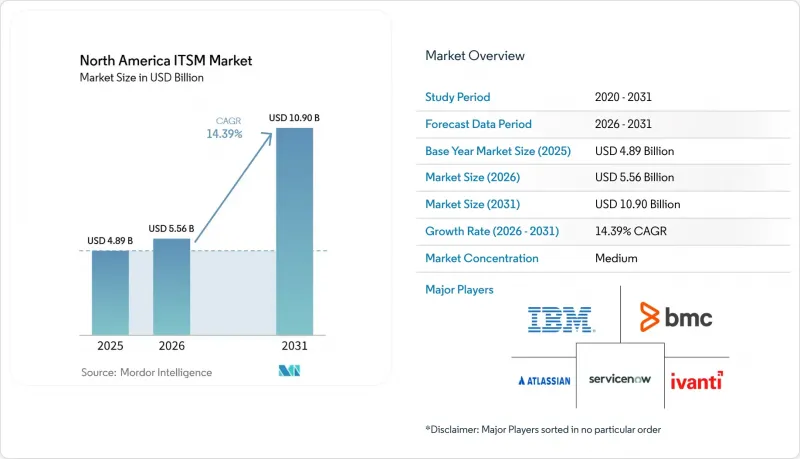
根據 Mordor Intelligence 預測,北美 IT 服務管理市場規模將從 2025 年的 48.9 億美元和 2026 年的 55.6 億美元成長到 2031 年的 109 億美元,2026 年至 2031 年的年複合成長率(CAGR)為 14.39%。
本報告按組件(解決方案和服務)、部署方式(雲端、本地部署、混合部署)、應用領域(服務台和事件管理、資產和配置管理等)、最終用戶行業(銀行、金融服務和保險業、政府和公共部門等)、企業規模(大型企業和中小企業)以及國家/地區進行細分。市場預測以美元計價。
北美IT服務管理市場的趨勢與洞察
大型企業雲端優先ITSM現代化
雲端遷移仍然是北美IT服務管理市場最強勁的需求促進因素。許多大型企業在2019年至2022年間推遲了遷移計劃,因為在不中斷服務的情況下遷移高度客製化的本地環境非常困難。然而,隨著舊版本支援即將結束,以及人工智慧驅動的藍圖在雲端環境中更容易實施,這些延遲正在轉變為不可避免的遷移週期。 ServiceNow報告稱,其2025會計年度的訂閱收入將達到128.8億美元,年增21%,其中603家客戶的年度合約價值超過500萬美元,顯示大型客戶對雲端平台的深度參與度很高。此外,由於每次遷移都會揭示先前配置中隱藏的流程,採購公司在進行平台遷移的同時,也越來越積極地尋求文件編制、知識收集和工作流程自動化。這一趨勢有助於供應商在高度監管的大規模環境中提升客戶價值,同時保持強勁的市場需求。
人工智慧驅動的工單優先排序和工作流程自動化
在北美IT服務管理市場,人工智慧驅動的工單處理正從差異化優勢轉變為採購談判中的標準配置。 2025年10月,SolarWinds報告稱,在生成式人工智慧應用方面排名前10%的公司,其平均事件解決時間從51小時縮短至23小時,與使用傳統自動化方式的組織相比,縮短了54.3%。 2026年2月26日,ServiceNow發布了「自主工作團隊」(Autonomous Workforce),宣布其「一級服務台人工智慧專家」能夠自主解決超過90%的員工IT請求,並且處理分配的IT案例的速度比人工操作員快99%。這些成就正在改變人們對人員配置的看法,許多組織開始根據異常處理能力而非單純的工單處理量來確定第一線支援團隊的規模。此外,供應商也面臨越來越大的壓力,需要證明人工智慧能夠在管治框架內運行,而不是作為獨立於工作流程之外的輔助工具。在高度監管的環境下,對管治和隱私的擔憂仍然會延緩全面實施,但採用的方向現在已經很堅定了。
大型企業市場的飽和限制了新授權的淨成長。
在北美IT服務管理市場,大型企業平台滲透率已非常高,成長正轉向現有客戶的拓展。 ServiceNow報告稱,2025年第四季新增244筆年度合約價值(NCV)超過100萬美元的新交易,較去年同期成長40%。這顯示成長主要來自現有客戶合約的擴展,而非新客戶的首次採用。這正在改變談判動態,因為大型買家意識到供應商正在爭取其現有軟體預算中更大的佔有率。許多公司也被迫審查功能重疊的工具,並減少平台數量的激增。這個過程透過替換特定現有系統,提升了領先供應商的訂單,但卻縮小了依賴大型企業新契約的供應商的市場空間。因此,儘管合約總價值持續成長,但新許可證的獲取速度正在放緩。
細分市場分析
預計到2025年,該解決方案將佔據北美IT服務管理市場62.61%的佔有率,而服務業預計到2031年也將以16.12%的複合年成長率成長。這項領先優勢反映出客戶明顯傾向於基於平台的訂閱模式,而非實施成本高昂的一次性合約。企業越來越傾向於尋求可擴展的、可隨時授權的功能,而不是每次範圍變更都需要重新談判的獨立軟體或諮詢合約。因此,能夠在統一的軟體層整合自動化、自助服務、分析和人工智慧的供應商在北美IT服務管理市場仍然備受青睞。這一趨勢也反映出,工單分類、快速回應支援和基本工作流程操作正在建構到平台中,而不是透過耗費大量人力的服務線來提供。
服務板塊是成長最快的板塊,因為醫療保健、政府和其他複雜環境中的許多組織都需要外部支援來進行工作流程配置和策略控制。然而,服務的角色正在從主導大規模部署轉向有針對性的功能使用支援、管理和營運以及培訓支援。根據 ServiceNow 的報告,到 2025 會計年度,訂閱收入將佔總收入的 97%,而專業服務和其他收入僅佔 3%,這凸顯了價值創造集中在軟體層面。雖然這種結構並未消除對服務的需求,但在許多大規模交易中,服務的角色正日益從核心轉變為補充。從長遠來看,儘管業務收益的絕對值可能仍會成長,但隨著平台功能不斷吸收先前單獨計費的任務,其在總支出中的佔有率預計將會下降。
截至2025年,雲端技術將佔採用率的58.72%,預計到2031年將以15.89%的複合年成長率成長。這是規模最大、成長最快的模式,顯示雲端遷移週期尚未成熟,仍處於活躍階段。買家青睞雲端技術的原因在於:升級更便捷,新的AI功能發布速度更快,並且支援多站點營運模式,同時最大限度地減少本地基礎設施。 2026年2月,ServiceNow宣布其平台每年在全球客戶群中處理超過800億個工作流程,這清楚展現了雲端架構的規模經濟優勢。此外,許多中型企業直接採用SaaS模式,無需像大型企業一樣經歷漫長的本地部署投資週期,這也有利於雲端領域的發展。
在資料管理、儲存或採購方面的法規更為嚴格的地區,本地部署和混合模式仍然發揮著至關重要的作用。聯邦機構、國防承包商以及一些大型金融和醫療機構,都在從比一般私人公司更為嚴格的合規角度評估架構方案。因此,隨著企業在尋求雲端級自動化和使用者體驗的同時,也需要對其部分資料和執行環境進行更嚴格的控制,混合模式正日益受到關注。 2026年2月,BMC與AWS簽署了一項為期五年的策略合作協議,旨在擴展其SaaS產品並深化整合。這表明,供應商正在加大投入,以滿足全部區域各種混合部署需求。因此,儘管雲端運算的領先優勢持續擴大,但在高度監管和深度嵌入式環境中,混合部署模式仍然扮演著風險管理橋樑的關鍵角色,而新興的部署市場也正在蓬勃發展。
其他好處:
- Excel格式的市場預測(ME)表
- 3個月的分析師支持
目錄
第1章:引言
- 研究假設和市場定義
- 調查範圍
第2章:調查方法
第3章執行摘要
第4章 市場狀況
- 市場概覽
- 市場促進因素
- 在大型企業中採用「雲端優先」方法實現IT服務管理現代化
- 人工智慧驅動的工單優先分類和工作流程自動化
- IT、人力資源和客戶服務部門對工作流程整合的需求十分強勁。
- 受監管行業審計和服務可追溯性面臨的監管壓力
- 企業與安全和可觀測性堆疊整合的採用率很高
- 透過平台整合努力實現快速更新周期
- 市場限制因素
- 大型企業市場的飽和限制了新授權的淨成長。
- 根深蒂固的傳統流程客製化導致了更長的更新周期。
- 加強對軟體採購的審查,精簡供應商。
- 對資料隱私和人工智慧管治的擔憂正在減緩生成式人工智慧技術的普及應用。
- 產業價值鏈分析
- 宏觀經濟因素的影響
- 監理情勢
- 技術展望
- 波特五力分析
第5章 市場規模與成長預測
- 按組件
- 解決方案
- 服務
- 不同的發展
- 雲
- 現場
- 混合
- 透過使用
- 服務台和事件管理
- 資產和配置管理
- 變更和發布管理
- 服務請求管理
- 知識管理
- 其他ITSM應用
- 按最終用戶行業分類
- BFSI
- 製造業
- 政府/公共部門
- 資訊科技/通訊
- 零售與電子商務
- 衛生保健
- 旅遊與飯店
- 其他終端用戶產業
- 按公司規模
- 大公司
- 中小企業
- 國家
- 美國
- 加拿大
- 墨西哥
第6章 競爭情勢
- 市場集中度
- 策略趨勢
- 市佔率分析
- 公司簡介
- ServiceNow, Inc.
- IBM Corporation
- BMC Software, Inc.
- Atlassian Corporation Plc
- Ivanti, Inc.
- Freshworks Inc.
- ManageEngine, a division of Zoho Corporation Pvt. Ltd.
- Broadcom Inc.
- Open Text Corporation
- Micro Focus International plc
- ASG Technologies Group, Inc.
- SysAid Technologies Ltd.
- Cherwell Software, LLC
- TOPdesk BV
- Hornbill Service Management Ltd.
- SymphonyAI Summit
- EasyVista SA
- SolarWinds Corporation
- Atlassian Corporation Plc
- Axelos Limited
第7章 市場機會與未來展望
According to Mordor Intelligence, the North America iT service management market size is projected to expand from USD 4.89 billion in 2025 and USD 5.56 billion in 2026 to USD 10.9 billion by 2031, registering a CAGR of 14.39% between 2026 to 2031.
This report is Segmented by Component (Solutions, and Services), Deployment (Cloud, On-Premise, and Hybrid), Application (Service Desk and Incident Management, Asset and Configuration Management, and More), End-User Industry (BFSI, Government and Public Sector, and More), Enterprise Size (Large Enterprises, and SME), and Country. The Market Forecasts are Provided in Terms of Value (USD).
North America ITSM Market Trends and Insights
Cloud-First ITSM Modernization Across Large Enterprises
Cloud migration remains the strongest demand catalyst in the North America IT service management market. Many large organizations delayed shifts during 2019-2022 because heavily customized on-premise environments were difficult to move without service disruption. Those delays have now turned into forced transition cycles, because older releases are reaching end-of-life and AI-heavy roadmaps are easier to execute in cloud environments. ServiceNow reported USD 12.88 billion in subscription revenue for fiscal 2025, up 21% year over year, and 603 customers with more than USD 5 million in annual contract value, which shows how deeply large accounts are engaging with cloud-based platforms. Each migration also exposes process knowledge that had been buried inside legacy configurations, so buyers increasingly pair platform moves with documentation, knowledge capture, and workflow automation work. That pattern is helping vendors raise account value while it keeps implementation demand active in large regulated environments.
AI-Assisted Ticket Triage And Workflow Automation
AI-assisted ticket handling is moving from a differentiating feature to a normal expectation in procurement discussions across the North America IT service management market. SolarWinds reported in October 2025 that top-decile generative AI adopters reduced average incident resolution time from 51 hours to 23 hours, a 54.3% reduction against organizations using conventional automation. ServiceNow launched Autonomous Workforce on February 26, 2026, and said its Level 1 Service Desk AI Specialist resolves over 90% of employee IT requests autonomously while operating 99% faster than human agents for assigned IT cases. These gains are changing staffing logic, because many organizations are beginning to size front-line support teams around exception handling rather than pure ticket volume. They are also increasing pressure on vendors to prove that AI can work inside governed workflows instead of sitting outside them as a separate assistant. Governance and privacy concerns still slow full-scale rollout in regulated settings, but the direction of adoption is now firmly established.
Saturation Among Large Enterprises Limiting Net-New License Growth
Large enterprises across the North America IT service management market already have deep platform penetration, so growth is shifting more toward expansion within existing accounts. ServiceNow reported 244 transactions above USD 1 million in net new annual contract value in Q4 2025, up 40% year over year, which points more to wallet expansion than to first-time adoption. This changes negotiation dynamics because large buyers know vendors are competing for a larger share of an existing software budget. It also pushes many enterprises to review overlapping tools and reduce platform sprawl. That process supports selected displacement wins for stronger vendors, but it narrows the room for providers that depend on new large-enterprise logos. The result is a slower net-new license environment even while total account value keeps rising.
Other drivers and restraints analyzed in the detailed report include:
- Strong Demand For Unified IT, HR, And Customer Service Workflows
- Regulatory Pressure For Auditability and Service Traceability In Regulated Industries
- Long Replacement Cycles Due To Deeply Embedded Legacy Process Customization
For complete list of drivers and restraints, kindly check the Table Of Contents.
Segment Analysis
Solutions held 62.61% of the North America IT service management market share in 2025, and Services are also projected to expand at a 16.12% CAGR through 2031. That lead reflects a clear buyer preference for platform-priced subscriptions over one-time implementation-heavy engagements. Enterprises increasingly want licensed capabilities that can expand over time, rather than separate software and consulting contracts that must be renegotiated whenever the scope changes. The North America IT service management market, therefore, continues to reward vendors that can package automation, self-service, analytics, and AI inside a unified software layer. This pattern also reflects the fact that ticket triage, first-response support, and basic workflow actions are being embedded in the platform rather than delivered through people-intensive service lines.
Services show the fastest-growing segment because many organizations in healthcare, government, and other complex settings need outside help to configure workflows and connect them to policy controls. Their role, however, is changing from broad implementation ownership toward targeted enablement, managed administration, and training support. ServiceNow reported that subscription revenue accounted for 97% of total fiscal 2025 revenue, while professional services and other revenue accounted for 3%, highlighting how value capture is concentrated within the software layer. That structure does not remove the need for services, but it does make them more complementary than central in many large deals. Over time, services revenue can still rise in absolute terms, yet it is likely to represent a smaller share of total spending as platform capabilities continue to absorb work that was once billed separately.
Cloud held 58.72% of the deployment segment in 2025, and it is projected to expand at a 15.89% CAGR through 2031. It was both the largest and the fastest-growing model, indicating that the migration cycle is still active rather than mature. Buyers continue to favor the cloud because it simplifies upgrades, enables new AI features to be released faster, and supports multi-site operating models with less local infrastructure. ServiceNow stated in February 2026 that its platform processes more than 80 billion workflows annually across its global customer base, which illustrates the scale benefits that favor cloud architecture. The cloud segment also benefits from the fact that many mid-sized organizations are adopting SaaS directly, rather than repeating the long on-premises investment cycle that earlier large enterprises experienced.
On-premises and hybrid models still play a role when data control, residency, or procurement rules are tighter. Federal agencies, defense-linked contractors, and some large financial and healthcare organizations continue to evaluate architecture choices through a heavier compliance lens than typical commercial buyers. Hybrid models are therefore gaining attention, as firms want cloud-grade automation and user experience while still needing tighter control over parts of the data or execution environment. BMC signed a five-year strategic collaboration agreement with AWS in February 2026 to widen SaaS availability and deepen integrations, which shows how vendors are investing to meet those mixed deployment needs across the region. The practical outcome is a deployment market where cloud keeps widening its lead, while hybrid remains relevant as a risk-managed bridge for more regulated or deeply embedded environments.
Complete Report Scope:
- By Component
- Solutions
- Services
- By Deployment
- Cloud
- On-Premise
- Hybrid
- By Application
- Service Desk and Incident Management
- Asset and Configuration Management
- Change and Release Management
- Service Request Management
- Knowledge Management
- Other ITSM Applications
- By End-User Industry
- BFSI
- Manufacturing
- Government and Public Sector
- IT and Telecommunications
- Retail and E-Commerce
- Healthcare
- Travel and Hospitality
- Other End-User Industries
- By Enterprise Size
- Large Enterprises
- Small and Mid-Size Enterprises (SME)
- By Country
- United States
- Canada
- Mexico
List of Companies Covered in this Report:
- ServiceNow, Inc.
- IBM Corporation
- BMC Software, Inc.
- Atlassian Corporation Plc
- Ivanti, Inc.
- Freshworks Inc.
- ManageEngine, a division of Zoho Corporation Pvt. Ltd.
- Broadcom Inc.
- Open Text Corporation
- Micro Focus International plc
- ASG Technologies Group, Inc.
- SysAid Technologies Ltd.
- Cherwell Software, LLC
- TOPdesk B.V.
- Hornbill Service Management Ltd.
- SymphonyAI Summit
- EasyVista S.A.
- SolarWinds Corporation
- Atlassian Corporation Plc
- Axelos Limited
Additional Benefits:
- The market estimate (ME) sheet in Excel format
- 3 months of analyst support
TABLE OF CONTENTS
1 INTRODUCTION
- 1.1 Study Assumptions and Market Definition
- 1.2 Scope of the Study
2 RESEARCH METHODOLOGY
3 EXECUTIVE SUMMARY
4 MARKET LANDSCAPE
- 4.1 Market Overview
- 4.2 Market Drivers
- 4.2.1 Cloud-First ITSM Modernization Across Large Enterprises
- 4.2.2 AI Assisted Ticket Triage and Workflow Automation
- 4.2.3 Strong Demand for Unified IT, HR, and Customer Service Workflows
- 4.2.4 Regulatory Pressure for Auditability and Service Traceability in Regulated Industries
- 4.2.5 High Adoption of Enterprise Integration with Security and Observability Stacks
- 4.2.6 Rapid Replacement Cycles Driven by Platform Consolidation Initiatives
- 4.3 Market Restraints
- 4.3.1 Saturation Among Large Enterprises Limiting Net-New License Growth
- 4.3.2 Long Replacement Cycles Due to Deeply Embedded Legacy Process Customization
- 4.3.3 Rising Software Procurement Scrutiny and Vendor Rationalization
- 4.3.4 Data Privacy and AI Governance Concerns Slowing GenAI Feature Rollouts
- 4.4 Industry Value Chain Analysis
- 4.5 Impact of Macroeconomic Factors
- 4.6 Regulatory Landscape
- 4.7 Technological Outlook
- 4.8 Porter's Five Forces Analysis
- 4.8.1 Bargaining Power of Suppliers
- 4.8.2 Bargaining Power of Buyers
- 4.8.3 Threat of New Entrants
- 4.8.4 Threat of Substitutes
- 4.8.5 Intensity of Competitive Rivalry
5 MARKET SIZE AND GROWTH FORECASTS (VALUE)
- 5.1 By Component
- 5.1.1 Solutions
- 5.1.2 Services
- 5.2 By Deployment
- 5.2.1 Cloud
- 5.2.2 On-Premise
- 5.2.3 Hybrid
- 5.3 By Application
- 5.3.1 Service Desk and Incident Management
- 5.3.2 Asset and Configuration Management
- 5.3.3 Change and Release Management
- 5.3.4 Service Request Management
- 5.3.5 Knowledge Management
- 5.3.6 Other ITSM Applications
- 5.4 By End-User Industry
- 5.4.1 BFSI
- 5.4.2 Manufacturing
- 5.4.3 Government and Public Sector
- 5.4.4 IT and Telecommunications
- 5.4.5 Retail and E-Commerce
- 5.4.6 Healthcare
- 5.4.7 Travel and Hospitality
- 5.4.8 Other End-User Industries
- 5.5 By Enterprise Size
- 5.5.1 Large Enterprises
- 5.5.2 Small and Mid-Size Enterprises (SME)
- 5.6 By Country
- 5.6.1 United States
- 5.6.2 Canada
- 5.6.3 Mexico
6 COMPETITIVE LANDSCAPE
- 6.1 Market Concentration
- 6.2 Strategic Moves
- 6.3 Market Share Analysis
- 6.4 Company Profiles (includes Global Level Overview, Market Level Overview, Core Segments, Financials as available, Strategic Information, Market Rank/Share, Products and Services, Recent Developments)
- 6.4.1 ServiceNow, Inc.
- 6.4.2 IBM Corporation
- 6.4.3 BMC Software, Inc.
- 6.4.4 Atlassian Corporation Plc
- 6.4.5 Ivanti, Inc.
- 6.4.6 Freshworks Inc.
- 6.4.7 ManageEngine, a division of Zoho Corporation Pvt. Ltd.
- 6.4.8 Broadcom Inc.
- 6.4.9 Open Text Corporation
- 6.4.10 Micro Focus International plc
- 6.4.11 ASG Technologies Group, Inc.
- 6.4.12 SysAid Technologies Ltd.
- 6.4.13 Cherwell Software, LLC
- 6.4.14 TOPdesk B.V.
- 6.4.15 Hornbill Service Management Ltd.
- 6.4.16 SymphonyAI Summit
- 6.4.17 EasyVista S.A.
- 6.4.18 SolarWinds Corporation
- 6.4.19 Atlassian Corporation Plc
- 6.4.20 Axelos Limited
7 MARKET OPPORTUNITIES AND FUTURE OUTLOOK
- 7.1 White-space and Unmet-Need Assessment

 IT服務管理平台市場:全球市場預測,2026-2032年
 中東歐IT服務管理:市場佔有率分析、產業趨勢與統計及成長預測(2026-2035)德國IT服務管理:市場佔有率分析、產業趨勢與統計、成長預測(2026-2035)東協IT服務管理:市場佔有率分析、產業趨勢與統計及成長預測(2026-2035)英國IT服務管理:市場佔有率分析、產業趨勢與統計、成長預測(2026-2035)IT 服務管理市場:按組件、部署類型、組織規模和產業分類-2026-2032 年全球市場預測IT服務管理:市場佔有率分析、產業趨勢與統計、成長預測(2026-2031年)中國IT服務管理(ITSM):市場佔有率分析、產業趨勢與統計及成長預測(2026-2031年)中東和非洲的IT服務管理:市場佔有率分析、行業趨勢和統計數據以及成長預測(2026-2031年)亞太地區IT服務管理:市場佔有率分析、產業趨勢與統計及成長預測(2026-2031年)