


 |
市場調查報告書
商品編碼
2117638
東協IT服務管理:市場佔有率分析、產業趨勢與統計及成長預測(2026-2035)ASEAN ITSM - Market Share Analysis, Industry Trends & Statistics, Growth Forecasts (2026 - 2035) |
||||||

※ 本網頁內容可能與最新版本有所差異。詳細情況請與我們聯繫。
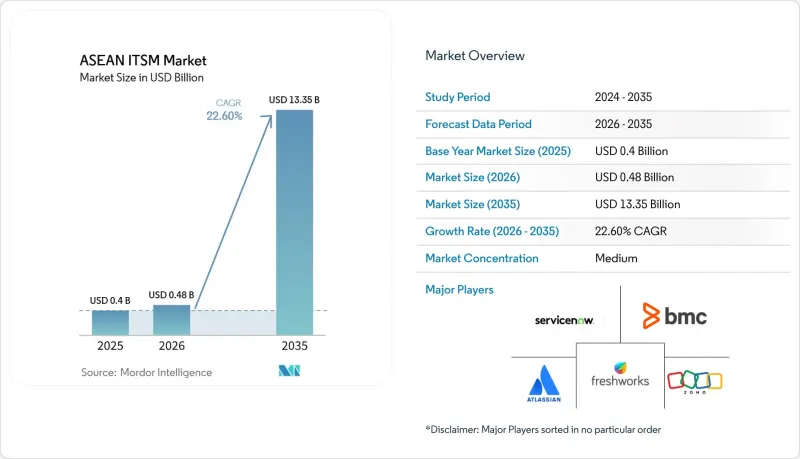
根據 Mordor Intelligence 預測,東協 ITSM 市場規模將從 2025 年的 4 億美元成長到 2026 年的 4.8 億美元,到 2035 年將達到 133.5 億美元,2026 年至 2035 年的複合年成長率為 22.60%。
本報告按組件(解決方案、服務)、部署方式(雲端、本地部署、混合部署)、應用領域(服務台、資產和配置管理、其他)、最終用戶行業(銀行、金融服務和保險 (BFSI)、製造業、其他)以及企業規模(大型企業、中小企業)進行細分。市場預測以美元 (USD) 為單位。
東協IT服務管理市場的趨勢與洞察
IT營運現代化進程以「雲端優先」為中心。
東協IT服務管理(ITSM)市場中的許多組織選擇採用雲端技術作為全面服務管理專案的起點,而不是升級過時的本地部署工具。越南工商銀行(VietinBank)已將其Jira和Confluence環境遷移到雲端,供約4,000名員工使用,並計劃於2025年完成遷移。這表明,即使是受監管的機構也優先考慮新服務環境中的可擴展性和連續性。政府主導的數位現代化也在推動這一轉變,因為國家服務平台需要更快、更標準化的支援系統。新加坡政府科技局(GTA)也在其政府商業雲端環境中採用了Jira服務管理,這表明雲端最佳化服務營運正被整合到公共數位基礎設施中。預計到2025年,東協數位轉型市場規模將達到1,020.7億美元,年複合成長率(CAGR)預計為23.68%,這將為ITSM平台的採用奠定良好的基礎。
對人工智慧驅動的自助服務和知識轉移的需求日益成長
隨著支援團隊面臨的壓力日益增大,其人員配置已無法滿足不斷成長的請求需求,人工智慧驅動的自助服務在東協IT服務管理(ITSM)市場的重要性日益凸顯。 Freshworks報告稱,到2026年,47%的IT工單將在非工作時間提交,這凸顯了企業為何要投資自動化支援和全天候服務體驗。一家領先的泰國銀行部署了原生人工智慧ITSM平台,實現了65%服務請求的自動化處理,客戶滿意度提升了60%,問題解決時間縮短了50%。這種營運模式為知識管理的強勁發展前景奠定了基礎,預計到2031年,知識管理將以22.99%的複合年成長率成長,成為東協ITSM市場成長最快的應用。 2026年5月,Freshworks還在Freshservice平台上發布了“AI Agent Studio”,使企業無需編寫程式碼即可將服務自動化擴展到Microsoft Teams、Slack、Workday和Rippling等工具。
在棕地IT環境中整合舊有系統的複雜性
在東協IT服務管理(ITSM)市場,尤其是依賴過時核心系統的大型企業,整合舊有系統仍是最大的營運障礙。東協創新商業平台的一項調查顯示,54.4%的企業將與現有系統的整合列為主要實施障礙,凸顯了現代化專案在工作流程完全實施前經常停滯不前的情況。小規模專案也面臨類似的問題。 EasyVista和OTRS集團的報告指出,66%的馬來西亞中小企業仍然依賴手動流程和電子表格來彌合ITSM和IT資產管理之間的差距。亞洲中部銀行也指出,在現代化過程中,技術和業務相關人員者之間的協調是一項挑戰,因為他們依賴運作多年的系統來確保日常營運的連續性。因此,更長的引進週期、更高的升級複雜性和分階段過渡支援是供應商在東協ITSM市場定位的關鍵。
細分市場分析
截至2025年,解決方案佔東協IT服務管理(ITSM)市場規模的65.22%,而服務領域預計到2031年將以23.01%的複合年成長率成長。這種構成反映了一種「平台優先」的採購模式,即企業傾向於先部署核心模組,然後隨著工作流程的日益規範化,再添加合作夥伴支援。在東協ITSM市場,新加坡和馬來西亞的大規模採購企業往往從多模組採購入手,這些模組涵蓋同一引進週期內的事件管理、資產管理和變更管理流程。這種趨勢使得軟體平台更容易獲得大部分初始投資,尤其是在管治和報告要求已經完善的情況下。從成長軌跡來看,隨著東協ITSM市場部署的深入,業務收益的重要性日益凸顯。
由於許多組織仍然需要外部支援來進行配置、培訓、升級規劃和日常營運管理,服務業正在快速擴張。 2026年4月,HPT越南與SMOne和ManageEngine簽署了合作備忘錄,以擴展其IT服務管理(ITSM)和IT營運管理解決方案的產品範圍。這清楚地表明,圍繞平台部署正在建立一個服務生態系統。 Cognizant與JG 高峰會於2026年5月簽署的ServiceNow協議也表明,部署和管理服務擴大與平台現代化專案結合。事實上,東協ITSM市場的買家已經意識到,在考慮工作流程設計、整合和營運管治時,授權費用只是其支出組成的一部分。因此,在東協ITSM市場,服務板塊正從輔助角色轉變為更永續的收入來源。
預計到2025年,雲端運算將佔東協IT服務管理(ITSM)市場規模的69.32%,並將以24.42%的複合年成長率持續成長至2031年。雲端運算作為規模最大且成長最快的部署模式,顯示許多首次購買者正在跳過本地部署評估階段,直接遷移到雲端環境。這種模式在東協ITSM市場尤其受歡迎,因為在多個產業和國家市場中,待開發區部署仍然很普遍。新加坡政府的雲端環境已將Jira服務管理整合到共用數位支援營運中,這增強了人們對受監管用例中基於雲端的服務模式的信心。越南工商銀行(VietinBank)為約4,000名員工遷移Jira和Confluence的案例也印證了這一觀點,即規模和監管並不一定會阻礙東協ITSM市場採用雲端運算。
在本地基礎設施管理被視為合規要求而非技術偏好的情況下,本地部署和混合模式仍然至關重要。在印尼和越南,以及一些政府機構和金融服務業,由於資料處理法規可能限制部署柔軟性,因此本地和混合環境得以保留。對於希望在維持通用服務層級的同時,運作具有獨立昇級週期的特定子公司系統的大型集團而言,混合模式也十分實用。這導致東協IT服務管理(ITSM)市場的需求趨勢更加兩極化,小規模「雲端優先」買家和大型受監管企業採用了不同的部署路徑。因此,能夠同時支援快速雲端部署和託管混合管治的供應商在東協ITSM市場中佔據更有利的地位。
其他好處
- Excel格式的市場預測(ME)表
- 3個月的分析師支持
目錄
第1章:引言
- 研究假設和市場定義
- 調查範圍
第2章:調查方法
第3章執行摘要
第4章 市場狀況
- 市場概覽
- 市場促進因素
- IT營運現代化進程以「雲端優先」為中心。
- 在整個企業範圍內推廣數位化服務台的標準化。
- 對跨部門企業服務管理的需求日益成長。
- 監管機構對可審計的IT變更管理施加越來越大的壓力
- 由於工具數量的快速成長,需要統一的工作流程協調。
- 對人工智慧驅動的自助服務和知識轉移的需求日益成長
- 市場限制因素
- 在棕地IT環境中整合舊有系統的複雜性
- 中型企業市場買家缺乏熟練的IT服務管理能力。
- 雲端採用中的資料居住和主權問題
- 小規模組織流程成熟度低導致的標準化延遲
- 產業價值鏈分析
- 宏觀經濟因素對市場的影響
- 監理情勢
- 技術展望
- 波特五力分析
第5章 市場規模與成長預測
- 按組件
- 解決方案
- 服務
- 不同的發展
- 雲
- 現場
- 混合
- 透過使用
- 服務台
- 資產和配置管理
- 變更管理與發布管理
- 服務請求管理
- 知識管理
- 其他用途
- 按最終用戶行業分類
- BFSI
- 製造業
- 政府/公共部門
- 資訊科技/通訊
- 零售與電子商務
- 衛生保健
- 旅遊與飯店
- 其他終端用戶產業
- 按公司規模
- 大公司
- 小型企業
- 按地區
- 新加坡
- 印尼
- 馬來西亞
- 泰國
- 越南
- 菲律賓
- 其他東南亞國協
第6章 競爭情勢
- 市場集中度
- 策略趨勢
- 市佔率分析
- 公司簡介
- ServiceNow, Inc.
- Atlassian Corporation Plc
- BMC Software, Inc.
- Freshworks Inc.
- Zoho Corporation Pvt. Ltd.
- Ivanti, Inc.
- Broadcom Inc.
- Open Text Corporation
- IBM Corporation
- Microsoft Corporation
- ManageEngine, a Division of Zoho Corporation Pvt. Ltd.
- Fujitsu Limited
- Tata Consultancy Services Limited
- Wipro Limited
- HCLTech Limited
- DXC Technology Company
- SysAid Technologies Ltd.
- SolarWinds Corporation
- EasyVista, Inc.
- TOPdesk BV
第7章 市場機會與未來展望
According to Mordor Intelligence, the ASEAN ITSM market size is expected to increase from USD 0.4 billion in 2025 to USD 0.48 billion in 2026 and reach USD 13.35 billion by 2035, growing at a CAGR of 22.60% over 2026-2035.
This report is Segmented by Component (Solutions, Services), Deployment (Cloud, On-Premises, Hybrid), Application (Service Desk and Incident Management, Asset and Configuration Management, and More), End-User Industry (BFSI, Manufacturing, and More), and Enterprise Size (Large Enterprises, Small and Medium Enterprises). The Market Forecasts are Provided in Terms of Value (USD).
ASEAN ITSM Market Trends and Insights
Rising Cloud-First IT Operations Modernization
Many organizations across the ASEAN ITSM market are choosing cloud deployment as the starting point for formal service management programs instead of upgrading older on-premises tools. VietinBank moved its Jira and Confluence environments to cloud in 2025 for nearly 4,000 personnel, showing that even regulated institutions are prioritizing scalability and continuity in new service environments. Government-led digital modernization is also reinforcing this shift because national service platforms need more responsive and standardized support systems. Singapore Government Technology Agency has also used Jira Service Management within its Government Commercial Cloud environment, which shows how cloud-aligned service operations are being embedded into public digital infrastructure. The broader digital transformation backdrop remains supportive, as the ASEAN digital transformation market was estimated at USD 102.07 billion in 2025 and was projected to grow at a 23.68% CAGR, creating a favorable base for ITSM platform adoption.
Escalating Demand For AI-Assisted Self-Service And Knowledge Deflection
AI-assisted self-service is gaining importance across the ASEAN ITSM market because support teams are under pressure to manage more requests without matching staff growth. Freshworks stated in 2026 that 47% of IT tickets are submitted after business hours, which highlights why enterprises are investing in automated support and always-on service experiences. A leading Thai bank used an AI-native ITSM platform and automated 65% of service requests, improved customer satisfaction by 60%, and cut resolution times by 50% across subsidiaries. That operating model supports the strong outlook for Knowledge Management, which is the fastest-growing application segment in the ASEAN ITSM market at a 22.99% CAGR through 2031. Freshworks also launched AI Agent Studio in Freshservice in May 2026, giving enterprises a no-code way to extend service automation into tools such as Microsoft Teams, Slack, Workday, and Rippling.
Legacy System Integration Complexity In Brownfield IT Environments
Legacy integration remains the strongest operational barrier for the ASEAN ITSM market, especially in large organizations that depend on older core systems. The ASEAN Innovation Business Platform found that 54.4% of organizations identified integration with existing systems as the main implementation barrier, which shows how often modernization programs slow before full workflow adoption begins. The same issue is visible in smaller buyers, where EasyVista and OTRS Group reported that 66% of Malaysian SMBs still relied on manual work or spreadsheets to bridge ITSM and IT asset management gaps. Bank Central Asia also described modernization as a coordination challenge between technology and business stakeholders who rely on long-running systems for daily continuity. This keeps implementation cycles longer, raises upgrade complexity, and makes phased migration support a central part of vendor positioning across the ASEAN ITSM market.
Other drivers and restraints analyzed in the detailed report include:
- Expanding Digital Service Desk Standardization Across Enterprises
- Growing Need For Cross-Functional Enterprise Service Management
- Data Residency And Sovereignty Concerns For Cloud Deployments
For complete list of drivers and restraints, kindly check the Table Of Contents.
Segment Analysis
Solutions accounted for 65.22% of the ASEAN ITSM market size in 2025, while Services is projected to grow at a 23.01% CAGR through 2031. That mix reflects a platform-first buying pattern, in which enterprises begin with core modules and then add partner support once workflows become more formalized. In the ASEAN ITSM market, larger buyers in Singapore and Malaysia have tended to start with multi-module purchases that cover incidents, assets, and change processes in the same rollout cycle. This behavior has helped software platforms capture the larger initial spend, especially where governance and reporting requirements are already well established. Even so, the growth profile shows that service revenue is becoming more important as implementation depth increases across the ASEAN ITSM market.
Services are expanding faster because many organizations still need outside support for configuration, training, upgrade planning, and daily administration. HPT Vietnam signed a memorandum of understanding with SMOne and ManageEngine in April 2026 to expand the delivery of ITSM and IT operations management solutions, underscoring how service ecosystems are being built around platform adoption. Cognizant's May 2026 ServiceNow engagement with JG Summit also illustrates how implementation and managed services are increasingly bundled with platform modernization programs. In practice, buyers in the ASEAN ITSM market are learning that license cost is only one part of the spending profile once workflow design, integrations, and operating governance are considered. That is why the Services segment is moving from a supporting role toward a more recurring commercial layer within the ASEAN ITSM market.
Cloud held 69.32% of the ASEAN ITSM market size in 2025 and is projected to advance at a 24.42% CAGR through 2031. This dual position as both the largest and fastest-growing deployment model shows that many first-time buyers are skipping on-premises evaluation and moving directly to cloud environments. The ASEAN ITSM market has been especially receptive to this model because greenfield adoption remains common across several industries and national markets. Singapore's government cloud environment has already embedded Jira Service Management into shared digital support operations, which reinforces confidence in cloud-based service models for regulated use cases. VietinBank's migration of Jira and Confluence for nearly 4,000 employees also supports the view that scale and regulation do not automatically prevent cloud adoption in the ASEAN ITSM market.
On-premises and hybrid models still remain relevant where local infrastructure control is treated as a compliance requirement rather than a technical preference. Indonesia, Vietnam, and parts of government and financial services continue to keep localized or mixed environments because data handling rules can narrow deployment flexibility. Hybrid models are also practical for large groups that want a common service layer while keeping certain subsidiary systems on separate upgrade cycles. This is creating a more divided demand profile inside the ASEAN ITSM market, where smaller cloud-first buyers and larger regulated enterprises do not follow the same deployment path. Vendors that support both rapid cloud rollout and controlled hybrid governance are therefore in a stronger position across the ASEAN ITSM market.
Complete Report Scope:
- By Component
- Solutions
- Services
- By Deployment
- Cloud
- On-Premises
- Hybrid
- By Application
- Service Desk
- Asset and Configuration Management
- Change and Release Management
- Service Request Management
- Knowledge Management
- Other ITSM Applications
- By End-User Industry
- BFSI
- Manufacturing
- Government and Public Sector
- IT and Telecom
- Retail and E-Commerce
- Healthcare
- Travel and Hospitality
- Other End-User Industries
- By Enterprise Size
- Large Enterprises
- Small and Medium Enterprises
- By Geography
- Singapore
- Indonesia
- Malaysia
- Thailand
- Vietnam
- Philippines
- Rest of ASEAN
List of Companies Covered in this Report:
- ServiceNow, Inc.
- Atlassian Corporation Plc
- BMC Software, Inc.
- Freshworks Inc.
- Zoho Corporation Pvt. Ltd.
- Ivanti, Inc.
- Broadcom Inc.
- Open Text Corporation
- IBM Corporation
- Microsoft Corporation
- ManageEngine, a Division of Zoho Corporation Pvt. Ltd.
- Fujitsu Limited
- Tata Consultancy Services Limited
- Wipro Limited
- HCLTech Limited
- DXC Technology Company
- SysAid Technologies Ltd.
- SolarWinds Corporation
- EasyVista, Inc.
- TOPdesk B.V.
Additional Benefits:
- The market estimate (ME) sheet in Excel format
- 3 months of analyst support
TABLE OF CONTENTS
1 INTRODUCTION
- 1.1 Study Assumptions and Market Definition
- 1.2 Scope of the Study
2 RESEARCH METHODOLOGY
3 EXECUTIVE SUMMARY
4 MARKET LANDSCAPE
- 4.1 Market Overview
- 4.2 Market Drivers
- 4.2.1 Rising Cloud-First IT Operations Modernization
- 4.2.2 Expanding Digital Service Desk Standardization Across Enterprises
- 4.2.3 Growing Need for Cross-Functional Enterprise Service Management
- 4.2.4 Increasing Regulatory Pressure for Auditable IT Change Control
- 4.2.5 Rapid Tool Sprawl Requiring Unified Workflow Orchestration
- 4.2.6 Escalating Demand for AI-Assisted Self-Service and Knowledge Deflection
- 4.3 Market Restraints
- 4.3.1 Legacy System Integration Complexity in Brownfield IT Environments
- 4.3.2 Skilled ITSM Administration Gap Across Mid-Market Buyers
- 4.3.3 Data Residency and Sovereignty Concerns for Cloud Deployments
- 4.3.4 Low Process Maturity in Smaller Organizations Slowing Standardization
- 4.4 Industry Value Chain Analysis
- 4.5 Impact of Macroeconomic Factors on the Market
- 4.6 Regulatory Landscape
- 4.7 Technological Outlook
- 4.8 Porter's Five Forces Analysis
- 4.8.1 Threat of New Entrants
- 4.8.2 Bargaining Power of Buyers
- 4.8.3 Bargaining Power of Suppliers
- 4.8.4 Threat of Substitutes
- 4.8.5 Competitive Rivalry
5 MARKET SIZE AND GROWTH FORECASTS (VALUE)
- 5.1 By Component
- 5.1.1 Solutions
- 5.1.2 Services
- 5.2 By Deployment
- 5.2.1 Cloud
- 5.2.2 On-Premises
- 5.2.3 Hybrid
- 5.3 By Application
- 5.3.1 Service Desk
- 5.3.2 Asset and Configuration Management
- 5.3.3 Change and Release Management
- 5.3.4 Service Request Management
- 5.3.5 Knowledge Management
- 5.3.6 Other ITSM Applications
- 5.4 By End-User Industry
- 5.4.1 BFSI
- 5.4.2 Manufacturing
- 5.4.3 Government and Public Sector
- 5.4.4 IT and Telecom
- 5.4.5 Retail and E-Commerce
- 5.4.6 Healthcare
- 5.4.7 Travel and Hospitality
- 5.4.8 Other End-User Industries
- 5.5 By Enterprise Size
- 5.5.1 Large Enterprises
- 5.5.2 Small and Medium Enterprises
- 5.6 By Geography
- 5.6.1 Singapore
- 5.6.2 Indonesia
- 5.6.3 Malaysia
- 5.6.4 Thailand
- 5.6.5 Vietnam
- 5.6.6 Philippines
- 5.6.7 Rest of ASEAN
6 COMPETITIVE LANDSCAPE
- 6.1 Market Concentration
- 6.2 Strategic Moves
- 6.3 Market Share Analysis
- 6.4 Company Profiles (includes Global Level Overview, Market Level Overview, Core Segments, Financials as available, Strategic Information, Market Rank/Share, Products and Services, Recent Developments)
- 6.4.1 ServiceNow, Inc.
- 6.4.2 Atlassian Corporation Plc
- 6.4.3 BMC Software, Inc.
- 6.4.4 Freshworks Inc.
- 6.4.5 Zoho Corporation Pvt. Ltd.
- 6.4.6 Ivanti, Inc.
- 6.4.7 Broadcom Inc.
- 6.4.8 Open Text Corporation
- 6.4.9 IBM Corporation
- 6.4.10 Microsoft Corporation
- 6.4.11 ManageEngine, a Division of Zoho Corporation Pvt. Ltd.
- 6.4.12 Fujitsu Limited
- 6.4.13 Tata Consultancy Services Limited
- 6.4.14 Wipro Limited
- 6.4.15 HCLTech Limited
- 6.4.16 DXC Technology Company
- 6.4.17 SysAid Technologies Ltd.
- 6.4.18 SolarWinds Corporation
- 6.4.19 EasyVista, Inc.
- 6.4.20 TOPdesk B.V.
7 MARKET OPPORTUNITIES AND FUTURE OUTLOOK
- 7.1 White-Space and Unmet-Need Assessment

 中東歐IT服務管理:市場佔有率分析、產業趨勢與統計及成長預測(2026-2035)德國IT服務管理:市場佔有率分析、產業趨勢與統計、成長預測(2026-2035)英國IT服務管理:市場佔有率分析、產業趨勢與統計、成長預測(2026-2035)
 IT 服務管理市場:按組件、部署類型、組織規模和產業分類-2026-2032 年全球市場預測IT服務管理:市場佔有率分析、產業趨勢與統計、成長預測(2026-2031年)中國IT服務管理(ITSM):市場佔有率分析、產業趨勢與統計及成長預測(2026-2031年)中東和非洲的IT服務管理:市場佔有率分析、行業趨勢和統計數據以及成長預測(2026-2031年)亞太地區IT服務管理:市場佔有率分析、產業趨勢與統計及成長預測(2026-2031年)北美IT服務管理(ITSM):市佔率分析、產業趨勢與統計及成長預測(2026-2031年)南美洲IT服務管理(ITSM):市場佔有率分析、產業趨勢與統計及成長預測(2026-2031年)