


 |
市場調查報告書
商品編碼
2099139
亞太地區IT服務管理:市場佔有率分析、產業趨勢與統計及成長預測(2026-2031年)Asia-Pacific ITSM - Market Share Analysis, Industry Trends & Statistics, Growth Forecasts (2026 - 2031) |
||||||

※ 本網頁內容可能與最新版本有所差異。詳細情況請與我們聯繫。
根據 Mordor Intelligence 預測,亞太地區的 IT 服務管理市場在 2025 年將達到 32 億美元,並將在 2026 年至 2031 年以 19.90% 的複合年成長率成長,到 2031 年達到 94.3 億美元。
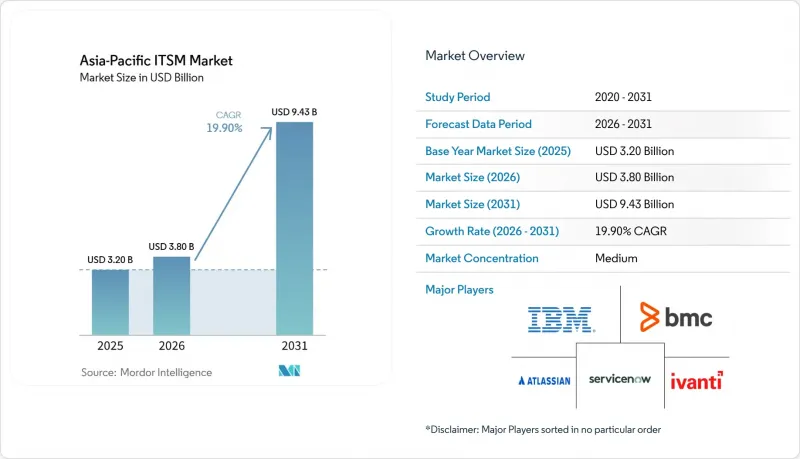
本報告按組件(解決方案和服務)、部署方式(雲端、本地部署、混合部署)、應用領域(服務台和事件管理、資產和配置管理等)、最終用戶行業(銀行、金融服務和保險、製造業、政府、IT和電信等)、企業規模(大型企業、中小企業)以及國家/地區進行細分。市場預測以美元(USD)為單位。
亞太地區ITSM市場趨勢及洞察。
公共和私營部門服務營運的快速數位化
亞太地區公共部門的現代化和企業的數位轉型,為IT服務管理市場創造了比純粹由任意軟體引進週期驅動更為穩定的需求基礎。隨著政府將服務遷移到雲端環境,各機構需要規範的請求、事件、核准和審計追蹤工作流程,這使得服務管理從一種可有可無的工具轉變為必不可少的營運基礎設施。在受監管行業和大型企業中也出現了類似的趨勢,數位化服務交付推動了對標準化變更管理和服務連續性管理的需求。韓國針對公共部門環境的雲端使用和安全指南就是一個典型的例子,它展示了政策框架如何將基礎設施變更轉化為管治義務,並優先考慮結構化平台而非人工流程。這一點至關重要,因為政策支援的部署比純粹的商業性支出更具確定性,從而提高了某些採購週期波動較大的地區的供應商透明度。隨著印度、中國和東南亞的服務營運數位化,亞太地區的 IT 服務管理市場可能會受益於需求驅動,這種需求不僅來自軟體更新決策,還來自合規性、業務永續營運和團隊間協作。
中型企業對雲端的IT服務管理(ITSM)的採用率不斷提高
基於雲端的交付方式正在降低成本、基礎設施負擔和採用門檻,這些曾經阻礙了許多中型企業進入亞太IT服務管理市場。過去透過共用收件匣和非正式電子表格處理支援的企業,現在無需先組建大規模的內部管理團隊,即可過渡到結構化的服務工作流程。 Freshworks於2026年5月發布了Freshservice中的AI Agent Studio,加速了這項變革。該軟體旨在幫助企業在數週內建立和部署基於代理的工作流程,而不是經歷漫長的引進週期。這種快速部署對於價格敏感的客戶至關重要,他們通常優先考慮購買利益,而不是分配給長期、依賴諮詢服務的部署的預算。中小企業(SME)也正在轉變其營運理念。根據OTRS的報告,亞太地區70%的中小企業認為人工智慧對於IT服務管理(ITSM)的成功至關重要,這表明需求不再局限於基本的工單處理。因此,亞太地區的 IT 服務管理市場正在吸引那些尋求更好的管理、更快的服務解決速度以及清晰的自動化路徑,同時又不想承擔大規模部署帶來的成本負擔的買家。
不同國家和產業的數位化成熟度有差異。
亞太地區IT服務管理市場面臨的主要障礙仍是數位化成熟度的差異。這是因為不同國家、產業甚至同一市場內不同城市的需求發展速度並不一致,這取決於各企業的準備程度。一些企業正在採用先進的工作流程編配和人工智慧驅動的知識庫,而另一些企業仍在努力取代人工工單系統和分散的內部支援流程。 OTRS的一項調查顯示,儘管62%的馬來西亞中小企業認為IT服務管理是一項策略機遇,但仍有35%的企業依賴基本的工單系統、電子表格或人工回應方式。這種兩極化使得供應商難以在全部區域實現軟體包、定價和服務模式的標準化,否則就會失去部分成熟用戶或早期採用者。此外,這也延長了銷售週期,因為在開始平台討論之前,通常需要進行培訓、內部流程重組和工作流程最佳化。只要這種準備程度的差異持續存在,亞太地區的IT服務管理市場就不會快速成長,也不會像全部區域需求所預期的那樣實現均衡成長。
細分市場分析
到2025年,解決方案將佔據亞太地區IT服務管理市場佔有率的62.61%,這表明在該地區目前的採用階段,平台支出仍超過服務支出。工單可見度、工作流程管理、審核、服務目錄和稽核追蹤都取決於採用初期階段選擇的平台,因此買家仍優先考慮核心系統。這項初步決策也會影響後續的整合選項、資料結構、使用者體驗以及相關功能的採用速度。正因如此,在亞太地區的IT服務管理產業,即使實施支援至關重要,軟體仍是採購的核心。這也解釋了為什麼擁有強大模組組合的供應商在大規模交易中仍然保持優勢,因為客戶尋求的是能夠處理從事件回應到未來更廣泛的營運管治等所有問題的平台。
在亞太地區的IT服務管理市場,服務正以21.12%的複合年成長率成為成長最快的市場區隔。這主要歸功於部署的增加,包括雲端遷移、工作流程重構、人工智慧應用、知識庫精簡和持續管治(ITSM)營運技能有限的國家。此外,由於人工智慧驅動的服務營運需要比傳統服務台部署更嚴格的資料管理、明確的責任分類和持續的平台維護,市場格局正在改變。從實際角度來看,儘管亞太地區IT服務管理產業的軟體主導結構預計仍將保持不變,但隨著部署的深入,服務層將繼續擴展。在預測期內,能夠將平台價值與降低執行風險相結合的供應商和合作夥伴將從這種服務架構的轉變中獲益最多。
預計到2025年,雲端運算將在亞太地區的IT服務管理市場佔據59.62%的佔有率,其中SaaS交付模式將成為許多新部署的首選方式。買家青睞雲端運算的原因在於,它減輕了基礎架構管理的負擔,加快了更新速度,並使跨分散式團隊部署服務工作流程變得更加容易,而無需進行大規模的初始架構工作。這種模式也符合那些希望更清晰地實現快速部署和自動化,同時避免包含大量舊有系統的環境所帶來的漫長引進週期的組織的需求。公共部門的合規框架正在推動這一轉變,而韓國政府關於雲端運算使用和安全的指導方針也有助於建構一個有利於更廣泛採用雲端運算的治理環境。雲端運算的主導地位也反映出,南亞和東南亞的許多新用戶可以直接遷移到現代環境,而無需承擔傳統企業環境中遺留系統的負擔。
在亞太地區的IT服務管理市場,混合部署和本地部署解決方案的需求依然強勁,因為並非所有組織都能以相同的速度將所有服務營運遷移到雲端。銀行、金融和保險(BFSI)機構、公共部門組織以及傳統製造企業通常遵循特定國家的基礎設施策略,這些策略傾向於更嚴格的資料管理、複雜的整合需求或分階段遷移。對於這些客戶而言,IT服務管理(ITSM)採用的障礙並非缺乏興趣,而是需要將工作流程系統與資料儲存、安全性和業務永續營運要求相協調。因此,混合模式仍然是一種有效的橋樑,尤其是在服務管理必須同時相容於現代應用程式和傳統本地系統的情況下。儘管雲端技術未來仍將佔據主導地位,但在舊有系統仍影響架構決策的國家,部署模式的多樣性仍將得以維持。這將使那些能夠支援「雲端優先」成長而無需強迫謹慎的買家進行大規模遷移的供應商獲得優勢。
其他好處:
- Excel格式的市場預測(ME)表
- 3個月的分析師支持
目錄
第1章:引言
- 研究假設和市場定義
- 調查範圍
第2章:調查方法
第3章執行摘要
第4章 市場狀況
- 市場概覽
- 市場促進因素
- 公共和私營部門服務營運的快速數位化
- 中型企業對雲端的IT服務管理(ITSM)採用率的提升
- 擴大託管服務和IT營運外包
- IT 服務交付領域對低程式碼工作流程設計的需求強勁。
- 電信、銀行、金融服務和保險以及製造業的IT營運大規模現代化。
- 行動優先和多語言服務入口網站的成長
- 市場限制因素
- 各國和各行業的數位化成熟度有差異。
- 中小企業的價格敏感度
- 熟練的IT服務管理管理員和流程顧問短缺
- 混合基礎設施和本地系統整合的複雜性。
- 產業價值鏈分析
- 宏觀經濟因素的影響
- 監理情勢
- 技術展望
- 波特五力分析
第5章 市場規模與成長預測
- 按組件
- 解決方案
- 服務
- 不同的發展
- 雲
- 現場
- 混合
- 透過使用
- 服務台和事件管理
- 資產和配置管理
- 變更和發布管理
- 服務請求管理
- 知識管理
- 其他ITSM應用
- 按最終用戶行業分類
- BFSI
- 製造業
- 政府/公共部門
- 資訊科技/通訊
- 零售與電子商務
- 衛生保健
- 旅遊與飯店
- 其他終端用戶產業
- 按公司規模
- 大公司
- 中小企業
- 國家
- 中國
- 日本
- 印度
- 韓國
- 東南亞
- 其他亞太國家
第6章 競爭情勢
- 市場集中度
- 策略趨勢
- 市佔率分析
- 公司簡介
- ServiceNow, Inc.
- IBM Corporation
- BMC Software, Inc.
- Atlassian Corporation Plc
- Ivanti, Inc.
- Freshworks Inc.
- ManageEngine, a division of Zoho Corporation Pvt. Ltd.
- Broadcom Inc.
- Open Text Corporation
- Micro Focus International plc
- ASG Technologies Group, Inc.
- SysAid Technologies Ltd.
- Cherwell Software, LLC
- TOPdesk BV
- Hornbill Service Management Ltd.
- SymphonyAI Summit
- EasyVista SA
- SolarWinds Corporation
- Atlassian Corporation Plc
- Axelos Limited
第7章 市場機會與未來展望
According to Mordor Intelligence, the Asia-Pacific iT service management market size was USD 3.20 billion in 2025 and is projected to reach USD 9.43 billion by 2031, at a CAGR of 19.90% over 2026-2031.
This report is Segmented by Component (Solutions, and Services), Deployment (Cloud, On-Premise, and Hybrid), Application (Service Desk and Incident Management, Asset and Configuration Management, and More), End-User Industry (BFSI, Manufacturing, Government, IT and Telecom, and More), Enterprise Size (Large Enterprises, SME), and Country. The Market Forecasts are Provided in Terms of Value (USD).
Asia-Pacific ITSM Market Trends and Insights
Rapid Digitization of Public and Private Sector Service Operations
Public-sector modernization and enterprise digitization are giving the Asia-Pacific IT service management market a steadier demand base than a purely discretionary software cycle would provide. When governments move services to cloud-oriented environments, agencies also need formal workflows for requests, incidents, approvals, and audit trails, which pushes service management from an optional tool into required operational infrastructure. The same pattern appears in regulated industries and large enterprises, where digital service delivery creates a higher need for standardized change control and service continuity management. South Korea's cloud use and security guidelines for public-sector environments demonstrate how policy frameworks can turn infrastructure changes into governance obligations that favor structured platforms over manual processes. This matters because policy-backed adoption tends to be more certain than purely commercial spending, which improves vendor visibility in parts of the region where procurement cycles are otherwise uneven. As more service operations are digitized across India, China, and Southeast Asia, the Asia-Pacific IT service management market is likely to benefit from demand driven by compliance, continuity, and cross-team coordination, rather than solely by software refresh decisions.
Increasing Adoption of Cloud-Based ITSM Among Mid-Market Enterprises
Cloud delivery is reducing the costs, infrastructure burden, and deployment friction that once kept many mid-market organizations out of the Asia-Pacific IT service management market. Companies that previously ran support operations through shared inboxes or informal spreadsheets can now move to structured service workflows without first building large in-house administration teams. Freshworks reinforced this shift in May 2026 when it launched AI Agent Studio within Freshservice, aimed at helping organizations build and deploy agentic workflows in weeks rather than in long implementation cycles. That shorter path matters in price-sensitive accounts, where buyer interest is often stronger than the budget available for long consulting-heavy rollouts. The operational mindset of smaller firms is also changing, as OTRS reported that 70% of Asia-Pacific SMBs consider AI important to ITSM success, indicating demand is no longer limited to basic ticket handling. As a result, the Asia-Pacific IT service management market is attracting buyers seeking better control, faster service resolution, and a clearer path to automation without the cost profile of large enterprise deployments.
Uneven Digital Maturity Across Countries and Industry Verticals
Uneven digital maturity remains a real brake on the Asia-Pacific IT service management market because demand does not move at the same level of readiness across countries, sectors, or even cities within the same market. Some organizations are buying advanced workflow orchestration and AI-enabled knowledge functions, while others are still trying to replace manual ticket handling and fragmented internal support processes. OTRS found that 35% of Malaysian SMBs still relied on basic ticketing systems, spreadsheets, or manual workarounds, even though 62% recognized ITSM as a strategic opportunity. This split makes it harder for vendors to standardize packaging, pricing, and service models across the region without losing either advanced buyers or first-stage adopters. It also extends sales cycles because education, internal process redesign, and workflow cleanup often need to occur before the platform discussion can move forward. As long as these readiness gaps persist, the Asia-Pacific IT service management market will grow quickly, but not as evenly as headline regional demand might suggest.
Other drivers and restraints analyzed in the detailed report include:
- Expansion of Managed Services and Outsourced IT Operations
- Strong Demand for Low-Code Workflow Design in IT Service Delivery
- Price Sensitivity Among Small and Mid-Size Enterprises
For complete list of drivers and restraints, kindly check the Table Of Contents.
Segment Analysis
Solutions accounted for 62.61% of the Asia-Pacific IT service management market share in 2025, which shows that platform spending still leads services spending at this stage of regional adoption. Buyers continue to prioritize the core system first, because ticket visibility, workflow control, approvals, service catalogs, and audit trails all depend on the platform chosen at the start of the journey. That first decision also shapes later integration choices, data structures, user experience, and the pace at which adjacent functions can be activated. In the Asia-Pacific IT service management industry, this keeps software at the center of procurement even when deployment support is important. It also explains why vendors with deep module portfolios still hold an advantage in larger deals, where clients want a platform that can stretch from incident handling to broader operational governance over time.
Services are gaining importance in the Asia-Pacific IT service management market as the fastest-growing segment, with a 21.12% CAGR, as more deployments now involve cloud migration, workflow redesign, AI enablement, knowledge base cleanup, and ongoing governance. As platforms become more central to operating models, many organizations find that configuration is only the starting point, not the end of the work. That makes implementation, consulting, and managed support structurally more relevant, especially in countries where internal ITSM administration skills are limited. The balance is also shifting because AI-enabled service operations require better data discipline, clearer ownership, and more sustained platform maintenance than earlier helpdesk rollouts. In practical terms, that means the software-led structure of the Asia-Pacific IT service management industry is likely to remain intact, but the services layer should keep expanding as deployments deepen. Over the forecast period, vendors and partners that can connect platform value with lower execution risk should benefit most from this component mix.
Cloud held a 59.62% share of the Asia-Pacific IT service management market in 2025, confirming that SaaS delivery has become the preferred route for many new implementations. Buyers favor the cloud because it reduces infrastructure management burdens, speeds updates, and makes it easier to roll out service workflows across distributed teams without the large upfront architecture work. This model also fits the needs of organizations that want faster onboarding and a clearer route to automation, but do not want the long deployment cycles associated with legacy-heavy environments. Public-sector compliance frameworks have supported this shift, and South Korea's government cloud-use and security guidelines have helped formalize the control environment for wider cloud adoption. The cloud lead also reflects the fact that many newer adopters in South and Southeast Asia can move directly into modern environments without carrying the same legacy stack burden seen in older enterprise estates.
Hybrid and on-premises demand still matters in the Asia-Pacific IT service management market because not every organization can move all service operations to the cloud at the same pace. BFSI institutions, public-sector bodies, and legacy manufacturing groups often maintain stricter data controls, complex integration needs, or country-specific infrastructure policies that favor a more gradual transition. In those accounts, ITSM adoption is not held back by lack of interest, but by the need to align workflow systems with residency, security, and operational continuity requirements. That is why hybrid models remain useful as a bridge, especially where service management must connect with both modern applications and older local systems. Over time, cloud should continue to gain weight, but the deployment mix will stay more diverse in countries where legacy estates still shape architecture decisions. This gives vendors an advantage when they can support cloud-first growth without forcing an all-at-once migration path on cautious buyers.
Complete Report Scope:
- By Component
- Solutions
- Services
- By Deployment
- Cloud
- On-Premise
- Hybrid
- By Application
- Service Desk and Incident Management
- Asset and Configuration Management
- Change and Release Management
- Service Request Management
- Knowledge Management
- Other ITSM Applications
- By End-User Industry
- BFSI
- Manufacturing
- Government and Public Sector
- IT and Telecommunications
- Retail and E-Commerce
- Healthcare
- Travel and Hospitality
- Other End-User Industries
- By Enterprise Size
- Large Enterprises
- Small and Mid-Size Enterprises (SME)
- By Country
- China
- Japan
- India
- South Korea
- Southeast Asia
- Rest of Asia-Pacific
List of Companies Covered in this Report:
- ServiceNow, Inc.
- IBM Corporation
- BMC Software, Inc.
- Atlassian Corporation Plc
- Ivanti, Inc.
- Freshworks Inc.
- ManageEngine, a division of Zoho Corporation Pvt. Ltd.
- Broadcom Inc.
- Open Text Corporation
- Micro Focus International plc
- ASG Technologies Group, Inc.
- SysAid Technologies Ltd.
- Cherwell Software, LLC
- TOPdesk B.V.
- Hornbill Service Management Ltd.
- SymphonyAI Summit
- EasyVista S.A.
- SolarWinds Corporation
- Atlassian Corporation Plc
- Axelos Limited
Additional Benefits:
- The market estimate (ME) sheet in Excel format
- 3 months of analyst support
TABLE OF CONTENTS
1 INTRODUCTION
- 1.1 Study Assumptions and Market Definition
- 1.2 Scope of the Study
2 RESEARCH METHODOLOGY
3 EXECUTIVE SUMMARY
4 MARKET LANDSCAPE
- 4.1 Market Overview
- 4.2 Market Drivers
- 4.2.1 Rapid Digitization of Public and Private Sector Service Operations
- 4.2.2 Increasing Adoption of Cloud-Based ITSM Among Mid-Market Enterprises
- 4.2.3 Expansion of Managed Services and Outsourced IT Operations
- 4.2.4 Strong Demand for Low Code Workflow Design in IT Service Delivery
- 4.2.5 Large-Scale Modernization of Telecom, BFSI, and Manufacturing IT Operations
- 4.2.6 Growth of Mobile-First and Multi-Language Service Portals
- 4.3 Market Restraints
- 4.3.1 Uneven Digital Maturity Across Countries and Industry Verticals
- 4.3.2 Price Sensitivity Among Small and Mid-Size Enterprises
- 4.3.3 Shortage of Skilled ITSM Administrators and Process Consultants
- 4.3.4 Integration Complexity Across Hybrid Infrastructure and Local Systems
- 4.4 Industry Value Chain Analysis
- 4.5 Impact of Macroeconomic Factors
- 4.6 Regulatory Landscape
- 4.7 Technological Outlook
- 4.8 Porter's Five Forces Analysis
- 4.8.1 Bargaining Power of Suppliers
- 4.8.2 Bargaining Power of Buyers
- 4.8.3 Threat of New Entrants
- 4.8.4 Threat of Substitutes
- 4.8.5 Intensity of Competitive Rivalry
5 MARKET SIZE AND GROWTH FORECASTS (VALUE)
- 5.1 By Component
- 5.1.1 Solutions
- 5.1.2 Services
- 5.2 By Deployment
- 5.2.1 Cloud
- 5.2.2 On-Premise
- 5.2.3 Hybrid
- 5.3 By Application
- 5.3.1 Service Desk and Incident Management
- 5.3.2 Asset and Configuration Management
- 5.3.3 Change and Release Management
- 5.3.4 Service Request Management
- 5.3.5 Knowledge Management
- 5.3.6 Other ITSM Applications
- 5.4 By End-User Industry
- 5.4.1 BFSI
- 5.4.2 Manufacturing
- 5.4.3 Government and Public Sector
- 5.4.4 IT and Telecommunications
- 5.4.5 Retail and E-Commerce
- 5.4.6 Healthcare
- 5.4.7 Travel and Hospitality
- 5.4.8 Other End-User Industries
- 5.5 By Enterprise Size
- 5.5.1 Large Enterprises
- 5.5.2 Small and Mid-Size Enterprises (SME)
- 5.6 By Country
- 5.6.1 China
- 5.6.2 Japan
- 5.6.3 India
- 5.6.4 South Korea
- 5.6.5 Southeast Asia
- 5.6.6 Rest of Asia-Pacific
6 COMPETITIVE LANDSCAPE
- 6.1 Market Concentration
- 6.2 Strategic Moves
- 6.3 Market Share Analysis
- 6.4 Company Profiles (includes Global Level Overview, Market Level Overview, Core Segments, Financials as available, Strategic Information, Market Rank/Share, Products and Services, Recent Developments)
- 6.4.1 ServiceNow, Inc.
- 6.4.2 IBM Corporation
- 6.4.3 BMC Software, Inc.
- 6.4.4 Atlassian Corporation Plc
- 6.4.5 Ivanti, Inc.
- 6.4.6 Freshworks Inc.
- 6.4.7 ManageEngine, a division of Zoho Corporation Pvt. Ltd.
- 6.4.8 Broadcom Inc.
- 6.4.9 Open Text Corporation
- 6.4.10 Micro Focus International plc
- 6.4.11 ASG Technologies Group, Inc.
- 6.4.12 SysAid Technologies Ltd.
- 6.4.13 Cherwell Software, LLC
- 6.4.14 TOPdesk B.V.
- 6.4.15 Hornbill Service Management Ltd.
- 6.4.16 SymphonyAI Summit
- 6.4.17 EasyVista S.A.
- 6.4.18 SolarWinds Corporation
- 6.4.19 Atlassian Corporation Plc
- 6.4.20 Axelos Limited
7 MARKET OPPORTUNITIES AND FUTURE OUTLOOK
- 7.1 White-space and Unmet-Need Assessment

 IT服務管理平台市場:全球市場預測,2026-2032年
 中東歐IT服務管理:市場佔有率分析、產業趨勢與統計及成長預測(2026-2035)德國IT服務管理:市場佔有率分析、產業趨勢與統計、成長預測(2026-2035)東協IT服務管理:市場佔有率分析、產業趨勢與統計及成長預測(2026-2035)英國IT服務管理:市場佔有率分析、產業趨勢與統計、成長預測(2026-2035)IT 服務管理市場:按組件、部署類型、組織規模和產業分類-2026-2032 年全球市場預測IT服務管理:市場佔有率分析、產業趨勢與統計、成長預測(2026-2031年)中國IT服務管理(ITSM):市場佔有率分析、產業趨勢與統計及成長預測(2026-2031年)中東和非洲的IT服務管理:市場佔有率分析、行業趨勢和統計數據以及成長預測(2026-2031年)北美IT服務管理(ITSM):市佔率分析、產業趨勢與統計及成長預測(2026-2031年)