


 |
市場調查報告書
商品編碼
2099145
南美洲IT服務管理(ITSM):市場佔有率分析、產業趨勢與統計及成長預測(2026-2031年)South America ITSM - Market Share Analysis, Industry Trends & Statistics, Growth Forecasts (2026 - 2031) |
||||||

※ 本網頁內容可能與最新版本有所差異。詳細情況請與我們聯繫。
據 Mordor Intelligence 稱,2025 年南美 IT 服務管理市場價值為 5.2 億美元,預計從 2026 年到 2031 年將以 16.00% 的複合年成長率成長,到 2031 年達到 12.6 億美元。
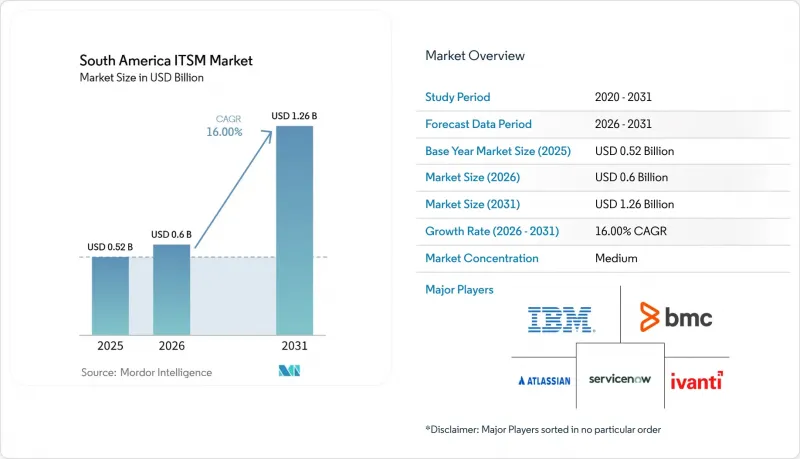
本報告按元件(解決方案和服務)、部署方式(雲端、本地部署、混合部署)、應用領域(服務台、資產管理、變更管理、知識管理等)、最終用戶(銀行、金融服務和保險、製造業等)、企業規模(大型企業、中小企業)和國家/地區進行細分。市場預測以美元計價。
南美洲IT服務管理市場的趨勢與洞察
銀行業、零售業和通訊業。
南美IT服務管理市場正受惠於銀行業、零售業和通訊業企業系統的大規模升級。銀行和通訊業者正以基於平台的服務管理取代分散的支援流程,以支援更快問題解決速度和更穩定營運需求的數位化管道。巴西銀行已為2025年的數位化營運累計了技術預算,雲端遷移預算也逐年顯著成長。通訊業向5G的轉型也增加了混合和多廠商環境下的營運複雜性,從而導致對更強大的工作流程管理和事件回應能力的需求日益成長。零售業也存在類似需求,因為全通路營運需要穩定的後端系統以及應用程式、設備和服務團隊之間更順暢的協調。隨著企業將這些工作流程擴展到IT部門以外的財務、人力資源和供應鏈職能部門,南美IT服務管理市場正受益於平台採用率的提高和對更新需求的成長。
對經濟高效的雲端IT服務管理平台的需求
推動南美IT服務管理市場擴張的另一個因素是,與依賴基礎設施的部署方式相比,基於雲端的交付模式更符合該地區的預算優先事項。許多公司都在尋求訂閱模式,以降低前期成本並簡化成本管理,即使在外匯波動和資金籌措不穩定的時期也是如此。巴西在公共雲端基礎設施上的支出已達到歷史新高,年成長顯著,證實了雲端技術在該地區最大的科技經濟體中已被廣泛應用。這些變化正在推動雲端IT服務管理(ITSM)的發展,因為SaaS平台消除了本地基礎設施的成本,實現了快速擴展,並縮短了引進週期。此外,預先配置範本和託管部署模式使得即使是沒有大規模內部IT團隊的公司也能輕鬆使用這些工具。隨著雲端環境在業務營運中扮演越來越重要的角色,南美IT服務管理市場對結構化支援、自動化工單管理和平台主導的服務管治的需求日益成長。
外匯波動影響訂閱和續訂預算
儘管許多軟體合約以美元定價,但客戶收入卻以該地貨幣累計,這使得外匯壓力成為南美IT服務管理市場面臨的最重要阻礙因素之一。這種貨幣錯配使得採購團隊難以進行多年規劃,並導致他們在平台升級、合約續約和用戶成長方面更加猶豫不決。在阿根廷,這個問題特別突出,外匯波動削弱了人們對長期軟體合約的信心。經合組織指出,國際貨幣基金組織在阿根廷的擴展融資機制(EFF)促進了大部分貨幣和資本管制的取消,從而改善了中期商業環境,儘管短期內仍存在不確定性。供應商正在採取一些措施,例如以該地貨幣開立發票和引入靈活的定價結構,但這些措施可能會增加交易的複雜性並延長銷售流程。這對中型買家來說是一個特別重要的限制因素,並可能減緩南美IT服務管理市場的擴張速度,尤其是在那些具有最大長期成長潛力的客戶群中。
細分市場分析
到2025年,解決方案將佔據南美IT服務管理市場64.82%的佔有率,顯示買家對整合平台的偏好遠勝於單一功能工具。同時,預計到2031年,服務細分市場將以17.12%的複合年成長率成長,顯示市場對整合事件管理、資產視覺化、變更工作流和知識支援的整合套件的需求持續旺盛。這一趨勢反映了南美IT服務管理市場的實際轉變,企業正尋求減輕孤立系統帶來的負擔並進行整合。這也符合區域IT團隊的營運實際情況,他們通常優先考慮快速部署和簡易管治,而不是進行大規模的工具客製化。
人工智慧能力也是解決方案佔據主導的重要因素。與組合多個獨立解決方案相比,在大型平台上實現諸如自動工單分類、虛擬代理和預測性問題解決等功能更加容易。企業越來越傾向於尋求能夠從IT支援擴展到員工服務、客戶工作流程和合規性任務的單一平台。這提升了平台授權的價值,並增強了已與大型客戶建立穩固關係的供應商續約的可能性。剩餘的需求仍以服務為主,因此,在南美IT服務管理產業,實施、培訓和託管支援的重要性仍然不變。本地系統整合商和全球顧問公司繼續從這個服務領域中受益,尤其是在企業擴展到更複雜的工作流程時。儘管如此,價值創造仍然以軟體平台為中心,南美IT服務管理市場仍然更注重解決方案,而非人工承包服務。
預計到2025年,雲端服務將佔南美IT服務管理市場收入的61.82%,證實了SaaS交付是首選的部署模式。雲也是成長最快的部署模式,預計到2031年複合年成長率將達到17.26%。買家選擇雲端的原因在於,它可以減少本地基礎架構需求、縮短部署時間,並且更符合基於訂閱的預算模式。企業對區域數位基礎設施信心的增強也促進了雲端在南美IT服務管理市場的優勢。公共雲端支出的成長強化了這樣一種理念:關鍵工作負載可以透過託管模式進行管理,而不是在孤立的本地環境中進行管理。
另一方面,雲端運算並未以相同的速度在所有產業取代其他模式。混合部署在政府機構和監管嚴格的金融服務業正蓬勃發展,因為這些行業的某些方面仍然需要本地管理。對於那些已經投入大規模基礎設施資金,並且更傾向於擴展資產而不是快速替換現有資產的組織而言,本地部署仍然是一個至關重要的選擇。供應商正在透過加強本地基礎設施和區域支援來應對這種情況,尤其是在巴西。 ServiceNow在里約熱內盧和巴西利亞擴建資料中心的舉措表明,領先的供應商將本地託管視為企業更廣泛採用雲端運算的必要條件。隨著這些安排的落實,預計雲端運算在南美 IT 服務管理市場的採用率將進一步提高,尤其是在較小的城市和對效能要求較高的應用場景中。
其他好處:
- Excel格式的市場預測(ME)表
- 3個月的分析師支持
目錄
第1章:引言
- 研究假設和市場定義
- 調查範圍
第2章:調查方法
第3章執行摘要
第4章 市場狀況
- 市場概覽
- 市場促進因素
- 銀行業、零售業和通訊業。
- 對經濟高效的雲端IT服務管理平台的需求
- 對西班牙語和葡萄牙語服務經驗的需求
- 在分散式營運中,人們對集中式服務交付的興趣日益濃厚
- 擴大共享服務的使用,並實現本地社區IT標準化
- 中型企業IT支援外包模式的擴展
- 市場限制因素
- 外匯波動影響合約和續約預算
- 在大都會圈以外,ITSM 的採用率較低。
- 預算限制延緩了企業平台的現代化進程。
- 依賴本地整合商,缺乏內部實施能力。
- 產業價值鏈分析
- 宏觀經濟因素的影響
- 監理情勢
- 技術展望
- 波特五力分析
第5章 市場規模與成長預測
- 按組件
- 解決方案
- 服務
- 不同的發展
- 雲
- 現場
- 混合
- 透過使用
- 服務台和事件管理
- 資產和配置管理
- 變更和發布管理
- 服務請求管理
- 知識管理
- 其他ITSM應用
- 按最終用戶行業分類
- BFSI
- 製造業
- 政府/公共部門
- 資訊科技/通訊
- 零售與電子商務
- 衛生保健
- 旅遊與飯店
- 其他終端用戶產業
- 按公司規模
- 大公司
- 中小企業
- 國家
- 巴西
- 阿根廷
- 其他南美國家
第6章 競爭情勢
- 市場集中度
- 策略趨勢
- 市佔率分析
- 公司簡介
- ServiceNow, Inc.
- IBM Corporation
- BMC Software, Inc.
- Atlassian Corporation Plc
- Ivanti, Inc.
- Freshworks Inc.
- ManageEngine, a division of Zoho Corporation Pvt. Ltd.
- Broadcom Inc.
- Open Text Corporation
- ASG Technologies Group, Inc.
- SysAid Technologies Ltd.
- Cherwell Software, LLC
- TOPdesk BV
- Hornbill Service Management Ltd.
- SymphonyAI Summit
- EasyVista SA
- SolarWinds Corporation
- Atlassian Corporation Plc
- Axelos Limited
第7章 市場機會與未來展望
According to Mordor Intelligence, the South America iT service management market size was valued at USD 0.52 billion in 2025 and is projected to reach USD 1.26 billion by 2031, at a CAGR of 16.00% during 2026-2031.
This report is Segmented by Component (Solutions, and Services), Deployment (Cloud, On-Premise, and Hybrid), Application (Service Desk, Asset Management, Change Management, Knowledge Management, and More), End-User (BFSI, Manufacturing, and More), Enterprise Size (Large Enterprises, and Small and Medium Enterprises), and Country. The Market Forecasts are Provided in Terms of Value (USD).
South America ITSM Market Trends and Insights
Increasing Enterprise Digitization In Banking, Retail, And Telecom
The South America IT service management market is benefiting from a broad upgrade in enterprise systems across banking, retail, and telecom. Banks and telecom operators are replacing disconnected support processes with platform-based service management to support digital channels that now require faster issue resolution and more stable operations. Brazilian banks allocated a combined technology budget toward digital operations in 2025, and cloud migration allocations rose significantly year over year. The telecom push into 5G is also increasing operational complexity across hybrid, multi-vendor environments, which is driving greater demand for stronger workflow control and incident response. Retailers are seeing a similar need because omnichannel operations require stable backend systems and better coordination across applications, devices, and service teams. As enterprises extend these workflows beyond IT into finance, HR, and supply chain functions, the South America IT service management market gains from deeper platform usage and stronger renewal potential.
Demand For Cost-Efficient Cloud ITSM Platforms
The South America IT service management market is also moving higher because cloud delivery better aligns with the region's budget priorities than infrastructure-heavy deployments. Many enterprises want subscription models that lower upfront spending and make costs easier to manage during periods of exchange-rate pressure and uneven capital availability. Public cloud infrastructure spending in Brazil reached new heights, with a notable year-over-year increase, confirming that cloud adoption is already well established in the region's largest technology economy. That shift supports cloud ITSM because SaaS platforms eliminate local infrastructure costs, enable faster scaling, and reduce the need for lengthy implementation cycles. Preconfigured templates and managed deployment models are also making these tools easier for companies without large internal IT teams to adopt. As cloud environments become more central to enterprise operations, the South America IT service management market is seeing stronger demand for structured support, automated ticketing, and platform-led service governance.
Currency Volatility Affecting Subscription and Renewal Budgets
Currency pressure remains one of the clearest restraints on the South America IT service management market because many software contracts are priced in USD while customer revenues are generated in local currency. That mismatch makes multi-year planning more difficult for procurement teams and creates greater hesitation around platform upgrades, renewals, and user expansion. The issue is especially relevant in Argentina, where exchange-rate instability has weighed on confidence in longer software commitments. The OECD noted that Argentina's IMF Extended Fund Facility supported the lifting of most currency and capital controls, thereby improving the medium-term operating backdrop, even though near-term uncertainty remained. Vendors are responding with local-currency billing and flexible pricing structures, but these steps add commercial complexity and can lengthen the sales process. This is particularly restrictive for mid-sized buyers, which means the South America IT service management market may face slower expansion among the very customer group that offers some of its best long-term upside.
Other drivers and restraints analyzed in the detailed report include:
- Need For Spanish And Portuguese Language Service Experiences
- Growing Interest In Centralized Service Delivery For Distributed Operations
- Lower ITSM Penetration Outside Large Urban Enterprises
For complete list of drivers and restraints, kindly check the Table Of Contents.
Segment Analysis
Solutions held 64.82% of South America IT service management market share in 2025, which showed how strongly buyers favored integrated platforms over narrow tools. While the services segment is projected to expand at a 17.12% CAGR through 2031, indicating continued preference for unified suites that combine incident management, asset visibility, change workflows, and knowledge support. This direction reflects a practical shift in the South America IT service management market, as enterprises seek fewer disconnected systems and less integration burden. It also aligns with the operational realities of regional IT teams, which often need faster rollouts and simpler governance rather than extensive tool customization.
The solutions lead is also tied to AI functionality, because automated ticket classification, virtual agents, and predictive resolution are easier to deploy within broader platforms than across mixed-point solutions. Enterprises are increasingly looking for a single layer that can extend from IT support to employee services, customer workflows, and compliance tasks. That raises the value of platform licensing and strengthens renewal potential for vendors that already have a foothold in large accounts. Services still account for the remaining component demand, and that keeps implementation, training, and managed support important in the South America IT service management industry. Local system integrators and global consulting firms continue to benefit from this services stream, especially when enterprises expand into more advanced workflows. Even so, the center of value creation remains in software platforms, which keeps the South America IT service management market weighted toward solutions rather than labor-led service contracts.
Cloud accounted for 61.82% of 2025 revenue in the South America IT service management market, confirming that SaaS delivery had become the preferred deployment model. It is also the fastest-growing deployment model, with a projected 17.26% CAGR through 2031. Buyers are choosing cloud because it reduces local infrastructure requirements, shortens rollout time, and aligns more naturally with subscription-based budget planning. The South America IT service management market is also seeing cloud benefit from stronger enterprise confidence in regional digital infrastructure. Growth in public cloud spending has reinforced the idea that critical workloads can be managed through hosted models rather than through isolated on-premise environments.
At the same time, cloud is not replacing every other model at the same pace across all verticals. Hybrid deployments are gaining traction in government and regulated financial services settings, where parts of the environment still require local control. On-premise deployments remain relevant for organizations that have already made large infrastructure investments and prefer to extend those assets rather than replace them quickly. Vendors have adjusted to this by strengthening local infrastructure and regional support capabilities, especially in Brazil. ServiceNow's expansion of its Rio de Janeiro and Brasilia data centers shows that major vendors see local hosting as a practical requirement for wider enterprise adoption. As those capabilities improve, the South America IT service management market should see cloud adoption widen further across secondary cities and more performance-sensitive use cases.
Complete Report Scope:
- By Component
- Solutions
- Services
- By Deployment
- Cloud
- On-Premise
- Hybrid
- By Application
- Service Desk and Incident Management
- Asset and Configuration Management
- Change and Release Management
- Service Request Management
- Knowledge Management
- Other ITSM Applications
- By End-User Industry
- BFSI
- Manufacturing
- Government and Public Sector
- IT and Telecommunications
- Retail and E-Commerce
- Healthcare
- Travel and Hospitality
- Other End-User Industries
- By Enterprise Size
- Large Enterprises
- Small and Mid-Size Enterprises (SME)
- By Country
- Brazil
- Argentina
- Rest of South America
List of Companies Covered in this Report:
- ServiceNow, Inc.
- IBM Corporation
- BMC Software, Inc.
- Atlassian Corporation Plc
- Ivanti, Inc.
- Freshworks Inc.
- ManageEngine, a division of Zoho Corporation Pvt. Ltd.
- Broadcom Inc.
- Open Text Corporation
- ASG Technologies Group, Inc.
- SysAid Technologies Ltd.
- Cherwell Software, LLC
- TOPdesk B.V.
- Hornbill Service Management Ltd.
- SymphonyAI Summit
- EasyVista S.A.
- SolarWinds Corporation
- Atlassian Corporation Plc
- Axelos Limited
Additional Benefits:
- The market estimate (ME) sheet in Excel format
- 3 months of analyst support
TABLE OF CONTENTS
1 INTRODUCTION
- 1.1 Study Assumptions and Market Definition
- 1.2 Scope of the Study
2 RESEARCH METHODOLOGY
3 EXECUTIVE SUMMARY
4 MARKET LANDSCAPE
- 4.1 Market Overview
- 4.2 Market Drivers
- 4.2.1 Increasing Enterprise Digitization in Banking, Retail, and Telecom
- 4.2.2 Demand for Cost-Efficient Cloud ITSM Platforms
- 4.2.3 Need for Spanish and Portuguese Language Service Experiences
- 4.2.4 Growing Interest in Centralized Service Delivery for Distributed Operations
- 4.2.5 Rising Use of Shared Services and Regional IT Standardization
- 4.2.6 Expansion of Outsourced IT Support Models Across Mid-Sized Firms
- 4.3 Market Restraints
- 4.3.1 Currency Volatility Affecting Subscription and Renewal Budgets
- 4.3.2 Lower ITSM Penetration Outside Large Urban Enterprises
- 4.3.3 Budget Constraints Delaying Enterprise Platform Modernization
- 4.3.4 Dependence on Local Integrators and Limited In-House Implementation Skills
- 4.4 Industry Value Chain Analysis
- 4.5 Impact of Macroeconomic Factors
- 4.6 Regulatory Landscape
- 4.7 Technological Outlook
- 4.8 Porter's Five Forces Analysis
- 4.8.1 Bargaining Power of Suppliers
- 4.8.2 Bargaining Power of Buyers
- 4.8.3 Threat of New Entrants
- 4.8.4 Threat of Substitutes
- 4.8.5 Intensity of Competitive Rivalry
5 MARKET SIZE AND GROWTH FORECASTS (VALUE)
- 5.1 By Component
- 5.1.1 Solutions
- 5.1.2 Services
- 5.2 By Deployment
- 5.2.1 Cloud
- 5.2.2 On-Premise
- 5.2.3 Hybrid
- 5.3 By Application
- 5.3.1 Service Desk and Incident Management
- 5.3.2 Asset and Configuration Management
- 5.3.3 Change and Release Management
- 5.3.4 Service Request Management
- 5.3.5 Knowledge Management
- 5.3.6 Other ITSM Applications
- 5.4 By End-User Industry
- 5.4.1 BFSI
- 5.4.2 Manufacturing
- 5.4.3 Government and Public Sector
- 5.4.4 IT and Telecommunications
- 5.4.5 Retail and E-Commerce
- 5.4.6 Healthcare
- 5.4.7 Travel and Hospitality
- 5.4.8 Other End-User Industries
- 5.5 By Enterprise Size
- 5.5.1 Large Enterprises
- 5.5.2 Small and Mid-Size Enterprises (SME)
- 5.6 By Country
- 5.6.1 Brazil
- 5.6.2 Argentina
- 5.6.3 Rest of South America
6 COMPETITIVE LANDSCAPE
- 6.1 Market Concentration
- 6.2 Strategic Moves
- 6.3 Market Share Analysis
- 6.4 Company Profiles (includes Global Level Overview, Market Level Overview, Core Segments, Financials as available, Strategic Information, Market Rank/Share, Products and Services, Recent Developments)
- 6.4.1 ServiceNow, Inc.
- 6.4.2 IBM Corporation
- 6.4.3 BMC Software, Inc.
- 6.4.4 Atlassian Corporation Plc
- 6.4.5 Ivanti, Inc.
- 6.4.6 Freshworks Inc.
- 6.4.7 ManageEngine, a division of Zoho Corporation Pvt. Ltd.
- 6.4.8 Broadcom Inc.
- 6.4.9 Open Text Corporation
- 6.4.10 ASG Technologies Group, Inc.
- 6.4.11 SysAid Technologies Ltd.
- 6.4.12 Cherwell Software, LLC
- 6.4.13 TOPdesk B.V.
- 6.4.14 Hornbill Service Management Ltd.
- 6.4.15 SymphonyAI Summit
- 6.4.16 EasyVista S.A.
- 6.4.17 SolarWinds Corporation
- 6.4.18 Atlassian Corporation Plc
- 6.4.19 Axelos Limited
7 MARKET OPPORTUNITIES AND FUTURE OUTLOOK
- 7.1 White-space and Unmet-Need Assessment

 IT服務管理平台市場:全球市場預測,2026-2032年
 中東歐IT服務管理:市場佔有率分析、產業趨勢與統計及成長預測(2026-2035)德國IT服務管理:市場佔有率分析、產業趨勢與統計、成長預測(2026-2035)東協IT服務管理:市場佔有率分析、產業趨勢與統計及成長預測(2026-2035)英國IT服務管理:市場佔有率分析、產業趨勢與統計、成長預測(2026-2035)IT 服務管理市場:按組件、部署類型、組織規模和產業分類-2026-2032 年全球市場預測IT服務管理:市場佔有率分析、產業趨勢與統計、成長預測(2026-2031年)中國IT服務管理(ITSM):市場佔有率分析、產業趨勢與統計及成長預測(2026-2031年)中東和非洲的IT服務管理:市場佔有率分析、行業趨勢和統計數據以及成長預測(2026-2031年)亞太地區IT服務管理:市場佔有率分析、產業趨勢與統計及成長預測(2026-2031年)