


 |
市場調查報告書
商品編碼
2099089
東協地區人工智慧能源管理軟體:市場佔有率分析、產業趨勢與統計及成長預測(2026-2031 年)ASEAN AI-powered Energy Management Software - Market Share Analysis, Industry Trends & Statistics, Growth Forecasts (2026 - 2031) |
||||||

※ 本網頁內容可能與最新版本有所差異。詳細情況請與我們聯繫。
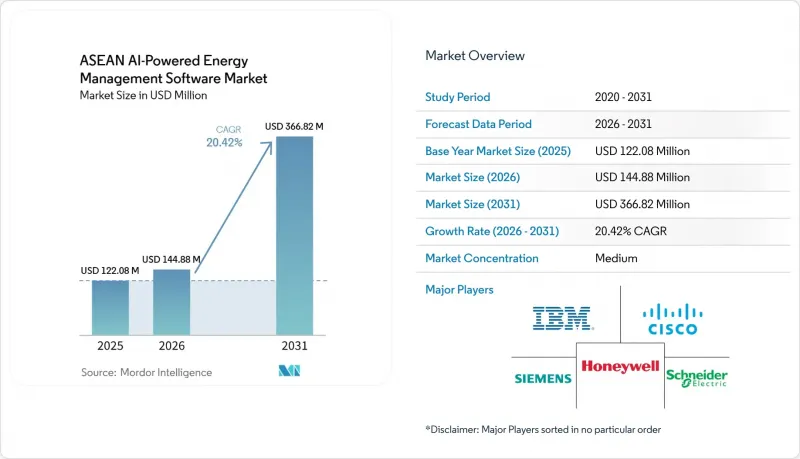
根據 Mordor Intelligence 預測,東協地區人工智慧能源管理軟體的市場規模預計將從 2025 年的 1.2208 億美元成長到 2026 年的 1.4488 億美元,然後從 2026 年到 2031 年以 20.42% 的複合年成長率成長,達到 203.3162.368 億美元到 363.168 億美元。
本報告按元件(軟體和服務)、部署模式(雲端、本地部署、混合部署)、應用(例如,能源消耗和需求最佳化、資產性能和預測性維護)、最終用戶(公共產業、商業建築、工業設施)和地區進行細分。市場預測以美元計價。
東協人工智慧能源管理軟體市場趨勢與洞察。
能源成本上漲和尖峰負載波動
電力價格的波動正推動人工智慧驅動的能源管理軟體在東協能源管理軟體市場中成為日常成本管理的首選。根據國際能源總署(IEA)預測,到2035年,東南亞的電力需求將以每年4%的速度成長,這將為公用事業公司和大型需求者帶來越來越大的壓力,迫使他們更精準地管理用電負載。隨著需求的快速成長,買家比幾年前更加關注價格風險、高峰時段費用以及以小時為單位的用電調度。這正在改變採購行為,因為人們現在期望軟體不僅能夠降低年度用電量,還能緩解帳單金額的波動。此外,《2026-2030年亞太經合組織能源合作計畫》設定了2030年將東協能源強度比2005年水準降低40%的目標,為更嚴格的能源管理提供了更有力的政策支持。因此,在東協人工智慧 (AI) 能源管理軟體市場,擁有強大的負載管理和報告工具的供應商更容易獲得預算批准。
加速東協大都會地區的智慧建築維修
商業不動產的維修仍是東協人工智慧能源管理軟體市場最明確的需求管道之一。西門子於2025年3月向東協推出了「Building X」項目,並以曼谷的「True Digital Park」作為雲端建築最佳化的首個案例研究。根據西門子介紹,該專案能夠即時監測並利用人工智慧技術最佳化溫度、濕度和能源參數,參與專案的建築通常可在一年內實現投資回報。這一點至關重要,因為許多業主希望分階段升級,在不徹底更換老舊設施控制系統的情況下提升建築性能。東協能源中心指出,能源服務公司(ESCO)模式整合了審計、資金籌措、安裝和測量等服務,減輕了缺乏內部實施能力的業主的負擔。維修需求與實施支援的結合意味著,在可預見的未來,現有建築仍將是軟體應用的核心。
與傳統建築管理系統(BMS)和監控與資料採集系統(SCADA)整合的複雜性。
在東協地區,人工智慧驅動的能源管理軟體面臨的最大障礙仍然是與過時的建築管理和電網控制系統整合。許多現有設施的暖通空調、照明、計量和工廠控制系統各自獨立運行,這些系統並非為無縫資料交換而設計。這種資料流的脆弱性降低了人工智慧建議的準確性,並延長了測試、試運行和故障排除的時間。東協能源中心指出,雖然由能源服務公司(ESCO)主導的維修專案可以整合審計、資金籌措、安裝和檢驗,但老舊資產仍需要精心的現場設計才能確保軟體穩定運作。因此,買家在進行後續部署之前,要求快速的投資回報、可靠的互通性和清晰的實施支援。這正是高能耗但技術預算有限的中型商業設施採用該軟體的最大阻礙因素。
細分市場分析
預計到2025年,東協人工智慧能源管理軟體市場中,軟體類產品將佔據66.31%的佔有率,成為尋求跨地域可視性的客戶的首選。買家通常會先部署分析、儀錶板和報告功能,因為這些工具能夠建立可操作的資料層,為更高階的自動化任務做好準備。這種部署順序至關重要,因為初始平台的選擇往往會影響後續的整合、工作流程和更新決策。在東協人工智慧能源管理軟體市場,軟體也受益於雲端交付模式,該模式允許供應商在無需重新配置現場基礎設施的情況下更新功能。由於其直接的營運價值以及作為更廣泛的數位化能源項目入口點的作用,該細分市場在2025年仍將保持主導地位。
預計到2031年,服務業將以23.81%的複合年成長率成長,成為整體業務中成長最快的板塊。這一成長反映出眾多客戶在整合、試運行、培訓和變更管理方面持續存在著巨大的支援需求。東協能源中心指出,東協地區的能源服務公司(ESCO)可以透過整合審計、資金籌措、安裝和測量/檢驗等服務,減輕建築業主的營運負擔。這個服務層至關重要,因為人工智慧工具只有在計量表、控制設備和運行計畫可靠連接的情況下才能有效運作。因此,儘管軟體在預測期內仍將是較大的收入來源,但預計服務業的成長速度將超過軟體業。
2025年,基於雲端的解決方案在東協人工智慧能源管理軟體市場佔了61.45%的佔有率。這表明,擴充性和較低的初始基礎設施成本仍然是最重要的採購考量。採用雲端技術使企業能夠監控、報告和更新其分散式建築組合中的軟體,而無需在每個地點建立單獨的本地伺服器環境。西門子於2025年3月發布了「面向東協的Building X」解決方案,為該地區提供了一個具體的範例。該方案的發布意義重大,因為商業營運商正在尋求一條清晰的路徑,以實現更快的部署、更少的維護和遠端最佳化。因此,在2025年,雲端仍然是新建多站點建築組合的首選方案。
預計到2031年,混合部署將以23.48%的複合年成長率成長,成為該類別中成長最快的部署方式。公共產業和工業運營商通常會將更廣泛的分析和報告功能遷移到雲端環境,同時在本地保留時間受限的控制功能。這種架構適用於需要在運作、內部核准規則和營運風險之間取得平衡的設施。此外,對於資料處理要求仍然嚴格或不確定的市場而言,它也為供應商提供了一個切實可行的切入點。隨著東協人工智慧驅動的能源管理軟體市場的日趨成熟,混合設計預計將在工業和電網應用場景中得到更廣泛的應用。
其他好處:
- Excel格式的市場預測(ME)表
- 3個月的分析師支持
目錄
第1章:引言
- 研究假設和市場定義
- 調查範圍
第2章:調查方法
第3章執行摘要
第4章 市場狀況
- 市場概覽
- 市場促進因素
- 能源成本上漲和尖峰負載波動
- 加速東協大都會地區的智慧建築維修
- 政府對能源效率和數位化的獎勵
- 利用人工智慧技術最佳化多站點投資組合的負載。
- 分散式能源資源的擴展和電池儲能的整合
- 對持續合規報告和ESG可追溯性的需求
- 市場限制因素
- 與傳統建築管理系統(BMS)和監控與資料採集系統(SCADA)整合的複雜性。
- 獲得熟練的能源數據和人工智慧專家是一項挑戰。
- 雲端採用中的資料主權與網路安全問題
- 東南亞國協。
- 產業價值鏈分析
- 監理情勢
- 技術展望
- 宏觀經濟因素對市場的影響
- 波特五力分析
第5章 市場規模與成長預測
- 按組件
- 軟體
- 服務
- 部署模式
- 基於雲端的
- 現場
- 混合
- 透過使用
- 最佳化能源消耗和需求
- 資產性能和預測性維護
- 智慧電網與分散式能源(DER)的管理
- 可再生能源預測與整合
- 能源交易、定價和市場訊息
- 最終用戶
- 公用事業
- 商業建築
- 工業設施
- 住宅大樓
- 按地區
- 新加坡
- 印尼
- 馬來西亞
- 菲律賓
- 泰國
- 越南
- 其他東南亞國協
第6章 競爭情勢
- 市場集中度
- 策略趨勢
- 市佔率分析
- 公司簡介
- Schneider Electric SE
- Siemens AG
- Honeywell International Inc.
- Johnson Controls International plc
- ABB Ltd
- Cisco Systems, Inc.
- IBM Corporation
- Microsoft Corporation
- Oracle Corporation
- SAP SE
- Enel X Srl
- AutoGrid Systems, Inc.
- Uplight, Inc.
- C3.ai, Inc.
- BrainBox AI Inc.
- GridPoint, Inc.
- DEXMA Sensors, SL
- EnergyCAP, LLC
- CopperTree Analytics Inc.
- Verdigris Technologies, Inc.
第7章 市場機會與未來展望
According to Mordor Intelligence, the ASEAN AI-powered energy management software market size is expected to grow from USD 122.08 million in 2025 to USD 144.88 million in 2026 and is forecast to reach USD 366.82 million by 2031 at 20.42% CAGR over 2026-2031.
This report is Segmented by Component (Software, and Services), Deployment Mode (Cloud-Based, On-premises, and Hybrid), Application (Energy Consumption and Demand Optimization, Asset Performance and Predictive Maintenance, and More), End User (Utilities, Commercial Buildings, Industrial Facilities, and More), and Geography. The Market Forecasts are Provided in Terms of Value (USD).
ASEAN AI-powered Energy Management Software Market Trends and Insights
Rising Energy Costs and Peak Load Volatility
Power price volatility has pushed energy software to the forefront of day-to-day cost control across the ASEAN AI-powered Energy Management Software Market. The International Energy Agency said Southeast Asia's electricity demand is projected to rise by 4% annually to 2035, which keeps pressure on utilities and large users to manage load more precisely. When demand rises this quickly, buyers pay more attention to tariff exposure, peak demand charges, and sub-hourly scheduling than they did a few years ago. That changes procurement behavior because software is now expected to reduce billing volatility, not just trim annual consumption. APAEC 2026-2030 also set a target to reduce ASEAN energy intensity by 40% by 2030 relative to 2005 levels, which adds policy weight to tighter energy controls. In the ASEAN Artificial Intelligence Powered Energy Management Software Market, vendors with strong load management and reporting tools are therefore finding a more direct path into budget approval.
Accelerated Smart Building Retrofits in ASEAN Urban Clusters
Retrofit activity in commercial properties remains one of the clearest demand channels for the ASEAN AI-powered Energy Management Software Market. Siemens launched Building X for ASEAN in March 2025 and used True Digital Park in Bangkok as an early reference site for cloud-based building optimization. Siemens said the deployment enabled real-time monitoring and AI-driven optimization of temperature, humidity, and energy parameters, with a typical return on investment of under 1 year for participating buildings. This matters because many property owners want staged upgrades that improve performance without forcing a full replacement of older site controls. The ASEAN Center for Energy said ESCO models can bundle audits, financing, installation, and measurement, thereby reducing the burden on owners who lack internal implementation capacity. That combination of retrofit demand and delivery support keeps existing buildings at the center of near-term software adoption.
High Integration Complexity With Legacy BMS and SCADA
Integration with older building and grid control systems remains the most immediate barrier in the ASEAN AI-powered Energy Management Software Market. Many brownfield assets still operate with separate systems for HVAC, lighting, metering, and plant controls, and those systems were not built to cleanly exchange data. That weak data flow reduces the quality of AI recommendations and extends testing, commissioning, and troubleshooting time. The ASEAN Centre for Energy said ESCO-led retrofits can combine audits, financing, installation, and verification, but older assets still require careful site-level design before software can perform consistently. Buyers, therefore, look for short payback, proven interoperability, and clear implementation support before expanding beyond initial sites. This slows adoption most in mid-tier commercial properties where energy use is meaningful but technical budgets remain limited.
Other drivers and restraints analyzed in the detailed report include:
- Government Incentives for Energy Efficiency and Digitalization
- AI-Enabled Load Optimization Across Multi-Site Portfolios
- Limited Availability of Skilled Energy Data and AI Specialists
For complete list of drivers and restraints, kindly check the Table Of Contents.
Segment Analysis
Software accounted for 66.31% of the ASEAN AI-powered Energy Management Software Market in 2025, making it the primary focus for customers seeking visibility across multiple sites. Buyers usually started with analytics, dashboards, and reporting because those tools created a usable data layer before deeper automation work began. This ordering mattered because the first platform choice often shaped later integration, workflow, and renewal decisions. In the ASEAN AI-powered Energy Management Software Market, software also benefited from cloud delivery models that enabled vendors to update functionality without rebuilding site infrastructure. The segment led in 2025 because it delivered direct operational value and also acted as the gateway to broader digital energy programs.
Services are projected to expand at a 23.81% CAGR through 2031, the fastest pace within this segmentation. That growth reflects the significant support many customers still need for integration, commissioning, training, and change management. The ASEAN Center for Energy said ESCO providers in ASEAN can combine audits, financing, installation, and measurement and verification, thereby reducing the execution burden for building owners. This service layer matters because AI tools only perform well when meters, controls, and operating schedules are reliably connected. Services are therefore set to grow faster than software, even though software will remain the larger revenue pool across the forecast period.
Cloud-based solutions held 61.45% of the ASEAN AI-powered Energy Management Software Market share in 2025, which showed that scalability and lower upfront infrastructure costs remained the strongest buying priorities. Cloud deployment lets organizations activate monitoring, reporting, and software updates across dispersed portfolios without building separate local server environments at each site. Siemens gave the region a visible example when it launched Building X for ASEAN in March 2025. That launch mattered because commercial operators wanted faster rollout, lighter upkeep, and clearer paths to remote optimization. Cloud, therefore, remained the default choice for new multi-site building portfolios in 2025.
Hybrid deployment is projected to grow at a 23.48% CAGR through 2031, the fastest rate in this grouping. Utilities and industrial operators often keep time-sensitive control functions on site while shifting wider analytics and reporting to cloud environments. This structure suits facilities that need to balance uptime, internal approval rules, and operational risk. It also gives vendors a practical route into markets where data handling expectations remain strict or unsettled. As the ASEAN AI-powered Energy Management Software Market matures, hybrid design is likely to gain more ground in industrial and grid-facing use cases.
Complete Report Scope:
- By Component
- Software
- Services
- By Deployment Mode
- Cloud-Based
- On-Premises
- Hybrid
- By Application
- Energy Consumption and Demand Optimization
- Asset Performance and Predictive Maintenance
- Smart Grid and Distributed Energy Resource (DER) Management
- Renewable Energy Forecasting and Integration
- Energy Trading, Pricing and Market Intelligence
- By End User
- Utilities
- Commercial Buildings
- Industrial Facilities
- Residential Buildings
- By Geography
- Singapore
- Indonesia
- Malaysia
- Philippines
- Thailand
- Vietnam
- Rest of ASEAN
List of Companies Covered in this Report:
- Schneider Electric SE
- Siemens AG
- Honeywell International Inc.
- Johnson Controls International plc
- ABB Ltd
- Cisco Systems, Inc.
- IBM Corporation
- Microsoft Corporation
- Oracle Corporation
- SAP SE
- Enel X S.r.l.
- AutoGrid Systems, Inc.
- Uplight, Inc.
- C3.AI, Inc.
- BrainBox AI Inc.
- GridPoint, Inc.
- DEXMA Sensors, S.L.
- EnergyCAP, LLC
- CopperTree Analytics Inc.
- Verdigris Technologies, Inc.
Additional Benefits:
- The market estimate (ME) sheet in Excel format
- 3 months of analyst support
TABLE OF CONTENTS
1 INTRODUCTION
- 1.1 Study Assumptions and Market Definition
- 1.2 Scope of the Study
2 RESEARCH METHODOLOGY
3 EXECUTIVE SUMMARY
4 MARKET LANDSCAPE
- 4.1 Market Overview
- 4.2 Market Drivers
- 4.2.1 Rising Energy Costs and Peak Load Volatility
- 4.2.2 Accelerated Smart Building Retrofits in ASEAN Urban Clusters
- 4.2.3 Government Incentives for Energy Efficiency and Digitalization
- 4.2.4 AI-Enabled Load Optimization Across Multi-Site Portfolios
- 4.2.5 Growth of Distributed Energy Resources and Battery Integration
- 4.2.6 Demand for Continuous Compliance Reporting and ESG Traceability
- 4.3 Market Restraints
- 4.3.1 High Integration Complexity with Legacy BMS and SCADA
- 4.3.2 Limited Availability of Skilled Energy Data and AI Specialists
- 4.3.3 Data Sovereignty and Cybersecurity Concerns for Cloud Deployment
- 4.3.4 Uneven Digitization Across ASEAN Commercial and Industrial Assets
- 4.4 Industry Value Chain Analysis
- 4.5 Regulatory Landscape
- 4.6 Technological Outlook
- 4.7 Impact of Macroeconomic Factors on the Market
- 4.8 Porter's Five Forces Analysis
- 4.8.1 Bargaining Power of Suppliers
- 4.8.2 Bargaining Power of Buyers
- 4.8.3 Threat of New Entrants
- 4.8.4 Threat of Substitutes
- 4.8.5 Competitive Rivalry
5 MARKET SIZE AND GROWTH FORECASTS (VALUE)
- 5.1 By Component
- 5.1.1 Software
- 5.1.2 Services
- 5.2 By Deployment Mode
- 5.2.1 Cloud-Based
- 5.2.2 On-Premises
- 5.2.3 Hybrid
- 5.3 By Application
- 5.3.1 Energy Consumption and Demand Optimization
- 5.3.2 Asset Performance and Predictive Maintenance
- 5.3.3 Smart Grid and Distributed Energy Resource (DER) Management
- 5.3.4 Renewable Energy Forecasting and Integration
- 5.3.5 Energy Trading, Pricing and Market Intelligence
- 5.4 By End User
- 5.4.1 Utilities
- 5.4.2 Commercial Buildings
- 5.4.3 Industrial Facilities
- 5.4.4 Residential Buildings
- 5.5 By Geography
- 5.5.1 Singapore
- 5.5.2 Indonesia
- 5.5.3 Malaysia
- 5.5.4 Philippines
- 5.5.5 Thailand
- 5.5.6 Vietnam
- 5.5.7 Rest of ASEAN
6 COMPETITIVE LANDSCAPE
- 6.1 Market Concentration
- 6.2 Strategic Moves
- 6.3 Market Share Analysis
- 6.4 Company Profiles (includes Global Level Overview, Market Level Overview, Core Segments, Financials as available, Strategic Information, Market Rank/Share, Products and Services, Recent Developments)
- 6.4.1 Schneider Electric SE
- 6.4.2 Siemens AG
- 6.4.3 Honeywell International Inc.
- 6.4.4 Johnson Controls International plc
- 6.4.5 ABB Ltd
- 6.4.6 Cisco Systems, Inc.
- 6.4.7 IBM Corporation
- 6.4.8 Microsoft Corporation
- 6.4.9 Oracle Corporation
- 6.4.10 SAP SE
- 6.4.11 Enel X S.r.l.
- 6.4.12 AutoGrid Systems, Inc.
- 6.4.13 Uplight, Inc.
- 6.4.14 C3.ai, Inc.
- 6.4.15 BrainBox AI Inc.
- 6.4.16 GridPoint, Inc.
- 6.4.17 DEXMA Sensors, S.L.
- 6.4.18 EnergyCAP, LLC
- 6.4.19 CopperTree Analytics Inc.
- 6.4.20 Verdigris Technologies, Inc.
7 MARKET OPPORTUNITIES AND FUTURE OUTLOOK
- 7.1 White-Space and Unmet-Need Assessment

 2034年人工智慧市場在發電領域的預測-按組件、部署模式、人工智慧技術、電源、應用、企業規模、最終用戶和地區分類的全球分析
 全球能源電力領域人工智慧(AI)市場:機會與策略展望(至2035年)
 中國人工智慧能源管理軟體:市場佔有率分析、產業趨勢與統計及成長預測(2026-2031)中東和非洲人工智慧能源管理軟體:市場佔有率分析、行業趨勢和統計數據以及成長預測(2026-2031 年)中東地區人工智慧能源管理軟體:市場佔有率分析、行業趨勢和統計數據以及成長預測(2026-2031 年)南美洲人工智慧能源管理軟體:市場佔有率分析、行業趨勢和統計數據以及成長預測(2026-2031 年)印度人工智慧能源管理軟體:市場佔有率分析、行業趨勢和統計數據以及成長預測(2026-2031 年)德國人工智慧能源管理軟體:市場佔有率分析、行業趨勢和統計數據以及成長預測(2026-2031 年)新加坡人工智慧能源管理軟體:市場佔有率分析、行業趨勢和統計數據以及成長預測(2026-2031 年)日本人工智慧能源管理軟體:市場佔有率分析、產業趨勢與統計及成長預測(2026-2031)