


 |
市場調查報告書
商品編碼
2098568
東非汽車潤滑油市場:市場佔有率分析、產業趨勢與統計及成長預測(2026-2031 年)East Africa Automotive Lubricants - Market Share Analysis, Industry Trends & Statistics, Growth Forecasts (2026 - 2031) |
||||||

※ 本網頁內容可能與最新版本有所差異。詳細情況請與我們聯繫。
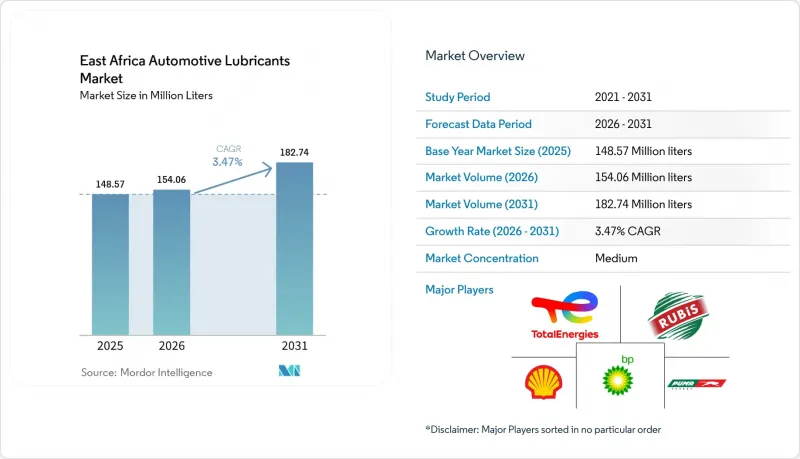
據 Mordor Intelligence 稱,東非汽車潤滑油市場預計將從 2025 年的 1.4857 億公升成長到 2026 年的 1.5406 億公升,到 2031 年達到 1.8274 億升,2026 年至 2031 年的複合年成長率為 3.47%。
本報告按產品類型(汽車引擎油、手排變速箱油等)、車輛類型(乘用車、商用車、摩托車)和地區(肯亞、坦尚尼亞、烏干達、衣索比亞、盧安達、蒲隆地、剛果民主共和國)進行細分。市場規模和預測均以銷售量(公升)為單位。
東非汽車潤滑油市場趨勢與洞察
車輛平均使用壽命和二手車進口激增
東非道路上行駛的輕型車輛約有90%是進口二手車。老舊的動力傳動系統由於活塞環磨損和運轉溫度升高,導致機油消耗量增加。 2024年1月至8月,坦尚尼亞處理了46,944輛日本二手車,同期肯亞處理了38,861輛。這支撐了以價格實惠的礦物基多級機油為主導的替換機油市場。隨著烏干達決定在2025年將進口車輛的車型年限限制降低至10年,預計車輛品質將略有提高,更換週期將縮短,潤滑油需求也將保持穩定。進口車輛的組成正日益轉向自動擋和混合動力汽車,從而推動了對自動變速箱油(ATF)和低粘度合成油的需求。隨著二手車持續湧入市場,能夠以具有競爭力的價格提供原廠認證二手產品的供應商將佔據有利地位,從而確保穩定的回頭客。
肯亞、烏干達和坦尚尼亞的摩托車數量正在迅速增加。
肯亞摩托車註冊量年增超過一倍,2025年前11個月達到145,714輛。正規資產融資模式的引入提高了摩托車計程車駕駛人(boda-boda)的維護合規性。二輪車市場正在推動對二行程和四衝程引擎小包裝潤滑油的需求。然而,該市場面臨電氣化的挑戰。電動機車在肯亞的註冊量已佔15%以上,最大限度地減少了除鏈條潤滑脂以外的其他潤滑油需求。雖然內燃機摩托車將在短期內促進潤滑油銷售量,但負責人需要將產品多元化經營至潤滑脂和特種潤滑油領域,以緩解機油需求長期下降的趨勢。成功的關鍵要素包括選擇合適的包裝規格、建立覆蓋當地的分銷網路以及對零售商進行培訓。
假冒劣質潤滑油的氾濫
2026年2月,肯亞仿冒品執法部門在布西亞邊境查獲了大量假貨。儘管採取了這些措施,假冒機油仍佔肯亞國內消費量的約20%,在坦尚尼亞則是超過一半。造假者經常將用過的瓶子重新填充或稀釋正品,這會導致引擎故障並損害消費者信任。為此,道達爾能源公司推出了帶有USSD(非結構化補充資料服務)檢驗碼的防篡改封條,而一些中國品牌則採用了基於區塊鏈的追蹤溯源包裝。儘管執法方面仍面臨挑戰,但由於消費者意識的提高和數位檢驗工具的普及,假冒產品的流通正在逐漸減少。
細分市場分析
在東非汽車潤滑油市場,預計到2025年,機油將佔總銷售量的47.72%。這主要是由於乘用車、卡車和摩托車需要頻繁更換機油。隨著自動變速箱在內羅畢和達累斯薩拉姆等交通堵塞嚴重的城市日益普及,預計到2031年,東非自動變速箱油(ATF)市場規模將以3.76%的複合年成長率成長。由於當地環境溫度持續偏高,傳統的15W-40和20W-50等黏度等級的機油仍佔據主導地位。然而,優質的5W-30合成機油正逐漸獲得市場認可,尤其是在日本和歐洲進口的新車中,這些車輛由於引擎公差要求嚴格,需要使用低黏度機油。
手排變速箱在乘用車領域仍佔據主導地位,雖然手排變速箱油的銷售量正經歷溫和成長,但其市場佔有率卻逐漸下降。煞車油和汽車潤滑脂的使用遵循標準保養計劃,而動力方向盤液和冷卻液則擴大被納入OEM(原始設備製造商)維修店提供的保養套件中。對於市場參與企業而言,建立多元化的產品系列至關重要。例如,埃塞俄比亞國家石油公司透過其八個區域倉庫銷售各種產品,包括Havoline礦物油和合成油、GL-4和GL-5齒輪油、DOT 4煞車油以及鋰基或二硫化鉬潤滑脂。隨著自動變速箱油(ATF)和合成潤滑油需求的持續成長,將產品線擴展到基礎機油以外的供應商更有利於維持利潤率。
其他好處:
- Excel格式的市場預測(ME)表
- 3個月的分析師支持
目錄
第1章:引言
- 研究假設和市場定義
- 調查範圍
第2章:調查方法
第3章執行摘要
第4章 市場狀況
- 市場概覽
- 市場促進因素
- 車輛平均車齡偏高,二手車進口量激增
- 肯亞、烏干達和坦尚尼亞的摩托車擁有量迅速成長
- 道路基礎設施和跨境貿易走廊的擴建
- 蓬勃發展的物流、採礦和農業部門正在推高對商用車的需求。
- 利用遠端資訊處理技術進行車輛維護,提高了按時更換機油的比率。
- 市場限制因素
- 假冒劣質潤滑油的氾濫
- 極高的價格敏感度使得低成本礦物油具有優勢。
- 監管不力,品質標準不一致
- 價值鏈分析
- 波特五力模型
第5章 市場規模與成長預測
- 依產品類型
- 汽車引擎油
- 0W-XX
- 5W-XX
- 10W-XX
- 15W-XX
- 單級
- 其他年級
- 手排變速箱油(MTF)
- 自排變速箱油(ATF)
- 煞車油
- 汽車潤滑脂
- 其他產品類型(例如動力方向盤機油)
- 汽車引擎油
- 車輛類型
- 搭乘用車
- 商用車輛
- 摩托車
- 按地區
- 肯亞
- 坦尚尼亞
- 烏干達
- 衣索比亞
- 盧安達
- 蒲隆地
- 剛果民主共和國
第6章 競爭情勢
- 市場集中度
- 策略趨勢
- 市佔率和排名分析
- 公司簡介
- AMSOIL Inc.
- BP plc(Castrol)
- Chevron Corporation
- Exxon Mobil Corporation
- FUCHS
- Lake Oil Group
- Motul SA
- National Oil Corporation of Kenya(NOC)
- OLA Energy
- Oryx Energies
- Petroliam Nasional Berhad(PETRONAS)
- Phillips 66 Company
- Puma Energy
- Repsol SA
- Rubis Energy Kenya(KenolKobil PLC)
- Shell plc
- TotalEnergies
- Veedol Corporation Limited
第7章 市場機會與未來展望
According to Mordor Intelligence, the east Africa automotive lubricants market size is expected to increase from 148.57 million liters in 2025 to 154.06 million liters in 2026 and reach 182.74 million liters by 2031, growing at a CAGR of 3.47% over 2026-2031.
This report is Segmented by Product Type (Automotive Engine Oil, Manual Transmission, Fluids (MTF), and More), Vehicle Type (Passenger Vehicles, Commercial Vehicles, and Two-Wheelers), and Geography (Kenya, Tanzania, Uganda, Ethiopia, Rwanda, Burundi, and Democratic Republic of Congo). The Market Sizes and Forecasts are Provided in Terms of Volume (Liters).
East Africa Automotive Lubricants Market Trends and Insights
High Average Vehicle Age and Surge of Used-Vehicle Imports
Approximately 90% of light vehicles in circulation across East Africa are pre-owned imports. Older powertrains contribute to increased oil consumption due to worn piston rings and higher operating temperatures. Between January and August 2024, Tanzania processed 46,944 Japanese vehicle imports, while Kenya handled 38,861 units during the same period, supporting a replacement market that prioritizes affordable mineral multigrades. Uganda's decision in 2025 to reduce the import-age ceiling to 10 years slightly improves fleet quality but shortens turnover intervals, maintaining lubricant demand. The import mix is increasingly shifting toward automatic and hybrid vehicles, driving demand for automatic transmission fluids (ATF) and low-viscosity synthetic oils. Suppliers offering competitively priced, original equipment manufacturer (OEM)-approved formulations are positioned to secure consistent repeat business as the influx of used vehicles continues.
Rapid Growth of Motorcycle Parc in Kenya, Uganda, and Tanzania
Motorcycle registrations in Kenya more than doubled year-on-year, reaching 145,714 units in the first 11 months of 2025. Formal asset-finance models are improving maintenance compliance among boda-boda operators. The two-wheeler segment drives demand for small-pack sales of 2-stroke and 4-stroke oils. However, the segment faces challenges from electrification, with electric motorcycles already accounting for over 15% of Kenyan registrations and requiring minimal lubrication beyond chain grease. While internal-combustion motorcycles provide a short-term boost in lubricant volumes, marketers must diversify into greases and specialty fluids to mitigate long-term declines in engine oil demand. Key success factors include appropriate package sizing, rural distribution networks, and retailer education.
Proliferation of Counterfeit and Sub-Standard Lubricants
Kenya's Anti-Counterfeit Authority seized products worth significant amounts at the Busia border in February 2026. Despite such efforts, counterfeit oils still account for approximately 20% of national consumption and over half of Tanzania's volume. Counterfeiters often refill used bottles or dilute genuine stocks, leading to engine failures that affect consumer trust. In response, TotalEnergies introduced tamper-proof seals with Unstructured Supplementary Service Data (USSD) validation codes, while several Chinese brands implemented blockchain-based track-and-trace packaging. Although enforcement gaps remain, increasing consumer awareness and the adoption of digital verification tools are gradually reducing the prevalence of counterfeit products.
Other drivers and restraints analyzed in the detailed report include:
- Expansion of Road Infrastructure and Cross-Border Trade Corridors
- Logistics, Mining, and Agriculture Boom Boosting Commercial Vehicles
- Extreme Price Sensitivity Favoring Low-Cost Mineral Oils
For complete list of drivers and restraints, kindly check the Table Of Contents.
Segment Analysis
Automotive engine oil accounted for 47.72% of the 2025 volume in the East Africa automotive lubricants market, driven by the high drain frequency required for cars, trucks, and motorcycles. The market size for automatic transmission fluids (ATF) in East Africa is projected to grow at a compound annual growth rate (CAGR) of 3.76% through 2031, as automatic gearboxes gain popularity in cities like Nairobi and Dar es Salaam, where stop-and-go traffic is common. Legacy grades such as 15W-40 and 20W-50 continue to dominate due to consistently high ambient temperatures. However, premium 5W-30 synthetic oils are gradually gaining traction, particularly in newer Japanese and European vehicle imports that require low-viscosity oils for tighter engine tolerances.
Manual transmission fluids are experiencing modest growth as manual gearboxes remain prevalent in passenger vehicles, although their market share is gradually declining. Brake fluids and automotive greases follow standard maintenance schedules, while power steering fluids and coolants are increasingly included in bundled service kits offered at original equipment manufacturer (OEM) workshops. A diverse product portfolio has become essential for market players. For instance, National Oil Ethiopia offers a range of products, including Havoline mineral and synthetic grades, GL-4 and GL-5 gear oils, DOT 4 brake fluids, and lithium or molybdenum disulfide greases, distributed across eight regional depots. Suppliers that expand their offerings beyond basic engine oils are better positioned to maintain margins as demand for automatic transmission fluid (ATF) and synthetic lubricants continues to grow.
Complete Report Scope:
- By Product Type
- Automotive Engine Oil
- 0W-XX
- 5W-XX
- 10W-XX
- 15W-XX
- Monogrades
- Other Grades
- Manual Transmission Fluids (MTF)
- Automatic Transmission Fluids (ATF)
- Brake Fluids
- Automotive Greases
- Other Product Types (Power-steering fluids etc.)
- Automotive Engine Oil
- By Vehicle Type
- Passenger Vehicles
- Commercial Vehicles
- Two-Wheelers
- By Geography
- Kenya
- Tanzania
- Uganda
- Ethiopia
- Rwanda
- Burundi
- Democratic Republic of Congo
List of Companies Covered in this Report:
- AMSOIL Inc.
- BP p.l.c. (Castrol)
- Chevron Corporation
- Exxon Mobil Corporation
- FUCHS
- Lake Oil Group
- Motul SA
- National Oil Corporation of Kenya (NOC)
- OLA Energy
- Oryx Energies
- Petroliam Nasional Berhad (PETRONAS)
- Phillips 66 Company
- Puma Energy
- Repsol S.A.
- Rubis Energy Kenya (KenolKobil PLC)
- Shell plc
- TotalEnergies
- Veedol Corporation Limited
Additional Benefits:
- The market estimate (ME) sheet in Excel format
- 3 months of analyst support
TABLE OF CONTENTS
1 Introduction
- 1.1 Study Assumptions and Market Definition
- 1.2 Scope of the Study
2 Research Methodology
3 Executive Summary
4 Market Landscape
- 4.1 Market Overview
- 4.2 Market Drivers
- 4.2.1 High average vehicle age and surge of used-vehicle imports
- 4.2.2 Rapid growth of motorcycle parc in Kenya, Uganda and Tanzania
- 4.2.3 Expansion of road-infrastructure and cross-border trade corridors
- 4.2.4 Logistics, mining and agriculture boom boosting commercial vehicles demand
- 4.2.5 Telematics-driven fleet maintenance raising oil-change compliance
- 4.3 Market Restraints
- 4.3.1 Proliferation of counterfeit and sub-standard lubricants
- 4.3.2 Extreme price sensitivity favouring low-cost mineral oils
- 4.3.3 Weak regulatory enforcement and fragmented quality standards
- 4.4 Value Chain Analysis
- 4.5 Porter's Five Forces
- 4.5.1 Bargaining Power of Suppliers
- 4.5.2 Bargaining Power of Buyers
- 4.5.3 Threat of New Entrants
- 4.5.4 Threat of Substitutes
- 4.5.5 Degree of Competition
5 Market Size and Growth Forecasts (Volume)
- 5.1 By Product Type
- 5.1.1 Automotive Engine Oil
- 5.1.1.1 0W-XX
- 5.1.1.2 5W-XX
- 5.1.1.3 10W-XX
- 5.1.1.4 15W-XX
- 5.1.1.5 Monogrades
- 5.1.1.6 Other Grades
- 5.1.2 Manual Transmission Fluids (MTF)
- 5.1.3 Automatic Transmission Fluids (ATF)
- 5.1.4 Brake Fluids
- 5.1.5 Automotive Greases
- 5.1.6 Other Product Types (Power-steering fluids etc.)
- 5.1.1 Automotive Engine Oil
- 5.2 By Vehicle Type
- 5.2.1 Passenger Vehicles
- 5.2.2 Commercial Vehicles
- 5.2.3 Two-Wheelers
- 5.3 By Geography
- 5.3.1 Kenya
- 5.3.2 Tanzania
- 5.3.3 Uganda
- 5.3.4 Ethiopia
- 5.3.5 Rwanda
- 5.3.6 Burundi
- 5.3.7 Democratic Republic of Congo
6 Competitive Landscape
- 6.1 Market Concentration
- 6.2 Strategic Moves
- 6.3 Market Share(%)/Ranking Analysis
- 6.4 Company Profiles {(includes Global level Overview, Market level overview, Core Segments, Financials as available, Strategic Information, Products and Services, and Recent Developments)}
- 6.4.1 AMSOIL Inc.
- 6.4.2 BP p.l.c. (Castrol)
- 6.4.3 Chevron Corporation
- 6.4.4 Exxon Mobil Corporation
- 6.4.5 FUCHS
- 6.4.6 Lake Oil Group
- 6.4.7 Motul SA
- 6.4.8 National Oil Corporation of Kenya (NOC)
- 6.4.9 OLA Energy
- 6.4.10 Oryx Energies
- 6.4.11 Petroliam Nasional Berhad (PETRONAS)
- 6.4.12 Phillips 66 Company
- 6.4.13 Puma Energy
- 6.4.14 Repsol S.A.
- 6.4.15 Rubis Energy Kenya (KenolKobil PLC)
- 6.4.16 Shell plc
- 6.4.17 TotalEnergies
- 6.4.18 Veedol Corporation Limited
7 Market Opportunities and Future Outlook
- 7.1 White-space and Unmet-Need Assessment
- 7.2 Rising Demand from Two-Wheeler and Commercial-Vehicle Segments

 日本汽車潤滑油市場:市場佔有率分析、產業趨勢與統計及成長預測(2026-2031)泰國汽車潤滑油市場:市場佔有率分析、產業趨勢與統計及成長預測(2026-2031)越南汽車潤滑油市場:市場佔有率分析、產業趨勢與統計及成長預測(2026-2031)非洲汽車潤滑油:市場佔有率分析、產業趨勢與統計及成長預測(2026-2031 年)馬來西亞汽車潤滑油:市場佔有率分析、產業趨勢與統計及成長預測(2026-2031)中國汽車潤滑油市場:市場佔有率分析、產業趨勢與統計及成長預測(2026-2031年)北美汽車潤滑油:市場佔有率分析、產業趨勢與統計及成長預測(2026-2031 年)德國汽車潤滑油市場:市場佔有率分析、產業趨勢與統計及成長預測(2026-2031)法國汽車潤滑油市場:市場佔有率分析、產業趨勢與統計及成長預測(2026-2031)
 2026-2034年全球汽車潤滑油市場規模、佔有率、趨勢及成長分析報告