


 |
市場調查報告書
商品編碼
2098459
美國人工智慧能源管理軟體:市場佔有率分析、產業趨勢與統計及成長預測(2026-2031 年)United States AI-powered Energy Management Software - Market Share Analysis, Industry Trends & Statistics, Growth Forecasts (2026 - 2031) |
||||||

※ 本網頁內容可能與最新版本有所差異。詳細情況請與我們聯繫。
據 Mordor Intelligence 稱,2025 年美國人工智慧能源管理軟體市值為 11.9 億美元,預計到 2031 年將達到 31.9 億美元,而 2026 年為 14 億美元,2026 年至 2031 年預測期內的複合年成長率為 18.00%。
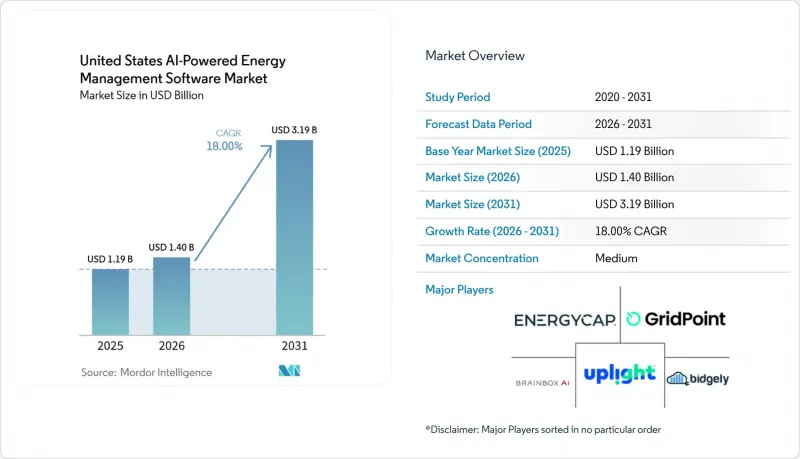
本報告按元件(軟體和服務)、部署模式(雲端、本地部署、混合部署)、應用(例如,能源消耗和需求最佳化、資產性能和預測性維護)以及最終用戶(公共產業、商業建築、工業設施、住宅)進行細分。市場預測以美元計價。
美國人工智慧能源管理軟體市場趨勢與洞察
公共產業數據快速數位化和電網現代化計劃
隨著公共產業不斷擴展其數位化電網項目,人工智慧基礎設施面臨的大規模負載正變得越來越難以以傳統的營運模式進行管理。美國能源局在2024年預測,到2028年,國內資料中心的電力消耗量將翻倍甚至兩番,達到325太瓦時至580太瓦時,這需要加強對電網和用戶資產的監控和控制。根據GridPoint的數據顯示,公用事業公司在2025年申請了總計182億美元的電價上漲,以支持電網投資,這推動了對能夠將間隔數據和運行訊號轉化為負載柔軟性的軟體的需求。 2026年,阿貢國家實驗室部署了GridMind作為電力系統營運商的人工智慧輔助系統,這標誌著公用事業公司對人工智慧的應用正從概念階段轉向全面運作。這項轉變對美國人工智慧能源管理軟體市場具有重大意義。這是因為電力公司對其控制環境進行現代化改造的同時,也催生了對能夠即時響應電網狀態的用戶端軟體的需求。
聯邦和州政府針對商業建築和產業的脫碳目標
建築性能標準的日益嚴格,加重了商業房地產所有者的合規負擔,持續監測正成為其日常運作不可或缺的一部分。市場轉型研究所的報告顯示,到2025年,將有四個州和至少九個地方政府制定建築性能標準,另有約30個市政當局承諾實施這些標準。該政策的適用範圍正在向沿海大都會圈以外的地區擴展,華盛頓州已於2025年通過了眾議院第1543號法案,伊利諾伊州埃文斯頓市也於2025年通過了「健康建築條例」。這些法規要求進行持續的測量、報告和營運調整,而非一次性的基準調查。在美國人工智慧驅動的能源管理軟體市場,這意味著對於管理大規模建築群的業主而言,訂閱式平台比定期審計工具更為實用。
將棕地設施與傳統營運技術 (OT) 和建築控制系統整合所帶來的高成本
將人工智慧整合到棕地(現有設施)中仍然是推廣應用的一大障礙,尤其是在老舊的商業和工業建築中。許多設施仍然運作專有的自動化系統,需要閘道器、中間件和客製化工程,人工智慧工具才能接收和利用資料。如果長時間的維護或控制系統運作期間的停機時間不可接受,成本還會進一步增加。此外,在多站點專案中,這個問題更加複雜,因為公用事業計量間隔資料、計費格式和需求收費系統仍然因服務區域而異。在美國人工智慧能源管理軟體市場,這種情況導致技術先進的企業買家比內部資源有限的小規模業主更快地採用這些軟體。
細分市場分析
在2025年的市場區隔結構中,軟體預計將佔74.50%,而服務細分市場預計到2031年將以20.80%的複合年成長率成長。這一細分錶明,在美國人工智慧驅動的能源管理軟體市場中,核心平台層仍然佔據大部分收入,但成長正在轉向部署和部署後支援。買家不再只是需要儀錶板,因為整合、最佳化和報告現在直接影響他們實現的成本節約和合規性結果。因此,與初始部署階段相比,專業服務服務和託管服務在供應商策略中變得越來越重要。
服務領域的機會包括系統整合支援、人工智慧模型調優、持續性能監控和碳排放報告。在美國人工智慧驅動的能源管理軟體產業,這反映出一種轉變,即從簡單的軟體採購轉向基於結果且在部署後仍持續提供服務的合約。 Bidgely 將於 2025 年發布適用於 AWS、Snowflake 和 Databricks 環境的 UtilityAI Pro,進一步強化了這個發展方向。這將使公共產業能夠在自身資料環境中運行模型,同時利用供應商的專業知識。隨著建築業主面臨持續的合規性和最佳化需求,擁有強大服務交付能力的供應商能夠維持長期合作關係,並更有效地控制價格。
預計到2025年,基於雲端的部署將佔據58.20%的市場佔有率,並有望保持最高的成長率,到2031年複合年成長率(CAGR)將達到21.10%。這一主導地位反映了即時資料擷取、集中更新以及跨多站點組合進行基準測試的優勢。在美國人工智慧驅動的能源管理軟體市場,雲端平台備受青睞,因為大規模用戶需要跨建築、設備和公用設施介面的統一營運視圖。這對於管理眾多具有不同需求特徵和合規義務的場所的公司而言尤其重要。
在工業和公共產業環境中,由於營運策略和安全設計的限制,直接雲端連接仍然有限,因此本地部署至關重要。混合模式的重要性日益凸顯,因為它們允許在邊緣進行對延遲敏感的控制,同時將資產組合資料發送到雲端進行分析和報告。因此,美國人工智慧驅動的能源管理軟體市場並非簡單地遷移到雲端,而是朝著選擇能夠滿足站點級風險和控制需求的架構方向發展。支援靈活部署模式的供應商在服務公共產業、關鍵基礎設施和擁有多元化資產基礎的大型企業方面更具優勢。供應商之間的夥伴關係關係進一步增強了混合架構,將邊緣和雲端功能連接起來。Honeywell和塔塔諮詢服務公司 (TCS) 於 2026 年達成的合作表明,營運技術 (OT) 和資訊科技 (IT) 將朝著自主營運的方向更廣泛地融合。
其他好處:
- Excel格式的市場預測(ME)表
- 3個月的分析師支持
目錄
第1章:引言
- 研究假設和市場定義
- 調查範圍
第2章:調查方法
第3章執行摘要
第4章 市場狀況
- 市場概覽
- 市場促進因素
- 公共產業數據快速數位化和電網現代化計劃
- 聯邦和州政府針對商業建築和工業部門所製定的脫碳目標
- 人工智慧驅動的尖峰需求削減和自動負載平衡
- 與現有BMS、EMS和IoT堆疊的雲端原生整合
- 來自企業買家的壓力,要求報告投資組合層面的碳排放量。
- 資料中心的能源強度及其持續最佳化的必要性
- 市場限制因素
- 與傳統 OT 和建築控制系統整合相關的棕地部署成本很高。
- 網路安全和關鍵基礎設施合規負擔
- 能源數據分散在不同的地點、電力公司和供應商之間。
- 負責實施人工智慧、控制系統和能源管理的人員短缺。
- 產業價值鏈分析
- 監理情勢
- 技術展望
- 波特五力分析
- 宏觀經濟因素對市場的影響
第5章 市場規模與成長預測
- 按組件
- 軟體
- 服務
- 部署模式
- 基於雲端的
- 現場
- 混合
- 透過使用
- 最佳化能源消耗和需求
- 資產性能和預測性維護
- 智慧電網與分散式能源(DER)的管理
- 可再生能源預測與整合
- 能源交易、定價和市場訊息
- 最終用戶
- 公用事業
- 商業建築
- 工業設施
- 住宅大樓
第6章 競爭情勢
- 市場集中度
- 策略趨勢
- 市佔率分析
- 公司簡介
- GridPoint, Inc.
- Bidgely, Inc.
- Uplight, Inc.
- EnergyCAP, LLC
- BrainBox AI Inc.
- 75F, Inc.
- Verdigris Technologies, Inc.
- CopperTree Analytics Inc.
- Metrikus Limited
- SkyFoundry, LLC
- Enertiv, Inc.
- Prospects Software Inc.
- PacifiQ, Inc.
- Schneider Electric SE
- Siemens AG
- Johnson Controls International plc
- Honeywell International Inc.
- ABB Ltd
- Emerson Electric Co.
- Schneider Electric Buildings Americas, Inc.
- Trane Technologies plc
- Itron, Inc.
第7章 市場機會與未來展望
According to Mordor Intelligence, the United States AI-powered energy management software market size was valued at USD 1.19 billion in 2025 and estimated to grow from USD 1.40 billion in 2026 to reach USD 3.19 billion by 2031, at a CAGR of 18.00% during the forecast period 2026 to 2031.
This report is Segmented by Component (Software, and Services), Deployment Mode (Cloud-Based, On-Premises, and Hybrid), Application (Energy Consumption and Demand Optimization, Asset Performance and Predictive Maintenance, and More), and End User (Utilities, Commercial Buildings, Industrial Facilities, and Residential Buildings). Market Forecasts are Provided in Value (USD).
United States AI-powered Energy Management Software Market Trends and Insights
Rapid Utility Data Digitization and Grid Modernization Programs
Utilities are expanding digital grid programs at the same time that large loads from AI infrastructure are becoming harder to manage with older operating models. The U.S. Department of Energy stated in 2024 that domestic data center electricity consumption is expected to double or triple by 2028 and reach 325TWh to 580TWh, which raises the need for better monitoring and control across both grid and customer assets. GridPoint stated that utilities filed USD 18.2 billion in aggregate rate increase requests in 2025 to support grid investment, which supports demand for software that can turn interval data and operating signals into load flexibility. Argonne National Laboratory introduced GridMind in 2026 as an AI co-pilot for power system operators, which shows that utility-side AI adoption is moving from concept to operating use. In the United States AI-powered Energy Management Software Market, that shift matters because utilities that modernize their own control environments also create demand for customer-side software that can respond to grid conditions in real time.
Federal and State Decarbonization Targets for Commercial Buildings and Industry
Building performance standards are widening the compliance burden for commercial property owners and pushing continuous monitoring into routine operations. The Institute for Market Transformation reported that by 2025, 4 states and at least 9 local jurisdictions had enacted building performance standards, while around 30 additional governments had committed to adoption. Washington State enacted House Bill 1543 in 2025, and Evanston, Illinois, passed its Healthy Buildings Ordinance in 2025, extending the policy push beyond the largest coastal cities. These rules create a recurring need for measurement, reporting, and operational adjustment rather than a single benchmarking exercise. In the United States AI-powered Energy Management Software Market, that makes subscription platforms more useful than periodic audit tools for owners managing large building portfolios.
High Brownfield Integration Cost with Legacy OT and Building Controls
Brownfield integration remains a major brake on deployment, especially in older commercial and industrial sites. Many facilities still run proprietary automation systems that need gateways, middleware, and custom engineering before AI tools can ingest and use the data. The cost is higher when building operators cannot accept long maintenance windows or downtime during control system work. The problem becomes harder in multi-site portfolios because utility interval data, billing formats, and demand charge structures still vary across service territories. In the United States AI-powered Energy Management Software Market, this keeps adoption faster among technically sophisticated enterprise buyers than among smaller owners with limited internal resources.
Other drivers and restraints analyzed in the detailed report include:
- AI-Enabled Peak Demand Reduction and Automated Load Flexibility
- Cloud-Native Integration with Existing BMS, EMS, and IoT Stacks
- Cybersecurity and Critical Infrastructure Compliance Burden
For complete list of drivers and restraints, kindly check the Table Of Contents.
Segment Analysis
Software accounted for 74.50% of the 2025 segment mix, while services is projected to expand at a 20.80% CAGR through 2031. This split shows that the United States AI-powered Energy Management Software Market still draws most revenue from the core platform layer, but growth is moving toward implementation and post-deployment support. Buyers are asking for more than dashboards because integration, optimization, and reporting now affect realized savings and compliance outcomes. That makes professional and managed services more central to vendor strategy than in earlier phases of adoption.
The services opportunity includes system integration, AI model tuning, ongoing performance monitoring, and carbon reporting support. In the United States AI-powered energy management software industry, this reflects a shift from software procurement alone to outcome-based engagements that remain active after installation. Bidgely's 2025 launch of UtilityAI Pro across AWS, Snowflake, and Databricks environments supports this direction because it lets utilities run proprietary models within their own data environments while leaning on vendor expertise. As building owners face recurring compliance and optimization needs, vendors with strong service delivery can hold relationships longer and defend pricing more effectively.
Cloud-based deployment held 58.20% of the market in 2025 and also posts the fastest projected CAGR at 21.10% through 2031. This leadership reflects the advantage of real-time data ingestion, centralized updates, and benchmarking across multi-site portfolios. The United States AI-powered Energy Management Software Market has favored cloud platforms because large users need a single operating view across buildings, devices, and utility interfaces. That is especially useful when companies manage many sites with different demand profiles and compliance obligations.
On-premises deployments still matter in industrial and utility settings where direct cloud exposure remains limited by operating policy or security design. Hybrid models are gaining importance because they allow latency-sensitive controls at the edge while sending portfolio data to the cloud for analytics and reporting. The United States AI-powered Energy Management Software Market is therefore not moving toward cloud in a simple way, but toward architecture choices that match site-level risk and control needs. Vendors that support flexible deployment models are better positioned to serve utilities, critical facilities, and large enterprises with mixed asset bases. Hybrid architectures are also being reinforced by vendor partnerships that connect edge and cloud capabilities. Honeywell's 2026 collaboration with Tata Consultancy Services points to broader OT and IT convergence for autonomous operations.
Complete Report Scope:
- By Component
- Software
- Services
- By Deployment Mode
- Cloud-Based
- On-Premises
- Hybrid
- By Application
- Energy Consumption and Demand Optimization
- Asset Performance and Predictive Maintenance
- Smart Grid and Distributed Energy Resource (DER) Management
- Renewable Energy Forecasting and Integration
- Energy Trading, Pricing and Market Intelligence
- By End User
- Utilities
- Commercial Buildings
- Industrial Facilities
- Residential Buildings
List of Companies Covered in this Report:
- GridPoint, Inc.
- Bidgely, Inc.
- Uplight, Inc.
- EnergyCAP, LLC
- BrainBox AI Inc.
- 75F, Inc.
- Verdigris Technologies, Inc.
- CopperTree Analytics Inc.
- Metrikus Limited
- SkyFoundry, LLC
- Enertiv, Inc.
- Prospects Software Inc.
- PacifiQ, Inc.
- Schneider Electric SE
- Siemens AG
- Johnson Controls International plc
- Honeywell International Inc.
- ABB Ltd
- Emerson Electric Co.
- Schneider Electric Buildings Americas, Inc.
- Trane Technologies plc
- Itron, Inc.
Additional Benefits:
- The market estimate (ME) sheet in Excel format
- 3 months of analyst support
TABLE OF CONTENTS
1 INTRODUCTION
- 1.1 Study Assumptions And Market Definition
- 1.2 Scope Of The Study
2 RESEARCH METHODOLOGY
3 EXECUTIVE SUMMARY
4 MARKET LANDSCAPE
- 4.1 Market Overview
- 4.2 Market Drivers
- 4.2.1 Rapid Utility Data Digitization and Grid Modernization Programs
- 4.2.2 Federal and State Decarbonization Targets for Commercial Buildings and Industry
- 4.2.3 AI-Enabled Peak Demand Reduction and Automated Load Flexibility
- 4.2.4 Cloud Native Integration With Existing BMS, EMS, and IoT Stacks
- 4.2.5 Portfolio-Level Carbon Reporting Pressure from Enterprise Buyers
- 4.2.6 Data Center Energy Intensity and Continuous Optimization Needs
- 4.3 Market Restraints
- 4.3.1 High Brownfield Integration Cost With Legacy OT and Building Controls
- 4.3.2 Cybersecurity and Critical Infrastructure Compliance Burden
- 4.3.3 Fragmented Energy Data Across Sites, Utilities, and Vendors
- 4.3.4 Shortage Of AI, Controls, and Energy Management Implementation Talent
- 4.4 Industry Value Chain Analysis
- 4.5 Regulatory Landscape
- 4.6 Technological Outlook
- 4.7 Porter's Five Forces Analysis
- 4.7.1 Bargaining Power Of Suppliers
- 4.7.2 Bargaining Power Of Buyers
- 4.7.3 Threat Of New Entrants
- 4.7.4 Threat Of Substitutes
- 4.7.5 Intensity of Competitive Rivalry
- 4.8 Impact Of Macroeconomic Factors On The Market
5 MARKET SIZE AND GROWTH FORECASTS (VALUE)
- 5.1 By Component
- 5.1.1 Software
- 5.1.2 Services
- 5.2 By Deployment Mode
- 5.2.1 Cloud-Based
- 5.2.2 On-Premises
- 5.2.3 Hybrid
- 5.3 By Application
- 5.3.1 Energy Consumption and Demand Optimization
- 5.3.2 Asset Performance and Predictive Maintenance
- 5.3.3 Smart Grid and Distributed Energy Resource (DER) Management
- 5.3.4 Renewable Energy Forecasting and Integration
- 5.3.5 Energy Trading, Pricing and Market Intelligence
- 5.4 By End User
- 5.4.1 Utilities
- 5.4.2 Commercial Buildings
- 5.4.3 Industrial Facilities
- 5.4.4 Residential Buildings
6 COMPETITIVE LANDSCAPE
- 6.1 Market Concentration
- 6.2 Strategic Moves
- 6.3 Market Share Analysis
- 6.4 Company Profiles (includes Global Level Overview, Market Level Overview, Core Segments, Financials as available, Strategic Information, Market Rank/Share, Products and Services, Recent Developments)
- 6.4.1 GridPoint, Inc.
- 6.4.2 Bidgely, Inc.
- 6.4.3 Uplight, Inc.
- 6.4.4 EnergyCAP, LLC
- 6.4.5 BrainBox AI Inc.
- 6.4.6 75F, Inc.
- 6.4.7 Verdigris Technologies, Inc.
- 6.4.8 CopperTree Analytics Inc.
- 6.4.9 Metrikus Limited
- 6.4.10 SkyFoundry, LLC
- 6.4.11 Enertiv, Inc.
- 6.4.12 Prospects Software Inc.
- 6.4.13 PacifiQ, Inc.
- 6.4.14 Schneider Electric SE
- 6.4.15 Siemens AG
- 6.4.16 Johnson Controls International plc
- 6.4.17 Honeywell International Inc.
- 6.4.18 ABB Ltd
- 6.4.19 Emerson Electric Co.
- 6.4.20 Schneider Electric Buildings Americas, Inc.
- 6.4.21 Trane Technologies plc
- 6.4.22 Itron, Inc.
7 MARKET OPPORTUNITIES AND FUTURE OUTLOOK
- 7.1 White-Space And Unmet-Need Assessment

 2034年人工智慧市場在發電領域的預測-按組件、部署模式、人工智慧技術、電源、應用、企業規模、最終用戶和地區分類的全球分析
 全球能源電力領域人工智慧(AI)市場:機會與策略展望(至2035年)
 中國人工智慧能源管理軟體:市場佔有率分析、產業趨勢與統計及成長預測(2026-2031)中東和非洲人工智慧能源管理軟體:市場佔有率分析、行業趨勢和統計數據以及成長預測(2026-2031 年)中東地區人工智慧能源管理軟體:市場佔有率分析、行業趨勢和統計數據以及成長預測(2026-2031 年)南美洲人工智慧能源管理軟體:市場佔有率分析、行業趨勢和統計數據以及成長預測(2026-2031 年)印度人工智慧能源管理軟體:市場佔有率分析、行業趨勢和統計數據以及成長預測(2026-2031 年)德國人工智慧能源管理軟體:市場佔有率分析、行業趨勢和統計數據以及成長預測(2026-2031 年)新加坡人工智慧能源管理軟體:市場佔有率分析、行業趨勢和統計數據以及成長預測(2026-2031 年)日本人工智慧能源管理軟體:市場佔有率分析、產業趨勢與統計及成長預測(2026-2031)