


 |
市場調查報告書
商品編碼
2097430
法國人工智慧能源管理軟體:市場佔有率分析、行業趨勢和統計數據以及成長預測(2026-2031 年)France AI-powered Energy Management Software - Market Share Analysis, Industry Trends & Statistics, Growth Forecasts (2026 - 2031) |
||||||

※ 本網頁內容可能與最新版本有所差異。詳細情況請與我們聯繫。
根據 Mordor Intelligence 稱,法國人工智慧能源管理軟體的市場規模預計將從 2025 年的 1.8052 億美元成長到 2026 年的 2.1142 億美元,到 2031 年達到 4.9425 億美元,預計 2026 年至 2031 年的複合年成長率為 11%。
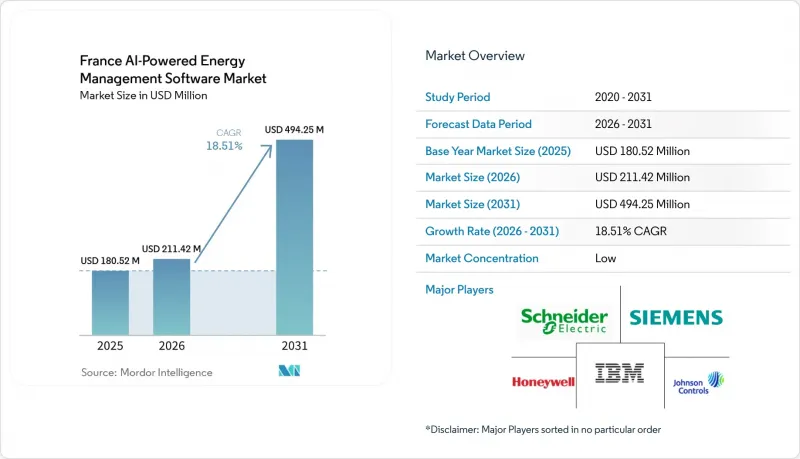
本報告按元件(軟體和服務)、部署模式(雲端、本地部署、混合部署)、應用(例如,能源消耗和需求最佳化、資產性能和預測性維護)以及最終用戶(公共產業、商業建築、工業設施、住宅)進行細分。市場預測以美元計價。
法國人工智慧能源管理軟體市場的趨勢和見解。
商業和工業設施面臨不斷上漲的電力成本壓力
隨著 ARENH 機制於 2026 年 1 月 1 日到期,受監管的核能價格上限被「普遍核電價格 (VNU)」模式所取代。因此,法國的工商業用電者不再享有固定的供電量和價格保障。能源監管委員會 (Commission de Regulation de l'Energie) 已將 2026 年至 2028 年期間的核能發電成本設定為 60.3 歐元/兆瓦時 (68.14 美元/兆瓦時),該成本基於 2026 年 1 歐元(1.14 美元)的匯率計算得出。同時,2026 年的批發基本負載價格維持穩定,採購成本則取決於市場狀況。對於參與「綠色定價 (Tarif Vert)」計畫的 250 千伏安以上的大型工業設施,供電成本為 0.12 至 0.15 歐元/kWh(不含稅,0.136 至 0.170 美元/kWh)。此外,假設2026年消費稅率為26.58歐元/兆瓦時(30.41美元/兆瓦時),即使在不進行尖峰負載最佳化的情況下,一座20吉瓦時的發電廠每年也將承擔531,600歐元(600,708美元)的稅負。這項成本結構凸顯了人工智慧驅動的尖峰用電移轉調度在降低現場可避免的電力成本方面所發揮的直接且可衡量的作用。在法國人工智慧能源管理軟體市場,取消監管價格上限已將避免尖峰需求的效果從單純的效率提升轉變為商業買家切實可觀的經濟回報。這種轉變縮短了評估週期。這是因為買家開始將調度、預測和負載平衡視為採購工具,而不僅僅是可選項式的永續功能。
歐盟建築能源性能法規的最後期限正在加速軟體的實施。
修訂後的《建築能源性能指令》(EPBD)於2024年5月28日生效,要求成員國在2026年5月29日前將其納入本國法律。該指令包含最低能源性能標準,要求到2030年,16%的能源效率最低的非住宅建築達到該標準;到2033年,這一比例將達到26%。法國也於2025年4月30日透過第2025-391號法律將歐盟《能源效率指令》納入本國法律。該法新增了公共部門建築每年3%的維修要求,並加強了對主要業者的審計義務。 2025年6月30日,歐盟委員會發布了一攬子實施支援方案,其中包括授權法規、實施細則以及關於最低能源性能標準和智慧準備指標的指南。自2023年以來,法國的OPERAT平台支援與能源管理系統(EMS)軟體的直接API連接,將年度報告轉變為建築營運商的常規軟體整合機會。在法國人工智慧能源管理軟體市場,切換成本很高,因為報告工作流程已與建築營運系統(OPERAT)整合,並在每個報告週期內同步運行。這意味著,儘早提供符合規範的報告模組的供應商將持續保持優勢直至2031年,因為一旦報告、審計和最佳化工具整合到同一流程鏈中,就很難將其移除。
與傳統建築和工業控制系統整合的複雜性。
法國人工智慧能源管理軟體市場面臨的主要障礙之一是,需要將最新的人工智慧工具連接到仍在使用Modbus、BACnet、DNP3和OPC-UA等過時協議的傳統建築管理系統(BMS)、分散式控制系統(DCS)和監控與資料收集系統(SCADA)。這些傳統設施通常缺乏現代化的API層,這意味著軟體部署仍然需要從協定映射、中間件開發和特定站點的整合邏輯入手。西門子繼續沿著務實的「棕地遷移」路徑部署自主建築管理軟體,這反映出法國大部分部署基礎仍然需要混合架構,而不是完全替換。此外,大規模工業採購商通常需要第三方系統整合商,這導致採購流程延誤、專案成本增加以及相關人員責任分散。研究表明,在現有設施(棕地)中,整合成本可能占到專案總預算的40%至60%,這削弱了競標階段投資報酬率的合理性。因此,擁有中間件、預認證適配器或在建築控制領域建立夥伴關係的供應商,在進入法國的化學、汽車和金屬行業的項目中,具有明顯的商業性優勢。
細分市場分析
預計到2025年,軟體將佔69.85%的市場佔有率,在法國人工智慧能源管理軟體市場中保持69.85%的佔有率。這是因為買家仍然傾向於從一個整合了資料擷取、人工智慧分析、報告和脫碳規劃的單一介面平台開始部署。 METRON軟體層已在全球超過25,000個地點部署,其中包括30多個國家的250個工業設施,這充分展現了成熟分析平台所帶來的規模經濟效益。基於METRON模型的Dalkia Analytics也展示了軟體如何與法國電力集團(EDF Group)廣泛的服務網路結合,從而增強其分銷能力。合規性相關軟體在法國人工智慧能源管理軟體市場仍佔據很高的市場佔有率。這是因為與OPERAT、BEGES和CSRD工作流程整合的報告模組一旦實施就難以取代。這種高留存率有利於那些已經將其解決方案本地化以滿足法國和歐盟報告要求的供應商,使他們能夠設定更高的價格並降低客戶流失率。
服務業是成長最快的領域,法國人工智慧能源管理軟體的服務市場預計將在2026年至2031年間以19.23%的複合年成長率成長,因為買家正從購買許可證轉向持續的效能交付。Honeywell和塔塔諮詢服務公司(TCS)於2026年2月達成的合作,顯示供應商如何將人工智慧平台與整合和諮詢能力結合,以支援大規模建築和工業環境中IT和OT的整合。 METRON和Dalquia透過其「快速脫碳」計劃,針對歐洲八個國家的60家工業設施,確定了超過250個脫碳項目,預計可減少19萬噸二氧化碳排放。此外,超過100個正在進行的項目已經避免了6萬噸二氧化碳排放。這些結果表明,法國買家不僅需要儀錶板和警報,還需要實施支援、指標檢驗和營運追蹤。因此,法國人工智慧能源管理軟體市場已經進入了一個階段,服務品質以及產品功能將顯著影響合約續約率。
到2025年,基於雲端的部署將佔法國人工智慧能源管理軟體市場的66.41%。這是因為商業設施營運商和中型設施管理人員仍然重視SaaS部署的速度和便利性。在法國人工智慧能源管理軟體市場,對於那些對營運技術(OT)隔離要求不高的買家而言,雲端部署仍然是一個重要的選擇。混合部署是成長最快的部署方式,複合年成長率(CAGR)為20.34%。這是因為許多受監管的工業用戶需要在將資料選擇性地上傳到雲端之前進行本地處理。在嚴格的網路安全和業務永續營運法規下運作的工業營運商將本地資料處理視為合規要求,而非架構偏好。在核能分包商、化學製造商和電網基礎設施營運商等規模較小的群體中,本地部署仍然很重要,因為隔離網路仍然會影響他們的採購決策。
預計到2031年,混合部署將以20.34%的複合年成長率成長,顯示市場並非在遠離雲端運算,而是轉向邊緣-雲端混合架構,以應對實際環境中的各種限制。 2025年11月,Schneider Electric發布了“EcoStruxure Foresight Operation”,該方案採用整合能源、電力和建築系統的設計,聲稱可將工程工作時間縮短40%,並將營運效率提高50%。西門子也繼續展示其建築軟體策略,旨在推動智慧建築向自主建築的轉型,並強調需要建造一個數位化層來應對現有設施(棕地項目),而不是快速替換基礎設施。這些發展表明,主要供應商目前正將混合架構定位為法國的核心產品需求,尤其是在那些擁有傳統控制基礎設施的建築和工廠中。到2031年,能夠在不犧牲分析深度的前提下彌合營運技術(OT)差距的供應商,將在受監管的大型客戶中佔據更有利的地位。
其他好處:
- Excel格式的市場預測(ME)表
- 3個月的分析師支持
目錄
第1章:引言
- 研究假設和市場定義
- 調查範圍
第2章:調查方法
第3章執行摘要
第4章 市場狀況
- 市場概覽
- 市場促進因素
- 商業和工業設施面臨不斷上漲的電力成本壓力
- 歐盟建築性能標準的最後期限正在加速該軟體的普及應用。
- 透過人工智慧驅動的尖峰負載預測,降低電網和設施層面的處罰風險。
- 透過邊緣人工智慧和更精細的計量數據,提升即時最佳化水平
- 範圍 3 和碳排放報告的自動化正在推動對能源智慧的需求。
- 透過以維修主導實現現有建築組合的數位化
- 市場限制因素
- 與傳統建築管理系統和工業控制系統整合的複雜性。
- 資料品質、計量覆蓋範圍和互通性限制
- 對網路安全、資料主權和營運技術風險的擔憂
- 對小規模場地和分散設施組合的投資回收期的敏感性
- 產業價值鏈分析
- 監理情勢
- 技術展望
- 波特五力分析
- 宏觀經濟因素對市場的影響
第5章 市場規模與成長預測
- 按組件
- 軟體
- 服務
- 部署模式
- 基於雲端的
- 現場
- 混合
- 透過使用
- 最佳化能源消耗和需求
- 資產性能和預測性維護
- 智慧電網與分散式能源(DER)的管理
- 可再生能源預測與整合
- 能源交易、定價和市場訊息
- 最終用戶
- 公用事業
- 商業建築
- 工業設施
- 住宅大樓
第6章 競爭情勢
- 市場集中度
- 策略趨勢
- 市佔率分析
- 公司簡介
- Deepki
- METRON
- BeeBryte
- Energisme
- SpinalCom
- Ubiant
- Advizeo by Setec
- Wattics Ltd.
- DEXMA Sensors, SL
- Grid4C Ltd.
- Bidgely, Inc.
- AutoGrid Systems, Inc.
- Innowatts, Inc.
- GridPoint, Inc.
- EnergyCAP, LLC
- Uplight, Inc.
- EnergyHub, LLC
- Verdigris Technologies, Inc.
- Measurabl, Inc.
- Prescinto Technologies Private Limited
- C3.ai, Inc.
- IBM Corporation
- Schneider Electric SE
- Siemens AG
- Honeywell International Inc.
- Johnson Controls International plc
第7章 市場機會與未來展望
According to Mordor Intelligence, the France AI-powered energy management software market size is expected to increase from USD 180.52 million in 2025 to USD 211.42 million in 2026 and reach USD 494.25 million by 2031, growing at a CAGR of 18.51% over 2026-2031.
This report is Segmented by Component (Software and Services), Deployment Mode (Cloud-Based, On-Premises, and Hybrid), Application (Energy Consumption and Demand Optimization, Asset Performance and Predictive Maintenance, and More), and End User (Utilities, Commercial Buildings, Industrial Facilities, and Residential). The Market Forecasts are Provided in Terms of Value (USD).
France AI-powered Energy Management Software Market Trends and Insights
Rising Electricity Cost Pressure Across Commercial And Industrial Sites
The January 1, 2026, expiry of the ARENH mechanism replaced a regulated nuclear price ceiling with the versement nucleaire universel model, which no longer provides a fixed volume or price guarantee for commercial and industrial electricity buyers in France. The Commission de Regulation de l'Energie set nuclear production costs at EUR 60.3/MWh (USD 68.14/MWh) at the 2026 EUR 1 (USD 1.14) rate for the 2026-2028 period, while wholesale baseload prices in 2026 have stabilized within a band that keeps procurement costs exposed to market conditions. Large industrial sites on Tarif Vert, above 250 kVA, face supply costs of EUR 0.12 to EUR 0.15/kWh HT (USD 0.136 to USD 0.170/kWh), and the 2026 accise rate of EUR 26.58/MWh (USD 30.41/MWh)means that a 20 GWh site carries EUR 531,600 (USD 600,708) in annual tax burden before any peak-load optimization. This cost structure gives AI-driven peak-shift scheduling a direct, measurable role in reducing avoidable electricity costs at the site level. In the France AI-powered Energy Management Software Market, the removal of a regulated floor has changed avoided peak demand from a soft efficiency benefit into a hard financial return for commercial buyers. That change has shortened evaluation cycles because buyers now treat scheduling, forecasting, and load orchestration as procurement tools rather than optional sustainability add-ons.
EU Building Performance Compliance Deadlines Accelerating Software Adoption
The revised EPBD entered into force on May 28, 2024, and requires member states to transpose it by May 29, 2026, with minimum energy performance standards that target the 16% worst-performing non-residential buildings by 2030 and the 26% worst-performing by 2033. France also transposed the EU Energy Efficiency Directive through Law No. 2025-391 of April 30, 2025, which added a 3% annual renovation requirement for public-sector buildings and tightened audit obligations for major operators. The European Commission released an implementation support package on June 30, 2025, including a delegated regulation, an implementing regulation, and guidance on minimum energy performance standards and the Smart Readiness Indicator. France's OPERAT platform has supported direct API connections for EMS software since 2023, turning annual reporting into a recurring software integration point for building operators. In the France AI-powered Energy Management Software Market, each OPERAT-linked declaration cycle deepens switching costs because the reporting workflow becomes embedded in building operations. That gives early vendors with compliant reporting modules a durable advantage through 2031 because removal becomes harder once reporting, audit, and optimization tools sit in the same process chain.
Integration Complexity With Legacy Building And Industrial Control Systems
A major barrier in the France AI-powered Energy Management Software Market is the need to connect modern AI tools with legacy BMS, DCS, and SCADA systems that still operate on older protocols such as Modbus, BACnet, DNP3, and OPC-UA. Legacy estates often lack modern API layers, which means software deployments still start with protocol mapping, middleware work, and site-specific integration logic. Siemens has continued to position its autonomous building software around practical brownfield transition paths, reflecting the fact that much of the French installed base still needs hybrid architectures rather than full replacement. Procurement also slows because large industrial buyers often require third-party system integrators, which raises project costs and spreads accountability across more parties. The input indicates that integration overhead can absorb 40-60% of total project budgets in brownfield cases, which weakens the payback case at the bid stage. Vendors with middleware, pre-certified adapters, or established building controls partnerships therefore enter French chemicals, automotive, and metals projects with a clear commercial edge.
Other drivers and restraints analyzed in the detailed report include:
- AI-Enabled Peak Load Forecasting Reducing Grid And Site-Level Penalty Exposure
- Edge AI And Meter Data Granularity Improving Real-Time Optimization
- Data Quality, Meter Coverage, and Interoperability Constraints
For complete list of drivers and restraints, kindly check the Table Of Contents.
Segment Analysis
Software captured 69.85% of the market in 2025, and it held 69.85% of the France AI-powered Energy Management Software Market share because buyers still start with platforms that combine data ingestion, AI analytics, reporting, and decarbonization planning in a single interface. METRON's software layer is deployed on more than 25,000 sites globally, including 250 industrial sites across more than 30 countries, which shows the scale advantage of established analytics platforms. The Dalkia Analytics, powered by the METRON model, also shows how software gains distribution strength when paired with EDF Group's large service network. In the France AI-powered Energy Management Software Market, compliance-linked software remains sticky because reporting modules tied to OPERAT, BEGES, and CSRD workflows are hard to replace once they are embedded. That stickiness supports premium pricing and lower churn for vendors that already localize around French and EU reporting requirements.
Services are the fastest-growing component, and the France AI-powered Energy Management Software Market size for services is projected to expand at a 19.23% CAGR between 2026 and 2031 as buyers move beyond license purchase into continuous performance delivery. Honeywell's February 2026 partnership with Tata Consultancy Services shows how vendors are combining AI platforms with integration and consulting capabilities to support IT-OT convergence in large building and industrial environments. METRON and Dalkia reported that their Decarb Fast Track program across 60 industrial sites in 8 European countries identified more than 250 decarbonization projects with potential savings of 190,000 tonnes of CO2, while more than 100 ongoing projects had already avoided 60,000 tonnes of CO2. Those results show why French buyers increasingly want implementation support, measurement validation, and operational follow-through, not only dashboards and alerts. The France AI-powered Energy Management Software Market is therefore entering a phase where service depth can shape renewal rates as much as product functionality.
Cloud-based deployment held a 66.41% share in 2025, accounting for 66.41% of the France AI-powered Energy Management Software Market, as commercial property operators and medium-sized facility managers still favor SaaS speed and lower setup burden. The France AI-powered Energy Management Software Market still shows a strong preference for the cloud among buyer groups that do not have high OT isolation requirements. Hybrid deployment is the fastest-growing mode, with a 20.34% CAGR, because many regulated industrial users need local processing before selectively uploading data to the cloud. Industrial operators working under strict cybersecurity and operational continuity rules treat local data handling as a compliance need rather than an architectural preference. On-premises deployment remains relevant for a narrower group, including nuclear subcontractors, chemical manufacturers, and grid infrastructure operators, where isolated networks still shape procurement decisions.
Hybrid deployment is projected to grow at a 20.34% CAGR through 2031, indicating that the market is not moving away from the cloud but toward mixed edge-cloud architectures that address real site constraints. Schneider Electric introduced EcoStruxure Foresight Operation in November 2025 with a design that unifies energy, power, and building systems and claims a 40% reduction in engineering workflow time, together with a 50% improvement in operational efficiency. Siemens also continued to present its building software strategy around the shift from smart to autonomous buildings, underscoring the need for brownfield-friendly digital layers rather than abrupt infrastructure replacement. These moves show that major vendors now treat hybrid architecture as a core product requirement in France, especially when buildings and plants carry older control infrastructure. The vendor that closes the OT gap without reducing analytics depth will hold a stronger position in large regulated accounts through 2031.
Complete Report Scope:
- By Component
- Software
- Services
- By Deployment Mode
- Cloud-Based
- On-Premises
- Hybrid
- By Application
- Energy Consumption and Demand Optimization
- Asset Performance and Predictive Maintenance
- Smart Grid and Distributed Energy Resource (DER) Management
- Renewable Energy Forecasting and Integration
- Energy Trading, Pricing and Market Intelligence
- By End User
- Utilities
- Commercial Buildings
- Industrial Facilities
- Residential Buildings
List of Companies Covered in this Report:
- Deepki
- METRON
- BeeBryte
- Energisme
- SpinalCom
- Ubiant
- Advizeo by Setec
- Wattics Ltd.
- DEXMA Sensors, S.L.
- Grid4C Ltd.
- Bidgely, Inc.
- AutoGrid Systems, Inc.
- Innowatts, Inc.
- GridPoint, Inc.
- EnergyCAP, LLC
- Uplight, Inc.
- EnergyHub, LLC
- Verdigris Technologies, Inc.
- Measurabl, Inc.
- Prescinto Technologies Private Limited
- C3.AI, Inc.
- IBM Corporation
- Schneider Electric SE
- Siemens AG
- Honeywell International Inc.
- Johnson Controls International plc
Additional Benefits:
- The market estimate (ME) sheet in Excel format
- 3 months of analyst support
TABLE OF CONTENTS
1 INTRODUCTION
- 1.1 Study Assumptions and Market Definition
- 1.2 Scope of the Study
2 RESEARCH METHODOLOGY
3 EXECUTIVE SUMMARY
4 MARKET LANDSCAPE
- 4.1 Market Overview
- 4.2 Market Drivers
- 4.2.1 Rising Electricity Cost Pressure Across Commercial and Industrial Sites
- 4.2.2 EU Building Performance Compliance Deadlines Accelerating Software Adoption
- 4.2.3 AI-Enabled Peak Load Forecasting Reducing Grid and Site-Level Penalty Exposure
- 4.2.4 Edge AI and Meter Data Granularity Improving Real-Time Optimization
- 4.2.5 Scope 3 and Carbon Reporting Automation Increasing Demand for Energy Intelligence
- 4.2.6 Retrofit-Led Digitization of Existing Building Portfolios
- 4.3 Market Restraints
- 4.3.1 Integration Complexity With Legacy Building and Industrial Control Systems
- 4.3.2 Data Quality, Meter Coverage, and Interoperability Constraints
- 4.3.3 Cybersecurity, Data Sovereignty, and OT Risk Concerns
- 4.3.4 Payback Sensitivity in Small Sites and Fragmented Facility Portfolios
- 4.4 Industry Value Chain Analysis
- 4.5 Regulatory Landscape
- 4.6 Technological Outlook
- 4.7 Porter's Five Forces Analysis
- 4.7.1 Threat of New Entrants
- 4.7.2 Bargaining Power of Buyers
- 4.7.3 Bargaining Power of Suppliers
- 4.7.4 Threat of Substitutes
- 4.7.5 Competitive Rivalry
- 4.8 Impact of Macroeconomic Factors on the Market
5 MARKET SIZE AND GROWTH FORECASTS (VALUE)
- 5.1 By Component
- 5.1.1 Software
- 5.1.2 Services
- 5.2 By Deployment Mode
- 5.2.1 Cloud-Based
- 5.2.2 On-Premises
- 5.2.3 Hybrid
- 5.3 By Application
- 5.3.1 Energy Consumption and Demand Optimization
- 5.3.2 Asset Performance and Predictive Maintenance
- 5.3.3 Smart Grid and Distributed Energy Resource (DER) Management
- 5.3.4 Renewable Energy Forecasting and Integration
- 5.3.5 Energy Trading, Pricing and Market Intelligence
- 5.4 By End User
- 5.4.1 Utilities
- 5.4.2 Commercial Buildings
- 5.4.3 Industrial Facilities
- 5.4.4 Residential Buildings
6 COMPETITIVE LANDSCAPE
- 6.1 Market Concentration
- 6.2 Strategic Moves
- 6.3 Market Share Analysis
- 6.4 Company Profiles (includes Global Level Overview, Market Level Overview, Core Segments, Financials as available, Strategic Information, Market Rank/Share, Products and Services, Recent Developments)
- 6.4.1 Deepki
- 6.4.2 METRON
- 6.4.3 BeeBryte
- 6.4.4 Energisme
- 6.4.5 SpinalCom
- 6.4.6 Ubiant
- 6.4.7 Advizeo by Setec
- 6.4.8 Wattics Ltd.
- 6.4.9 DEXMA Sensors, S.L.
- 6.4.10 Grid4C Ltd.
- 6.4.11 Bidgely, Inc.
- 6.4.12 AutoGrid Systems, Inc.
- 6.4.13 Innowatts, Inc.
- 6.4.14 GridPoint, Inc.
- 6.4.15 EnergyCAP, LLC
- 6.4.16 Uplight, Inc.
- 6.4.17 EnergyHub, LLC
- 6.4.18 Verdigris Technologies, Inc.
- 6.4.19 Measurabl, Inc.
- 6.4.20 Prescinto Technologies Private Limited
- 6.4.21 C3.ai, Inc.
- 6.4.22 IBM Corporation
- 6.4.23 Schneider Electric SE
- 6.4.24 Siemens AG
- 6.4.25 Honeywell International Inc.
- 6.4.26 Johnson Controls International plc
7 MARKET OPPORTUNITIES AND FUTURE OUTLOOK
- 7.1 White-Space and Unmet-Need Assessment

 2034年人工智慧市場在發電領域的預測-按組件、部署模式、人工智慧技術、電源、應用、企業規模、最終用戶和地區分類的全球分析
 全球能源電力領域人工智慧(AI)市場:機會與策略展望(至2035年)
 中國人工智慧能源管理軟體:市場佔有率分析、產業趨勢與統計及成長預測(2026-2031)中東和非洲人工智慧能源管理軟體:市場佔有率分析、行業趨勢和統計數據以及成長預測(2026-2031 年)中東地區人工智慧能源管理軟體:市場佔有率分析、行業趨勢和統計數據以及成長預測(2026-2031 年)南美洲人工智慧能源管理軟體:市場佔有率分析、行業趨勢和統計數據以及成長預測(2026-2031 年)印度人工智慧能源管理軟體:市場佔有率分析、行業趨勢和統計數據以及成長預測(2026-2031 年)德國人工智慧能源管理軟體:市場佔有率分析、行業趨勢和統計數據以及成長預測(2026-2031 年)新加坡人工智慧能源管理軟體:市場佔有率分析、行業趨勢和統計數據以及成長預測(2026-2031 年)日本人工智慧能源管理軟體:市場佔有率分析、產業趨勢與統計及成長預測(2026-2031)