


 |
市場調查報告書
商品編碼
2097401
南美洲共享辦公空間:市場佔有率分析、產業趨勢與統計及成長預測(2026-2031 年)South America Coworking Office Spaces - Market Share Analysis, Industry Trends & Statistics, Growth Forecasts (2026 - 2031) |
||||||

※ 本網頁內容可能與最新版本有所差異。詳細情況請與我們聯繫。
據 Mordor Intelligence 稱,2025 年南美共享辦公空間市場價值 11 億美元,預計將從 2026 年的 12.5 億美元成長到 2031 年的 22.5 億美元,預測期(2026-2031 年)的複合年成長率為 12%。
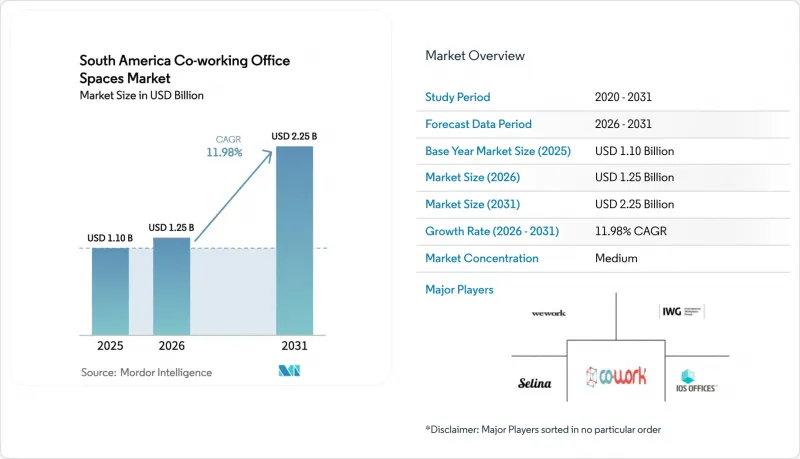
本報告按設施規模(小規模、中型、大型)、行業(IT及IT服務、銀行、金融服務和保險、商業諮詢及專業服務、其他服務)、最終用戶(自由職業者、企業、新創公司、其他)以及國家/地區(巴西、阿根廷、智利、哥倫比亞、秘魯及其他南美國家)進行細分。市場預測以美元計價。
南美洲共享辦公空間市場的趨勢與洞察
巴西新創企業和中小企業快速成長
預計到2025年,巴西科技業將新增超過170萬個IT和BPO相關就業崗位,越來越多的小規模團隊傾向選擇計量型的辦公桌位,而非簽訂多年租約。巴西中小企業署(SEBRAE)和市政培養箱提供的補貼,正鼓勵非正式企業轉型為提供商務服務的正規辦公空間。儘管早期資金籌措正在縮減,但流入弗洛里亞諾波利斯、貝洛奧裡藏特和其他二線城市的資本比例卻在增加,迫使企業將業務拓展到聖保羅市中心以外的地區。住宅開發商現在將公共區域預租為共享辦公空間,方便居住者步行即可到達專業的辦公室。這些因素共同推動了南美洲共享辦公空間市場的擴張,既滿足了郊區的潛在需求,又在巴西信貸週期波動的情況下穩定了企業收入。
混合辦公模式正在推動對靈活短期租賃的需求。
在全球範圍內,員工每週到辦公室的工作頻率已穩定在四天左右,租戶也明確表示有意最佳化總部規模,並將多餘的員工外包給靈活的辦公中心。在聖保羅,2024年共簽訂了25萬平方公尺的租賃協議,創下2019年以來的最高水平,這主要得益於科技和服務業的租戶。企業正在實現辦公空間多元化,核心團隊繼續留在公司自有的辦公大樓,而靈活團隊則輪流使用按季度調整的共同工作會員資格。 IWG敏銳地捕捉到了這一趨勢,在2024年簽署了899個辦公中心的協議,這些中心主要位於郊區,採用特許經營模式,避免了租賃義務。提供固定辦公桌、按需會議室和數位郵件處理等服務的營運商,如今正從同一批客戶身上獲得多元化的收入來源,從而保護了南美共享辦公空間市場免受經濟波動的影響。
聖保羅市中心競爭激烈,面臨供應過剩的風險
2024年第四季度,查卡里亞聖安東尼奧區和伊泰恩區的空置率分別達到48.16%和43.64%,促使業主提供免租期和維修補貼。 WeWork於2024年9月撤離,凸顯了過度擴張至低需求地區會如何侵蝕利潤率,尤其是在收入無法跟上租金支出的情況下。預計2025年將新增25萬平方公尺的供應,低需求地區面臨的壓力將持續存在。業者需要避免被低迷地區看似低廉的租金所誘惑,而應將目光轉向高入住率地區,例如法裡亞利馬,那裡的平均月租金為每平方米283.85巴西幣(約合56.80美元),空置率僅為10.4%。透過實施嚴格的位置,我們可以保護整個南美洲的共同工作空間市場免受價格競爭的影響,而這種價格競爭正在破壞巴西最大城市的市場穩定。
細分市場分析
到2025年,中型辦公空間將佔南美洲共享辦公空間市場佔有率的46%,這反映了其最適合20至100人團隊的規模。同時,大型辦公空間預計在2026年至2031年間將實現12.7%的複合年成長率,是所有規模類別中成長最快的。實際上,企業現在正將整層辦公空間外包為“託管園區”,並將接待、IT、清潔和安保等服務打包到可預測的月度帳單中。 IWG的低資本負擔合約以及Celina對「Remote Year」的收購表明,混合模式可以將這種經營模式擴展到郊區。隨著南美洲共享辦公空間生態系統的日趨成熟,那些對其產品組合進行分級的運營商——例如面向自由職業者的微型中心、面向成長型企業的中型套房以及面向大型企業的園區樓層——正在將客戶留在該生態系統中。
大型共享辦公空間通常面積超過5000平方米,包括私人套房、共享咖啡廳和活動露台。 2024年至2025年間,諸如「JK Square」等新建共享辦公空間為租戶提供提前入住獎勵,有效補貼了內部裝修成本,直至整棟大樓全部出租。面積在2000至5000平方米之間的中型共享辦公中心仍然是主流,在成本和配套設施之間取得了良好的平衡。面積小於2000平方公尺的小規模辦公中心正在「15分鐘車程」的城市區域迅速擴張,透過將閒置的零售空間整修成擁有10至30個工位的閣樓式辦公空間,吸引當地自由工作者入駐。這種多層次的結構為南美洲共享辦公空間市場的持續成長奠定了基礎。
其他好處:
- Excel格式的市場預測(ME)表
- 3個月的分析師支持
目錄
第1章:引言
- 研究假設和市場定義
- 調查範圍
第2章:調查方法
第3章執行摘要
第4章 市場狀況
- 市場概覽
- 市場促進因素
- 巴西新創企業和中小企業的快速成長(主流)
- 混合辦公模式正在推動對彈性短期租賃(主流)的需求。
- 投資者和開發人員之間的合作正在擴大主要城市(主流)甲級房產的供應。
- 智利和哥倫比亞政府資助的創新經濟區旨在促進精品中心的發展(這一發展被低估了)。
- 「15分鐘城市」分區試點計畫正在推動以社區為基礎的微型中心的發展(這項運動尚未受到太多關注)。
- 市場限制因素
- 聖保羅(主流)CBD市場競爭激烈,有供應過剩的風險
- 儘管潛在需求,但在區域城市和內陸地區(主流)的採用率仍然有限。
- 產權登記和遵守分區法規的複雜過程正在減緩企業擴張(這是一個不易察覺的因素)。
- 城市安全和保險成本的飆升正在推動室內裝修投資的增加(這是一個被忽視的因素)。
- 價值供應鏈分析
- 概述
- 房地產開發商和業主—關鍵見解
- 工作空間設計與技術顧問 - 主要見解
- 模組化家具和智慧辦公室解決方案供應商—關鍵洞察
- 政府法規和政策
- 技術創新
- 辦公室房地產關鍵指標(供應量、租金、價格、運轉率/空置率)
- 遠距辦公對辦公室需求的影響
- 波特五力模型
第5章 市場規模與成長預測
- 按設施規模
- 小規模
- 中號
- 大規模
- 按行業
- 資訊科技與資訊科技服務
- 銀行、金融服務和保險業 (BFSI)
- 商業諮詢和專業服務
- 其他服務(零售、生命科學、能源、法律等)
- 按最終用途
- 自由工作者/個人
- 公司
- 新創企業及其他
- 國家
- 巴西
- 阿根廷
- 智利
- 哥倫比亞
- 秘魯
- 其他南美國家
第6章 競爭情勢
- 市場集中度
- 策略趨勢
- 公司簡介
- WeWork Inc.
- IWG plc(Regus, Spaces)
- Selina Hospitality
- Co-Work LatAm
- IOS OFFICES
- Urban Station
- AreaTres
- UOffice
- Impact Hub
- Krismar Business Center
- Co-Work Bogota
- Work &Go
- Nube Coworking
- Punktla
- Distrito Ofice
- MyOffice Chile
- Spaces Argentina
- Selina Co-work
- The Executive Centre(LatAm)
- Cowork Peru
第7章 市場機會與未來展望
According to Mordor Intelligence, South America coworking office spaces market size was valued at USD 1.10 billion in 2025 and is estimated to grow from USD 1.25 billion in 2026 to USD 2.25 billion by 2031, at a CAGR of 12% during the forecast period (2026-2031).
This report is Segmented by Size & Scale of Facility (Small, Medium, and Large), by Sector (IT and ITES, BFSI, Business Consulting & Professional Service, and Other Services), by End Use (Freelancers, Enterprises, Start Ups, and Others), by Country (Brazil, Argentina, Chile, Colombia, Peru and Rest of South America). The Market Forecasts are Provided in Terms of Value (USD).
South America Coworking Office Spaces Market Trends and Insights
Rapid Growth of Start-ups and SMEs in Brazil
Brazil's technology scene generated more than 1.7 million IT and BPO positions by 2025, creating a steady pipeline of small teams that prefer pay-as-you-go desks to multi-year leases. SEBRAE subsidies and municipal incubators have nudged informal ventures toward formal space equipped with business services. Early-stage funding has contracted, yet the share flowing to Florianopolis, Belo Horizonte, and other secondary hubs has risen, forcing operators to seed locations outside Sao Paulo's core. Residential developers are now pre-leasing common areas as co-working zones, ensuring residents have professional offices within walking distance. Together, these forces expand the South American co-working office space market by absorbing latent suburban demand while stabilizing operator revenue during Brazil's volatile credit cycle.
Hybrid Work Models Boosting Demand for Flexible Short-term Leases
Global attendance norms have settled around 4 days a week, giving occupiers clarity to right-size headquarters and outsource overflow to flexible centers. Sao Paulo posted 250,000 m2 of leasing in 2024, the highest since 2019, led by tech and services tenants. Enterprises are splitting portfolios: core teams stay in owned towers, while agile squads rotate through co-working memberships that can be tweaked quarterly. IWG captured this shift by signing 899 mostly suburban centers in 2024 under franchise deals that avoid lease liabilities. Operators that package reserved desks, on-demand rooms, and digital mail handling are now harvesting multi-threaded revenue streams from the same client, fortifying the South America Coworking Office Spaces Market against economic swings.
High Competition and Oversupply Risk in Sao Paulo CBDs
Vacancy rates reached 48.16% in Chacara Santo Antonio and 43.64% in Itaim during Q4 2024, prompting landlords to offer rent-free months and improvement allowances. WeWork's September 2024 evictions highlighted how overstretching into soft districts erodes margins when dues cannot keep pace with lease obligations. With 250,000 m2 of fresh stock arriving in 2025, pressure on weak nodes will persist. Operators must avoid the siren song of low headline rents in distressed corridors and instead pivot to high-occupancy zones such as Faria Lima, where asking rents average BRL 283.85/m2 (USD 56.8) per month and vacancy is only 10.4%. Disciplined site selection shields the broader South America Coworking Office Spaces Market from destabilizing price wars in Brazil's largest city.
Other drivers and restraints analyzed in the detailed report include:
- Investor-Developer Partnerships Expanding Grade-A Supply in Tier-1 Metros
- Government-funded Creative-economy Districts Catalyzing Boutique Hubs in Chile and Colombia
- Limited Penetration in Secondary and Interior Cities Despite Latent Demand
For complete list of drivers and restraints, kindly check the Table Of Contents.
Segment Analysis
The medium category captured 46% of the South America Coworking Office Spaces Market share in 2025, reflecting its sweet spot for 20- to 100-person teams. Large formats, however, are projected to log a 12.7% CAGR between 2026 and 2031, the quickest of any size class. In practice, corporations now outsource entire floors as managed campuses, bundling reception, IT, cleaning, and security into a predictable monthly invoice. IWG's capital-light signings and Selina's Remote Year acquisition illustrate how franchising and hospitality hybrids can stretch this model across suburban belts. Operators that tier portfolios-micro hubs for freelancers, mid-size suites for scale-ups, and campus floors for corporates-keep customers within the South American co-working office space ecosystem as it matures.
Large facilities generally exceed 5,000 m2 and combine private suites with communal cafes and event terraces. During 2024-2025, new deliveries such as JK Square offered co-working tenants early-move-in incentives, effectively subsidizing fit-outs while towers leased up. Medium centers, often 2,000-5,000 m2, remain the workhorse, balancing cost and amenity depth. Small hubs under 2,000 m2 proliferate in 15-minute-city districts, converting retail shells into 10- to 30-desk lofts that capture local freelancers. This tiered spectrum underpins the enduring breadth of the South American coworking office space market.
Complete Report Scope:
- By Size & Scale of Facility
- Small
- Medium
- Large
- By Sector
- Information Technology & ITES
- BFSI (Banking, Financial Services and Insurance)
- Business Consulting & Professional Services
- Other Services (Retail, Life-sciences, Energy, Legal, etc.)
- By End Use
- Freelancers / Individuals
- Enterprises
- Start-ups & Others
- By Country
- Brazil
- Argentina
- Chile
- Colombia
- Peru
- Rest of South America
List of Companies Covered in this Report:
- WeWork Inc.
- IWG plc (Regus, Spaces)
- Selina Hospitality
- Co-Work LatAm
- IOS OFFICES
- Urban Station
- AreaTres
- UOffice
- Impact Hub
- Krismar Business Center
- Co-Work Bogota
- Work&Go
- Nube Coworking
- Punktla
- Distrito Ofice
- MyOffice Chile
- Spaces Argentina
- Selina Co-work
- The Executive Centre (LatAm)
- Cowork Peru
Additional Benefits:
- The market estimate (ME) sheet in Excel format
- 3 months of analyst support
TABLE OF CONTENTS
1 Introduction
- 1.1 Study Assumptions & Market Definition
- 1.2 Scope of the Study
2 Research Methodology
3 Executive Summary
4 Market Landscape
- 4.1 Market Overview
- 4.2 Market Drivers
- 4.2.1 Rapid growth of start-ups & SMEs in Brazil (mainstream)
- 4.2.2 Hybrid work models boosting demand for flexible short-term leases (mainstream)
- 4.2.3 Investor-developer partnerships expanding Grade-A supply in tier-1 metros (mainstream)
- 4.2.4 Government-funded creative-economy districts catalysing boutique hubs in Chile & Colombia (under-radar)
- 4.2.5 "15-minute-city" zoning pilots driving neighbourhood micro-hubs (under-radar)
- 4.3 Market Restraints
- 4.3.1 High competition & oversupply risk in Sao Paulo CBDs (mainstream)
- 4.3.2 Limited penetration in secondary & interior cities despite latent demand (mainstream)
- 4.3.3 Complex title-registration & zoning compliance delaying expansion (under-radar)
- 4.3.4 Urban-security & insurance cost spikes increasing fit-out cap-ex (under-radar)
- 4.4 Value / Supply-Chain Analysis
- 4.4.1 Overview
- 4.4.2 Real-Estate Developers & Asset Owners - Key Insights
- 4.4.3 Workspace Design & Technology Consultants - Key Insights
- 4.4.4 Modular Furniture & Smart-office Solution Providers - Key Insights
- 4.5 Government Regulations & Initiatives
- 4.6 Technological Innovations
- 4.7 Key Office-real-estate Metrics (Supply, Rents, Prices, Occupancy/Vacancy %)
- 4.8 Impact of Remote Working on Space Demand
- 4.9 Porter's Five Forces
- 4.9.1 Bargaining Power of Suppliers
- 4.9.2 Bargaining Power of Buyers
- 4.9.3 Threat of New Entrants
- 4.9.4 Threat of Substitutes
- 4.9.5 Intensity of Competitive Rivalry
5 Market Size & Growth Forecasts (Value, USD Million)
- 5.1 By Size & Scale of Facility
- 5.1.1 Small
- 5.1.2 Medium
- 5.1.3 Large
- 5.2 By Sector
- 5.2.1 Information Technology & ITES
- 5.2.2 BFSI (Banking, Financial Services and Insurance)
- 5.2.3 Business Consulting & Professional Services
- 5.2.4 Other Services (Retail, Life-sciences, Energy, Legal, etc.)
- 5.3 By End Use
- 5.3.1 Freelancers / Individuals
- 5.3.2 Enterprises
- 5.3.3 Start-ups & Others
- 5.4 By Country
- 5.4.1 Brazil
- 5.4.2 Argentina
- 5.4.3 Chile
- 5.4.4 Colombia
- 5.4.5 Peru
- 5.4.6 Rest of South America
6 Competitive Landscape
- 6.1 Market Concentration
- 6.2 Strategic Moves
- 6.3 Company Profiles (includes Global level Overview, Market level overview, Core Segments, Financials as available, Strategic Information, Market Rank/Share for key companies, Products & Services, and Recent Developments)
- 6.3.1 WeWork Inc.
- 6.3.2 IWG plc (Regus, Spaces)
- 6.3.3 Selina Hospitality
- 6.3.4 Co-Work LatAm
- 6.3.5 IOS OFFICES
- 6.3.6 Urban Station
- 6.3.7 AreaTres
- 6.3.8 UOffice
- 6.3.9 Impact Hub
- 6.3.10 Krismar Business Center
- 6.3.11 Co-Work Bogota
- 6.3.12 Work&Go
- 6.3.13 Nube Coworking
- 6.3.14 Punktla
- 6.3.15 Distrito Ofice
- 6.3.16 MyOffice Chile
- 6.3.17 Spaces Argentina
- 6.3.18 Selina Co-work
- 6.3.19 The Executive Centre (LatAm)
- 6.3.20 Cowork Peru
7 Market Opportunities & Future Outlook
- 7.1 White-space & Unmet-need Assessment
- 7.2 Decentralised neighbourhood micro-hubs & hybrid subscriptions

 英國彈性辦公空間:市場佔有率分析、產業趨勢與統計及成長預測(2026-2031)
 節能型辦公空間市場分析及預測(至2035年):依類型、產品、服務、技術、組件、應用、材料類型、部署方式、最終用戶及解決方案分類
 共享辦公空間市場規模、佔有率和成長分析:按空間類型、經營模式、最終用戶、應用、產業、會員期限和地區分類-2026-2033年產業預測亞太地區共享辦公空間:市場佔有率分析、產業趨勢與統計及成長預測(2026-2031)北美共享辦公空間:市場佔有率分析、產業趨勢與統計及成長預測(2026-2031)印度共享辦公空間:市場佔有率分析、產業趨勢與統計及成長預測(2026-2031)美國共享辦公空間:市場佔有率分析、產業趨勢與統計及成長預測(2026-2031)
 辦公空間市場規模、佔有率和成長分析:按物業類型、等級、租賃類型、公司規模、最終用途產業、用途和地區分類-2026-2033年產業預測印度彈性辦公空間:市場佔有率分析、產業趨勢與統計及成長預測(2026-2031)
 共享辦公空間市場:按類型、產品類型、營運模式、產業和最終用戶分類-2026-2032年全球市場預測