


 |
市場調查報告書
商品編碼
2066674
北美建築黏合劑和密封劑:市場佔有率分析、行業趨勢和統計數據以及成長預測(2026-2031 年)North America Construction Adhesives And Sealants - Market Share Analysis, Industry Trends & Statistics, Growth Forecasts (2026 - 2031) |
||||||

※ 本網頁內容可能與最新版本有所差異。詳細情況請與我們聯繫。
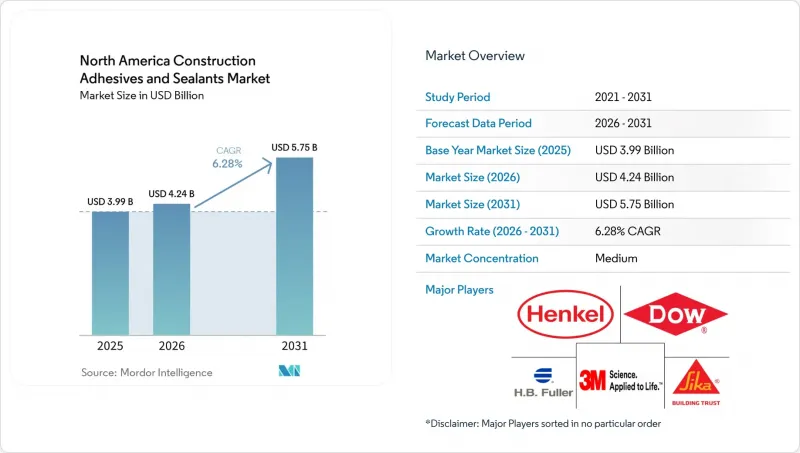
據 Mordor Intelligence 稱,北美建築黏合劑和密封劑市場預計將從 2025 年的 39.9 億美元成長到 2026 年的 42.4 億美元,到 2031 年達到 57.5 億美元,2026 年至 2031 年的複合年成長率為 6.28%。
本報告按樹脂類型(聚氨酯、丙烯酸等)、技術類型(密封劑、水性等)、應用領域(地板材料/瓷磚、屋頂材料、牆板/外牆等)、最終用途(住宅、商業、工業、基礎設施)和地區(美國、加拿大、墨西哥)進行細分。市場預測以美元(USD)為單位。
北美建築黏合劑密封劑市場趨勢及洞察
低揮發性有機化合物(VOC)建材需求激增
加州南海岸空氣品質管理區 (SCAQMD) 的第 1168 號規則將揮發性有機化合物 (VOC) 含量限制在 50–250 克/公升,這正在推動配方的大規模變革,以減少溶劑型化學品的使用。馬裡蘭州、馬薩諸塞州、德克薩斯州和其他州的類似法規正在使法規環境更加分散,這有利於那些擁有符合這些要求的廣泛產品系列的供應商。 2025 年 3 月,BASF和西卡推出了 Baxxodur EC 151,該產品可將 VOC排放量降低高達 90%,並在 5–10 度C的低溫下固化。改性矽烷混合產品在滿足黏合要求的同時,避免了接觸異氰酸酯,因此市場佔有率正在不斷擴大。規範制定者擴大將成熟的低 VOC 性能與生命週期耐久性相結合,並將環境合規性納入競標規範,而不僅僅將其視為一項形式上的監管要求。
異地模組化建築的快速發展
預計到2024年,永久性模組化建築的市場規模將達到146億美元,較十年前的43億美元顯著成長。這反映了市場向受控環境下的組裝轉變。工廠生產流程需要固化特性可預測且能與機器人點膠機配合使用的黏合劑。例如,SikaWall-3000 Rapid Bond可在交叉層壓木材(CLT)生產線上於一小時內固化,從而提高生產效率。同樣,Kiilt的Pro SW黏合劑可將CLT的黏合時間縮短30%,提高生產週期效率。隨著模組化單元在工廠完成組裝,對用於現場的慢速固化黏合劑的需求正在下降,北美建築黏合劑和密封劑市場正轉向針對工廠使用最佳化的配方。
石油衍生原料價格波動
截至2026年3月20日當週,由於苯原料成本大幅上漲,MDI價格上漲5.86%,促使科思創和亨斯邁宣布每噸上調220至260美元。由於原料成本約佔黏合劑生產成本的75%,即使1%的價格變動也會使中型製造商的淨利減少1,330萬美元。複合材料製造商正在探索使用生物基多元醇和再生樹脂,但根據建築規範進行的重新認證過程可能需要長達兩年的時間,這將給中小企業的利潤率帶來壓力。
細分市場分析
預計到2031年,矽膠樹脂將以6.43%的複合年成長率成長,因為外牆工程師高度重視其在紫外線照射和熱循環下的長期耐久性。聚氨酯主要應用於地板材料和噴塗泡沫隔熱材料,預計到2025年將佔據北美建築黏合劑和密封劑市場24.38%的佔有率,但由於異氰酸酯原料價格波動,其成本面臨挑戰。丙烯酸類材料更適用於室內應用,因為在室內應用中,易於清潔和成本比室外耐久性更為重要。環氧樹脂用於高耐久性地板材料和耐化學腐蝕的黏合,而低溫、低VOC固化劑(如Baxxodur EC 151)等技術進步也確保了其在寒冷氣候應用中的效用。
矽酮卓越的耐候性已透過40年的戶外測試得到證實。這些測試表明,在週期性的紫外線照射、鹽霧和溫度波動下,矽酮的彈性模量與聚氨酯和丙烯酸密封劑相比,下降幅度極小。目前,建築規範已將矽酮納入帷幕牆規範,橋樑管理部門也批准在使用壽命長達75年的結構中使用雙組分矽酮接縫。雖然酚醛-間苯二酚樹脂在結構複合板中仍然至關重要,但改性矽烷混合樹脂兼具矽酮的耐久性和聚氨酯的黏合性。擁有多種樹脂產品組合專業知識的供應商更有能力應對北美建築黏合劑和密封劑市場中不同材料黏合的挑戰。
預計到2031年,水性密封劑技術將以6.43%的複合年成長率保持最高成長率,這主要得益於南海岸空氣品質管理區(SCAQMD)第1168號規則和OTC示範規則等監管措施,這些措施對揮發性有機化合物(VOC)含量設定了嚴格的限制。到2025年,密封劑將佔技術銷售額的42.01%,而不斷提高的性能要求正促使針對特定應用開發專用配方,例如混凝土與FRP、金屬與玻璃以及木材與聚合物的黏合。
溶劑型產品在一些水性替代品因反覆凍融和多孔基材等挑戰而不適用的應用中仍然佔有一席之地,但其市場佔有率持續下降。環氧樹脂、聚氨酯和甲基丙烯酸酯等反應型化學黏合劑用於複雜的混合物和高強度結構黏合。熱熔膠在門窗和保溫板的工廠生產中蓬勃發展,阿科瑪計劃在2024年擴大其UV丙烯酸產品的產能,以滿足模組化建築的需求。結合水性產品低VOC優勢和反應型黏合劑強度的混合技術正在成為北美建築黏合劑和密封劑市場的主要成長領域。
其他好處:
- Excel格式的市場預測(ME)表
- 3個月的分析師支持
目錄
第1章:引言
- 研究假設和市場定義
- 調查範圍
第2章:調查方法
第3章執行摘要
第4章 市場狀況
- 市場概覽
- 市場促進因素
- 低揮發性有機化合物(VOC)建材需求激增
- 異地模組化建築的快速發展
- 美國和加拿大的基礎設施獎勵策略
- 黏合劑配方創新,可實現不同材質的黏合
- 高層木造建築越來越受歡迎。
- 由於極端天氣,屋頂進行了大規模更換。
- 市場限制因素
- 石油衍生原料價格波動
- 更嚴格的REACH和TSCA法規所帶來的合規成本
- 技術純熟勞工短缺,無法正確塗抹密封劑
- 與屋頂結構機械緊固方法的其他技術競爭。
- 價值鏈分析
- 波特五力模型
第5章 市場規模與成長預測
- 依樹脂類型
- 聚氨酯
- 丙烯酸纖維
- 氰基丙烯酸酯
- 環氧樹脂
- 矽酮
- VAE/EVA
- 其他樹脂
- 透過技術
- 密封劑
- 水溶液
- 溶劑型
- 反應性
- 熱熔膠
- 透過使用
- 地板材料和瓷磚
- 屋頂材料
- 牆板和外觀
- 隔熱防潮
- 基礎設施連接點(橋樑、隧道)
- 按最終用途
- 住宅
- 商業
- 產業
- 基礎設施
- 按地區
- 美國
- 加拿大
- 墨西哥
第6章 競爭情勢
- 市場集中度
- 策略趨勢
- 市佔率和排名分析
- 公司簡介
- 3M
- Arkema
- ATP adhesive systems AG
- Avery Dennison
- BASF
- Carlisle Construction Materials
- Dow
- Franklin International
- HB Fuller Company
- Henkel AG & Co. KGaA
- Huntsman International LLC
- ITW Performance Polymers
- MAPEI SpA
- Momentive
- PARKER HANNIFIN CORP
- Pecora Corporation
- RPM International Inc.
- Sika AG
- Soudal Group
- Wacker Chemie AG
第7章 市場機會與未來展望
According to Mordor Intelligence, the north america construction adhesives and sealants market size is expected to increase from USD 3.99 billion in 2025 to USD 4.24 billion in 2026 and reach USD 5.75 billion by 2031, growing at a CAGR of 6.28% over 2026-2031.
This report is Segmented by Resin (Polyurethane, Acrylic, and More), Technology (Sealants, Water-Borne, and More), Application (Flooring and Tiling, Roofing, Wall Panels and Facades, and More), End-Use Sector (Residential, Commercial, Industrial, and Infrastructure), and Geography (United States, Canada, and Mexico). The Market Forecasts are Provided in Terms of Value (USD).
North America Construction Adhesives And Sealants Market Trends and Insights
Surging Demand for Low-VOC Construction Materials
California's SCAQMD Rule 1168, which limits VOC content to 50-250 g/L, has driven widespread reformulation away from solvent-based chemistries. Similar regulations in Maryland, Massachusetts, Texas, and other OTC states have created a fragmented regulatory environment that benefits suppliers with extensive compliant product portfolios. In March 2025, BASF and Sika introduced Baxxodur EC 151, which reduces VOC emissions by up to 90% and cures at temperatures as low as 5-10 °C. Modified-silane hybrids are gaining market share as they eliminate isocyanate exposure while meeting adhesion requirements. Specifiers are increasingly integrating low-VOC credentials with lifecycle durability, embedding environmental compliance into bid specifications rather than treating it as a regulatory formality.
Rapid Growth of Off-Site Modular Construction
Permanent modular construction reached USD 14.6 billion in 2024, up from USD 4.3 billion a decade earlier, reflecting a shift toward controlled-environment assembly. Factory workflows require adhesives that cure predictably and integrate with robotic dispensers. For instance, SikaWall-3000 Rapid Bond cures within one hour on cross-laminated timber (CLT) production lines, enhancing throughput. Similarly, Kiilto's Pro SW adhesive reduces CLT bond times by 30%, improving cycle-time efficiency. Since modular units are completed in factories, demand for field-focused slow-cure adhesives is declining, steering the North America construction adhesives and sealants market toward factory-optimized formulations.
Volatility in Petro-Derived Raw Material Prices
MDI prices rose by 5.86% in the week ending March 20, 2026, following a spike in benzene feedstock costs, with Covestro and Huntsman announcing price increases of USD 220-260 per ton. Raw materials account for approximately 75% of adhesive production costs, so a 1% price change can impact net income by USD 13.3 million for mid-sized producers. While formulators are exploring bio-based polyols and recycled resins, the requalification process for building codes can take up to two years, leaving smaller firms exposed to margin pressures.
Other drivers and restraints analyzed in the detailed report include:
- Infrastructure Stimulus Packages in the U.S. and Canada
- Adhesive Formulation Innovations Enabling Mixed-Material Bonding
- Stricter REACH and TSCA Compliance Costs
For complete list of drivers and restraints, kindly check the Table Of Contents.
Segment Analysis
Silicone resins are projected to grow at a CAGR of 6.43% through 2031, as facade engineers value their long-term elasticity under UV exposure and thermal cycling. Polyurethane accounted for 24.38% of the North America construction adhesives and sealants market share in 2025, driven by its use in flooring and spray-foam insulation, though it faces cost challenges due to fluctuating isocyanate feedstock prices. Acrylics are preferred for interior applications where ease of cleanup and cost are prioritized over exterior durability. Epoxies are utilized in heavy-duty flooring and chemical-resistant bonds, with advancements such as low-temperature, low-VOC hardeners like Baxxodur EC 151 ensuring their relevance in cold-climate applications.
Silicone's weathering advantage is supported by a 40-year outdoor study that demonstrated minimal modulus loss compared to polyurethane or acrylic sealants under cyclic UV, salt fog, and temperature variations. Code officials now include silicone in curtain-wall specifications, and bridge authorities approve two-part silicone joints for 75-year assets. Phenol-resorcinol remains critical for structural mass-timber laminations, while modified-silane hybrids combine silicone's durability with polyurethane's adhesion. Suppliers with expertise in multi-resin portfolios are better positioned to address the mixed-material bonding challenges in the North America construction adhesives and sealants market.
Water-borne technology is expected to grow at the highest CAGR of 6.43% through 2031, driven by regulatory measures such as SCAQMD Rule 1168 and OTC model rules, which impose strict VOC limits. Sealants accounted for 42.01% of technology revenue in 2025, with performance demands leading to niche formulations for specific applications like concrete-to-FRP, metal-to-glass, and wood-to-polymer joints.
Solvent-borne products maintain a presence in applications where freeze-thaw cycles or porous substrates challenge water-based alternatives, though their market share continues to decline. Reactive chemistries, including epoxies, polyurethanes, and methacrylates, are used for high-strength structural bonds despite their mixing complexity. Hot-melt adhesives are thriving in factory settings for windows and insulated panels, with Arkema expanding UV acrylic capacity in 2024 to meet modular construction demand. Hybrid technologies that combine water-borne low-VOC benefits with reactive strength are emerging as a key growth area in the North America construction adhesives and sealants market.
List of Companies Covered in this Report:
- 3M
- Arkema
- ATP adhesive systems AG
- Avery Dennison
- BASF
- Carlisle Construction Materials
- Dow
- Franklin International
- H.B. Fuller Company
- Henkel AG & Co. KGaA
- Huntsman International LLC
- ITW Performance Polymers
- MAPEI S.p.A.
- Momentive
- PARKER HANNIFIN CORP
- Pecora Corporation
- RPM International Inc.
- Sika AG
- Soudal Group
- Wacker Chemie AG
Additional Benefits:
- The market estimate (ME) sheet in Excel format
- 3 months of analyst support
TABLE OF CONTENTS
1 Introduction
- 1.1 Study Assumptions and Market Definition
- 1.2 Scope of the Study
2 Research Methodology
3 Executive Summary
4 Market Landscape
- 4.1 Market Overview
- 4.2 Market Drivers
- 4.2.1 Surging demand for low-VOC construction materials
- 4.2.2 Rapid growth of off-site modular construction
- 4.2.3 Infrastructure stimulus packages in the U.S. and Canada
- 4.2.4 Adhesive formulation innovations enabling mixed-material bonding
- 4.2.5 Rising multi-story timber buildings adoption
- 4.2.6 Widespread reroofing linked to extreme-weather events
- 4.3 Market Restraints
- 4.3.1 Volatility in petro-derived raw material prices
- 4.3.2 Stricter REACH and TSCA compliance costs
- 4.3.3 Skilled-labor shortages for correct sealant application
- 4.3.4 Competition from mechanical fastening alternatives in roofing
- 4.4 Value Chain Analysis
- 4.5 Porter's Five Forces
- 4.5.1 Bargaining Power of Suppliers
- 4.5.2 Bargaining Power of Buyers
- 4.5.3 Threat of New Entrants
- 4.5.4 Threat of Substitutes
- 4.5.5 Competitive Rivalry
5 Market Size and Growth Forecasts (Value)
- 5.1 By Resin Type
- 5.1.1 Polyurethane
- 5.1.2 Acrylic
- 5.1.3 Cyanoacrylate
- 5.1.4 Epoxy
- 5.1.5 Silicone
- 5.1.6 VAE/EVA
- 5.1.7 Other Resins
- 5.2 By Technology
- 5.2.1 Sealants
- 5.2.2 Water-borne
- 5.2.3 Solvent-borne
- 5.2.4 Reactive
- 5.2.5 Hot-melt
- 5.3 By Application
- 5.3.1 Flooring and Tiling
- 5.3.2 Roofing
- 5.3.3 Wall Panels and Facades
- 5.3.4 Insulation and Weatherproofing
- 5.3.5 Infrastructure Joints (bridges, tunnels)
- 5.4 By End-use Sector
- 5.4.1 Residential
- 5.4.2 Commercial
- 5.4.3 Industrial
- 5.4.4 Infrastructure
- 5.5 By Geography
- 5.5.1 United States
- 5.5.2 Canada
- 5.5.3 Mexico
6 Competitive Landscape
- 6.1 Market Concentration
- 6.2 Strategic Moves
- 6.3 Market Share (%)/Ranking Analysis
- 6.4 Company Profiles (includes Global level Overview, Market level overview, Core Segments, Financials as available, Strategic Information, Products and Services, and Recent Developments)
- 6.4.1 3M
- 6.4.2 Arkema
- 6.4.3 ATP adhesive systems AG
- 6.4.4 Avery Dennison
- 6.4.5 BASF
- 6.4.6 Carlisle Construction Materials
- 6.4.7 Dow
- 6.4.8 Franklin International
- 6.4.9 H.B. Fuller Company
- 6.4.10 Henkel AG & Co. KGaA
- 6.4.11 Huntsman International LLC
- 6.4.12 ITW Performance Polymers
- 6.4.13 MAPEI S.p.A.
- 6.4.14 Momentive
- 6.4.15 PARKER HANNIFIN CORP
- 6.4.16 Pecora Corporation
- 6.4.17 RPM International Inc.
- 6.4.18 Sika AG
- 6.4.19 Soudal Group
- 6.4.20 Wacker Chemie AG
7 Market Opportunities and Future Outlook
- 7.1 White-space and Unmet-Need Assessment

 建築密封膠市場:全球市場預測,2026-2032年建築黏合劑市場:2026-2032年全球市場預測(依化學性質、配方技術、基材、包裝、應用及最終用途產業分類)
 中東和非洲建築黏合劑和密封劑:市場佔有率分析、行業趨勢和統計數據以及成長預測(2026-2031 年)亞太地區建築黏合劑密封劑:市場佔有率分析、產業趨勢與統計及成長預測(2026-2031 年)建築黏合劑和密封劑:市場佔有率分析、行業趨勢和統計數據以及成長預測(2026-2031 年)歐洲建築黏合劑和密封劑:市場佔有率分析、行業趨勢和統計數據以及成長預測(2026-2031 年)美國建築黏合劑和密封劑:市場佔有率分析、行業趨勢和統計數據以及成長預測(2026-2031 年)
 建築黏合劑市場規模、佔有率和趨勢分析報告:按樹脂類型、技術、應用、地區和細分市場預測(2026-2033 年)
 全球建築黏合劑市場規模、佔有率、趨勢和成長分析報告(2026-2034年)
 2026年全球建築黏合劑市場報告