


 |
市場調查報告書
商品編碼
2044258
美國建築黏合劑和密封劑:市場佔有率分析、行業趨勢和統計數據以及成長預測(2026-2031 年)United States Construction Adhesives And Sealants - Market Share Analysis, Industry Trends & Statistics, Growth Forecasts (2026 - 2031) |
||||||

※ 本網頁內容可能與最新版本有所差異。詳細情況請與我們聯繫。
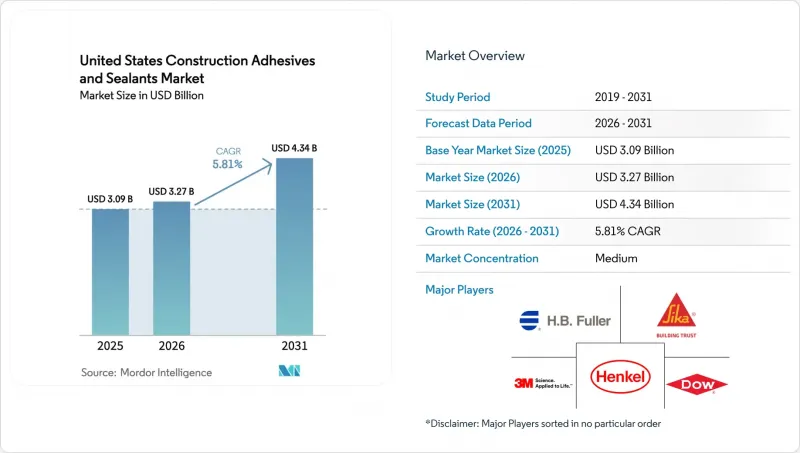
美國建築黏合劑和密封劑市場預計將從 2025 年的 30.9 億美元成長到 2026 年的 32.7 億美元,到 2031 年達到 43.4 億美元,2026 年至 2031 年的複合年成長率預計為 5.81%。
更嚴格的能源標準、異地模組化建築的穩定成長以及生物基聚氨酯化學技術的快速成熟,正推動產品需求,因為相關人員都在追求更高的性能和更低的碳排放目標。水性技術已在美國建築黏合劑和密封劑市場佔據主導地位,而南海岸空氣品質管理區 (AQMD) 第 1168 號規則對揮發性有機化合物 (VOC) 的持續限制,正促使產品規範從溶劑型系統轉向水性系統。快速固化反應型產品因其能縮短預製建築的施工時間而日益普及,而矽酮和聚氨酯產品對於必須承受地震荷載和紫外線輻射的高延展性外牆仍然至關重要。目前的競爭優勢取決於生物基成分的研發、加速核准測試以及區域產能擴張,以避免在陽光地帶和太平洋西北地區等高成長地區出現供應瓶頸。
美國建築黏合劑和密封劑市場的趨勢和洞察
嚴格的能源標準推動了高性能建築圍護結構的發展。
2024 年國際節能標準 (IECC) 將 75 Pa 下的允許空氣洩漏率降低至 0.25 cfm/ft²,比 2021 年版本收緊了 38%。這些標準於 2024 年 7 月至 2025 年 1 月期間在華盛頓州、麻薩諸塞州和加州正式生效。因此,低模量聚氨酯和混合 SMP 複合材料取代了機械緊固件,尤其是在根據 ASHRAE 90.1-2022 標準需要更高隔熱性能(R 值)以避免熱橋效應的氣候區。剝離強度超過 25 pli 和剪切強度超過 150 psi 的黏合劑現在已成為標準要求,傳統的丙烯酸密封膠逐漸被淘汰。對高延伸率產品的需求不斷成長,直接推高了平均售價,進而推動了進一步的研發。
快速轉向異地模組化建築
隨著開發商競相縮短工期並降低勞動風險,預計到2025年,模組化建築將占美國非住宅房屋開工量的6.2%(高於2020年的4.8%)。濕固化反應型熱熔膠可在90分鐘內達到80%的接著強度,進而維持每小時約12個牆體組件的生產速度。 HB Fuller公司的Swift-Tak 1357即可實現此性能,使工廠無需進行過夜固化,並能更有效地利用1200平方英尺的占地面積。浴室單元製造商也正在轉向使用通過ASTM D1151濕式老化測試的防水聚氨酯和環氧樹脂系統。
南海岸空氣品質管理區 (AQMD) 第 1168 號規則規定的 VOC 含量限制
第1168號規則規定,洛杉磯盆地大多數建築黏合劑的揮發性有機化合物(VOC)含量統一限制在70克/公升或以下。 OTC成員州也將在2025年前採用類似的限制,涵蓋38%的需求。配方再融資成本高昂,每個SKU的成本在12萬至18萬美元之間,這阻礙了中型供應商的參與,並加劇了美國建築黏合劑和密封劑市場中跨國公司的集中度。水性丙烯酸產品的不黏性時間較長,導致工程工期延長,給緊急建設工程帶來了阻力。
細分市場分析
2025年,丙烯酸樹脂佔黏合劑市場總值的28.89%。這一佔有率主要由瓷磚黏合劑和石膏板接縫材料推動,這些產品對成本效益和易於清潔性要求極高。這一佔有率使丙烯酸樹脂成為美國建築黏合劑和密封劑市場中最大的組成部分。儘管該細分市場的成長仍然有限,但北美瓷磚協會的規範要求在薄層砂漿中使用丙烯酸乳膠改質劑。聚氨酯產品在預測期(2026-2031年)內將以6.24%的複合年成長率成長,這得益於其在幕牆和異種基材粘合方面優異的延伸率。環氧樹脂黏合劑在高模量錨固和裂縫填充應用領域中保持著獨特的地位。
丙烯酸產品的創新正朝著低VOC、快乾且符合1168號規則的水性乳液方向發展。 VAE/EVA共聚物兼具快乾性能和與熱熔膠的相容性,使其適用於以每分鐘200英尺速度運輸的層壓門表面材料。矽酮和氰基丙烯酸酯樹脂則佔據了特種應用、阻燃防水和瞬乾膠修補等領域。儘管丙烯酸酯單體原料價格的持續波動可能會促使規範制定者考慮聚氨酯替代品,但承包商熟悉的現有技術仍保持強大的競爭優勢。
其他好處
- Excel格式的市場預測(ME)表
- 3個月的分析師支持
目錄
第1章:引言
- 研究假設和市場定義
- 調查範圍
第2章:調查方法
第3章執行摘要
第4章 市場狀況
- 市場概覽
- 市場促進因素
- 嚴格的能源標準推動了高性能建築圍護結構的發展。
- 快速過渡到異地模組化建造
- 綠色標籤認證(LEED v4.1/IBU)合規性要求
- 生物基聚氨酯化學品的興起
- 現場3D列印水泥建築物
- 市場限制因素
- 南海岸空氣品質管理區 (AQMD) 第 1168 號規則規定的 VOC 含量限制
- 由於技術純熟勞工短缺,黏合劑施工進度延誤。
- 創新化學產品耐火性能測試重新認證的成本
- 價值鏈分析
- 波特五力模型
- 供應商的議價能力
- 買方的議價能力
- 新進入者的威脅
- 替代品的威脅
- 競爭程度
第5章 市場規模與成長預測
- 黏合劑樹脂類型
- 丙烯酸纖維
- 氰基丙烯酸酯
- 環氧樹脂
- 聚氨酯
- 矽
- VAE/EVA
- 其他
- 黏合劑技術
- 熱熔膠
- 反應性
- 溶劑型
- 紫外線固化型
- 水溶液
- 不同類型的密封樹脂
- 聚氨酯
- 環氧樹脂
- 丙烯酸纖維
- 矽
- 多硫化物
- 其他
第6章 競爭情勢
- 市場集中度
- 策略趨勢
- 市佔率/排名分析
- 公司簡介
- 3M
- Arkema Group
- Dow
- Franklin International.
- HB Fuller Company
- Henkel AG & Co. KGaA
- Huntsman International LLC
- Illinois Tool Works Inc.
- MAPEI SpA
- Pecora Corporation
- RPM International Inc.
- Sika AG
- Soudal Inc.
- Tremco
- Wacker Chemie AG
第7章 市場機會與未來展望
The United States Construction Adhesives and Sealants Market size is expected to increase from USD 3.09 billion in 2025 to USD 3.27 billion in 2026 and reach USD 4.34 billion by 2031, growing at a CAGR of 5.81% over 2026-2031. Implementation of tighter energy-code mandates, the steady rise of off-site modular construction, and fast-maturing bio-based polyurethane chemistries are expanding product demand as stakeholders pursue higher performance and lower embodied carbon targets. Water-borne technology already leads the United States construction adhesives & sealants market, and continued VOC (Volatile Organic Compound) caps under South Coast AQMD (Air Quality Management District) Rule 1168 keep shifting specifications away from solvent-borne systems. Rapid-cure reactive systems are gaining ground because they shorten installation cycles in panelized builds, while silicone and polyurethane chemistries remain indispensable for high-movement facades that must withstand seismic loading and UV exposure. Competitive positioning now hinges on research and development for bio-content, accelerated test approvals, and regional capacity expansions that avert supply bottlenecks in high-growth Sunbelt and Pacific Northwest corridors.
United States Construction Adhesives And Sealants Market Trends and Insights
Tight Energy-Code Adoption Driving High-Performance Building Envelopes
The 2024 edition of the International Energy Conservation Code cut allowable air-leakage to 0.25 cfm/ft2 at 75 Pa, a 38% tightening versus 2021; Washington, Massachusetts, and California codified those limits between July 2024 and January 2025. Low-modulus polyurethane and hybrid SMP formulations, therefore, replaced mechanical fasteners to avoid thermal bridging, especially in climate zones demanding R-value upgrades under ASHRAE 90.1-2022. Adhesives exceeding 25 pli peel strength and 150 psi shear are now baseline requirements, sidelining older acrylic mastics. Demand acceleration for high-elongation products translates directly into higher average selling prices that support incremental research and development.
Rapid Shift to Off-Site Modular Construction
Modular techniques captured 6.2% of the United States non-residential starts in 2025, up from 4.8% in 2020, as developers raced to cut schedules and labor risk. Moisture-cure reactive hot-melts enable 80% bond strength within 90 minutes, keeping throughput near 12 wall cassettes per hour. H.B. Fuller's Swift-Tak 1357 delivers this profile, letting factories eliminate overnight curing and reclaim 1,200 ft2 of floor space. Bathroom-pod builders also migrate toward water-resistant polyurethane and epoxy systems that pass ASTM D1151 humidity aging.
VOC-Content Caps Under South Coast AQMD Rule 1168
Rule 1168 drives universal sub-70 g/L VOC limits for most construction adhesives in the Los Angeles basin; OTC states adopted matching caps by 2025, covering 38% of demand. Reformulation costs of USD 120,000-180,000 per SKU deterred mid-tier suppliers, increasing the United States construction adhesives & sealants market concentration around multinationals. Longer tack-free times for water-borne acrylics extend schedules, creating pushback on fast-track jobs.
Other drivers and restraints analyzed in the detailed report include:
- Green-Label Credit Compliance (LEED v4.1/IBU)
- Emergence of Bio-Based Polyurethane Chemistries
- Skilled-Labor Shortage Delaying Adhesive Application
For complete list of drivers and restraints, kindly check the Table Of Contents.
Segment Analysis
In 2025, acrylic resins represented 28.89% of overall adhesive value, a level grounded in ceramic-tile mastics and drywall joint compounds where cost efficiency and clean-up ease are paramount. This share positions acrylics as the single largest component within the United States Construction Adhesives and Sealants market. The segment's elasticity remains limited, yet Tile Council of North America specifications keep acrylic-latex modifiers mandatory in thin-set mortars. Polyurethane grades are advancing at a 6.24% CAGR during the forecast period (2026-2031), leveraging superior elongation for curtain-wall and dissimilar-substrate bonding. Epoxy adhesives preserve niche status in high-modulus anchoring and crack injection work.
Acrylic innovation points toward lower-VOC and faster-tack water emulsions, aligning with Rule 1168. VAE/EVA copolymers possess quick tack and hot-melt compatibility, a fit for laminated door skins moving at 200 lf/min. Silicone and cyanoacrylate resins occupy specialist corners, fire-stop flashing, and instant-bond repairs. Continued raw-material price swings for acrylate monomers could nudge specifiers toward polyurethane alternatives, yet installer familiarity provides a durable moat.
The United States Construction Adhesives and Sealants Market Report is Segmented by Adhesives Resin (Acrylic, Cyanoacrylate, Epoxy, Polyurethane, Silicone, VAE/EVA, and Other Resins), by Adhesives Technology (Hot-Melt, Reactive, Solvent-Borne, UV-Cured, and Water-Borne), and by Sealants Resin (Polyurethane, Epoxy, Acrylic, Silicone, Polysulfide, and Other Resins). The Market Size and Forecasts are Provided in Terms of Value (USD).
List of Companies Covered in this Report:
- 3M
- Arkema Group
- Dow
- Franklin International.
- H.B. Fuller Company
- Henkel AG & Co. KGaA
- Huntsman International LLC
- Illinois Tool Works Inc.
- MAPEI S.p.A.
- Pecora Corporation
- RPM International Inc.
- Sika AG
- Soudal Inc.
- Tremco
- Wacker Chemie AG
Additional Benefits:
- The market estimate (ME) sheet in Excel format
- 3 months of analyst support
TABLE OF CONTENTS
1 Introduction
- 1.1 Study Assumptions and Market Definition
- 1.2 Scope of the Study
2 Research Methodology
3 Executive Summary
4 Market Landscape
- 4.1 Market Overview
- 4.2 Market Drivers
- 4.2.1 Tight energy-code adoption driving high-performance building envelopes
- 4.2.2 Rapid shift to off-site modular construction
- 4.2.3 Green-label credit (LEED v4.1/IBU) compliance requirements
- 4.2.4 Emergence of bio-based polyurethane chemistries
- 4.2.5 On-site 3-D printing of concrete structures
- 4.3 Market Restraints
- 4.3.1 VOC-content caps under South Coast AQMD Rule 1168
- 4.3.2 Skilled-labor shortage delaying adhesive application
- 4.3.3 Fire-test re-certification costs for innovative chemistries
- 4.4 Value Chain Analysis
- 4.5 Porter's Five Forces
- 4.5.1 Bargaining Power of Suppliers
- 4.5.2 Bargaining Power of Buyers
- 4.5.3 Threat of New Entrants
- 4.5.4 Threat of Substitutes
- 4.5.5 Degree of Competition
5 Market Size & Growth Forecasts (Value)
- 5.1 By Adhesives Resin
- 5.1.1 Acrylic
- 5.1.2 Cyanoacrylate
- 5.1.3 Epoxy
- 5.1.4 Polyurethane
- 5.1.5 Silicone
- 5.1.6 VAE/EVA
- 5.1.7 Other Resins
- 5.2 By Adhesives Technology
- 5.2.1 Hot-Melt
- 5.2.2 Reactive
- 5.2.3 Solvent-Borne
- 5.2.4 UV-Cured
- 5.2.5 Water-Borne
- 5.3 By Sealants Resin
- 5.3.1 Polyurethane
- 5.3.2 Epoxy
- 5.3.3 Acrylic
- 5.3.4 Silicone
- 5.3.5 Polysulfide
- 5.3.6 Other Resins
6 Competitive Landscape
- 6.1 Market Concentration
- 6.2 Strategic Moves
- 6.3 Market Share/Ranking Analysis
- 6.4 Company Profiles (includes Global-level overview, Market-level overview, Core segments, Financials, Strategic information, Market rank/share, Products & services, Recent developments)
- 6.4.1 3M
- 6.4.2 Arkema Group
- 6.4.3 Dow
- 6.4.4 Franklin International.
- 6.4.5 H.B. Fuller Company
- 6.4.6 Henkel AG & Co. KGaA
- 6.4.7 Huntsman International LLC
- 6.4.8 Illinois Tool Works Inc.
- 6.4.9 MAPEI S.p.A.
- 6.4.10 Pecora Corporation
- 6.4.11 RPM International Inc.
- 6.4.12 Sika AG
- 6.4.13 Soudal Inc.
- 6.4.14 Tremco
- 6.4.15 Wacker Chemie AG
7 Market Opportunities and Future Outlook
- 7.1 White-space and Unmet-Need Assessment

 建築密封膠市場:全球市場預測,2026-2032年建築黏合劑市場:2026-2032年全球市場預測(依化學性質、配方技術、基材、包裝、應用及最終用途產業分類)
 中東和非洲建築黏合劑和密封劑:市場佔有率分析、行業趨勢和統計數據以及成長預測(2026-2031 年)北美建築黏合劑和密封劑:市場佔有率分析、行業趨勢和統計數據以及成長預測(2026-2031 年)亞太地區建築黏合劑密封劑:市場佔有率分析、產業趨勢與統計及成長預測(2026-2031 年)建築黏合劑和密封劑:市場佔有率分析、行業趨勢和統計數據以及成長預測(2026-2031 年)歐洲建築黏合劑和密封劑:市場佔有率分析、行業趨勢和統計數據以及成長預測(2026-2031 年)
 建築黏合劑市場規模、佔有率和趨勢分析報告:按樹脂類型、技術、應用、地區和細分市場預測(2026-2033 年)
 全球建築黏合劑市場規模、佔有率、趨勢和成長分析報告(2026-2034年)
 2026年全球建築黏合劑市場報告