


 |
市場調查報告書
商品編碼
2066666
亞太地區建築黏合劑密封劑:市場佔有率分析、產業趨勢與統計及成長預測(2026-2031 年)Asia-Pacific Construction Adhesives And Sealants - Market Share Analysis, Industry Trends & Statistics, Growth Forecasts (2026 - 2031) |
||||||

※ 本網頁內容可能與最新版本有所差異。詳細情況請與我們聯繫。
據 Mordor Intelligence 稱,2025 年亞太地區建築黏合劑和密封劑市場價值為 70.2 億美元,預計到 2031 年將從 2026 年的 75.2 億美元成長至 105.6 億美元,預測期(2026-2031 年)複合年成長率為 7.04%。
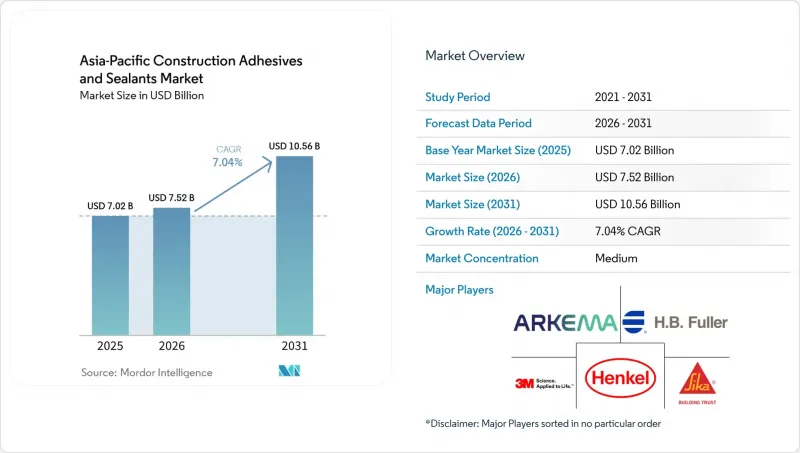
本報告按樹脂(丙烯酸樹脂、氰基丙烯酸酯樹脂、環氧樹脂等)、技術(水性、溶劑型等)、應用(地板材料/瓷磚、屋頂材料等)、最終用途(住宅、商業等)和地區(澳大利亞、中國、印度、日本、越南、泰國等)進行細分。市場預測以美元計價。
亞太地區建築黏合劑和密封劑市場趨勢及洞察。
亞太地區的基礎建設大型企劃儲備
在泰國耗資360億美元的高架橋工程中,潮間帶橋墩和隧道牆體指定使用船用級聚硫密封膠。越南的守添四號大橋採用了可承受10萬次壓縮循環的伸縮縫系統,這項性能目前正被應用於都市區高架橋工程。 BMI預測,受印度6.2%的成長率推動,亞太地區的建築支出將從2025年的2.429兆美元增至2026年的2.5804兆美元。自動化黏合劑塗覆系統可將現場人工減少30%,並將黏合劑強度均勻性提高40%,從而提高了小規模攪拌機的准入門檻。這些大型企劃共同為亞太地區建築黏合劑和密封膠市場提供了穩健的長期前景。
綠建築標準的推行正在推動對低VOC密封劑的需求。
中國國家標準GB 33372-2020根據應用場景設定了揮發性有機化合物(VOC)的限量標準,而北京市的DB11/1983-2022則將室內使用的VOC限量標準收緊至50克/公升,實際上禁止在國家工程中使用溶劑型密封膠。香港建設業局的認證將室外密封膠的VOC排放限制在100克/公升以內,並建議使用水性丙烯酸酯和改性矽烷聚合物。日本的「4VOC」自願註冊系統允許建築師選擇具有檢驗排放數據的產品,這與2025會計年度撥出的2088億日元(約合13.95億美元)的抗震維修預算共同推動了市場發展。新加坡的「綠建築總體規劃」要求到2030年,80%的新建建築獲得「綠色建築標誌鉑金級」認證,並鼓勵引入可由跨國供應商輕鬆提供的環境產品聲明(EPD)。這些法規正在加速向水性化學產品的轉變,擴大亞太地區的建築黏合劑和密封劑市場。
石化原料價格波動劇烈
2024年下半年,由於產能成長超過聚合物需求,乙烯利潤率下降了50%。 2025年中期,霍爾木茲海峽90%的航道關閉,迫使韓國裂解裝置停產,導致區域烯烴供應大幅減少。由於期貨曲線流動性不足,黏合劑生產商無法進行超過六個月的避險。因此,現貨價格飆升給利潤率帶來壓力。泰國和馬來西亞的生物石腦油先導計畫溢價30-40%,其應用僅限於綠色建築示範計畫。因此,原料價格波動限制了亞太地區建築黏合劑和密封劑市場的利潤率成長。
細分市場分析
到2025年,聚氨酯將佔銷售額的25.14%,在屋頂、隔熱材料和地板材料領域佔據主導地位。矽酮預計將超越聚氨酯,在預測期(2026-2031年)內以7.18%的複合年成長率成長,因為高層高層建築外觀需要±25%的變形容接受度和紫外線穩定性。中性固化產品已成為帷幕牆承包商防止陽極氧化鋁腐蝕的標準選擇。環氧樹脂目前仍屬於小眾市場,但其3500 PSI的抗張強度使其能夠連接預製鋼材而無需焊接,從而減少了熱工許可證和保險附加費。
銷售量受永續性驅動。陶氏的碳中和矽酮服務正在推動高階專案向矽酮方向轉型,因為這些服務提供生命週期評估 (LCA) 文件,並有助於申請「綠色標誌白金級」認證。丙烯酸產品在高檔乙烯基瓷磚的安裝中佔據主導地位,尤其是在電商倉庫中,壓敏膠粘劑能夠加快交付速度。用於乾混砂漿的通用型 VAE 分散體正面臨價格壓力,因為中國產能過剩擠壓了利潤空間。氰基丙烯酸酯和熱熔樹脂僅限於模組化生產線,其即時黏性使其價格溢價合理。因此,每種樹脂類別都針對亞太地區建築黏合劑和密封劑市場中不同的價值群體。
到2025年,單組分和雙組分密封膠將佔總銷售額的44.37%,這反映出地震多發地區對防水和結構玻璃的高度依賴。單組分矽酮密封膠因其施工簡單而被廣泛應用於住宅外牆,而雙組分體系則在橋樑和隧道等需要較長使用期限的工程中佔據主導地位。在亞太地區建築黏合劑和密封膠市場,水性黏合劑的市場佔有率預計在預測期(2026-2031年)內將以7.32%的複合年成長率成長。北京市的採購標準已強制要求室內揮發性有機化合物(VOC)排放接近零,這迫使建築公司轉向使用水性丙烯酸黏合劑。
反應型化學黏合劑、濕固化聚氨酯和雙組分環氧樹脂在預製構件工廠中市場佔有率不斷擴大,其6分鐘即可完成操作的強度顯著提高了生產效率。熱熔膠黏劑在家具封邊領域仍然很受歡迎,但由於人們對其戶外耐久性的擔憂依然存在,因此其市場佔有率仍然較小。由於主要城市和內陸省份在監管執行上的差異,目前存在雙重價格結構。溶劑型丙烯酸黏合劑仍在農村地區使用,而水性或改性矽烷膠黏劑則被指定用於城市中心的高層建築。這種政策差異將繼續影響亞太地區建築黏合劑和密封劑市場的技術替代。
其他好處:
- Excel格式的市場預測(ME)表
- 3個月的分析師支持
目錄
第1章:引言
- 研究假設和市場定義
- 調查範圍
第2章:調查方法
第3章執行摘要
第4章 市場狀況
- 市場促進因素
- 亞太地區大型基礎建設項目的規劃方案
- 綠建築標準正在推動對低VOC密封劑的需求。
- 模組化和預製建築的快速成長
- 電子商務倉庫的擴張正在推動工業地板黏合劑市場的發展。
- 用結構性黏著劑。
- 對亞太地區成熟經濟體中老舊建築進行維修。
- 市場限制因素
- 石化原料價格波動劇烈
- 加強溶劑型技術的VOC法規
- 中國矽酮單體供應中斷
- 先進施工方法熟練勞動力短缺
- 價值鏈分析
- 波特五力模型
第5章 市場規模與成長預測
- 依樹脂類型
- 丙烯酸纖維
- 氰基丙烯酸酯
- 環氧樹脂
- 聚氨酯
- 矽酮
- VAE/EVA
- 其他
- 透過技術
- 水溶液
- 溶劑型
- 反應性
- 熱熔膠
- 密封膠(單組分和雙組分)
- 透過使用
- 地板材料和瓷磚
- 屋頂材料
- 牆板和外觀
- 隔熱防潮
- 基礎設施連接(橋樑和隧道)
- 按最終用途
- 住宅
- 商業
- 產業
- 基礎設施
- 國家
- 澳洲
- 中國
- 印度
- 印尼
- 日本
- 馬來西亞
- 新加坡
- 韓國
- 泰國
- 越南
- 菲律賓
- 其他亞太國家
第6章 競爭情勢
- 市場集中度
- 策略趨勢
- 市佔率(%)和排名分析
- 公司簡介
- 3M
- Aica Kogyo Co., Ltd.
- Arkema
- Ashland Inc.
- Dow
- HB Fuller Company
- Henkel AG & Co. KGaA
- ITW Performance Polymers
- Momentive
- Pidilite Industries Ltd.
- PPG Industries Inc.
- Shin-Etsu Chemical Co., Ltd.
- Sika AG
- Soudal Group
- Wacker Chemie AG
第7章 市場機會與未來展望
According to Mordor Intelligence, the asia-Pacific construction adhesives and sealants market size was valued at USD 7.02 billion in 2025 and is estimated to grow from USD 7.52 billion in 2026 to reach USD 10.56 billion by 2031, at a CAGR of 7.04% during the forecast period (2026-2031).
This report is Segmented by Resin Type (Acrylic, Cyanoacrylate, Epoxy, and More), Technology (Water-Borne, Solvent-Borne, and More), Application (Flooring and Tiling, Roofing, and More), End-Use Sector (Residential, Commercial, and More), and Geography (Australia, China, India, Japan, Vietnam, Thailand, and More). The Market Forecasts are Provided in Terms of Value (USD).
Asia-Pacific Construction Adhesives And Sealants Market Trends and Insights
Infrastructure Megaproject Pipeline Across APAC
Thailand's USD 36 billion land-bridge will specify marine-grade polysulfide sealants for tidal-zone piers and tunnel linings. Vietnam's Thu Thiem 4 Bridge used expansion-joint systems that endured 100,000 compression cycles, a performance now replicated in metro-viaduct projects. BMI forecasts regional construction spending to climb from USD 2,429 billion in 2025 to USD 2,580.4 billion in 2026, led by India at 6.2% growth. Automated adhesive-dispensing systems are trimming on-site labor by 30% and lifting bond-strength consistency by 40%, raising entry barriers for smaller blenders. Collectively, megaproject pipelines anchor long-run visibility that sustains the Asia-Pacific Construction Adhesives and Sealants market.
Green-Building Codes Boosting Low-VOC Sealants Demand
China's GB 33372-2020 sets differentiated VOC ceilings, and Beijing's DB11/1983-2022 tightens limits to 50 g/L for interior applications, effectively banning solvent-borne mastics in state projects. Hong Kong's Construction Industry Council certification caps exterior sealant emissions at 100 g/L, favoring water-borne acrylics and modified-silane polymers. Japan's 4VOC voluntary registry lets architects select products with verified emission data, dovetailing with JPY 208.8 billion (USD 1.395 billion) allocated for seismic upgrades in FY2025. Singapore's Green Building Masterplan requires 80% of new builds to achieve Green Mark Platinum by 2030, incentivizing Environmental Product Declarations that multinational suppliers can readily furnish. These codes accelerate substitution toward water-borne chemistries, expanding the Asia-Pacific Construction Adhesives and Sealants market.
Volatile Petrochemical Feedstock Prices
Ethylene margins slid 50% in H2 2024 as capacity additions outpaced polymer demand. A 90% shipping-lane closure scenario in the Strait of Hormuz during mid-2025 forced South Korean crackers to idle units, slashing regional olefin supply. Adhesive formulators cannot hedge beyond six months because forward curves lack liquidity, so spot price spikes squeeze margins. Bio-naphtha pilots in Thailand and Malaysia trade at 30-40% premiums, confining uptake to green-building showcases. Feedstock volatility, therefore, tempers margin expansion inside the Asia-Pacific Construction Adhesives and Sealants market.
Other drivers and restraints analyzed in the detailed report include:
- Rapid Growth of Modular and Prefab Construction
- E-Commerce Warehousing Fuelling Industrial Flooring Adhesives
- Stricter VOC Limits on Solvent-Borne Technologies
For complete list of drivers and restraints, kindly check the Table Of Contents.
Segment Analysis
Polyurethane captured 25.14% of 2025 revenue, anchoring its leadership across roofing, insulation, and flooring. Silicone is set to outpace at 7.18% CAGR during the forecast period (2026-2031) because supertall facades require +-25% movement plus UV stability. Neutral-cure profiles avert corrosion on anodized aluminum, making them the default for curtain-wall contractors. Epoxy remains a niche, but its 3,500 PSI tensile strength enables weld-free prefab steel connections, saving hot-work permits and insurance surcharges.
Volume dynamics pivot on sustainability. Dow's carbon-neutral silicone service provides Life-Cycle-Assessment documentation that eases Green Mark Platinum submissions, tilting premium projects toward silicone. Acrylics dominate luxury-vinyl-tile installations, especially in e-commerce warehouses where pressure-sensitive tack accelerates handover. Commodity VAE dispersions in dry-mix mortars face price pressure as Chinese overcapacity drags margins. Cyanoacrylates and hot-melts stay confined to modular-factory lines where instant tack justifies price premiums. Each resin tier, therefore, targets discrete value pools inside the Asia-Pacific Construction Adhesives and Sealants market.
Sealant (1K and 2K) combined for 44.37% of 2025 sales, reflecting reliance on weatherproofing and structural glazing in seismic-prone geographies. One-component silicones are prevalent in residential facades due to application simplicity, whereas two-component systems prevail on bridges and tunnels that demand extended pot life. The Asia-Pacific Construction Adhesives and Sealants market share for water-borne adhesives is poised to climb at a CAGR of 7.32% during the forecast period (2026-2031). Beijing's procurement standards already enforce near-zero-VOC interiors, pushing contractors toward water-borne acrylics.
Reactive chemistries, moisture-cure polyurethanes, and two-part epoxies are stealing share in prefab factories where six-minute handling strength boosts throughput. Hot-melts remain small because outdoor durability concerns persist, but they retain popularity in furniture edge-banding. Enforcement gaps between tier-1 and interior provinces create dual pricing structures: solvent-borne acrylics linger in rural zones, while city-center towers specify water-borne or modified-silane systems. This policy gradient will continue to shape technology substitution inside the Asia-Pacific Construction Adhesives and Sealants market.
List of Companies Covered in this Report:
- 3M
- Aica Kogyo Co., Ltd.
- Arkema
- Ashland Inc.
- Dow
- H.B. Fuller Company
- Henkel AG & Co. KGaA
- ITW Performance Polymers
- Momentive
- Pidilite Industries Ltd.
- PPG Industries Inc.
- Shin-Etsu Chemical Co., Ltd.
- Sika AG
- Soudal Group
- Wacker Chemie AG
Additional Benefits:
- The market estimate (ME) sheet in Excel format
- 3 months of analyst support
TABLE OF CONTENTS
1 Introduction
- 1.1 Study Assumptions and Market Definition
- 1.2 Scope of the Study
2 Research Methodology
3 Executive Summary
4 Market Landscape
- 4.1 Market Drivers
- 4.1.1 Infrastructure megaproject pipeline across APAC
- 4.1.2 Green-building codes boosting low-VOC sealants demand
- 4.1.3 Rapid growth of modular and prefab construction
- 4.1.4 E-commerce warehousing fuelling industrial flooring adhesives
- 4.1.5 Substitution of mechanical fasteners by structural adhesives
- 4.1.6 Ageing building stock retrofits in mature Asia-Pacific economies
- 4.2 Market Restraints
- 4.2.1 Volatile petrochemical feedstock prices
- 4.2.2 Stricter VOC limits on solvent-borne technologies
- 4.2.3 Silicone monomer supply disruptions in China
- 4.2.4 Skilled labour shortage for advanced application methods
- 4.3 Value Chain Analysis
- 4.4 Porter's Five Forces
- 4.4.1 Threat of New Entrants
- 4.4.2 Bargaining Power of Suppliers
- 4.4.3 Bargaining Power of Buyers
- 4.4.4 Threat of Substitutes
- 4.4.5 Competitive Rivalry
5 Market Size and Growth Forecasts (Value and Volume)
- 5.1 By Resin
- 5.1.1 Acrylic
- 5.1.2 Cyanoacrylate
- 5.1.3 Epoxy
- 5.1.4 Polyurethane
- 5.1.5 Silicone
- 5.1.6 VAE/EVA
- 5.1.7 Others
- 5.2 By Technology
- 5.2.1 Water-borne
- 5.2.2 Solvent-borne
- 5.2.3 Reactive
- 5.2.4 Hot-melt
- 5.2.5 Sealants (1K and 2K)
- 5.3 By Application
- 5.3.1 Flooring and Tiling
- 5.3.2 Roofing
- 5.3.3 Wall Panels and Facades
- 5.3.4 Insulation and Weatherproofing
- 5.3.5 Infrastructure Joints (bridges and tunnels)
- 5.4 By End-use Sector
- 5.4.1 Residential
- 5.4.2 Commercial
- 5.4.3 Industrial
- 5.4.4 Infrastructure
- 5.5 By Country
- 5.5.1 Australia
- 5.5.2 China
- 5.5.3 India
- 5.5.4 Indonesia
- 5.5.5 Japan
- 5.5.6 Malaysia
- 5.5.7 Singapore
- 5.5.8 South Korea
- 5.5.9 Thailand
- 5.5.10 Vietnam
- 5.5.11 Philippines
- 5.5.12 Rest of Asia-Pacific
6 Competitive Landscape
- 6.1 Market Concentration
- 6.2 Strategic Moves
- 6.3 Market Share/(%)Ranking Analysis
- 6.4 Company Profiles {(includes Global level Overview, Market level overview, Core Segments, Financials as available, Strategic Information, Products and Services, and Recent Developments)}
- 6.4.1 3M
- 6.4.2 Aica Kogyo Co., Ltd.
- 6.4.3 Arkema
- 6.4.4 Ashland Inc.
- 6.4.5 Dow
- 6.4.6 H.B. Fuller Company
- 6.4.7 Henkel AG & Co. KGaA
- 6.4.8 ITW Performance Polymers
- 6.4.9 Momentive
- 6.4.10 Pidilite Industries Ltd.
- 6.4.11 PPG Industries Inc.
- 6.4.12 Shin-Etsu Chemical Co., Ltd.
- 6.4.13 Sika AG
- 6.4.14 Soudal Group
- 6.4.15 Wacker Chemie AG
7 Market Opportunities and Future Outlook
- 7.1 White-space and Unmet-need Assessment

 建築密封膠市場:全球市場預測,2026-2032年建築黏合劑市場:2026-2032年全球市場預測(依化學性質、配方技術、基材、包裝、應用及最終用途產業分類)
 中東和非洲建築黏合劑和密封劑:市場佔有率分析、行業趨勢和統計數據以及成長預測(2026-2031 年)北美建築黏合劑和密封劑:市場佔有率分析、行業趨勢和統計數據以及成長預測(2026-2031 年)建築黏合劑和密封劑:市場佔有率分析、行業趨勢和統計數據以及成長預測(2026-2031 年)歐洲建築黏合劑和密封劑:市場佔有率分析、行業趨勢和統計數據以及成長預測(2026-2031 年)美國建築黏合劑和密封劑:市場佔有率分析、行業趨勢和統計數據以及成長預測(2026-2031 年)
 建築黏合劑市場規模、佔有率和趨勢分析報告:按樹脂類型、技術、應用、地區和細分市場預測(2026-2033 年)
 全球建築黏合劑市場規模、佔有率、趨勢和成長分析報告(2026-2034年)
 2026年全球建築黏合劑市場報告