


 |
市場調查報告書
商品編碼
2066665
建築黏合劑和密封劑:市場佔有率分析、行業趨勢和統計數據以及成長預測(2026-2031 年)Construction Adhesives And Sealants - Market Share Analysis, Industry Trends & Statistics, Growth Forecasts (2026 - 2031) |
||||||

※ 本網頁內容可能與最新版本有所差異。詳細情況請與我們聯繫。
根據 Mordor Intelligence 預測,建築黏合劑和密封劑市場規模預計將在 2025 年達到 183.5 億美元,2026 年達到 195.6 億美元,到 2031 年達到 269 億美元,2026 年至 2031 年的複合年成長率為 6.58%。
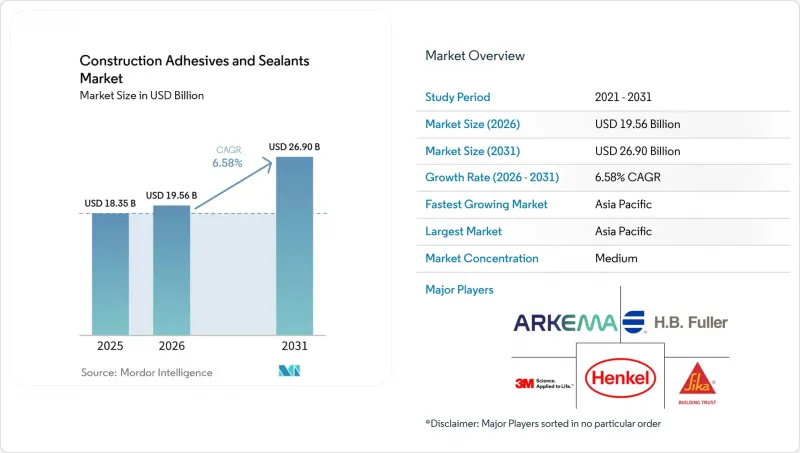
本報告按樹脂類型(丙烯酸樹脂、氰基丙烯酸酯樹脂、環氧樹脂等)、工藝(水性、溶劑型等)、應用領域(地板材料/瓷磚、屋頂材料等)、最終用途(住宅、商業等)和地區(亞太地區、北美、歐洲、南美、中東和非洲)進行細分。市場預測以美元計價。
全球建築黏合劑密封劑市場趨勢及洞察
綠建築認證的激增推動了對低VOC黏合劑的需求。
到2025年,全球LEED認證計畫數量將超過11萬個,比上一年成長14%。 BREEAM認證建築數量將超過62萬棟,WELL認證計畫數量將比2023年增加三倍。所有這些都要求黏合劑的VOC含量必須遠低於溶劑型產品的閾值。加州第1168號規則將於2025年中期生效,該規則收緊了PVC、CPVC和ABS黏合劑的VOC含量限制,鼓勵黏合劑生產商轉向水性和反應型系統。 2025年第四季度,歐盟宣布了類似的VOC限制措施,將於2026年中期生效。這將導致鄰苯二甲酸酯類塑化劑(pCBtF)的逐步淘汰,以及叔丁基乙酸酯等溶劑的禁用,從而進一步減少可使用的溶劑種類。為此,漢高和西卡於2025年3月聯合推出了一款環氧樹脂固化系統,與現有產品相比,該系統可將VOC排放降低90%。這些趨勢使得低VOC化學技術成為建築黏合劑和密封劑市場中新商業和公共項目的標準選擇。
美國、歐盟和印度的基礎設施獎勵策略
印度2026-2027會計年度的聯邦預算中累計11.21兆印度盧比(約1,330億美元)用於基礎建設,較去年同期成長11.4%。布倫特-斯彭斯大橋走廊計畫是一項耗資36億美元的維修工程,於2026年初啟動,該計畫需要符合ISO 11600和ASTM C920位移阻力標準的高性能接縫密封劑和結構性黏著劑。為提高能源效率而進行的強制性維修正在推動歐洲對幕牆密封劑的需求,漢高公司於2026年2月收購Weatherby Laroc的多數股權,正是為了把握這一維修熱潮。大規模公共工程項目正在提高規範標準,增強對高價複合產品的需求,並刺激整個建築黏合劑和密封劑市場的價值成長。
原物料價格波動與原油價格相關
在截至2026年1月的六個月裡,MDI(二苯基甲烷二異氰酸酯)和TDI(甲苯二異氰酸酯)的價格上漲了約40%。同時,布蘭特原油價格上漲,歐洲天然氣價格也達到基準值的3至4倍,導致多元醇價格上漲20%至30%,使中小型調配商的毛利率下降了5%至10個百分點。BASF等一體化生產商正利用自有原料進行避險,但他們仍指出,原油價格每桶20至30美元的波動對其收益十分敏感。這種價格波動正在加速向大豆油和再生PET衍生多元醇的轉變,但注重永續發展的客戶將承擔10%至15%的成本溢價。
細分市場分析
丙烯酸類產品在2025年佔據了24.82%的市場佔有率,仍然是地板材料和室內裝潢的經濟選擇。聚氨酯在結構連接領域仍佔據主導地位,但其市場佔有率正受到可避免異氰酸酯標籤的混合聚合物的蠶食。環氧樹脂在承重修復應用中保持著一定的市場地位,而生物基木質素和單寧體係正在穩步成長,預計將實現兩位數的成長,儘管成長低於5%。預計2026年至2031年,矽酮類產品的複合年成長率將達到7.22%,超過建築黏合劑和密封劑市場的整體表現。其±50%的變形能力和極高的耐溫性滿足了高層建築和體育場館幕牆和防水應用的需求。陶氏化學於2025年推出的DOWSIL 791,其VOC含量為45克/公升,並透過使用回收的消費品墨盒,將產品固有的碳排放減少了30%。
矽酮膠黏劑價格較高,但其25年的保固期可降低生命週期成本。在炎熱潮濕地區,由於溶劑型系統出現一系列過早失效的情況,建築師擴大選擇矽酮膠黏劑而非聚氨酯膠合劑。同時,監管機構要求降低單體含量,這促使供應商重新設計聚氨酯預聚物,雖然縮小了與矽酮膠黏劑的性能差距,但也增加了成本。這些因素共同推動了矽酮膠黏劑在建築黏合劑和密封劑市場佔有率的成長。
預計到2025年,水性化學產品將佔據59.27%的市場佔有率,並在加州1168號規則和歐盟2026年VOC排放上限規定的推動下,以6.75%的年均成長率持續成長至2031年。漢高於2026年1月收購ATP黏合劑系統公司,該公司90%的產品系列為水性產品,這清楚地顯示了其資本正向水性平台轉移。溶劑型產品則被限制在工業細分市場,在這些市場中,固化速度比排放法規的合規性更為重要。反應型體系,特別是雙組分聚氨酯和環氧樹脂,仍然是高負荷結構黏合的關鍵,但熱熔膠在自動化模組化工廠中正日益普及。
向水性解決方案的過渡需要不銹鋼混合罐和溫控儲存設施,這些資本投資對於大型承包商和模組製造商比小規模企業更有利。作為回報,承包商可以受益於更低的易燃性和更少的揮發性有機化合物 (VOC) 暴露,從而降低保險費用。正是這種結構性優勢使得水性技術在建築黏合劑和密封劑市場中脫穎而出。
區域分析
亞太地區在2025年僅佔建築黏合劑和密封劑市場的46.74%,但預計到2031年將達到6.89%的複合年成長率。中國住宅市場成長放緩,2025年12月投資年減17.2%,房價較2021年尖峰時段下跌40%,對市場需求構成壓力。另一方面,印度1330億美元的基礎設施投資以及東南亞的都市化正在推動結構密封劑和防水材料的消費。此外,日本和韓國為滿足節能和抗震標準而維修項目也進一步促進了高階矽酮產品的銷售。 Pidilight預計,隨著產能的擴大,國內住宅市場也將迎來成長。
在北美,受強勁的住宅開工量和模組化建築的支撐,市場正以穩健的速度擴張。漢高公司位於密西西比州布蘭登的工廠升級項目(投資3000萬美元,預計於2025年完工)以及西卡公司位於德克薩斯州州錫利的工廠擴建計劃(投資9000萬美元,預計於2026年1月宣布),都將增強該地區的產能。耗資36億美元的布倫特-斯彭斯大橋計畫表明,大型企劃正在推動對密封劑的需求,而諸如1168號規則等揮發性有機化合物(VOC)法規則刺激了產品配方改良和工廠升級。
儘管歐洲面臨能源成本壓力,但在「適合55歲族群居住」目標的推動下,維修需求依然穩定成長。歐盟將於2026年中期實施的VOC排放上限規定,正在加速向水性塗料的轉型。漢高收購Weatherby Laroque的股份,為老舊住宅存量的外觀維修奠定了基礎。西卡以2.2億瑞士法郎(約2.6554億美元)收購土耳其Akkim公司,為東歐、中東和非洲市場打造了一個成本效益高的業務基地。預計南美和海灣合作理事會(GCC)地區將隨著住宅建設的擴張以及基礎設施走廊的開發而進一步成長,這些地區氣候惡劣,需要高性能密封劑。
其他好處:
- Excel格式的市場預測(ME)表
- 3個月的分析師支持
目錄
第1章:引言
- 研究假設和市場定義
- 調查範圍
第2章:調查方法
第3章執行摘要
第4章 市場狀況
- 市場概覽
- 市場促進因素
- 綠建築認證的激增推動了對低VOC黏合劑的需求。
- 美國、歐盟和印度的基礎設施獎勵策略
- 異地模組化建築的迅速普及
- 3D列印混凝土需要客製化黏合劑。
- 符合室內空氣品質標準的低單體聚氨酯預聚物
- 用於結構完整性監測的智慧型感測器嵌入式密封劑
- 市場限制因素
- 與原油相關的原物料價格波動
- 加強全球溶劑型產品揮發性有機化合物(VOC)排放法規
- 混合密封劑因缺乏熟練的安裝人員而出現問題。
- 生物黏合劑在複合板結構中的應用現狀
- 價值鏈分析
- 波特五力模型
第5章 市場規模與成長預測
- 依樹脂類型
- 丙烯酸纖維
- 氰基丙烯酸酯
- 環氧樹脂
- 聚氨酯
- 矽酮
- VAE/EVA
- 其他樹脂
- 透過技術
- 水溶液
- 溶劑型
- 反應性
- 熱熔膠
- 密封膠(單組分和雙組分)
- 透過使用
- 地板材料和瓷磚
- 屋頂材料
- 牆板和外觀
- 隔熱防潮
- 基礎設施交會點(橋樑和隧道)
- 按最終用途
- 住宅
- 商業
- 產業
- 基礎設施
- 按地區
- 亞太地區
- 中國
- 日本
- 印度
- 韓國
- 印尼
- 澳洲
- 馬來西亞
- 泰國
- 新加坡
- 其他亞太國家
- 北美洲
- 美國
- 加拿大
- 墨西哥
- 歐洲
- 德國
- 法國
- 義大利
- 西班牙
- 英國
- 俄羅斯
- 其他歐洲國家
- 南美洲
- 巴西
- 阿根廷
- 其他南美國家
- 中東和非洲
- 沙烏地阿拉伯
- 阿拉伯聯合大公國
- 南非
- 其他中東和非洲國家
- 亞太地區
第6章 競爭情勢
- 市場集中度
- 策略趨勢
- 市佔率(%)和排名分析
- 公司簡介
- 3M
- Aica Kogyo Co. Ltd.
- Arkema
- Astral Adhesives
- BASF
- Dow
- DAP Global Inc.
- Franklin International
- HB Fuller Company
- Henkel AG & Co. KGaA
- Huntsman International LLC
- ITW Performance Polymers
- MAPEI SpA
- Momentive
- Pidilite Industries Ltd.
- PPG Industries Inc.
- RPM International
- Saint-Gobain
- Shin-Etsu Chemical Co., Ltd.
- Sika AG
- Soudal Group
- Wacker Chemie AG
第7章 市場機會與未來展望
According to Mordor Intelligence, the construction adhesives & sealants market size is projected to be USD 18.35 billion in 2025, USD 19.56 billion in 2026, and reach USD 26.90 billion by 2031, growing at a CAGR of 6.58% from 2026 to 2031.
This report is Segmented by Resin Type (Acrylic, Cyanoacrylate, Epoxy, and More), Technology (Water-Borne, Solvent-Borne, and More), Application (Flooring and Tiling, Roofing, and More), End-Use Sector (Residential, Commercial, and More), and Geography (Asia-Pacific, North America, Europe, South America, and Middle East and Africa). The Market Forecasts are Provided in Terms of Value (USD).
Global Construction Adhesives And Sealants Market Trends and Insights
Surge in Green-Building Certifications Driving Low-VOC Adhesive Demand
Global LEED certifications topped 110,000 projects in 2025, up 14% year over year, while BREEAM certifications surpassed 620,000 buildings, and WELL certifications tripled from 2023 levels, each mandating adhesive VOC levels well below solvent-borne thresholds. California's Rule 1168, effective mid-2025, tightened VOC caps for PVC, CPVC, and ABS cements, pushing formulators toward water-borne and reactive systems. The EU announced parallel VOC limits in Q4 2025 for mid-2026 enforcement, eliminating phthalate plasticizers such as phase-out of phthalate-based plasticizers (pCBtF) and solvents like t-butyl acetate, further shrinking the solvent palette. In response, Henkel and Sika launched joint epoxy hardener systems in March 2025, delivering 90% lower VOC emissions than incumbent products. These developments position low-VOC chemistries as the default for new commercial and institutional projects in the Construction Adhesives and Sealants market.
Infrastructure Stimulus Packages in the US, EU, and India
India's FY 2026-27 Union Budget earmarked INR 11.21 trillion (USD 133 billion) for infrastructure, up 11.4% year over year. The Brent Spence Bridge Corridor, a USD 3.6 billion overhaul begun in early 2026, will require high-performance joint sealants and structural adhesives that meet ISO 11600 and ASTM C920 movement ratings. Across Europe, energy-efficiency retrofit mandates are driving facade-sealant demand, and Henkel's February 2026 majority stake in Wetherby Laroc targets this renovation wave. Large public works elevate specification standards, reinforcing premium-priced formulations and lifting overall value growth in the Construction Adhesives and Sealants market.
Crude-Oil-Linked Raw-Material Price Volatility
MDI (Methylene Diphenyl Diisocyanate) and TDI (Toluene Diisocyanate) prices climbed roughly 40% in the six months to January 2026, while polyols rose 20-30% as Brent crude rallied and European gas settled at 3-4 times baseline, slicing 5-10 percentage points from gross margins of smaller formulators. Integrated producers such as BASF hedge through captive feedstocks, yet even they flag earnings sensitivity to USD 20-30/barrel oil swings. The volatility accelerates reformulation toward soybean-oil and recycled-PET polyols, albeit at 10-15% cost premiums borne by sustainability-minded customers.
Other drivers and restraints analyzed in the detailed report include:
- Rapid Uptake of Off-Site Modular Construction
- 3D-Printed Concrete Requiring Tailormade Bonding Agents
- Tightening Global VOC Emission Limits on Solvent-Borne Systems
For complete list of drivers and restraints, kindly check the Table Of Contents.
Segment Analysis
Acrylics, which held 24.82% share in 2025, remain the cost-effective choice for flooring and interior trim. Polyurethanes still dominate structural joints but face encroachment from hybrid polymers that avoid isocyanate labeling. Epoxies retain a niche in load-bearing repairs, while bio-based lignin and tannin systems occupy a sub-5% but double-digit-growth foothold. Silicone products are projected to grow at 7.22% CAGR during 2026-2031, eclipsing the broader construction adhesives & sealants market. Their +-50% movement capability and extreme-temperature resilience meet the demands of curtain-wall and weatherproofing applications in skyscrapers and stadiums. Dow's DOWSIL 791, released in 2025, delivers VOC at 45 g/L and uses post-consumer-recycled cartridges that cut embodied carbon by 30%.
Silicone's premium pricing is offset by 25-year warranties that reduce life-cycle cost. Architects in hot-humid geographies increasingly specify silicone over polyurethane after early failures of solvent-borne systems. Meanwhile, regulatory momentum behind low-monomer content is prompting suppliers to re-engineer polyurethane prepolymers, a step that narrows the benchmark gap with silicone but raises costs. Collectively, these shifts reinforce silicone's climb within the Construction Adhesives and Sealants market.
Water-borne chemistries captured 59.27% share in 2025 and are forecast to compound at 6.75% through 2031, aided by California's Rule 1168 and the EU's 2026 VOC ceiling. Henkel's January 2026 deal for ATP Adhesive Systems, whose portfolio is 90% water-based, illustrates the capital pivot toward this platform. Solvent-borne lines retreat to industrial niches where cure speed overrides emissions compliance. Reactive systems, especially two-component polyurethanes and epoxies, remain essential for heavy-duty structural bonds, while hot-melts gain ground in automated modular factories.
The water-borne shift demands stainless-steel mixing tanks and climate-controlled storage, upgrades that favor large contractors and module fabricators over small firms. In return, contractors gain lower insurance premiums tied to reduced flammability and VOC exposure. These structural advantages underpin the outperformance of water-borne technology within the Construction Adhesives and Sealants market.
Geography Analysis
Asia-Pacific held only 46.74% of the Construction Adhesives and Sealants market in 2025, yet is forecast to post 6.89% CAGR to 2031. China's residential downturn, investment down 17.2% year over year in December 2025 and prices off 40% from 2021 peaks, dampens demand. Offsetting this, India's USD 133 billion infrastructure outlay and Southeast-Asian urbanization spur structural-sealant and waterproofing consumption. Japanese and Korean retrofits to meet energy-efficiency and seismic codes further buoy premium silicone sales, while Pidilite's new capacity targets domestic housing growth.
North America is expanding at a nominal pace, lifted by housing-start resilience and modular construction. Henkel's USD 30 million Brandon, Mississippi, upgrade, completed in 2025, and Sika's USD 90 million Sealy, Texas, expansion announced in January 2026, reinforce regional capacity. The USD 3.6 billion Brent Spence Bridge illustrates how megaprojects amplify sealant requirements, while VOC rules such as Rule 1168 drive reformulations and equipment upgrades.
Europe faces energy-cost pressure yet enjoys steady renovation demand under Fit-for-55 targets. The EU's mid-2026 VOC ceiling accelerates water-borne migration, and Henkel's Wetherby Laroc stake positions it for facade upgrades in aging housing stock. Sika's CHF 220 million (USD 265.54 million) purchase of Turkey-based Akkim builds a cost-efficient hub for Eastern Europe, the Middle East, and Africa. South America and the GCC (Gulf Cooperation Council) add incremental growth via residential expansion and infrastructure corridors exposed to extreme climates that need high-performance sealants.
- 3M
- Aica Kogyo Co. Ltd.
- Arkema
- Astral Adhesives
- BASF
- Dow
- DAP Global Inc.
- Franklin International
- H.B. Fuller Company
- Henkel AG & Co. KGaA
- Huntsman International LLC
- ITW Performance Polymers
- MAPEI S.p.A.
- Momentive
- Pidilite Industries Ltd.
- PPG Industries Inc.
- RPM International
- Saint-Gobain
- Shin-Etsu Chemical Co., Ltd.
- Sika AG
- Soudal Group
- Wacker Chemie AG
Additional Benefits:
- The market estimate (ME) sheet in Excel format
- 3 months of analyst support
TABLE OF CONTENTS
1 Introduction
- 1.1 Study Assumptions and Market Definition
- 1.2 Scope of the Study
2 Research Methodology
3 Executive Summary
4 Market Landscape
- 4.1 Market Overview
- 4.2 Market Drivers
- 4.2.1 Surge in green-building certifications driving low-VOC adhesive demand
- 4.2.2 Infrastructure stimulus packages in the US, EU and India
- 4.2.3 Rapid uptake of off-site modular construction
- 4.2.4 3D-printed concrete requiring tailormade bonding agents
- 4.2.5 Low-monomer PU prepolymers to meet indoor-air labels
- 4.2.6 Smart-sensor-embedded sealants for structural-health monitoring
- 4.3 Market Restraints
- 4.3.1 Crude-oil linked raw-material price volatility
- 4.3.2 Tightening global VOC emission limits on solvent-borne systems
- 4.3.3 Skilled-applicator shortage causing hybrid-sealant failures
- 4.3.4 Bio-adhesive uptake in engineered-wood construction
- 4.4 Value Chain Analysis
- 4.5 Porter's Five Forces
- 4.5.1 Threat of New Entrants
- 4.5.2 Bargaining Power of Suppliers
- 4.5.3 Bargaining Power of Buyers
- 4.5.4 Threat of Substitutes
- 4.5.5 Competitive Rivalry
5 Market Size and Growth Forecasts (Value and Volume)
- 5.1 By Resin Type
- 5.1.1 Acrylic
- 5.1.2 Cyanoacrylate
- 5.1.3 Epoxy
- 5.1.4 Polyurethane
- 5.1.5 Silicone
- 5.1.6 VAE/EVA
- 5.1.7 Other Resins
- 5.2 By Technology
- 5.2.1 Water-borne
- 5.2.2 Solvent-borne
- 5.2.3 Reactive
- 5.2.4 Hot-melt
- 5.2.5 Sealants (1K and 2K)
- 5.3 By Application
- 5.3.1 Flooring and Tiling
- 5.3.2 Roofing
- 5.3.3 Wall Panels and Facades
- 5.3.4 Insulation and Weatherproofing
- 5.3.5 Infrastructure Joints (bridges and tunnels)
- 5.4 By End-use Sector
- 5.4.1 Residential
- 5.4.2 Commercial
- 5.4.3 Industrial
- 5.4.4 Infrastructure
- 5.5 By Geography
- 5.5.1 Asia-Pacific
- 5.5.1.1 China
- 5.5.1.2 Japan
- 5.5.1.3 India
- 5.5.1.4 South Korea
- 5.5.1.5 Indonesia
- 5.5.1.6 Australia
- 5.5.1.7 Malaysia
- 5.5.1.8 Thailand
- 5.5.1.9 Singapore
- 5.5.1.10 Rest of Asia-Pacific
- 5.5.2 North America
- 5.5.2.1 United States
- 5.5.2.2 Canada
- 5.5.2.3 Mexico
- 5.5.3 Europe
- 5.5.3.1 Germany
- 5.5.3.2 France
- 5.5.3.3 Italy
- 5.5.3.4 Spain
- 5.5.3.5 United Kingdom
- 5.5.3.6 Russia
- 5.5.3.7 Rest of Europe
- 5.5.4 South America
- 5.5.4.1 Brazil
- 5.5.4.2 Argentina
- 5.5.4.3 Rest of South America
- 5.5.5 Middle East and Africa
- 5.5.5.1 Saudi Arabia
- 5.5.5.2 United Arab Emirates
- 5.5.5.3 South Africa
- 5.5.5.4 Rest of Middle East and Africa
- 5.5.1 Asia-Pacific
6 Competitive Landscape
- 6.1 Market Concentration
- 6.2 Strategic Moves
- 6.3 Market Share/(%)Ranking Analysis
- 6.4 Company Profiles {(includes Global level Overview, Market level overview, Core Segments, Financials as available, Strategic Information, Products and Services, and Recent Developments)}
- 6.4.1 3M
- 6.4.2 Aica Kogyo Co. Ltd.
- 6.4.3 Arkema
- 6.4.4 Astral Adhesives
- 6.4.5 BASF
- 6.4.6 Dow
- 6.4.7 DAP Global Inc.
- 6.4.8 Franklin International
- 6.4.9 H.B. Fuller Company
- 6.4.10 Henkel AG & Co. KGaA
- 6.4.11 Huntsman International LLC
- 6.4.12 ITW Performance Polymers
- 6.4.13 MAPEI S.p.A.
- 6.4.14 Momentive
- 6.4.15 Pidilite Industries Ltd.
- 6.4.16 PPG Industries Inc.
- 6.4.17 RPM International
- 6.4.18 Saint-Gobain
- 6.4.19 Shin-Etsu Chemical Co., Ltd.
- 6.4.20 Sika AG
- 6.4.21 Soudal Group
- 6.4.22 Wacker Chemie AG
7 Market Opportunities and Future Outlook
- 7.1 White-space and Unmet-Need Assessment

 建築密封膠市場:全球市場預測,2026-2032年建築黏合劑市場:2026-2032年全球市場預測(依化學性質、配方技術、基材、包裝、應用及最終用途產業分類)
 中東和非洲建築黏合劑和密封劑:市場佔有率分析、行業趨勢和統計數據以及成長預測(2026-2031 年)北美建築黏合劑和密封劑:市場佔有率分析、行業趨勢和統計數據以及成長預測(2026-2031 年)亞太地區建築黏合劑密封劑:市場佔有率分析、產業趨勢與統計及成長預測(2026-2031 年)歐洲建築黏合劑和密封劑:市場佔有率分析、行業趨勢和統計數據以及成長預測(2026-2031 年)美國建築黏合劑和密封劑:市場佔有率分析、行業趨勢和統計數據以及成長預測(2026-2031 年)
 建築黏合劑市場規模、佔有率和趨勢分析報告:按樹脂類型、技術、應用、地區和細分市場預測(2026-2033 年)
 全球建築黏合劑市場規模、佔有率、趨勢和成長分析報告(2026-2034年)
 2026年全球建築黏合劑市場報告