


 |
市場調查報告書
商品編碼
2066669
中東和非洲建築黏合劑和密封劑:市場佔有率分析、行業趨勢和統計數據以及成長預測(2026-2031 年)Middle East And Africa Construction Adhesives And Sealants - Market Share Analysis, Industry Trends & Statistics, Growth Forecasts (2026 - 2031) |
||||||

※ 本網頁內容可能與最新版本有所差異。詳細情況請與我們聯繫。
據 Mordor Intelligence 稱,中東和非洲的建築黏合劑和密封劑市場預計將從 2025 年的 12.2 億美元成長到 2026 年的 12.9 億美元,到 2031 年達到 16.7 億美元,預計 2026 年至 2031 年的複合年成長率為 5.37%。
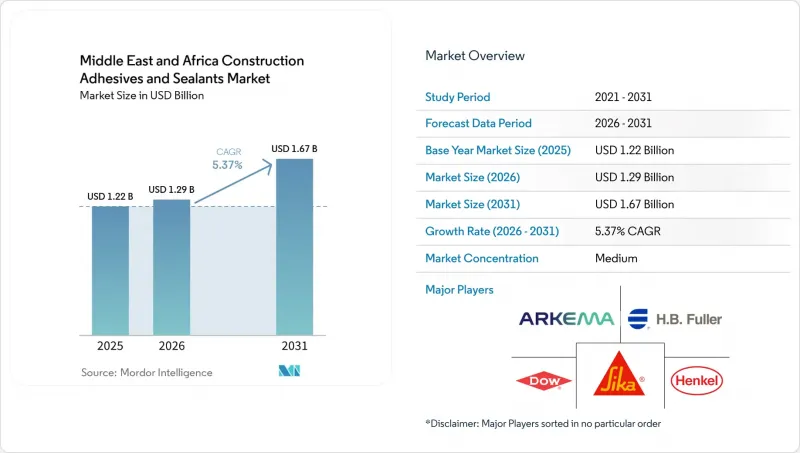
本報告按樹脂類型(丙烯酸樹脂等)、工藝(熱熔樹脂等)、應用領域(地板材料/瓷磚、屋頂材料等)、最終用途(住宅、商業等)以及地區(沙烏地阿拉伯、阿拉伯聯合大公國、卡達、南非、埃及以及其他中東和非洲國家)進行分類。市場預測以美元計價。
中東和非洲建築黏合劑和密封劑市場的趨勢和洞察。
海灣合作理事會地區大型計畫的快速擴張正在推動對特種黏合劑的需求。
沙烏地阿拉伯新阿姆機場(NEOM)的管理合約(15億美元)和吉迪亞體育場(18億美元)都需要使用防火密封膠和結構環氧樹脂,這使得黏合劑的消耗量顯著增加至普通建築工程的3-4倍。帷幕牆、隔熱金屬面板和預製模組的使用需要連續的耐候密封輪胎邊緣,這促使跨國供應商在當地設立庫存和技術團隊。此外,卡達耗資810億卡達裡亞爾(約222億美元)的基礎建設項目(包括2029年完成的286個項目)也推動了對能夠承受高達50°C溫度波動的矽酮和聚氨酯接縫的需求。高資本密集度構成了准入壁壘,迫使小規模的進口商轉向監管相對寬鬆的非洲市場。因此,在海灣合作理事會 (GCC) 的超級項目推動下,中東和非洲的建築黏合劑和密封劑市場正受益於銷售量的成長以及向經過認證的高品質配方的轉變。
海灣合作理事會 (GCC) 日益嚴格的低 VOC 法規正在加速水性產品的普及。
阿拉伯聯合大公國2024年第21號聯邦法規將黏合劑中的揮發性有機化合物(VOC)含量限制在每公升50克以內,而杜拜的TG-04法規則將密封劑的VOC含量限制降低至每公升250克,並透過強制性第三方審核來確保合規性。為此,BASF推出了Baxxodur EC 151,該產品可將VOC排放降低90%。這將使地板材料承包商避免因產品批次不合規而面臨5萬迪拉姆的罰款。因此,預計到2025年,水性丙烯酸分散體在阿拉伯聯合大公國地板黏合劑銷售中的佔有率將從2023年的38%上升至60%。目前,供應商的產品組合主要分為兩類:一類是針對海灣合作理事會(GCC)國家專案的受監管的高級產品線,另一類是監管相對寬鬆的非洲市場的傳統溶劑產品系列。監管合規方面的這種差異正在加速先進技術的應用,即使在監管執法力度有限的地區也是如此。
石油原料價格波動和運費上漲給利潤率帶來了壓力。
2025年,布蘭特原油價格在每桶72美元至95美元之間波動,導致二苯基甲烷二異氰酸酯(MDI)和甲苯二異氰酸酯(TDI)的價格波動幅度達22%至28%。這些波動給參與固定價格專案的承包商帶來了挑戰,使其難以控制成本變化。此外,繞道紅海的運輸方式使每個貨櫃的運費增加了1900美元,並將醋酸的前置作業時間延長了最多六週。這種情況迫使非洲經銷商提高安全庫存水準。雖然擁有期貨合約避險能力的跨國公司能夠維持利潤率,但規模較小的經銷商卻被迫降低市場佔有率。
細分市場分析
預計2026年至2031年間,矽膠樹脂的複合年成長率將達7.02%。這一成長主要受橋樑、隧道和地鐵接縫中對±25%位移能力且不發生內聚破壞的需求驅動。此外,卡達交通基礎設施的擴建以及埃及高層建築外觀的建設也與此成長密切相關。這些項目優先使用低模量密封劑,以協助取得LEED(能源與環境設計先鋒獎)認證積分。到2025年,丙烯酸樹脂在中東和非洲建築黏合劑和密封劑市場將佔據23.49%的佔有率。這主要得益於符合波灣合作理事會(GCC)揮發性有機化合物(VOC)法規的地板材料和瓷磚應用。符合大尺寸瓷磚20-30分鐘開放時間要求且VOC閾值低於50克/公升(g/L)的水性丙烯酸產品深受承包商青睞。
聚氨酯樹脂廣泛應用於屋頂和隔熱材料,其濕固化特性簡化了非洲偏遠地區的物流運輸。環氧樹脂是預製構件結構黏合的首選材料,例如「Baxxodur EC 151」等產品可使工業地面當天即可通行。醋酸乙烯酯-乙烯 (VAE)/乙烯-醋酸乙烯酯 (EVA) 乳液在埃及和南非注重成本的住宅項目中廣泛應用,其黏接強度可達丙烯酸樹脂的 70%,而成本卻降低 40%。混合矽烷體系則用於易受鹽霧侵蝕的沿海計畫。
預計到2025年,密封膠將佔銷售額的40.73%,並以7.09%的複合年成長率成長,這主要得益於其在橋面、幕牆周邊以及海灣合作理事會(GCC)競標中指定的伸縮縫等領域的應用。例如,卡達地鐵延伸線和埃及行政首都建設項目等工程需要使用能夠承受每日15-20毫米撓度並具有耐熱衝擊性的矽酮和聚氨酯密封膠。在阿拉伯聯合大公國,隨著第21號法令的實施,該法令將揮發性有機化合物(VOC)含量限制在50克/公升以下,並對違規者處以5萬迪拉姆(約合13612.30美元)的罰款,水性黏合劑在地板材料市場的佔有率從2023年的38%成長到2023年的60%。
活性化學品,例如雙組分環氧樹脂,在10至50 度C的溫度範圍內,現場黏合強度可超過2.5兆帕(MPa)。固化時間為3秒的黏合劑在預製保溫板中的應用日益廣泛,其中漢高公司的「樂泰HB S ECO」含有63%的生物基材料,尤其受到追求LEED認證的承包商的關注。溶劑型黏合劑在監管強度較弱的市場中仍持續使用,但隨著南非在2028年將VOC(揮發性有機化合物)限值提高至75克/公升,預計其市場佔有率將會下降。
其他好處:
- Excel格式的市場預測(ME)表
- 3個月的分析師支持
目錄
第1章:引言
- 研究假設和市場定義
- 調查範圍
第2章:調查方法
第3章執行摘要
第4章 市場狀況
- 市場概覽
- 市場促進因素
- 海灣合作理事會大型計畫(例如,NEOM、吉地亞)的快速發展
- 海灣合作理事會國家更嚴格的低VOC法規正在將需求轉向水性和反應性化學產品。
- 東非地區模組化異地建造的興起
- 在沙烏地阿拉伯和阿拉伯聯合大公國在地化生產聚氨酯預聚物(成本和前置作業時間)
- 強制性碳排放減少正在加速生物基配方的採用。
- 引入人工智慧智慧點膠系統提高了應用流程的效率。
- 市場限制因素
- 紅海航線石油原料價格波動及運費附加費
- 海灣合作理事會地區以外分散的經銷網路正在減緩產品的普及速度。
- 由於非洲各國在統一揮發性有機化合物(VOC)法規方面進展緩慢,合規成本不斷增加。
- 熟練承包商的短缺增加了專案返工的風險。
- 價值鏈分析
- 波特五力模型
第5章 市場規模與成長預測
- 依樹脂類型
- 丙烯酸纖維
- 氰基丙烯酸酯
- 環氧樹脂
- 聚氨酯
- 矽酮
- VAE/EVA
- 其他樹脂
- 透過技術
- 水溶液
- 溶劑型
- 反應性
- 熱熔膠
- 密封劑
- 透過使用
- 地板材料和瓷磚
- 屋頂材料
- 牆板和外觀
- 隔熱防潮
- 基礎設施連接點(橋樑、隧道)
- 按最終用途
- 住宅
- 商業
- 產業
- 基礎設施
- 按地區
- 沙烏地阿拉伯
- 阿拉伯聯合大公國
- 卡達
- 南非
- 埃及
- 其他中東和非洲國家
第6章 競爭情勢
- 市場集中度
- 策略趨勢
- 市佔率(%)和排名分析
- 公司簡介
- 3M
- Arkema
- Avery Dennison Corp.
- BASF
- Dow
- Fosroc, Inc.
- HB Fuller Company
- Henkel AG & Co. KGaA
- Huntsman International LLC
- ITW Performance Polymers
- MAPEI SpA
- Permoseal
- Pidilite Industries Ltd.
- RPM International Inc.
- Saint-Gobain
- Sika AG
- Soudal Group
- Tremco Construction Products Group
- Wacker Chemie AG
第7章 市場機會與未來展望
According to Mordor Intelligence, the middle east and Africa Construction Adhesives and Sealants Market size is expected to increase from USD 1.22 billion in 2025 to USD 1.29 billion in 2026 and reach USD 1.67 billion by 2031, growing at a CAGR of 5.37% over 2026-2031.
This report is Segmented by Resin (Acrylic and More), Technology (Hot Melt and More), Application (Flooring and Tiling, Roofing, and More), End-Use Sector (Residential, Commercial, and More) and Geography (Saudi Arabia, United Arab Emirates, Qatar, South Africa, Egypt, and Rest of Middle East and Africa). The Market Forecasts are Provided in Terms of Value (USD).
Middle East And Africa Construction Adhesives And Sealants Market Trends and Insights
Booming GCC Giga-Projects Drive Specialty Adhesive Demand
Saudi Arabia's NEOM airport management contract, valued at USD 1.5 billion, and Qiddiya's USD 1.8 billion athletics stadium both require fire-rated sealants and structural epoxies, significantly increasing adhesive consumption, up to three-to-four times more than standard construction projects. The use of curtain walls, insulated metal panels, and prefabricated modules necessitates continuous weatherproofing beads, prompting multinational suppliers to position inventories and technical teams within the kingdom. Additionally, Qatar's QAR 81 billion (USD 22.20 billion) infrastructure pipeline, which includes 286 projects through 2029, sustains demand for silicone and polyurethane joints capable of withstanding temperature swings of up to 50 degrees Celsius. High capital intensity creates entry barriers, steering smaller importers toward less-regulated African markets. As a result, the Middle East and Africa construction adhesives and sealants market benefits from both increased volume and a shift toward certified, premium formulations driven by GCC giga-projects.
Stricter GCC Low-VOC Regulations Accelerate Water-Borne Adoption
The United Arab Emirates (UAE) Federal Decree-Law No. 21 of 2024 limits adhesive volatile organic compounds (VOCs) to 50 grams per liter, while Dubai's TG-04 regulation reduces sealant VOC limits to 250 grams per liter, with compliance enforced through mandatory third-party audits. In response, BASF introduced Baxxodur EC 151, which reduces VOC emissions by 90%, enabling flooring contractors to avoid AED 50,000 penalties for non-compliant batches. Consequently, water-borne acrylic dispersions are projected to rise from 38% of UAE flooring-adhesive sales in 2023 to 60% by 2025. Suppliers are now segmenting their portfolios into premium, compliant lines for GCC projects and legacy solvent-borne grades for less-regulated African markets. This compliance gap is accelerating the adoption of advanced technologies, even in regions with limited enforcement.
Petro-Feedstock Volatility & Freight Surcharges Compress Margins
In 2025, Brent crude oil prices fluctuated between USD 72-95 per barrel, resulting in 22-28% price variations for methylene diphenyl diisocyanate (MDI) and toluene diisocyanate (TDI). These fluctuations have created challenges for contractors working on fixed-price projects, as they face difficulties in managing cost changes. Additionally, rerouting through the Red Sea increased freight costs by USD 1,900 per container and extended acetic acid lead times by up to six weeks. This situation has required African distributors to increase their safety stock levels. Multinational companies with the ability to hedge futures have managed to maintain their margins, while smaller resellers have experienced a reduction in market share.
Other drivers and restraints analyzed in the detailed report include:
- Rise of Modular Construction in East Africa Expands Acrylic Volumes
- Localization of Polyurethane Pre-Polymer Production Reduces Supply-Chain Risk
- Fragmented Distribution Networks Hinder Product Penetration
For complete list of drivers and restraints, kindly check the Table Of Contents.
Segment Analysis
Silicone resins are projected to grow at a 7.02% compound annual growth rate (CAGR) from 2026 to 2031, driven by demand for +-25% movement capacity in bridge, tunnel, and metro joints without cohesive failure. This growth is linked to Qatar's transportation infrastructure expansion and Egypt's high-rise facades, which prioritize low-modulus sealants that contribute to Leadership in Energy and Environmental Design (LEED) certification points. Acrylic resins held a 23.49% share of the Middle East & Africa construction adhesives and sealants market in 2025, supported by flooring and tiling applications that comply with Gulf Cooperation Council (GCC) volatile organic compound (VOC) regulations. Water-borne acrylics, meeting 20-30 minute open-time requirements for large tiles and adhering to 50 grams per liter (g/L) VOC thresholds, have secured contractor preference.
Polyurethane resins are widely used in roofing and insulation, where moisture-curing simplifies logistics in remote African locations. Epoxy resins are preferred for structural bonding in precast elements, with products like Baxxodur EC 151 enabling same-day traffic on industrial floors. Vinyl acetate ethylene (VAE)/ethylene vinyl acetate (EVA) emulsions dominate cost-sensitive housing projects in Egypt and South Africa, offering 70% of acrylic bond strength at 40% lower cost. Hybrid silane systems are utilized in coastal projects exposed to salt spray.
Sealants accounted for 40.73% of 2025 revenue and are expected to grow at a 7.09% CAGR, driven by applications in bridge decks, curtain-wall perimeters, and expansion joints specified in GCC tenders. Qatar's metro extensions and Egypt's administrative capital projects require thermal-shock-resistant silicones and polyurethanes capable of flexing 15-20 millimeters (mm) daily. Water-borne adhesives have increased their share of UAE flooring sales from 38% in 2023 to 60%, following the implementation of Decree-Law No. 21, which enforces 50 g/L VOC limits and imposes AED 50,000 (USD 13,612.3) fines for non-compliance.
Reactive chemistries, such as two-component epoxies, provide bond strengths exceeding 2.5 megapascals (MPa) across job sites with temperatures ranging from 10-50 °C. Hot melts, with three-second set times, are increasingly used for prefabricated insulated panels, with Henkel's 63% bio-based LOCTITE HB S ECO gaining traction among contractors aiming for LEED certification. Solvent-borne adhesives remain in use in markets with limited regulatory enforcement, but are expected to lose market share as South Africa adopts 75 g/L VOC caps by 2028.
List of Companies Covered in this Report:
- 3M
- Arkema
- Avery Dennison Corp.
- BASF
- Dow
- Fosroc, Inc.
- H.B. Fuller Company
- Henkel AG & Co. KGaA
- Huntsman International LLC
- ITW Performance Polymers
- MAPEI S.p.A.
- Permoseal
- Pidilite Industries Ltd.
- RPM International Inc.
- Saint-Gobain
- Sika AG
- Soudal Group
- Tremco Construction Products Group
- Wacker Chemie AG
Additional Benefits:
- The market estimate (ME) sheet in Excel format
- 3 months of analyst support
TABLE OF CONTENTS
1 Introduction
- 1.1 Study Assumptions and Market Definition
- 1.2 Scope of the Study
2 Research Methodology
3 Executive Summary
4 Market Landscape
- 4.1 Market Overview
- 4.2 Market Drivers
- 4.2.1 Booming GCC giga-projects (e.g., NEOM, Qiddiya)
- 4.2.2 Stricter GCC low-VOC regulations shifting demand to water-borne and reactive chemistries
- 4.2.3 Rise of modular/off-site construction across East Africa
- 4.2.4 Localization of polyurethane pre-polymer production in Saudi Arabia and UAE (cost and lead-time)
- 4.2.5 Carbon-reduction mandates accelerating bio-based formulations adoption
- 4.2.6 Adoption of AI-driven smart-dispensing systems improving application productivity
- 4.3 Market Restraints
- 4.3.1 Petro-feedstock price volatility and Red Sea freight surcharges
- 4.3.2 Fragmented distribution network outside GCC slowing product penetration
- 4.3.3 Delayed harmonization of VOC limits across African countries raises compliance costs
- 4.3.4 Skilled-applicator shortage elevating project re-work risk
- 4.4 Value Chain Analysis
- 4.5 Porter's Five Forces
- 4.5.1 Threat of New Entrants
- 4.5.2 Bargaining Power of Suppliers
- 4.5.3 Bargaining Power of Buyers
- 4.5.4 Threat of Substitutes
- 4.5.5 Industry Rivalry
5 Market Size and Growth Forecasts (Value)
- 5.1 By Resin
- 5.1.1 Acrylic
- 5.1.2 Cyanoacrylate
- 5.1.3 Epoxy
- 5.1.4 Polyurethane
- 5.1.5 Silicone
- 5.1.6 VAE/EVA
- 5.1.7 Other Resins
- 5.2 By Technology
- 5.2.1 Water-borne
- 5.2.2 Solvent-borne
- 5.2.3 Reactive
- 5.2.4 Hot-melt
- 5.2.5 Sealants
- 5.3 By Application
- 5.3.1 Flooring and Tiling
- 5.3.2 Roofing
- 5.3.3 Wall Panels and Facades
- 5.3.4 Insulation and Weatherproofing
- 5.3.5 Infrastructure Joints (bridges, tunnels)
- 5.4 By End-use Sector
- 5.4.1 Residential
- 5.4.2 Commercial
- 5.4.3 Industrial
- 5.4.4 Infrastructure
- 5.5 By Geography
- 5.5.1 Saudi Arabia
- 5.5.2 United Arab Emirates
- 5.5.3 Qatar
- 5.5.4 South Africa
- 5.5.5 Egypt
- 5.5.6 Rest of Middle East and Africa
6 Competitive Landscape
- 6.1 Market Concentration
- 6.2 Strategic Moves
- 6.3 Market Share/(%)Ranking Analysis
- 6.4 Company Profiles {(includes Global level Overview, Market level overview, Core Segments, Financials as available, Strategic Information, Products and Services, and Recent Developments)}
- 6.4.1 3M
- 6.4.2 Arkema
- 6.4.3 Avery Dennison Corp.
- 6.4.4 BASF
- 6.4.5 Dow
- 6.4.6 Fosroc, Inc.
- 6.4.7 H.B. Fuller Company
- 6.4.8 Henkel AG & Co. KGaA
- 6.4.9 Huntsman International LLC
- 6.4.10 ITW Performance Polymers
- 6.4.11 MAPEI S.p.A.
- 6.4.12 Permoseal
- 6.4.13 Pidilite Industries Ltd.
- 6.4.14 RPM International Inc.
- 6.4.15 Saint-Gobain
- 6.4.16 Sika AG
- 6.4.17 Soudal Group
- 6.4.18 Tremco Construction Products Group
- 6.4.19 Wacker Chemie AG
7 Market Opportunities and Future Outlook
- 7.1 White-space and Unmet-Need Assessment

 建築密封膠市場:全球市場預測,2026-2032年建築黏合劑市場:2026-2032年全球市場預測(依化學性質、配方技術、基材、包裝、應用及最終用途產業分類)
 北美建築黏合劑和密封劑:市場佔有率分析、行業趨勢和統計數據以及成長預測(2026-2031 年)亞太地區建築黏合劑密封劑:市場佔有率分析、產業趨勢與統計及成長預測(2026-2031 年)建築黏合劑和密封劑:市場佔有率分析、行業趨勢和統計數據以及成長預測(2026-2031 年)歐洲建築黏合劑和密封劑:市場佔有率分析、行業趨勢和統計數據以及成長預測(2026-2031 年)美國建築黏合劑和密封劑:市場佔有率分析、行業趨勢和統計數據以及成長預測(2026-2031 年)
 建築黏合劑市場規模、佔有率和趨勢分析報告:按樹脂類型、技術、應用、地區和細分市場預測(2026-2033 年)
 全球建築黏合劑市場規模、佔有率、趨勢和成長分析報告(2026-2034年)
 2026年全球建築黏合劑市場報告