


 |
市場調查報告書
商品編碼
2066632
印度屋頂工程:市場佔有率分析、產業趨勢與統計、成長預測(2026-2031)India Roofing - Market Share Analysis, Industry Trends & Statistics, Growth Forecasts (2026 - 2031) |
||||||

※ 本網頁內容可能與最新版本有所差異。詳細情況請與我們聯繫。
根據 Mordor Intelligence 預測,印度屋頂市場規模將從 2025 年的 80.8 億美元成長到 2026 年的 86 億美元,然後在 2031 年達到 117.3 億美元,2026 年至 2031 年的複合年成長率為 6.41%。
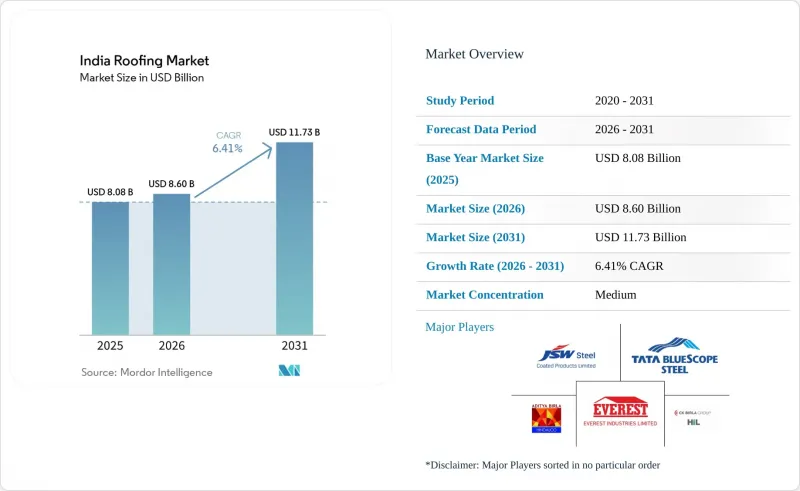
本報告按材料類型(瀝青瓦、粘土/混凝土瓦等)、施工類型(新建、屋頂更換/維修)、應用領域(住宅、商業、工業、公共及其他)和地區(印度北部、印度南部、印度西部、印度東部和東北部)進行細分。市場預測以美元計價。
印度屋頂市場趨勢與洞察
可支配所得增加和中產階級擴大
可支配收入的成長推動了住宅對高階防水卷材的需求,這類卷材使用壽命更長,冷凍成本更低。政府的「人人享有住房機會計畫」(PMAY)已在住宅都市區提供了1180萬套,在農村地區提供了2950萬套,從而建立了大規模的安裝基礎,為維修做好了準備。目前,在二、三線城市,採用熱塑性聚烯(TPO)和三元乙丙橡膠(EPDM)膜材取代普通瀝青卷材的高規格項目比例正在擴大。製造商正在加強對分銷商的培訓,以滿足這一潛在需求,而金融機構則正在試點推出經濟實惠的分期付款計劃,以促進這些價格昂貴但經久耐用的系統的應用。
政府基礎建設發展舉措(智慧城市計畫、PMAY)
PMAY的標準化屋頂模板使製造商能夠利用規模經濟,並收回其在自動化輥壓成型生產線上的投資。同時,智慧城市計畫正在引入綠色建築評估標準,從而推動了冷屋頂塗料和太陽能相容緊固件的廣泛應用。能夠根據不同氣候區(潮濕的沿海地區、乾燥的內陸地區或溫帶北部地區)調整規格的供應商不斷獲得來自邦政府機構的訂單。因此,大規模住宅與智慧城市基礎設施的整合為印度屋頂市場提供了多個可預測的收入來源,並獎勵加強追蹤終端用戶補貼使用情況的數位化銷售管道。
假冒劣質材料的氾濫
透過非官方零售通路銷售的低價屋頂捲材中,高達30%未能通過IS 15965拉伸測試,損害了消費者信心,並拉低了平均售價。仿冒高階品牌的仿冒品導致保固索賠激增,迫使正規企業額外投入資金用於全像標籤和QR碼檢驗。一些不法分子利用行動應用程式,允許零售商掃描批號進行即時真偽驗證,從而確保回頭客。儘管監管力道不斷加大,但各州執法力度不一,遵守規定的企業仍需承擔3-5%的成本劣勢。
細分市場分析
到2025年,金屬屋頂將佔印度屋頂市場佔有率的26.5%,超過所有其他材料類別,這主要得益於工業倉庫、商業建築和預製鋼結構建築(PEB)的廣泛應用。在整個印度屋頂產業,金屬屋頂系統持續享有諸多優勢,例如安裝快速、使用壽命長,以及在對結構可靠性和美觀性要求較高的跨度大建築應用中廣受歡迎。主要供應商廣泛的分銷網路也是關鍵因素,因為更完善的末端配送網路使品牌塗層鋼板更容易滲透到非大都會圈的建築市場,在這些市場中,在地採購仍然是屋頂材料選擇的重要考慮因素。粘土瓦和混凝土瓦在印度南部住宅建築中仍然佔據穩固地位,尤其是在坡屋頂是當地建築慣例的地區。然而,在商業和公共建築項目中,金屬屋頂系統的市場佔有率正在穩步成長,因為在這些項目中,耐腐蝕性、安裝速度和較低的維護成本比傳統的美觀更為重要。
預計到2031年,瀝青基/改質瀝青防水卷材的複合年成長率將達到8.20%,成為印度屋頂材料市場成長最快的產品線。這一成長主要得益於平屋頂商業建築、大型零售項目、物流園區和公共設施等場所,在這些場所,防水性能不再是可選項,而是必需品。熱塑性聚烯(TPO)、三元乙丙橡膠(EPDM)和聚氯乙烯(PVC)等單層薄膜在高規格商業屋頂中也越來越受歡迎,因為這些場所對隔熱性和維護性能要求較高。木質屋頂仍然主要應用於高階和特定領域。同時,波紋纖維水泥板、未增聚氯乙烯(UPVC)和聚碳酸酯產品持續滿足農村、農業和臨時建築等價格較低的市場需求。因此,印度屋頂材料市場正在經歷兩極分化的擴張:高性能的高級產品在以規格主導的項目中不斷成長,而基本替代品在以低初始成本為首要考慮因素的地區保持穩定的需求。
其他好處:
- Excel格式的市場預測(ME)表
- 3個月的分析師支持
目錄
第1章:引言
- 研究假設和市場定義
- 調查範圍
第2章:調查方法
第3章執行摘要
第4章 市場狀況
- 市場概覽
- 市場促進因素
- 可支配所得增加和中產階級擴大
- 快速的都市化與建設熱潮
- 政府基礎建設發展政策(智慧城市計畫、PMAY)
- 住宅太陽能發電的補貼正在加速對金屬夾芯板的需求。
- 促進沿海國家應對氣候變遷能力的義務
- 州級「冷屋頂」政策旨在緩解都市區熱島效應
- 市場限制因素
- 假冒仿冒品產品的氾濫。
- 技術純熟勞工短缺
- 進口瀝青和金屬價格波動(或下降?)。
- 地方政府對創新系統的核准延誤
- 價值供應鏈分析
- 監理情勢
- 技術展望
- 波特五力分析
第5章 市場規模與成長預測
- 材料類型
- 瀝青瓦
- 粘土磚和水泥瓦
- 金屬屋頂
- 瀝青基/改質瀝青基防水卷材
- 單層薄膜(TPO、EPDM、PVC)
- 樹
- 其他
- 依建築類型
- 新建工程
- 屋頂更換和維修
- 透過使用
- 住宅
- 商業
- 產業
- 公共和非營利組織
- 其他
- 按地區
- 印度北部
- 南印度
- 西印度群島
- 印度東部和東北部
第6章 競爭情勢
- 市場集中度
- 策略趨勢
- 市佔率分析
- 公司簡介
- Tata BlueScope Steel
- Hindalco Industries Ltd
- JSW Steel Coated Products
- CK Birla Group(HIL Ltd)
- Everest Industries Ltd
- Bansal Roofing Products Ltd
- Metecno India Pvt Ltd
- Indian Roofing Industries Pvt Ltd
- Visaka Industries Ltd
- Ramco Industries Ltd
- Onduline India
- Interarch Building Products
- Saint-Gobain India Pvt Ltd
- Supreme Industries Ltd
- Bhushan Power & Steel Ltd
- Peninsular Roofing Products
- Vijay Roofing Systems
- JSW Everglow(JSW Steel)
- LYSAGHTA(R)Roofing Solutions
第7章 市場機會與未來展望
According to Mordor Intelligence, the india roofing market size is expected to grow from USD 8.08 billion in 2025 to USD 8.6 billion in 2026 and is forecast to reach USD 11.73 billion by 2031 at 6.41% CAGR over 2026-2031.
This report is Segmented by Material Type (Asphalt Shingles, Clay & Concrete Tiles, and More), by Construction Type (New Construction, Reroofing and Replacement), by Application (Residential, Commercial, Industrial, Institutional, Others), and by Geography (North India, South India, West India, East and North East India). The Market Forecasts are Provided in Terms of Value (USD).
India Roofing Market Trends and Insights
Rising Disposable Income & Middle-Class Expansion
Higher disposable income is steering homeowners toward premium membranes that promise extended service life and lower cooling costs. The government's PMAY program has delivered 1.18 crore homes under its urban component and 2.95 crore under its rural arm, creating a large installed base ready for upgrades. Tier-2 and Tier-3 cities now account for a growing share of specification-rich projects where thermoplastic polyolefin (TPO) and EPDM membranes displace commodity asphalt sheets. Manufacturers are amplifying dealer training to capture this latent demand, while financiers are piloting easy EMI plans that ease the adoption of costlier but more durable systems.
Government Infrastructure Initiatives (Smart Cities Mission, PMAY)
PMAY's standardized roofing templates allow scale-driven manufacturers to amortize investments in automated roll-forming lines. Simultaneously, Smart Cities projects impose green-building scorecards that popularize cool-roof pigments and solar-ready fasteners. Vendors able to localize specifications for climate zones, humid coastal, dry arid, or temperate northern win repeat orders from state agencies. The convergence of mass housing and smart municipal assets, therefore, gives the India roofing market multiple predictable revenue streams and an incentive to upgrade digital sales channels that track subsidy availment for end users.
Counterfeit/Sub-Standard Materials Prevalence
Up to 30% of low-ticket roofing rolls in informal retail channels fail IS 15965 tensile tests, eroding consumer trust and compressing average selling prices. Warranty claims surge when counterfeit logos masquerade as premium brands, forcing genuine companies to spend more on hologram labels and QR-based verification. Organized players leverage mobile apps that allow dealers to scan batch numbers and instantly confirm authenticity, thereby locking in repeat orders. Regulatory raids, though increasing, remain uneven across states, leaving compliance-paying firms at a 3-5% cost disadvantage.
Other drivers and restraints analyzed in the detailed report include:
- Solar-Rooftop Subsidies are Accelerating Metal Sandwich Demand
- Climate-Resilience Mandates in Coastal States
- Imported Bitumen & Metal Price Volatility
For complete list of drivers and restraints, kindly check the Table Of Contents.
Segment Analysis
Metal Roofing held 26.5% of the India roofing market share in 2025, keeping it ahead of all other material categories, driven by industrial warehousing, commercial buildings, and Pre-Engineered Buildings (PEBs). Across the India roofing industry, metal systems continue to benefit from faster installation, long service life, and stronger acceptance in large-span applications where structural reliability matters as much as appearance. The dealer footprint of large suppliers also matters because broader last-mile reach helps branded coated steel move into non-metro construction markets where local procurement still drives many roofing decisions. Clay and concrete tiles still retain a clear place in South India residential construction, especially where sloped roofs are part of local building practice. Even so, metal systems are steadily taking share in commercial and institutional projects where corrosion resistance, speed, and lower maintenance carry more weight than traditional appearance.
Bituminous/Modified Bitumen Membranes are forecast to grow at a 8.20% CAGR through 2031, making them the fastest-growing material line in the India roofing market. This growth is tied to flat-roof commercial buildings, organized retail projects, logistics parks, and institutional assets where waterproofing performance is a hard requirement rather than a discretionary feature. Single-ply membranes such as Thermoplastic Polyolefin (TPO), Ethylene Propylene Diene Monomer (EPDM), and Polyvinyl Chloride (PVC) are also becoming more visible in higher-specification commercial roofs where thermal and maintenance performance have gained importance. Wood roofing remains limited to premium and niche uses. At the same time, corrugated fiber cement, Unplasticized Polyvinyl Chloride (UPVC), and polycarbonate products continue to serve rural, agricultural, and temporary-structure demand at lower price points. In the India roofing market, the material mix is therefore widening at both ends, with premium performance products growing in specification-led projects and basic alternatives holding steady where upfront affordability still dominates.
List of Companies Covered in this Report:
- Tata BlueScope Steel
- Hindalco Industries Ltd
- JSW Steel Coated Products
- CK Birla Group (HIL Ltd)
- Everest Industries Ltd
- Bansal Roofing Products Ltd
- Metecno India Pvt Ltd
- Indian Roofing Industries Pvt Ltd
- Visaka Industries Ltd
- Ramco Industries Ltd
- Onduline India
- Interarch Building Products
- Saint-Gobain India Pvt Ltd
- Supreme Industries Ltd
- Bhushan Power & Steel Ltd
- Peninsular Roofing Products
- Vijay Roofing Systems
- JSW Everglow (JSW Steel)
- LYSAGHTA(R) Roofing Solutions
Additional Benefits:
- The market estimate (ME) sheet in Excel format
- 3 months of analyst support
TABLE OF CONTENTS
1 Introduction
- 1.1 Study Assumptions & Market Definition
- 1.2 Scope of the Study
2 Research Methodology
3 Executive Summary
4 Market Landscape
- 4.1 Market Overview
- 4.2 Market Drivers
- 4.2.1 Rising disposable income & middle-class expansion
- 4.2.2 Rapid urbanization & construction boom
- 4.2.3 Government infrastructure initiatives (Smart Cities Mission, PMAY)
- 4.2.4 Solar-rooftop subsidies accelerating metal sandwich demand
- 4.2.5 Climate-resilience mandates in coastal states
- 4.2.6 State-level "cool roof" policies for urban heat mitigation
- 4.3 Market Restraints
- 4.3.1 Counterfeit / sub-standard materials prevalence
- 4.3.2 Skilled-labour shortage
- 4.3.3 Imported bitumen & metal price volatility (? depreciation)
- 4.3.4 Municipal approval delays for innovative systems
- 4.4 Value / Supply-Chain Analysis
- 4.5 Regulatory Landscape
- 4.6 Technological Outlook
- 4.7 Porter's Five Forces Analysis
- 4.7.1 Bargaining Power of Suppliers
- 4.7.2 Bargaining Power of Consumers
- 4.7.3 Threat of New Entrants
- 4.7.4 Threat of Substitutes
- 4.7.5 Intensity of Competitive Rivalry
5 Market Size & Growth Forecasts (Value, In USD Billion)
- 5.1 By Material Type
- 5.1.1 Asphalt Shingles
- 5.1.2 Clay & Concrete Tiles
- 5.1.3 Metal Roofing
- 5.1.4 Bituminous / Modified Bitumen Membranes
- 5.1.5 Single-Ply Membranes (TPO, EPDM, and PVC)
- 5.1.6 Wood
- 5.1.7 Others
- 5.2 By Construction Type
- 5.2.1 New Construction
- 5.2.2 Reroofing and Replacement
- 5.3 By Application
- 5.3.1 Residential
- 5.3.2 Commercial
- 5.3.3 Industrial
- 5.3.4 Institutional
- 5.3.5 Others
- 5.4 By Geography
- 5.4.1 North India
- 5.4.2 South India
- 5.4.3 West India
- 5.4.4 East and North East India
6 Competitive Landscape
- 6.1 Market Concentration
- 6.2 Strategic Moves
- 6.3 Market Share Analysis
- 6.4 Company Profiles (includes Global level Overview, Market level overview, Core Segments, Financials as available, Strategic Information, Products & Services, and Recent Developments)
- 6.4.1 Tata BlueScope Steel
- 6.4.2 Hindalco Industries Ltd
- 6.4.3 JSW Steel Coated Products
- 6.4.4 CK Birla Group (HIL Ltd)
- 6.4.5 Everest Industries Ltd
- 6.4.6 Bansal Roofing Products Ltd
- 6.4.7 Metecno India Pvt Ltd
- 6.4.8 Indian Roofing Industries Pvt Ltd
- 6.4.9 Visaka Industries Ltd
- 6.4.10 Ramco Industries Ltd
- 6.4.11 Onduline India
- 6.4.12 Interarch Building Products
- 6.4.13 Saint-Gobain India Pvt Ltd
- 6.4.14 Supreme Industries Ltd
- 6.4.15 Bhushan Power & Steel Ltd
- 6.4.16 Peninsular Roofing Products
- 6.4.17 Vijay Roofing Systems
- 6.4.18 JSW Everglow (JSW Steel)
- 6.4.19 LYSAGHTA(R) Roofing Solutions
7 Market Opportunities & Future Outlook
- 7.1 White-space & Unmet-need Assessment

 屋面材料市場:2026-2032年全球市場預測(按屋頂類型、材料類型、安裝類型、分銷管道和應用分類)水泥屋頂材料市場:2026-2032年全球市場預測(依產品種類、厚度、材質成分、應用、最終用途及通路分類)
 中東和北非屋頂材料市場:市場佔有率分析、行業趨勢和統計數據以及成長預測(2026-2031 年)中東歐屋頂材料:市場佔有率分析、產業趨勢與統計及成長預測(2026-2031 年)亞太地區屋頂材料:市場佔有率分析、產業趨勢與統計及成長預測(2026-2031)南美洲屋頂材料市場:市場佔有率分析、產業趨勢與統計、成長預測(2026-2031年)東協屋頂材料市場:市佔率分析、產業趨勢與統計、成長預測(2026-2031年)美國屋頂材料:市場佔有率分析、產業趨勢與統計及成長預測(2026-2031 年)
 2026年全球低坡度住宅屋頂市場報告2026年全球屋頂材料市場報告