


 |
市場調查報告書
商品編碼
2064458
東協機械、電氣和管道(MEP)服務:市場佔有率分析、行業趨勢和統計數據以及成長預測(2026-2031 年)ASEAN Mechanical, Electrical, And Plumbing (MEP) Services - Market Share Analysis, Industry Trends & Statistics, Growth Forecasts (2026 - 2031) |
||||||

※ 本網頁內容可能與最新版本有所差異。詳細情況請與我們聯繫。
根據 Mordor Intelligence 預測,東協機電管線 (MEP) 服務市場規模將從 2025 年的 154.4 億美元成長到 2026 年的 166.9 億美元,然後在 2031 年達到 280.9 億美元,2026 年至 2031 年的複合年成長率為 10.97%。
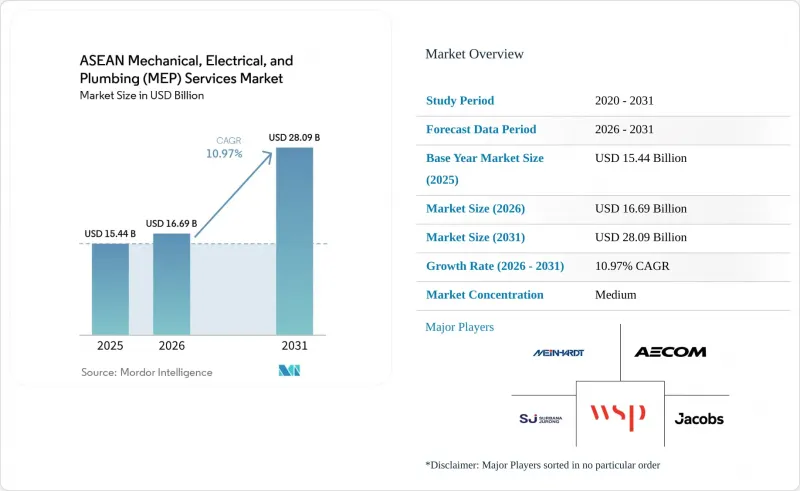
本報告按類型(機械、電氣、管道、機電一體化)、服務類型(設計工程、安裝試運行、維護維修及其他服務)、最終用戶行業(住宅、商業、基礎設施)和地區(印尼、馬來西亞、泰國、越南、新加坡及其他東協國家)進行細分。市場預測以以金額為準(十億美元)表示。
東協機電管道(MEP)服務市場趨勢與洞察
馬來西亞、印尼和新加坡的資料中心容量擴張
短期內,資料中心的擴張是東協機電工程服務市場需求最集中的驅動力之一。這是因為與傳統辦公大樓或飯店相比,資料中心需要更高密度的冷卻、電力冗餘、消防系統和水資源管理。這一趨勢在柔佛州和馬來西亞各地均有體現,模組化和大型數位設施的建設速度遠超以往的商業建築,且機電設備的整合度更高。奧雅納在柔佛州屢獲殊榮的60兆瓦預製資料中心專案便是此趨勢的例證。泰國的「ARAYA Eastern Gateway」計畫也反映了類似的趨勢,該計畫以資料中心營運商為主要租戶,並整合了高壓電力、燃氣供應和5G連接。人工智慧賦能的設施需要高密度配電、精確的溫度控制、嚴格的水資源管理以及更嚴苛的試運行標準。這意味著機電工程(機械、電氣和管道)行業的盈利成長速度將遠遠超出僅從占地面積所能推斷的水平。因此,開發商更傾向於採用一體化的交付結構,以便在單一責任制下協調機械、電氣、管道、檢驗和試運行等工程包,這直接有利於東協機電工程服務市場。
城市住宅和交通基礎設施的擴建
東協機電工程服務市場持續受到都市化的驅動,城市發展帶動了住宅、交通樞紐、隧道、公共產業和公共服務設施等一系列需求的激增。到2026年,該地區近三分之二的人口將居住在都市區,預計2018年至2030年間,東協五國也將新增9,000萬名都市化。這將同時在多個國家形成廣泛且永續的建設項目儲備。這種需求不僅限於住宅供應;隨著城市向外擴張,地鐵、道路和公共產業項目中對通風系統、電力分配、供水排水和消防系統的需求也在增加。河內、胡志明市和雅加達都會區都在擴大交通基礎設施,這些項目需要一系列專業的電氣和機械安裝工作,而這些工作僅靠一般的土木工程承包商無法完成。預計到 2025 年,越南建築業將成長超過 9%,約佔 GDP 的 17%,凸顯了交通和住宅投資對東協機電服務市場技術工作量的巨大影響。
技術純熟勞工短缺和資格差距
技術純熟勞工短缺是東協機電工程服務市場面臨的一項明顯營運限制因素,因為專案儲備的成長速度超過了工程師、BIM協調員、試運行專家和認證現場團隊的供應速度。在數位基礎設施、交通運輸和先進工業項目中,這個問題尤其突出,因為這些項目對錯誤的接受度低,且文件工作量繁重。隨著市場向新加坡式的數位化提交和建築服務合規標準轉型,也出現了類似的趨勢,因為這些框架提高了數位化協調和認證工程師批准的門檻。因此,市場出現了兩極分化的訂單環境,只有全球性公司和少數資金雄厚的區域承包商才能獲得高品質項目,而許多中型本地公司則被迫專注於複雜度較低的項目。除非加快培訓和認證計畫的實施,否則勞動力短缺問題可能會繼續限制東協機電工程服務市場將訂單工作轉化為按時完成專案的效率。
細分市場分析
到2025年,機械設備服務將佔市場佔有率的48.34%,這反映出在東協大部分地區,冷凍、通風和室內環境控制仍然是建築系統中成本最高的環節。由於熱帶氣候的影響,暖通空調系統在商業建築、酒店項目、綜合用途大樓和交通基礎設施中繼續發揮核心作用,而先進的工業設施則對環境規範提出了更嚴格的要求。資料中心、半導體設施和大規模交通基礎設施也依賴高性能的機械系統,因為熱穩定性和空氣品質會影響其營運和合規性。 Sinliyo Indonesia的專案組合,包括雅加達的Brands Mega Kunigan和泗水的Manyar冶煉廠,充分展現了其機械業務的廣泛性,涵蓋從豪華房地產到重工業設施的各個領域。
一體化機電工程服務是成長最快的細分市場,預計2026年至2031年將以8.1%的複合年成長率成長。隨著客戶對複雜設施的單一聯絡點和責任制需求日益成長,東協一體化機電工程服務市場也不斷擴張。這種轉變在數位基礎設施和先進製造項目中尤其明顯,這些項目中機械、電氣、給予排水、控制和試運行團隊必須無縫協作。電氣服務在工業園區、交通系統和公共產業建築中持續成長,而給排水服務則受益於城市和基礎設施項目中日益複雜的排水、污水處理、消防和水資源再利用需求。此外,「綠建築標誌」等合規標準正在提高各類專案的技術標準基準,從而支持對多領域交付能力日益成長的需求。
其他福利
- Excel格式的市場預測(ME)表
- 3個月的分析師支持
目錄
第1章:引言
- 研究假設和市場定義
- 調查範圍
第2章:調查方法
第3章執行摘要
第4章 市場狀況
- 市場概覽
- 市場促進因素
- 馬來西亞、印尼和新加坡的資料中心容量擴張
- 都市區住宅和交通基礎設施的擴建
- 電動車、電子產品和半導體製造群
- 智慧城市與工業園區發展計畫
- 綠建築標準和BIM的強制性電子提交。
- 設計防洪供水、排水和冷卻系統。
- 市場限制因素
- 技術純熟勞工短缺和資格差距
- 授權程序複雜且監管分散
- 透過最低價格採購來減少附加價值範圍
- 核心樞紐以外地區電力品質和供電可靠性的限制
- 價值供應鏈分析
- 監理情勢
- 技術展望
- 產業吸引力—五力分析
- 新進入者的威脅
- 買方的議價能力
- 供應商的議價能力
- 替代品的威脅
- 競爭公司之間的競爭
- 成本結構分析
第5章 市場規模與成長預測
- 按類型
- 機械服務
- 電力服務
- 管道服務
- 綜合機電服務
- 按服務類型
- 設計工程
- 安裝、檢查和試運行。
- 維護/修理
- 其他服務
- 按最終用戶行業分類
- 住宅
- 商業
- 基礎設施
- 按地區
- 印尼
- 馬來西亞
- 泰國
- 越南
- 新加坡
- 其他東協國家
- 東協當地
第6章 競爭情勢
- 市場集中度
- 策略趨勢
- 市佔率分析
- 公司簡介
- Meinhardt Group
- Surbana Jurong
- WSP Global
- AECOM
- Jacobs
- Arup
- Aurecon
- Mott MacDonald
- Beca Group
- Shinryo Corporation
- Obayashi Corporation
- CSF Group
- LSK Engineering
- Powerware Systems
- DSCO Group
- First Balfour
- Gamuda Berhad
- Sunway Construction Group
- Nippon Koei
- Oriental Consultants Global
- Kienta Engineering Construction
- PM Group
第7章 市場機會與未來展望
According to Mordor Intelligence, the aSEAN mechanical, electrical, and plumbing services market size is expected to grow from USD 15.44 billion in 2025 to USD 16.69 billion in 2026 and is forecast to reach USD 28.09 billion by 2031 at 10.97% CAGR over 2026-2031.
This report is Segmented by Type (Mechanical, Electrical, Plumbing, Integrated MEP), Service Type (Design & Engineering, Installation & Commissioning, Maintenance & Repair, Other Services), and End-User Industry (Residential, Commercial, Infrastructure), and Geography (Indonesia, Malaysia, Thailand, Vietnam, Singapore, Rest of ASEAN). The Market Forecasts are Provided in Terms of Value (USD Billion).
ASEAN Mechanical, Electrical, And Plumbing (MEP) Services Market Trends and Insights
Data-Center Capacity Growth Across Malaysia, Indonesia, and Singapore
Data-center expansion is one of the most concentrated demand drivers for the ASEAN MEP services market in the near term, as these assets require far denser cooling, power redundancy, fire systems, and water management than conventional offices or hotels. The pattern is visible in Johor and wider Malaysia, where modular and large-format digital facilities are being delivered faster and with more integrated mechanical and electrical coordination than earlier commercial buildings, as shown by Aurecon's award-winning 60 MW prefab data center project in Johor. It is also evident in Thailand's ARAYA Eastern Gateway, which is integrating high-voltage power, gas utilities, and 5G connectivity while targeting data center operators among its anchor tenants. AI-ready facilities require high-density electrical distribution, precision thermal control, disciplined water management, and tighter commissioning standards, which means MEP revenue intensity rises much faster than floor area alone would suggest. Developers are therefore favoring integrated delivery structures that can coordinate mechanical, electrical, plumbing, testing, and commissioning packages under a single accountability framework, which directly benefits the ASEAN MEP services market.
Urban Housing and Transport Infrastructure Expansion
The ASEAN MEP services market continues to draw strength from urbanization because city growth creates linked demand for housing, transit stations, tunnels, utilities, and public-service buildings. By 2026, nearly two-thirds of the region's population will live in cities, and 90 million more people are expected to urbanize across the ASEAN-5 between 2018 and 2030, which keeps the construction pipeline broad and durable across several countries at the same time. This demand is not confined to residential supply, as outward urban expansion also increases the need for ventilation systems, power distribution, water handling, and fire protection on metro, road, and utility projects. Hanoi, Ho Chi Minh City, and Greater Jakarta are all expanding their transport infrastructure, and these programs require specialist electromechanical scopes that general civil contractors cannot take on themselves. Vietnam's construction sector grew by more than 9% in 2025 and contributed nearly 17% to GDP, underscoring the significant impact of transport and housing investment on the technical workload available to the ASEAN MEP services market.
Skilled-Labor Shortages and Certification Gaps
Skilled labor shortages are a clear operating restraint for the ASEAN MEP services market because project pipelines are rising faster than the supply of engineers, BIM coordinators, commissioning specialists, and certified site teams. The problem is becoming more visible in digital infrastructure, transport, and advanced industrial projects, where tolerance for errors is low, and documentation burdens are high. It is also becoming more visible in markets moving toward Singapore-style digital submission and building-services compliance standards, as those frameworks raise the baseline for digital coordination and certified engineering sign-off. The result is a two-tier delivery environment where global firms and a limited group of better-capitalized regional contractors can access premium scopes, while many mid-tier local firms remain concentrated in less complex packages. Unless training and accreditation expand faster, labor scarcity will continue to limit the ASEAN MEP services market's efficiency in converting awarded work into on-time project completion.
Other drivers and restraints analyzed in the detailed report include:
- EV, Electronics, and Semiconductor Manufacturing Clusters
- Smart-City and Industrial-Park Development Pipeline
- Permitting Complexity and Regulatory Fragmentation
For complete list of drivers and restraints, kindly check the Table Of Contents.
Segment Analysis
Mechanical services held 48.34% of the market in 2025, reflecting the fact that cooling, ventilation, and indoor environmental control remain the costliest building-system requirements across much of ASEAN countries. Tropical climate conditions keep HVAC central in commercial buildings, hospitality projects, mixed-use towers, and transport infrastructure, while advanced industrial sites add even tighter environmental specifications. Data centers, semiconductor facilities, and large transit assets also depend on high-performance mechanical systems because thermal stability and air quality affect both operations and compliance. Shinryo Indonesia's project portfolio, spanning Branz Mega Kuningan in Jakarta and the Manyar Smelter in Surabaya, demonstrates the breadth of the mechanical scope across premium real estate and heavy industrial settings.
Integrated MEP services is the fastest-growing sub-segment, with an 8.1% CAGR from 2026 to 2031, and the ASEAN MEP services market for integrated solutions is growing as clients move toward single-point accountability for complex facilities. That shift is especially visible in digital infrastructure and advanced manufacturing projects where mechanical, electrical, plumbing, controls, and commissioning teams must work as one coordinated package. Electrical services continue to expand with industrial estates, transport systems, and utility-heavy buildings, while plumbing services are benefiting from more complex drainage, wastewater, fire-fighting, and water-reuse requirements in urban and infrastructure projects. Green Mark-style compliance structures are also raising the baseline technical standard across the full type landscape, which supports stronger demand for multidisciplinary delivery capability.
List of Companies Covered in this Report:
- Meinhardt Group
- Surbana Jurong
- WSP Global
- AECOM
- Jacobs
- Arup
- Aurecon
- Mott MacDonald
- Beca Group
- Shinryo Corporation
- Obayashi Corporation
- CSF Group
- LSK Engineering
- Powerware Systems
- DSCO Group
- First Balfour
- Gamuda Berhad
- Sunway Construction Group
- Nippon Koei
- Oriental Consultants Global
- Kienta Engineering Construction
- PM Group
Additional Benefits:
- The market estimate (ME) sheet in Excel format
- 3 months of analyst support
TABLE OF CONTENTS
1 Introduction
- 1.1 Study Assumptions & Market Definition
- 1.2 Scope of the Study
2 Research Methodology
3 Executive Summary
4 Market Landscape
- 4.1 Market Overview
- 4.2 Market Drivers
- 4.2.1 Data-Center Capacity Growth Across Malaysia, Indonesia, and Singapore
- 4.2.2 Urban Housing and Transport Infrastructure Expansion
- 4.2.3 EV, Electronics, and Semiconductor Manufacturing Clusters
- 4.2.4 Smart-City and Industrial-Park Development Pipeline
- 4.2.5 Green-Building Codes and BIM E-Submission Mandates
- 4.2.6 Flood-Resilient Water, Drainage, and Cooling System Design
- 4.3 Market Restraints
- 4.3.1 Skilled-Labor Shortages and Certification Gaps
- 4.3.2 Permitting Complexity and Regulatory Fragmentation
- 4.3.3 Lowest-Bid Procurement Compressing Value-Added Scopes
- 4.3.4 Power-Quality and Utility-Reliability Constraints Outside Core Hubs
- 4.4 Value / Supply-Chain Analysis
- 4.5 Regulatory Landscape
- 4.6 Technological Outlook
- 4.7 Industry Attractiveness - Porter's Five Forces Analysis
- 4.7.1 Threat of New Entrants
- 4.7.2 Bargaining Power of Buyers
- 4.7.3 Bargaining Power of Suppliers
- 4.7.4 Threat of Substitute Products
- 4.7.5 Intensity of Competitive Rivalry
- 4.8 Cost Structure Analysis
5 Market Size & Growth Forecasts (Value, In USD Billion)
- 5.1 By Type
- 5.1.1 Mechanical Services
- 5.1.2 Electrical Services
- 5.1.3 Plumbing Services
- 5.1.4 Integrated MEP Services
- 5.2 By Service Type
- 5.2.1 Design & Engineering
- 5.2.2 Installation, Testing, and Commissioning
- 5.2.3 Maintenance & Repair
- 5.2.4 Other Services
- 5.3 By End-User Industry
- 5.3.1 Residential
- 5.3.2 Commercial
- 5.3.3 Infrastructure
- 5.4 By Geography
- 5.4.1 Indonesia
- 5.4.2 Malaysia
- 5.4.3 Thailand
- 5.4.4 Vietnam
- 5.4.5 Singapore
- 5.4.6 Rest of ASEAN
- 5.4.7 Mainland ASEAN
6 Competitive Landscape
- 6.1 Market Concentration
- 6.2 Strategic Moves
- 6.3 Market Share Analysis
- 6.4 Company Profiles {(includes Global level Overview, Market level overview, Core Segments, Financials as available, Strategic Information, Market Rank/Share for key companies, Products & Services, and Recent Developments)}
- 6.4.1 Meinhardt Group
- 6.4.2 Surbana Jurong
- 6.4.3 WSP Global
- 6.4.4 AECOM
- 6.4.5 Jacobs
- 6.4.6 Arup
- 6.4.7 Aurecon
- 6.4.8 Mott MacDonald
- 6.4.9 Beca Group
- 6.4.10 Shinryo Corporation
- 6.4.11 Obayashi Corporation
- 6.4.12 CSF Group
- 6.4.13 LSK Engineering
- 6.4.14 Powerware Systems
- 6.4.15 DSCO Group
- 6.4.16 First Balfour
- 6.4.17 Gamuda Berhad
- 6.4.18 Sunway Construction Group
- 6.4.19 Nippon Koei
- 6.4.20 Oriental Consultants Global
- 6.4.21 Kienta Engineering Construction
- 6.4.22 PM Group
7 Market Opportunities & Future Outlook
- 7.1 White-space & Unmet-Need Assessment

 管道服務軟體市場:全球市場預測,2026-2032年
 美國機電工程服務:市場佔有率分析、產業趨勢與統計、成長預測(2026-2031)機械、電氣和管道服務市場:全球市場預測,2026-2032年中東歐機械、電氣和管道 (MEP) 服務:市場佔有率分析、行業趨勢和統計數據以及成長預測 (2026-2031)中東和北非地區的機電管道(MEP)服務:市場佔有率分析、行業趨勢與統計數據以及成長預測(2026-2031 年)亞太地區機電管道(MEP)服務:市場佔有率分析、產業趨勢與統計及成長預測(2026-2031)歐洲機電管道(MEP)服務:市場佔有率分析、產業趨勢與統計及成長預測(2026-2031 年)北美機電管道(MEP)服務:市場佔有率分析、行業趨勢和統計數據以及成長預測(2026-2031 年)南美洲機電管道(MEP)服務:市場佔有率分析、行業趨勢和統計數據以及成長預測(2026-2031 年)
 機械、電氣和管道服務市場:按服務類型、最終用戶和地區分類