


 |
市場調查報告書
商品編碼
2064456
中東歐機械、電氣和管道 (MEP) 服務:市場佔有率分析、行業趨勢和統計數據以及成長預測 (2026-2031)Central And Eastern Europe Mechanical, Electrical, And Plumbing (MEP) Services - Market Share Analysis, Industry Trends & Statistics, Growth Forecasts (2026 - 2031) |
||||||

※ 本網頁內容可能與最新版本有所差異。詳細情況請與我們聯繫。
據 Mordor Intelligence 稱,2025 年中東歐機械、電氣和管道 (MEP) 服務市場價值為 138.8 億美元,預計到 2031 年將從 2026 年的 151 億美元成長至 227.4 億美元,複合年成長率為 8.67%。
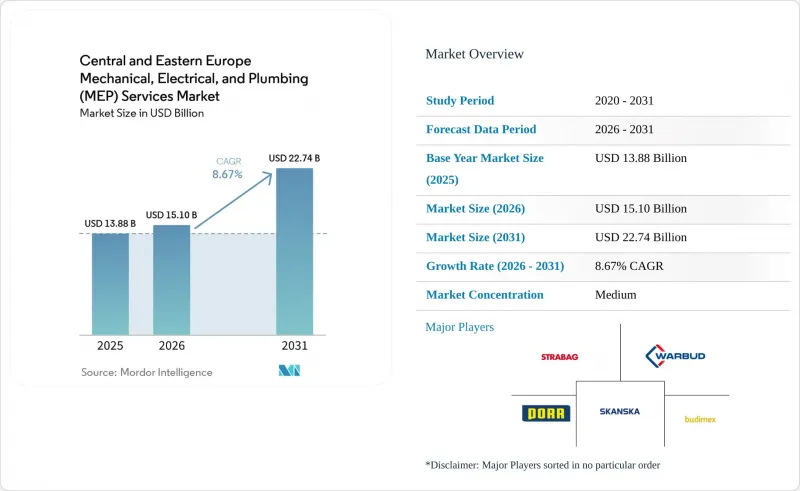
本報告按類型(機械、電氣、管道、一體化機電工程)、服務類型(設計工程、安裝試運行、維護維修及其他服務)、最終用戶行業(住宅、商業、基礎設施)和地區(波蘭、捷克、匈牙利、羅馬尼亞及其他地區)進行細分。市場預測以貨幣單位(十億美元)呈現。
中東歐機械、電氣和管道 (MEP) 服務市場趨勢與洞察
受《能源性能指令》(EPBD) 和《55歲以上人士適用標準》(Fit-for-55) 的推動,大規模維修的需求不斷成長,從而催生出源源不斷的機電工程項目。
修訂後的《建築能源性能指令》(EPBD)要求到2030年平均住宅初級能源消耗量降低16%,到2035年降低20-22%,其中至少55%的減排量來自能源效率最低的建築。在中東歐地區,75%的建築建於2000年之前,年維修率維持在1%左右。這意味著,要符合相關法規,需要從根本上提升維修工程的能力,而不僅僅是進行一些小的改進。對於中東歐地區的機電工程服務市場而言,這意味著需要持續進行諸如暖通空調系統更換、電氣設備升級、建築管理系統以及熱泵整合等工作。 EPBD第10條規定的光電發電要求擴大了電氣工程的範圍,規定從2026年起,所有面積超過250平方公尺的新建公共建築都必須安裝光電系統。除了標準項目包之外,這還增加了對光伏系統整合、逆變器、併網介面和控制系統連接的需求。此外,歐盟委員會於2026年3月發布的關於一站式服務的指導意見,正有助於引導中東歐機電工程服務市場的維修需求走向更系統化的分銷管道。
歐盟資助的交通和公共產業現代化計畫正在維持歐洲議會的投資。
2025年7月,歐洲連接與設施(CEF)撥款28億歐元(31億美元)用於94個交通項目,其中77%的預算用於鐵路電氣化、ERTMS號誌系統和港口碼頭電力設備升級。在中東歐機電工程(MEP)服務市場,資金籌措至關重要,因為交通基礎設施現代化涉及大量系統相關要素,例如變電站、低壓配電、消防安全、隧道通風和控制系統等。這種打包方式意味著機電工程被納入長期公共契約,而非單一用途的建築安裝。因此,能夠同時承接交通基礎設施和公共產業項目的電氣和機械承包商的專案訂單更加穩定。此外,能夠協調試運行、安全合規和營運移交等工作的公司的價值也隨之提升。隨著走廊專案的推進,預計中東歐的機電工程服務市場將繼續吸引受監管支出需求,而這些支出受私人資金籌措週期的影響較小。
技術純熟勞工短缺和工資上漲限制了專案產能。
技術純熟勞工短缺限制了中東歐機電工程服務市場同時承接的工作量。電工、暖通空調安裝工、水管工和認證性能驗證人員面臨的壓力尤其顯著。在波蘭,擁有F-gas認證的暖通空調技術人員僅有6萬人,遠不足以應付從2026年底到2027年初的安裝高峰。薪資上漲也推高了全部區域電氣和暖通空調工程的競標價格。小規模承包商首當其沖地感受到這種壓力,因為他們無法透過規模經濟、增強購買力或跨國員工配置來抵消人事費用。因此,專案承接能力下降,價格飆升,擁有內部認證團隊的公司在中東歐機電工程服務市場中變得越來越有價值。
細分市場分析
2025年,機械設備服務在中東歐機電工程服務市場中佔據48.3%的市場佔有率,成為該地區最大的細分市場。這一主導地位反映了現有建築和新建工業項目中暖通空調維修、冷卻系統、通風和機房升級所帶來的巨大價值。儘管電氣和給排水服務仍然是專案執行的核心,但由於熱力系統和冷卻基礎設施在維修和新建專案中發揮核心作用,機械服務佔據了最大的合約價值。此外,該地區的專案結構也凸顯了機械服務在工廠、物流設施、醫院和資料中心等場所的重要性,這些場所對冷卻性能和環境控制的要求極高。因此,儘管採購模式日益多樣化,機械服務在中東歐機電工程服務市場中仍佔據核心地位。
預計到2031年,整合式機電工程(MEP)服務將以11.1%的複合年成長率成長,成為中東歐MEP服務市場成長最快的細分領域。這一轉變反映了市場對單一責任交付日益成長的需求,因為資料中心、醫院和先進製造設施等場所需要從一開始就讓多個技術系統協同運作。傳統的分散式分包結構增加了複雜專案中的介面風險,因此客戶越來越傾向於選擇整合機械、電氣、管道和控制協調的打包服務。預計這一趨勢將繼續有利於那些能夠在單一交付結構下整合工程、安裝、檢驗和試運行的公司。未來,整合式服務可望在中東歐MEP服務市場的高階領域中從單一細分模式中奪取市場佔有率。
其他福利
- Excel格式的市場預測(ME)表
- 3個月的分析師支持
目錄
第1章:引言
- 研究假設和市場定義
- 調查範圍
第2章:調查方法
第3章執行摘要
第4章 市場狀況
- 市場概覽
- 市場促進因素
- 由於EPBD和Fit-For-55法規,大規模維修需求激增。
- 歐盟資助的交通和公共產業現代化項目
- 資料中心和數位基礎設施的擴展
- 近岸外包主導的工業與物流設施發展
- 區域供熱脫碳及向熱泵的維修
- 公共專案中的BIM和強制性電子採購
- 市場限制因素
- 技術純熟勞工短缺和工資上漲
- 高利率和財政緊縮
- 授權延誤和跨境合規的複雜性。
- 戰爭風險、保險和電網連接瓶頸
- 價值供應鏈分析
- 監理情勢
- 技術展望
- 產業吸引力—五力分析
- 新進入者的威脅
- 買方的議價能力
- 供應商的議價能力
- 替代品的威脅
- 競爭公司之間的競爭
- 成本結構分析
第5章 市場規模與成長預測
- 按類型
- 機械服務
- 電力服務
- 管道服務
- 綜合機電服務
- 按服務類型
- 設計工程
- 安裝、檢查和試運行。
- 維護/修理
- 其他
- 按最終用戶行業分類
- 住宅
- 商業
- 基礎設施
- 按地區
- 波蘭
- 捷克共和國
- 匈牙利
- 羅馬尼亞
- 斯洛維尼亞
- 其他中歐和東歐國家
第6章 競爭情勢
- 市場集中度
- 策略趨勢
- 市佔率分析
- 公司簡介
- STRABAG SE
- PORR Group
- Skanska
- Budimex
- Warbud
- Mercury Engineering
- Winthrop Engineering and Contracting
- SPIE
- Bilfinger
- ENGIE Solutions
- VINCI Energies
- Royal BAM Group
- Eiffage
- Bouygues Energies & Services
- AECOM
- Arup
- WSP Global
- AtkinsRealis
- Drees & Sommer
- Termomont
- Energoprojekt
- KESZ Group
- UPB
- Merko Ehitus
第7章 市場機會與未來展望
According to Mordor Intelligence, the central and eastern europe mechanical, electrical, and plumbing services market size was valued at USD 13.88 billion in 2025 and is estimated to grow from USD 15.10 billion in 2026 to reach USD 22.74 billion by 2031, at a CAGR of 8.67% during the forecast period (2026-2031).
This report is Segmented by Type (Mechanical, Electrical, Plumbing, Integrated MEP), Service Type (Design & Engineering, Installation & Commissioning, Maintenance & Repair, Other Services), and End-User Industry (Residential, Commercial, Infrastructure), and Geography (Poland, Czech Republic, Hungary, Romania, and More). The Market Forecasts are Provided in Terms of Value (USD Billion).
Central And Eastern Europe Mechanical, Electrical, And Plumbing (MEP) Services Market Trends and Insights
Deep-Renovation Demand from EPBD and Fit-for-55 Creates Recurring MEP Pipeline
The revised Energy Performance of Buildings Directive requires a 16% reduction in average residential primary energy use by 2030 and a 20% to 22% reduction by 2035, with at least 55% of that cut coming from the lowest-performing buildings. In Central and Eastern Europe, 75% of buildings were built before 2000 and the annual renovation rate had stayed near 1%, which means compliance needs a structural increase in retrofit throughput rather than a small improvement. For the Central and Eastern Europe MEP services market, that translates into recurring work in HVAC replacement, electrical upgrades, building management systems, and heat-pump integration. The solar requirement under EPBD Article 10 extends the electrical scope, as new public buildings above 250 m2 must install solar-energy systems in 2026. That creates additional demand for PV integration, inverters, grid-tie interfaces, and control-system connectivity, on top of the standard project packages. The European Commission's March 2026 guidance on one-stop shops also supports a more organized referral path for renovation demand into the Central and Eastern Europe MEP services market.
EU-Funded Transport and Utility Modernization Drives Sustained MEP Investment
The Connecting Europe Facility allocated EUR 2.8 billion (USD 3.1 billion) in July 2025 across 94 transport projects, and 77% of that envelope went to rail electrification, ERTMS signaling, and port shore-power upgrades. In the Central and Eastern Europe MEP services market, funding matters because transport modernization involves substantial systems content in substations, low-voltage distribution, fire and life safety, tunnel ventilation, and control layers. These packages pull MEP work into long-duration public contracts instead of one-time building installations. The result is a steadier project flow for electrical and mechanical contractors that can work across transport and utility assets. It also increases the value of firms that can coordinate commissioning, safety compliance, and operations handover under a single scope. As more corridor projects move into delivery, the Central and Eastern Europe MEP services market should continue to draw demand from regulated spending that is less sensitive to private financing cycles.
Skilled-Labor Shortages and Wage Inflation Constrain Project Throughput
Skilled-labor shortages are limiting how much work the Central and Eastern Europe MEP services market can execute at one time. The pressure is strongest in electricians, HVAC fitters, pipefitters, and certified commissioning staff. In Poland, the F-gas-certified HVAC technician pool of 60,000 remains below the level needed for the installation wave expected in late 2026 and early 2027. Wage inflation is also lifting bid prices for electrical and HVAC packages across the region. Smaller contractors feel this pressure first because they cannot offset labor costs through scale, wider purchasing power, or multi-country staffing. The result is slower project throughput, higher pricing, and a greater premium on firms that already control certified in-house teams in the Central and Eastern Europe MEP services market.
Other drivers and restraints analyzed in the detailed report include:
- Data-Center and Digital Infrastructure Expansion Transforms Electrical Services Demand
- Nearshoring-Led Industrial and Logistics Build-Out Generates High-Value MEP Contracts
- High Interest Rates and Fiscal Tightening Squeeze Private-Sector Investment
For complete list of drivers and restraints, kindly check the Table Of Contents.
Segment Analysis
Mechanical services accounted for 48.3% of the Central and Eastern Europe MEP services market share in 2025, making it the largest segment in the region. This lead reflects the heavy value of HVAC retrofits, cooling systems, ventilation, and plant-room upgrades across old building stock and new industrial projects. Electrical and plumbing services remained core to project execution, but Mechanical Services accounted for the largest contract value because thermal systems and cooling infrastructure are central to both renovation and new-build demand. The regional project mix also favored mechanical scope in factories, logistics facilities, hospitals, and data centers, where cooling performance and environmental control are essential. This kept mechanical work at the center of the Central and Eastern Europe MEP services market, even as procurement models started to broaden.
Integrated MEP services is projected to expand at a 11.1% CAGR through 2031, making it the fastest-growing segment in the Central and Eastern Europe MEP services market. The shift reflects rising demand for single-responsibility delivery in data centers, hospitals, and advanced manufacturing facilities where multiple technical systems must work together from the start. Clients are increasingly preferring bundled mechanical, electrical, plumbing, and controls coordination because traditional fragmented subcontracting creates greater interface risk on complex projects. This trend should continue to favor firms that can combine engineering, installation, testing, and commissioning under one delivery structure. Over time, integrated capability is likely to take share from single-discipline models at the top end of the Central and Eastern Europe MEP services market.
List of Companies Covered in this Report:
- STRABAG SE
- PORR Group
- Skanska
- Budimex
- Warbud
- Mercury Engineering
- Winthrop Engineering and Contracting
- SPIE
- Bilfinger
- ENGIE Solutions
- VINCI Energies
- Royal BAM Group
- Eiffage
- Bouygues Energies & Services
- AECOM
- Arup
- WSP Global
- AtkinsRealis
- Drees & Sommer
- Termomont
- Energoprojekt
- KESZ Group
- UPB
- Merko Ehitus
Additional Benefits:
- The market estimate (ME) sheet in Excel format
- 3 months of analyst support
TABLE OF CONTENTS
1 Introduction
- 1.1 Study Assumptions & Market Definition
- 1.2 Scope of the Study
2 Research Methodology
3 Executive Summary
4 Market Landscape
- 4.1 Market Overview
- 4.2 Market Drivers
- 4.2.1 Deep-Renovation Demand from EPBD and Fit-For-55
- 4.2.2 EU-Funded Transport and Utility Modernization
- 4.2.3 Data-Center and Digital Infrastructure Expansion
- 4.2.4 Nearshoring-Led Industrial and Logistics Build-Out
- 4.2.5 District-Heating Decarbonization and Heat-Pump Retrofits
- 4.2.6 BIM and E-Procurement Mandates in Public Projects
- 4.3 Market Restraints
- 4.3.1 Skilled-Labor Shortages and Wage Inflation
- 4.3.2 High Interest Rates and Fiscal Tightening
- 4.3.3 Permitting Delays and Cross-Border Compliance Complexity
- 4.3.4 War-Risk, Insurance, and Grid-Connection Bottlenecks
- 4.4 Value / Supply-Chain Analysis
- 4.5 Regulatory Landscape
- 4.6 Technological Outlook
- 4.7 Industry Attractiveness - Porter's Five Forces Analysis
- 4.7.1 Threat of New Entrants
- 4.7.2 Bargaining Power of Buyers
- 4.7.3 Bargaining Power of Suppliers
- 4.7.4 Threat of Substitute Products
- 4.7.5 Intensity of Competitive Rivalry
- 4.8 Cost Structure Analysis
5 Market Size & Growth Forecasts (Value, in USD)
- 5.1 By Type
- 5.1.1 Mechanical Services
- 5.1.2 Electrical Services
- 5.1.3 Plumbing Services
- 5.1.4 Integrated MEP Services
- 5.2 By Service Type
- 5.2.1 Design & Engineering
- 5.2.2 Installation, Testing, and Commissioning
- 5.2.3 Maintenance & Repair
- 5.2.4 Other Services
- 5.3 By End-User Industry
- 5.3.1 Residential
- 5.3.2 Commercial
- 5.3.3 Infrastructure
- 5.4 By Geography
- 5.4.1 Poland
- 5.4.2 Czech Republic
- 5.4.3 Hungary
- 5.4.4 Romania
- 5.4.5 Slovenia
- 5.4.6 Rest of CEE
6 Competitive Landscape
- 6.1 Market Concentration
- 6.2 Strategic Moves
- 6.3 Market Share Analysis
- 6.4 Company Profiles {(includes Global level Overview, Market level overview, Core Segments, Financials as available, Strategic Information, Market Rank/Share for key companies, Products & Services, and Recent Developments)}
- 6.4.1 STRABAG SE
- 6.4.2 PORR Group
- 6.4.3 Skanska
- 6.4.4 Budimex
- 6.4.5 Warbud
- 6.4.6 Mercury Engineering
- 6.4.7 Winthrop Engineering and Contracting
- 6.4.8 SPIE
- 6.4.9 Bilfinger
- 6.4.10 ENGIE Solutions
- 6.4.11 VINCI Energies
- 6.4.12 Royal BAM Group
- 6.4.13 Eiffage
- 6.4.14 Bouygues Energies & Services
- 6.4.15 AECOM
- 6.4.16 Arup
- 6.4.17 WSP Global
- 6.4.18 AtkinsRealis
- 6.4.19 Drees & Sommer
- 6.4.20 Termomont
- 6.4.21 Energoprojekt
- 6.4.22 KESZ Group
- 6.4.23 UPB
- 6.4.24 Merko Ehitus
7 Market Opportunities & Future Outlook
- 7.1 White-space & Unmet-Need Assessment

 管道服務軟體市場:全球市場預測,2026-2032年
 美國機電工程服務:市場佔有率分析、產業趨勢與統計、成長預測(2026-2031)機械、電氣和管道服務市場:全球市場預測,2026-2032年東協機械、電氣和管道(MEP)服務:市場佔有率分析、行業趨勢和統計數據以及成長預測(2026-2031 年)中東和北非地區的機電管道(MEP)服務:市場佔有率分析、行業趨勢與統計數據以及成長預測(2026-2031 年)亞太地區機電管道(MEP)服務:市場佔有率分析、產業趨勢與統計及成長預測(2026-2031)歐洲機電管道(MEP)服務:市場佔有率分析、產業趨勢與統計及成長預測(2026-2031 年)北美機電管道(MEP)服務:市場佔有率分析、行業趨勢和統計數據以及成長預測(2026-2031 年)南美洲機電管道(MEP)服務:市場佔有率分析、行業趨勢和統計數據以及成長預測(2026-2031 年)
 機械、電氣和管道服務市場:按服務類型、最終用戶和地區分類