


 |
市場調查報告書
商品編碼
2063910
美國有機廢棄物收集服務:市場佔有率分析、行業趨勢和統計數據以及成長預測(2026-2031 年)United States Organic Waste Collection Services - Market Share Analysis, Industry Trends & Statistics, Growth Forecasts (2026 - 2031) |
||||||

※ 本網頁內容可能與最新版本有所差異。詳細情況請與我們聯繫。
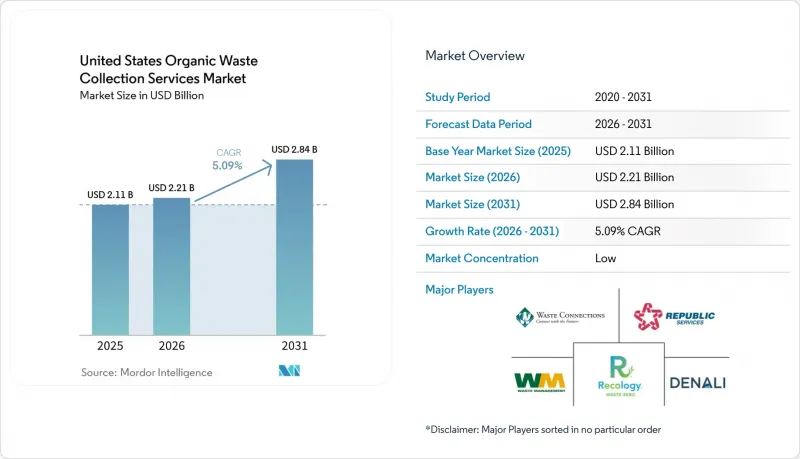
根據 Mordor Intelligence 預測,美國有機廢棄物收集服務市場規模將從 2025 年的 21.1 億美元和 2026 年的 22.1 億美元成長到 2031 年的 28.4 億美元,2026 年至 2031 年的年複合成長率(CAGR)為 5.09%。
本報告按廢棄物類型(食物廢棄物、園林綠化廢棄物等)、最終用戶(住宅、商業設施等)、收集方式(路邊收集、投放點等)以及技術/設備(人工收集、半自動收集等)進行分類。市場預測以價值(美元)和數量(噸)表示。
美國有機廢棄物收集服務市場趨勢與洞察
嚴格的政府法規和強制性有機廢棄物回收法律
加州SB 1383法案規定,到2025年,有機廢棄物處理量必須比2014年減少75%。該法案要求食物垃圾回收率達20%,並強制所有轄區向居民和企業提供有機廢棄物收集服務。為了確保合規並避免處罰,地方政府正在實施上門有機廢棄物收集、食物垃圾收集外包以及採購回收有機產品等措施,從而在各城市和縣範圍內創造了對收集和處理能力的穩定需求。華盛頓州HB 2301法案將於2026年前分階段實施企業有機廢棄物再利用的要求,並制定了明確的時間表、標準容器顏色和產品標籤控制措施,以應對住宅有機廢棄物收集過程中的污染風險。聯邦機構也支持這一趨勢,美國環保署(EPA)、農業部(USDA)和食品藥物管理局(FDA)正在協調一項國家戰略,力爭2030年將食物損失和廢棄物減少50%。這與各州的努力一致,並向地方政府發出明確的政策訊號,即在2026年擴大相關項目。美國環保署的「永續食品和工業食品回收計畫」(SWIFR)指導方針和農業部的合作協議為降低引入新的上門收集方式和升級後端基礎設施所帶來的實施風險提供了資金支持。
掩埋處理費和廢棄物處理成本不斷上漲
2024年,全美一般廢棄物掩埋處理成本上漲10%,達到每噸62.28美元。東北部地區成本最高,中南部地區成本最低,進一步凸顯了在高成本市場進行有機資源回收的經濟合理性。實施垃圾焚化發電(WTE)計畫的州,其垃圾掩埋成本比未實施WTE計畫的州高出28%,這表明處理能力的限制正在改變價格訊號,並加速掩埋收集和處理等替代方案的推廣。隨著市政當局續約,傳統處理方法與有機物處理項目之間日益擴大的成本差距,促使提案新的、預算中性或成本節約的上門有機物收集服務方案,尤其是在填埋場選擇有限的人口密集城市。國際案例也印證了這一點:當一般廢棄物(垃圾桶)處理與有機物回收之間存在顯著成本差異時,政策和定價會影響居民的行為。即使到了 2026 年,這種價格環境仍然促使大規模工業排放和市政當局簽訂有機廢物收集契約,以減少對掩埋的依賴,並減輕未來因處置成本上升而產生的責任。
有機廢棄物處理和處理設施的基礎設施能力有其局限性
根據美國環保署(EPA)的國家基礎設施評估,需要大量資金來擴大堆肥和厭氧消化能力,到2030年需要140億至160億美元才能實現預計的61%的全國回收率。這筆資金涵蓋設施建設、收集系統擴建和宣傳活動,凸顯了擴大收集量並非取決於孤立的項目,而是需要在整個供應鏈中進行均衡投資。南部、西南部和落基山脈地區的產能短缺最為嚴重,凸顯了在原料潛力高但設施稀少的地區進行有針對性的位置和授權支持的必要性。到2026年,產能限制將繼續制約多個州的市政新項目部署和私人契約,儘管有明確的政策指導方針,但廢棄物再利用(回收)的進展仍然緩慢。解決這一瓶頸需要加快資金籌措和實施,具體措施包括結合公共資金、採購改革和公私夥伴關係,將長期原料供應承諾與數據透明度相結合。
細分市場分析
預計從2026年到2031年,包括生產前和消費後在內的食物廢棄物將以5.9%的複合年成長率快速成長,主要原因是各州對合規期限和商業要求的日益嚴格。美國有機廢棄物收集服務市場正受益於SB 1383法案的要求,該法案將全年食物垃圾收集列為普遍服務。這確保了專案的連續性,並為收集者和處理者建立了可預測的垃圾量基礎。華盛頓州的HB 2301法案為企業設定了分級回收率標準,並強制要求住宅指定路邊有機垃圾收集,這將隨著時間的推移促進收集路線密度和設施利用率的提高。由於商用廚房、現場食堂和加工商產生的生產前食物廢棄物噸位密度高、污染風險低,因此非常適合採用專門的服務模式和針對大規模產生者的可預測排放時間表。隨著行業團體和企業協調原料採購,並實現高效轉化為沼氣和消化殘渣,收集和厭氧消化相關的夥伴關係正在不斷擴大。即使到了2025年,園林綠化廢棄物仍將維持70.9%的最大佔有率,這得益於市政計畫多年的成熟發展。然而,人口結構變化以及多用戶住宅數量的增加(導致園林垃圾減少)正在限制其逐步成長。
到2026年,強制和自願的住宅餐後食物廢棄物收集將在主要都市區普及,這將擴大家庭的參與範圍,並隨著時間的推移加深人們對垃圾分類的理解。農業殘餘物仍將佔較小比例,因為大部分此類材料會在現場處理,或透過專業仲介業者轉移到市政系統無法直接取得的營養和能源來源。同時,包括生物固形物和工業有機物在內的其他領域正在穩步成長,因為合規框架和有效利用標準的實施減少了對掩埋的依賴,並促進了生產可銷售產品的統一處理流程。隨著教育、污染控制和設備升級帶來的大規模績效提升,美國有機廢棄物收集服務市場將繼續向更高的餐後食物廢棄物比例傾斜。企業在環境、社會和治理(ESG)計畫中對檢驗的資源回收情況進行透明報告的期望,進一步鞏固了餐後食物廢棄物在美國有機廢棄物收集服務市場中的佔比。
其他好處:
- Excel格式的市場預測(ME)表
- 3個月的分析師支持
目錄
第1章:引言
- 研究假設和市場定義
- 調查範圍
第2章:調查方法
第3章執行摘要
第4章 市場狀況
- 市場概覽
- 市場促進因素
- 法律規定政府必須嚴格監管有機廢棄物。
- 掩埋處理費和廢棄物處理成本不斷上漲
- 環保意識日益增強,企業對環境、社會及公司治理(ESG)和永續發展的承諾也日益提高。
- 回收系統、分類自動化和加工方面的技術進步。
- 引入循環經濟模式,實現從「廢棄物為寶」的模式轉移
- 獎勵發展可再生能源以及將排碳權貨幣化的機會
- 市場限制因素
- 有機廢棄物處理和加工設施的基礎設施能力不足。
- 收集和處理系統需要高額的資本投資和營運成本。
- 住宅和商業回收項目的參與率都很低。
- 缺乏社區宣傳、教育和行為改變計畫。
- 價值供應鏈分析
- 監理情勢
- 技術展望
- 用於廢棄物追蹤的RFID智慧垃圾桶
- 人工智慧徹底改變了廢棄物分類方式。
- 利用物聯網最佳化車輛路線
- 波特五力模型
- 廢棄物收集車輛的現代化和電氣化
- 生物甲烷對有機廢棄物收集的影響分析
- 地方政府與私人企業之間的合作正在加速發展。
- 為了實現氣候目標,人們越來越關注從有機廢棄物中回收甲烷。
第5章 市場規模及成長預測(價值:美元,數量:噸)
- 廢棄物類型
- 食物廢棄物
- 園林綠化廢棄物
- 農業殘餘物
- 其他
- 最終用戶
- 住宅
- 商用食品服務業
- 工業(食品加工和製造)
- 其他(農業廢棄物)
- 透過收集方法
- 上門收集
- 投放和回收系統
- 其他
- 按下技術/設備
- 人工收集系統
- 半自動系統
- 全自動系統
- 其他
第6章 競爭情勢
- 市場集中度
- 策略趨勢
- 市佔率分析
- 公司簡介
- Waste Management, Inc.(WM)
- Republic Services
- Waste Connections
- Denali
- Recology
- Synagro
- CompostNow
- Agri-Cycle Energy
- Compost Crew
- Black Earth Compost
- Bootstrap Compost
- Groot Industries
- Atlas Organics
- Vanguard Renewables
- Anaergia Technologies
- RNG Energy Solutions LLC
- PurposeEnergy
- Convertus Group
- Remix Organics
- AgRecycle
- Action Carting Environmental Services, Inc.
第7章 市場機會與未來展望
According to Mordor Intelligence, the united states organic waste collection services market size is projected to expand from USD 2.11 billion in 2025 and USD 2.21 billion in 2026 to USD 2.84 billion by 2031, registering a CAGR of 5.09% between 2026 to 2031.
This report is Segmented by Waste Type (Food Waste, Yard & Landscape Waste, and More), End-User (Residential, Commercial, and More), Collection Method (Door-To-Door Collection, Drop-Off / Bring Systems, and Others), and Technology & Equipment (Manual Collection, Semi-Automated, and More). The Market Forecasts are Provided in Terms of Value (USD) and Volume (Tons).
United States Organic Waste Collection Services Market Trends and Insights
Stringent Government Regulations and Mandatory Organic Waste Diversion Laws
California's SB 1383 mandated a 75% reduction in organic waste disposal by 2025 versus a 2014 baseline. It required 20% edible food recovery, compelling every jurisdiction to provide organic waste collection services to residents and businesses . Jurisdictions are implementing curbside organics, edible food recovery contracting, and the procurement of recovered organic products to maintain compliance and avoid penalties, thereby creating steady demand for collection and processing capacity across cities and counties. Washington's HB 2301 phases in organic waste diversion requirements for businesses through 2026 and sets firm timelines for residential curbside organics collection, standard bin colors, and product labeling controls to address contamination risks. Federal agencies are reinforcing this trajectory as the EPA, USDA, and FDA coordinate a national strategy to cut food loss and waste by 50% by 2030, which aligns with multistate action and gives municipalities a clear policy signal for program expansion in 2026. EPA's SWIFR program guidance and USDA cooperative agreements provide funding to reduce execution risk for new curbside rollouts and upgrades to back-end infrastructure.
Rising Landfill Tipping Fees and Disposal Costs
Tipping fees for municipal solid waste disposal rose 10% nationally in 2024 to USD 62.28 per ton, with the Northeast showing the highest fees and the South Central the lowest, which tightens the economic case for organics diversion across high-cost markets. Waste-to-energy states paid 28% more for landfill disposal than non-WTE states, indicating that constrained disposal capacity alters price signals and accelerates the adoption of alternatives, such as organics collection and processing. As municipalities update contracts, the widening cost gap between traditional disposal and organics programs supports budget-neutral or savings-oriented pitches for new curbside organics service, especially in dense metros with scarce landfill options. International examples reinforce the same thesis as policy and pricing shift behavior when residents face meaningful cost differentials between gray-bin disposal and organics recycling. In 2026, this price environment continues to steer large commercial generators and municipalities toward organics collection contracts that reduce landfill exposure and future liability for disposal escalators.
Limited Infrastructure Capacity for Organic Waste Processing and Treatment Facilities
EPA's national infrastructure assessment identifies a sizable funding requirement to expand composting and anaerobic digestion capacity, with USD 14-16 billion needed by 2030 to reach a projected national recycling rate of 61%. The funding envelope spans facility development, collection system expansion, and education, underscoring that collection growth depends on balanced investments across the chain rather than stand-alone projects. Capacity gaps are most acute in the South, Southwest, and Rocky Mountain regions, which underscores the need for targeted siting and permitting support where feedstock potential is high but facilities are sparse. In 2026, constrained throughput continues to limit new municipal rollouts and private contracts in several states, which slows diversion despite clear policy direction. Addressing this bottleneck requires blending public funding, procurement reforms, and private partnerships that bundle long-term feedstock commitments with data transparency to accelerate financing and delivery.
Other drivers and restraints analyzed in the detailed report include:
- Growing Environmental Awareness and Corporate ESG/Sustainability Commitments
- Technological Advancements in Collection Systems, Sorting Automation, and Processing
- High Capital and Operational Costs for Collection and Processing Systems
For complete list of drivers and restraints, kindly check the Table Of Contents.
Segment Analysis
Food waste, including pre-consumer and post-consumer streams, is projected to grow the fastest, with a 5.9% CAGR from 2026 to 2031, as compliance deadlines and business thresholds tighten across major states. The United States organic waste collection services market benefits from SB 1383 requirements that make year-round food scrap collection a universal service, which establishes program continuity and a predictable volume base for haulers and processors. Washington's HB 2301 establishes tiered diversion thresholds for businesses and requires residential curbside organics collection on a set timetable, thereby supporting improvements in route density and equipment utilization over time. Pre-consumer food waste from commercial kitchens, institutional cafeterias, and processors offers higher tonnage density and lower contamination risk, which aligns with specialized service models and predictable pickups for large generators. Partnerships linking collection with anaerobic digestion have expanded as industry groups and operators coordinate feedstock sourcing to enable efficient conversion to biogas and digestate. Yard and landscape waste continued to hold the largest share at 70.9% in 2025, driven by the long-standing maturity of municipal programs. However, incremental growth is limited by demographic shifts and the rise of multi-family housing, where yard generation is lower.
In 2026, residential post-consumer food waste collection gains coverage in major metros through policy mandates and voluntary rollouts, expanding household access and building familiarity with source separation over time. Agricultural Residues remain a smaller share, as many materials are managed on-site or move through specialized brokers into nutrient and energy pathways that are not always visible to municipal systems. Others, including biosolids and industrial organics, grow steadily as compliance frameworks and beneficial use standards drive consistent processing routes that reduce landfill exposure and produce marketable outputs. The United States organic waste collection services market will continue to shift toward higher food waste penetration as education, contamination controls, and equipment upgrades improve performance at scale. Food waste's contribution to the United States organic waste collection services market size is reinforced by transparent reporting expectations in corporate ESG programs that reward verifiable diversion at the facility level.
List of Companies Covered in this Report:
- Waste Management, Inc. (WM)
- Republic Services
- Waste Connections
- Denali
- Recology
- Synagro
- CompostNow
- Agri-Cycle Energy
- Compost Crew
- Black Earth Compost
- Bootstrap Compost
- Groot Industries
- Atlas Organics
- Vanguard Renewables
- Anaergia Technologies
- RNG Energy Solutions LLC
- PurposeEnergy
- Convertus Group
- Remix Organics
- AgRecycle
- Action Carting Environmental Services, Inc.
Additional Benefits:
- The market estimate (ME) sheet in Excel format
- 3 months of analyst support
TABLE OF CONTENTS
1 Introduction
- 1.1 Study Assumptions & Market Definition
- 1.2 Scope of the Study
2 Research Methodology
3 Executive Summary
4 Market Landscape
- 4.1 Market Overview
- 4.2 Market Drivers
- 4.2.1 Stringent Government Regulations and Mandatory Organic Waste Diversion Laws
- 4.2.2 Rising Landfill Tipping Fees and Disposal Costs
- 4.2.3 Growing Environmental Awareness and Corporate ESG/Sustainability Commitments
- 4.2.4 Technological Advancements in Collection Systems, Sorting Automation, and Processing
- 4.2.5 Circular Economy Adoption and Waste-to-Wealth Paradigm Shift
- 4.2.6 Renewable Energy Incentives and Carbon Credit Monetization Opportunities
- 4.3 Market Restraints
- 4.3.1 Limited Infrastructure Capacity for Organic Waste Processing and Treatment Facilities
- 4.3.2 High Capital and Operational Costs for Collection and Processing Systems
- 4.3.3 Low Participation Rates in Residential and Commercial Collection Programs
- 4.3.4 Insufficient Community Outreach, Education, and Behavior Change Programs
- 4.4 Value / Supply-Chain Analysis
- 4.5 Regulatory Landscape
- 4.6 Technological Outlook
- 4.6.1 RFID Smart Bins for Waste Tracking
- 4.6.2 AI Revolutionizes Waste Sorting
- 4.6.3 IoT Optimizing for Fleet Routes
- 4.7 Porter's Five Forces
- 4.7.1 Threat of New Entrants
- 4.7.2 Bargaining Power of Suppliers
- 4.7.3 Bargaining Power of Buyers
- 4.7.4 Threat of Substitutes
- 4.7.5 Industry Rivalry
- 4.8 Fleet Modernization & Electrification in Waste Collection
- 4.9 Analysis of Biomethane Impact on Organic Waste Collection
- 4.10 Collaboration Between Municipalities and Private Operators is Gaining Traction
- 4.11 Growing Focus on Methane Capture from Organic Waste to Meet Climate Targets
5 Market Size & Growth Forecasts (Value in USD & Volume in Tons)
- 5.1 By Waste Type
- 5.1.1 Food Waste
- 5.1.2 Yard & Landscape Waste
- 5.1.3 Agricultural Residues
- 5.1.4 Others
- 5.2 By End-User
- 5.2.1 Residential
- 5.2.2 Commercial Food Service
- 5.2.3 Industrial (Food Processing & Manufacturing)
- 5.2.4 Others (Agri-waste)
- 5.3 By Collection Method
- 5.3.1 Door-to-Door Collection
- 5.3.2 Drop-Off / Bring Systems
- 5.3.3 Others
- 5.4 By Technology & Equipment
- 5.4.1 Manual Collection Systems
- 5.4.2 Semi-Automated Systems
- 5.4.3 Fully Automated Systems
- 5.4.4 Others
6 Competitive Landscape
- 6.1 Market Concentration
- 6.2 Strategic Moves
- 6.3 Market Share Analysis
- 6.4 Company Profiles {(Includes Global Level Overview, Market Level Overview, Core Segments, Financials as Available, Strategic Information, Products & Services, and Recent Developments)}
- 6.4.1 Waste Management, Inc. (WM)
- 6.4.2 Republic Services
- 6.4.3 Waste Connections
- 6.4.4 Denali
- 6.4.5 Recology
- 6.4.6 Synagro
- 6.4.7 CompostNow
- 6.4.8 Agri-Cycle Energy
- 6.4.9 Compost Crew
- 6.4.10 Black Earth Compost
- 6.4.11 Bootstrap Compost
- 6.4.12 Groot Industries
- 6.4.13 Atlas Organics
- 6.4.14 Vanguard Renewables
- 6.4.15 Anaergia Technologies
- 6.4.16 RNG Energy Solutions LLC
- 6.4.17 PurposeEnergy
- 6.4.18 Convertus Group
- 6.4.19 Remix Organics
- 6.4.20 AgRecycle
- 6.4.21 Action Carting Environmental Services, Inc.
7 Market Opportunities & Future Outlook
- 7.1 Smart Cities & IoT Integration
- 7.2 Producer Responsibility Expansion
- 7.3 Shift Toward Decentralized Organic Waste Processing

 全球食品廢棄物管理市場規模、佔有率、趨勢和成長分析報告(2026-2034年)
 2026-2030年全球升級再造材料市場
 北美有機廢棄物收集服務:市場佔有率分析、行業趨勢和統計數據以及成長預測(2026-2031 年)歐洲有機廢棄物收集服務:市場佔有率分析、行業趨勢和統計數據以及成長預測(2026-2031 年)
 升級再造食品配料市場:預測至2034年-按配料類型、來源、應用、分銷管道、最終用戶和地區分類的全球分析升級再造食品配料市場:預測至2034年-按配料類型、功能、分銷管道、應用、最終用戶和地區分類的全球分析
 食品廢棄物管理市場:2026-2032年全球市場預測(依處理技術、來源、服務模式、產品/服務、廢棄物類型和應用分類)
 2026-2030年全球食品廢棄物管理市場德國有機廢棄物收集服務:市場佔有率分析、產業趨勢與統計及成長預測(2026-2031 年)義大利有機廢棄物收集服務:市場佔有率分析、行業趨勢和統計數據以及成長預測(2026-2031 年)