


 |
市場調查報告書
商品編碼
2061778
西班牙熱泵市場:市場佔有率分析、產業趨勢與統計及成長預測(2026-2031)Spain Heat Pump - Market Share Analysis, Industry Trends & Statistics, Growth Forecasts (2026 - 2031) |
||||||

※ 本網頁內容可能與最新版本有所差異。詳細情況請與我們聯繫。
根據 Mordor Intelligence 預測,西班牙熱泵市場規模將從 2025 年的 7.0538 億美元成長到 2026 年的 7.4484 億美元,到 2031 年達到 9.5641 億美元,2026 年至 2031 年的複合年成長率為 5.13%。
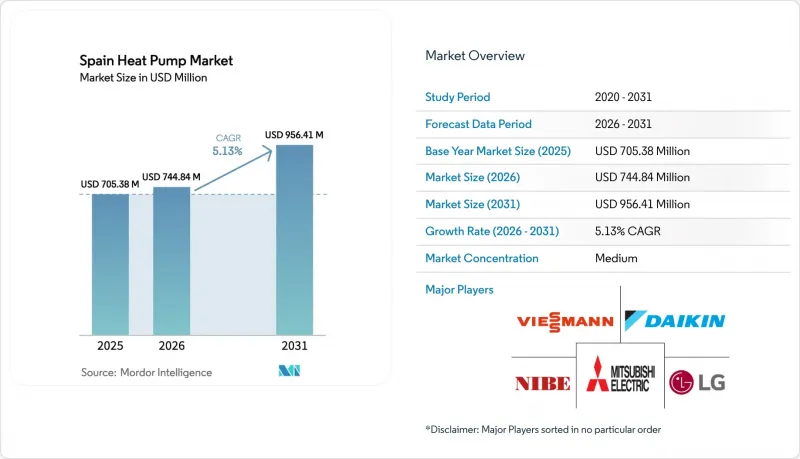
本報告按熱源類型(空氣源、水源等)、技術(空氣-空氣、空氣-水等)、容量(小於10kW、10-50kW等)、應用(空間供暖、空間冷卻等)、最終用戶(住宅、商業、工業)、安裝類型(新建、維修)和地區進行細分。市場預測以美元計價。
西班牙熱泵市場趨勢與洞察
政府獎勵和環境補貼
西班牙分階段實施的財政支持體系結合了國家復甦津貼自治區提供的補充支持,向家庭提供3000至5000歐元(約合3390至5650美元)的補貼,巴塞隆納也提供高達18800歐元(約21240美元)的項目支持。加泰隆尼亞40%的資本補貼以及安達盧西亞新建的價值6,190萬歐元(約6,995萬美元)的蓄熱管線,使得安裝能力集中在高獎勵地區,導致補貼較少的地區需求無法滿足。根據2026年RENORED計劃,公共部門實體可獲得高達75%的津貼,這正在加速區域供熱系統的電氣化進程。雖然獎勵將投資回收期縮短至最短五年,但也造成了區域勞動力不平衡,並加劇了對安裝人員技能發展的需求。
歐盟綠色新政與環境影響評估指令(EPBD)合規期限
隨著修訂後的《建築能源性能指令》(EPBD)於2026年5月生效,開發商和業主必須在各地區建築規範禁止使用石化燃料鍋爐之前,最終確定零排放解決方案。 D級以下建築必須在2033年前維修,預計維修工作將集中在西班牙1980年以前建造的、缺乏隔熱材料和冷暖散熱器的住宅存量中。商業地產業主正在轉向空氣-水和混合式系統,以保持綠色金融的合格,這一趨勢反映在馬德里和巴塞隆納的安裝商的大規模累積訂單中。
安裝工作中技術純熟勞工短缺
西班牙需要培訓數千名技術人員,才能達到歐盟到2030年培訓50萬名安裝人員的目標。目前的認證體系每年僅能培養不到8,000名專業人員,主要城市的工程工期也從四週延長至十二週。熱水器維修專案需要水力平衡調節和低溫散熱器選擇等技能,而這些技能通常是分離式空調安裝人員所不具備的,導致複雜專案的人事費用高出15%至25%。為了解決安裝能力短缺的問題,企業買家越來越直接收購整個安裝團隊。
細分市場分析
儘管目前混合式空調機組的裝置量較低,但預計其複合年成長率將達到5.49%,並透過利用西班牙現有的500萬套冷凍系統,最大限度地減少額外投資。這將使業者能夠在尖峰負載低谷時段維持燃氣鍋爐的運行,而不會對冬季電網造成壓力,從而減少60%的排放。相較之下,在西班牙熱泵市場,空氣源熱泵預計將成為市場主導力量,到2025年將佔據84.73%的市場佔有率,這得益於該國溫和的冬季氣候,使得季節性能源效率比(COP)能夠保持在3.5以上。
混合動力系統的發展動能與電能轉氣之間的價格差異以及短期電網升級政策的不確定性。製造商正在將預測控制功能融入其中,實現燃料的動態切換,從而在電網升級完成後,以成本最優的方式逐步過渡到全面電氣化。因此,西班牙熱泵市場呈現兩極化的模式:沿海地區以純電氣化系統主導,而北部地區則因寒潮期間的可靠性問題而逐漸興起混合動力系統。
由於空氣源熱泵平台與地暖和零碳建築標準要求的熱水循環系統相容,其市場佔有率正在不斷成長。預計到2025年,該細分市場將佔38.31%的佔有率,年複合成長率達5.69%,正逐步蠶食空氣源熱泵的裝機量。為了確保符合分類標準的資金籌措,水熱系統正逐漸成為學校、旅館和醫院的標配,這一趨勢正推動西班牙熱泵市場擺脫僅製冷解決方案的局面。
這項轉型也影響著供應鏈,對能夠處理55-60°C排氣溫度的壓縮機和循環泵的需求增加,安裝人員也需要接受關於調整水力平衡的再培訓。數位化試運行工具正在簡化流量最佳化流程,並將推出時間縮短三分之一。因此,預計到2031年,西班牙熱泵市場中用於熱水維修的市場規模將超過每年3億歐元(3.4億美元)。
其他好處:
- Excel格式的市場預測(ME)表
- 3個月的分析師支持
目錄
第1章:引言
- 研究假設和市場定義
- 調查範圍
第2章:調查方法
第3章執行摘要
第4章 市場狀況
- 市場概覽
- 市場促進因素
- 政府獎勵措施和環境補貼
- 歐盟綠色新政與環境影響評估指令(EPBD)合規期限
- 電力和天然氣價格比率的上升推高了總擁有成本。
- 低全球暖化潛勢丙烷熱泵技術的進展
- 利用冷凍基礎設施的混合式熱泵的普及
- 旅遊業繁榮推動旅館業脫碳
- 市場限制因素
- 安裝工作中技術純熟勞工短缺
- 高昂的初始設備成本和維修成本
- 都市區電網容量限制
- 多用戶住宅屋頂和垂直管道空間的限制
- 監理情勢
- 技術展望
- 產業價值鏈分析
- 波特五力分析
- 宏觀經濟因素對市場的影響
第5章 市場規模與成長預測
- 按供應來源
- 空氣源
- 水源
- 地熱
- 混合
- 透過技術
- 空對空
- 空氣中的水
- 水-水
- 來自地下的水(土壤)
- 按產能
- 小於10千瓦
- 10~50 kW
- 50~200 kW
- 超過200千瓦
- 透過使用
- 空間暖氣
- 空調
- 家用和衛生熱水
- 工業和製程加熱
- 其他用途
- 最終用戶
- 住宅
- 商業
- 產業
- 按安裝類型
- 新安裝
- 改裝
第6章 競爭情勢
- 市場集中度
- 策略趨勢
- Vendor Positioning Analysis
- 公司簡介
- Daikin Industries Ltd.
- Mitsubishi Electric Corporation
- Panasonic Corporation
- Fujitsu General Ltd.
- Midea Group Co., Ltd.
- LG Electronics Inc.
- NIBE Industrier AB
- Viessmann Werke GmbH & Co. KG
- Vaillant Group
- Bosch Thermotechnology(Robert Bosch GmbH)
- Stiebel Eltron GmbH & Co. KG
- Carrier Global Corporation
- Trane Technologies plc
- Johnson Controls International plc(York)
- Lennox International Inc.
- Aermec SpA
- Ariston Group
- Clivet SpA
- Hitachi Air Conditioning Europe SAS
- Danfoss A/S
第7章 市場機會與未來展望
According to Mordor Intelligence, the spain heat pump market size is expected to increase from USD 705.38 million in 2025 to USD 744.84 million in 2026 and reach USD 956.41 million by 2031, growing at a CAGR of 5.13% over 2026-2031.
This report is Segmented by Source Type (Air Source, Water Source, and More), Technology (Air-To-Air, Air-To-Water, and More), Capacity (Below 10 KW, 10-50 KW, and More), Application (Space Heating, Space Cooling, and More), End User (Residential, Commercial, and Industrial), Installation (New Installation, and Retrofit), and Geography. The Market Forecasts are Provided in Terms of Value (USD).
Spain Heat Pump Market Trends and Insights
Government Incentives and Environmental Subsidies
Spain's tiered funding stack blends national recovery grants with autonomous-community top-ups, delivering household rebates of EUR 3,000-5,000 (USD 3.39-5.65 thousand) and, in Barcelona, project support worth up to EUR 18,800 (USD 21.24 thousand). Catalonia's 40% capital grants and Andalusia's new EUR 61.9 million (USD 69.95 million) thermal-storage line have pulled installer capacity toward high-incentive regions, leaving lower-subsidy provinces underserved. Grant intensity that reaches 75% for public entities under the 2026 RENORED program extends electrification into district energy schemes. While incentives shorten payback periods to as little as five years, they also create regional labor imbalances and accelerate the need for installer upskilling.
EU Green Deal and EPBD Compliance Deadlines
The May 2026 transposition of the recast Energy Performance of Buildings Directive forces developers and owners to lock in zero-emission solutions before fossil boiler bans cascade through regional codes. Buildings rated below class D must be upgraded by 2033, concentrating retrofit activity in Spain's pre-1980 housing stock that lacks insulation or low-temperature radiators. Commercial property owners are pivoting toward air-to-water and hybrid systems to retain eligibility for green finance, a trend reflected in large pre-order backlogs with installers in Madrid and Barcelona.
Skilled Labor Shortage for Installations
Spain must train thousands more technicians to reach its proportional share of the EU-wide 500,000-installer goal by 2030. Current certification pipelines graduate fewer than 8,000 specialists yearly, inflating lead times from four to 12 weeks in major cities. Hydronic retrofits require hydraulic balancing and low-temperature radiator sizing skills rare among crews focused on cooling splits, pushing labor premiums 15-25% higher for complex jobs. Corporate buyers are acquiring installer teams outright to lock in scarce capacity.
Other drivers and restraints analyzed in the detailed report include:
- Rising Electricity-to-Gas Price Ratio Boosting TCO
- Advancements in Low-GWP Propane-Based Heat Pumps
- High Up-Front Equipment and Retrofit Costs
For complete list of drivers and restraints, kindly check the Table Of Contents.
Segment Analysis
Hybrid units, though a small base today, are projected to post a 5.49% CAGR and draw on Spain's five-million-unit cooling fleet to minimize incremental investment. They allow operators to retain gas boilers for sparse peak-load hours, delivering 60% emissions cuts without straining winter grid capacity. In contrast, air source equipment dominates the Spain heat pump market with an 84.73% 2025 share, buoyed by benign winter temperatures that support seasonal COP above 3.5.
Hybrid momentum aligns with power-to-gas price spreads and policy uncertainty over near-term grid upgrades. Manufacturers bundle predictive controls that switch fuels dynamically, creating a cost-optimized pathway into full electrification once network reinforcement arrives. The Spain heat pump market therefore shows a bifurcated profile in which pure electrification leads coastal regions, while hybrids anchor northern provinces still wary of cold-spell reliability.
Air-to-water platforms are winning share thanks to their compatibility with underfloor heating and domestic hot water loops required by zero-carbon building codes. Holding 38.31% share in 2025, this cohort is projected to grow at 5.69% CAGR, gradually eroding the air-to-air installed base. Schools, hotels, and hospitals are standardizing on hydronics to secure taxonomy-aligned finance, a trend reinforcing the Spain heat pump market pivot away from cooling-only solutions.
The transition also affects supply chains; compressors and circulators rated for 55-60 °C delivery temperatures face rising demand, and installers retrain on hydraulic balancing. Digital commissioning tools now streamline flow-rate optimization, cutting start-up time by one-third. As such, the Spain heat pump market size allocated to hydronic retrofits is expected to eclipse EUR 300 million (USD 340 million) annually by 2031.
List of Companies Covered in this Report:
- Daikin Industries Ltd.
- Mitsubishi Electric Corporation
- Panasonic Corporation
- Fujitsu General Ltd.
- Midea Group Co., Ltd.
- LG Electronics Inc.
- NIBE Industrier AB
- Viessmann Werke GmbH & Co. KG
- Vaillant Group
- Bosch Thermotechnology (Robert Bosch GmbH)
- Stiebel Eltron GmbH & Co. KG
- Carrier Global Corporation
- Trane Technologies plc
- Johnson Controls International plc (York)
- Lennox International Inc.
- Aermec S.p.A.
- Ariston Group
- Clivet S.p.A.
- Hitachi Air Conditioning Europe SAS
- Danfoss A/S
Additional Benefits:
- The market estimate (ME) sheet in Excel format
- 3 months of analyst support
TABLE OF CONTENTS
1 INTRODUCTION
- 1.1 Study Assumptions and Market Definition
- 1.2 Scope of the Study
2 RESEARCH METHODOLOGY
3 EXECUTIVE SUMMARY
4 MARKET LANDSCAPE
- 4.1 Market Overview
- 4.2 Market Drivers
- 4.2.1 Government Incentives and Environmental Subsidies
- 4.2.2 EU Green Deal and EPBD Compliance Deadlines
- 4.2.3 Rising Electricity?to?Gas Price Ratio Boosting TCO
- 4.2.4 Advancements in Low-GWP Propane-Based Heat Pumps
- 4.2.5 Uptake of Hybrid Heat Pumps Leveraging Cooling Base
- 4.2.6 Hospitality Decarbonization Driven by Tourism Boom
- 4.3 Market Restraints
- 4.3.1 Skilled Labor Shortage for Installations
- 4.3.2 High Up-Front Equipment and Retrofit Costs
- 4.3.3 Grid Capacity Limits in Urban Districts
- 4.3.4 Limited Roof/Riser Space in Multi-Family Buildings
- 4.4 Regulatory Landscape
- 4.5 Technological Outlook
- 4.6 Industry Value Chain Analysis
- 4.7 Porter's Five Forces Analysis
- 4.7.1 Bargaining Power of Suppliers
- 4.7.2 Bargaining Power of Buyers
- 4.7.3 Threat of New Entrants
- 4.7.4 Threat of Substitutes
- 4.7.5 Intensity of Competitive Rivalry
- 4.8 Impact of Macroeconomic Factors on the Market
5 MARKET SIZE AND GROWTH FORECASTS (VALUE)
- 5.1 By Source Type
- 5.1.1 Air Source
- 5.1.2 Water Source
- 5.1.3 Ground Source
- 5.1.4 Hybrid
- 5.2 By Technology
- 5.2.1 Air-to-Air
- 5.2.2 Air-to-Water
- 5.2.3 Water-to-Water
- 5.2.4 Ground-to-Water
- 5.3 By Capacity
- 5.3.1 Below 10 kW
- 5.3.2 10-50 kW
- 5.3.3 50-200 kW
- 5.3.4 Above 200 kW
- 5.4 By Application
- 5.4.1 Space Heating
- 5.4.2 Space Cooling
- 5.4.3 Domestic and Sanitary Hot Water
- 5.4.4 Industrial and Process Heating
- 5.4.5 Other Applications
- 5.5 By End User
- 5.5.1 Residential
- 5.5.2 Commercial
- 5.5.3 Industrial
- 5.6 By Installation
- 5.6.1 New Installation
- 5.6.2 Retrofit
6 COMPETITIVE LANDSCAPE
- 6.1 Market Concentration
- 6.2 Strategic Moves
- 6.3 Vendor Positioning Analysis
- 6.4 Company Profiles (includes Global Level Overview, Market Level Overview, Core Segments, Financials as available, Strategic Information, Market Rank/Share, Products and Services, Recent Developments)
- 6.4.1 Daikin Industries Ltd.
- 6.4.2 Mitsubishi Electric Corporation
- 6.4.3 Panasonic Corporation
- 6.4.4 Fujitsu General Ltd.
- 6.4.5 Midea Group Co., Ltd.
- 6.4.6 LG Electronics Inc.
- 6.4.7 NIBE Industrier AB
- 6.4.8 Viessmann Werke GmbH & Co. KG
- 6.4.9 Vaillant Group
- 6.4.10 Bosch Thermotechnology (Robert Bosch GmbH)
- 6.4.11 Stiebel Eltron GmbH & Co. KG
- 6.4.12 Carrier Global Corporation
- 6.4.13 Trane Technologies plc
- 6.4.14 Johnson Controls International plc (York)
- 6.4.15 Lennox International Inc.
- 6.4.16 Aermec S.p.A.
- 6.4.17 Ariston Group
- 6.4.18 Clivet S.p.A.
- 6.4.19 Hitachi Air Conditioning Europe SAS
- 6.4.20 Danfoss A/S
7 MARKET OPPORTUNITIES AND FUTURE OUTLOOK
- 7.1 White-Space and Unmet-Need Assessment

 全球熱泵市場(至2031年):按技術、冷媒、類型、額定容量、最終用戶、應用和地區分類
 英國熱泵市場:市場佔有率分析、產業趨勢與統計及成長預測(2026-2031)美國熱泵:市場佔有率分析、行業趨勢和統計數據以及成長預測(2026-2031 年)
 全球工業熱泵市場:按類型、冷媒、溫度範圍、容量、終端用戶產業和地區分類-市場規模、產業動態、機會分析和預測(2026-2035 年)
 農產品乾燥熱泵市場規模、佔有率和成長分析:按產品類型、農產品類型、乾燥能力、最終用戶、安裝類型、銷售管道和地區分類-2026-2033年產業預測
 熱泵市場:按類型、技術、容量、安裝方式、應用領域、最終用戶和分銷管道分類-2026-2032年全球市場預測
 熱泵市場機會、成長促進因素、產業趨勢分析及2026-2035年預測。熱泵式乾衣機:市場佔有率分析、行業趨勢和統計數據、成長預測(2026-2031 年)
 2026年全球農作物乾燥熱泵市場報告
 熱泵市場規模及預測(2021-2034),全球及區域佔有率、趨勢和成長機會分析報告:按最終用戶和技術分類