


 |
市場調查報告書
商品編碼
2044219
非洲設施管理:市場佔有率分析、產業趨勢與統計、成長預測(2026-2031 年)Africa Facility Management - Market Share Analysis, Industry Trends & Statistics, Growth Forecasts (2026 - 2031) |
||||||

※ 本網頁內容可能與最新版本有所差異。詳細情況請與我們聯繫。
非洲設施管理市場預計到 2026 年價值將達到 1,035.7 億美元,高於 2025 年的 925.2 億美元,預計到 2031 年將達到 1,820.7 億美元。
預計 2026 年至 2031 年的複合年成長率為 11.95%。
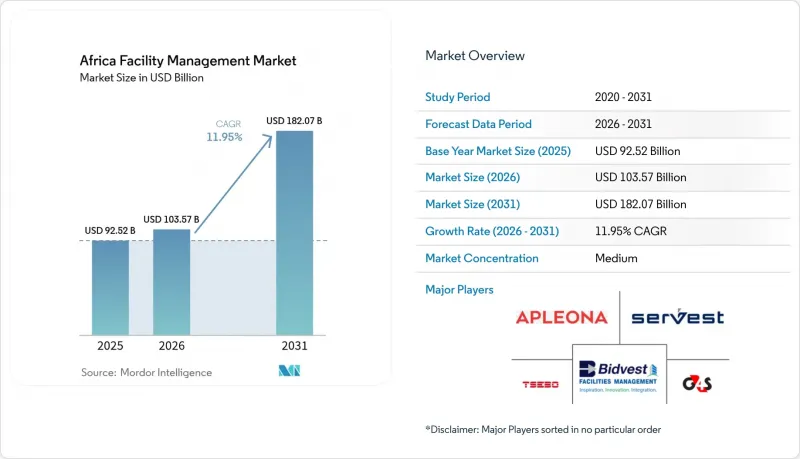
這一發展勢頭反映了基礎設施投資的加速成長、外包服務模式日益受到青睞,以及法規結構的不斷完善,該框架重視建築運營的專業標準。奈及利亞佔29.47%的市場佔有率,對區域需求有顯著影響。另一方面,南非和埃及以其規模、資金籌措實力和政策穩定性,吸引了國際供應商。在成本節約綜效和對私人及公共業主都具有吸引力的績效保證的推動下,外包合約目前佔市場佔有率的67.3%。商業領域仍然是最大的終端用戶,佔據40.2%的市場佔有率,但由於採礦和能源項目設施的日益複雜,需要更專業的技術知識,工業和加工設施的擴張速度最快。技術整合,特別是物聯網賦能的建築管理系統和人工智慧驅動的預測性維護,有助於在通貨膨脹和成本不斷上漲的環境下提高盈利能力,並為早期採用者在非洲設施管理市場贏得基於績效的競標奠定了基礎。
非洲設施管理市場的趨勢與洞察
外包的勢頭
非洲各地的組織機構正擴大將非核心建築營運外包,旨在釋放資金、規範流程並確保擁有充足的熟練人才。奈及利亞2024年發布的《在地化內容合規總統指令》鼓勵那些展現本土人才培育能力的競標,並鼓勵本地設施管理公司與全球專家成立合資企業。波札那的醫院服務外包案例表明,品質指標的顯著提升足以抵消成本增加,凸顯了管理式合約在公共衛生基礎設施領域的有效性。合約模式正轉向多年期合約,將技術和支援服務捆綁在績效保證之下,從而減少了重新談判帶來的摩擦,並提高了資產所有者的預算可預測性。設施管理人員現在正透過引入基於服務水準的關鍵績效指標(KPI),並將付款計劃與運轉率、能源效率和用戶舒適度掛鉤,來促進透明的價值交付。隨著成功案例在同儕網路中傳播,越來越多的董事會開始將外包視為一種策略工具,而不僅僅是一種削減成本的嘗試,這促進了非洲設施管理市場的合約數量成長。
技術整合
物聯網感測器、雲端分析和人工智慧診斷技術能夠實現遠端監控、自動故障檢測和預測性維護,從而延長資產使用壽命並最大限度地減少意外停機時間。現場研究表明,智慧建築控制系統在感測器發生故障時可將設施的平均電力消耗量降低 36.8 千瓦,從而降低電價波動帶來的風險。南非的一個試點計畫利用 Energy AI 的軟體,透過將設施遙測數據與天氣和價格資訊結合,最佳化暖通空調循環,實現了 10-15% 的營運成本降低。採用數位雙胞胎和行動工單平台的供應商透過提供即時儀錶板、自動合規日誌和數據驅動的資本規劃建議來脫穎而出。然而,由於精通數據分析和 OT-IT 整合的工程師人才有限,主要都市區以外的大規模部署進展緩慢。因此,與技術大學和供應商學院建立培訓合作關係,正成為那些希望在非洲設施管理市場贏得技術型合約的公司必備的競爭優勢。
營運成本上升
自2023年以來,奈及利亞貨幣貶值和對進口材料的依賴導致建築材料價格上漲了200%,擠壓了設施管理服務的利潤空間,迫使企業重新談判長期合約。在同一時期,水泥、鋼鐵和技術純熟勞工的人事費用加倍,而全球能源價格的波動也導致公用事業收費飆升。為了應對這些挑戰,服務提供者正透過引入動態定價條款、建立大量採購夥伴關係關係以及轉向在地採購消耗品等措施來降低成本轉嫁風險。一些公司正透過遠端監控和基於感測器的巡檢來減少技術人員的差旅費用,從而部分抵消非洲設施管理市場的通膨壓力。然而,持續存在的物流瓶頸和飆升的燃料成本威脅著現金流的可預測性,並限制了中小型供應商進行技術升級的能力。
細分市場分析
以機械、電氣和管道 (MEP) 維護為核心的硬性服務,旨在確保關鍵建築系統的運作,預計到 2025 年將佔據非洲設施管理市場 60.20% 的佔有率。強制性的消防和生命安全檢查、暖通空調最佳化以及電梯檢查意味著,在商業大廈和工業廠房中,技術服務並非低優先級項目。資產所有者在申請使用許可證和續保時會優先考慮硬性服務,從而確保即使在經濟放緩時期也能保持穩定的需求。同時,數位資產帳簿和狀態監測 (CBM) 透過將以資料為中心的工作流程整合到維護週期中,正在增強持續的收入來源。
隨著雇主將職場環境與員工留任率和品牌形象連結起來,軟性服務正以14.54%的複合年成長率快速成長。保全和辦公室支援引領成長,主要得益於都市區犯罪率上升和混合辦公模式普及,導致對門禁控制、接待管理和門房服務的需求不斷成長。清潔和廢棄物管理服務正在採用環保化學品和機器人技術,以減輕人工勞動負擔,同時滿足環境、社會和治理(ESG)標準。由佔用感測器觸發的預測性排班可以最大限度地減少加班,使空氣品質指標保持在健康指南範圍內,並提高員工滿意度。這種健康與效率的整合正在擴大軟性服務的支出,並逐步縮小非洲設施管理市場中軟性服務與硬性服務之間的收入差距。
非洲設施管理市場按服務類型(硬性服務和軟性服務)、交付方式(內部營運和外包)、最終用戶行業(商業、酒店、公共基礎設施、醫療保健、工業流程等)以及國家/地區進行細分。市場預測以價值(美元)表示。
其他好處:
- Excel格式的市場預測(ME)表
- 3個月的分析師支持
目錄
第1章:引言
- 研究假設和市場定義
- 調查範圍
第2章:調查方法
第3章執行摘要
第4章 市場狀況
- 市場概覽
- 目前運轉率
- 主要設施管理業者的盈利指標
- 勞動指標 - 勞動參與率
- 按服務類型分類的設施管理市場佔有率(%)
- 按硬體服務分類的設施管理市場佔有率(%)
- 軟服務類設施管理市場佔有率(%)
- 主要都會區的都市化和人口成長
- 非洲基礎設施管道的特定產業投資重點
- 與勞動和安全標準相關的監管因素
- 市場促進因素
- 外包趨勢
- 技術整合
- 符合ESG標準的解決方案
- 對綜合設施管理的需求
- 擴大經濟特區
- 保險主導的合規要求
- 市場限制因素
- 營運成本上升
- 對外包的文化抵制
- 數位調頻技術領域的技能差距
- 外匯波動會影響合約的有效性。
- 價值鏈分析
- PESTEL 分析
- 市場進入者的法規與法律體系
- 宏觀經濟指標對FM需求的影響
- 波特五力分析
- 供應商的議價能力
- 買方的議價能力
- 新進入者的威脅
- 替代品的威脅
- 競爭公司之間的競爭
- 投資與資金籌措分析
第5章 市場規模與成長預測
- 按服務類型
- 硬服務
- 資產管理
- 機電及暖通空調服務
- 消防系統和安全
- 其他硬體維修服務
- 軟服務
- 辦公室支援和安全
- 清潔服務
- 餐飲服務
- 其他軟調頻服務
- 硬服務
- 以規定形式
- 內部
- 外包
- 獨立調頻廣播
- 捆綁式調頻廣播
- 整合調頻
- 按最終用戶行業分類
- 商業(IT/電信、零售/倉儲)
- 飯店餐飲業(飯店、餐廳、大型餐廳)
- 公共服務和公共基礎設施(政府、教育、交通)
- 醫療保健(公立和私立機構)
- 工業和流程(製造業、能源業、採礦業)
- 其他終端用戶產業(多用戶住宅、娛樂、運動和休閒)
- 國家
- 南非
- 埃及
- 奈及利亞
- 其他非洲地區
第6章 競爭情勢
- 市場集中度
- 策略趨勢
- 市佔率分析
- 公司簡介
- Bidvest Facilities Management
- Apleona GmbH
- Tsebo Facilities Solution
- Servest Africa
- G4S Africa
- EFS Facilities Management Africa
- Global PFI Facilities Management Ltd.
- Contrack Facilities Management SAE
- Broll Nigeria
- Alpha Mead Group
- Integrico(Pty)Ltd.
- Benchmark Facilities Management
- Emdad Facility Management
- Grandeur Real-Estate Company
- Eliezer Group
第7章 市場機會與未來趨勢
- 評估未開發的領域和未滿足的需求
- 技術主導整合設施管理(利用物聯網、建築管理系統和人工智慧的預測性維護)
- 對符合ESG標準的設施管理解決方案的需求
- 服務模式的未來變化(基於績效的合約)
Africa Facility Management Market size in 2026 is estimated at USD 103.57 billion, growing from 2025 value of USD 92.52 billion with 2031 projections showing USD 182.07 billion, growing at 11.95% CAGR over 2026-2031.
This momentum reflects accelerating infrastructure investment, the growing preference for outsourced service models, and tightening regulatory frameworks that reward professional standards in building operations. Nigeria's 29.47% share gives it an outsized influence on regional demand, while South Africa and Egypt provide scale, financing depth, and policy stability that attract international providers. Outsourced contracts now account for 67.3% of value thanks to cost-saving synergies and performance guarantees that appeal to private and public owners alike. The commercial segment remains the largest end-user at 40.2% share, though industrial and process facilities are expanding fastest as mining and energy projects add complex sites that demand specialized technical expertise. Technology integration, particularly IoT-enabled building management systems and AI-driven predictive maintenance, underpins margin protection in an inflationary cost environment and positions early adopters to win outcome-based tenders across the Africa facility management market.
Africa Facility Management Market Trends and Insights
Outsourcing Momentum
Organizations across the continent increasingly outsource non-core building operations to unlock capital, standardize processes, and access specialized talent pools. Nigeria's 2024 Presidential Directive on Local Content Compliance rewards bidders that demonstrate domestic workforce development, encouraging local FM firms to form joint ventures with global specialists. Botswana's experience with hospital service outsourcing illustrates measurable gains in quality metrics that offset incremental cost, reinforcing the case for managed contracts in public health infrastructure. Contracting models have shifted toward multi-year agreements that bundle technical and support services under performance guarantees, subsequently reducing renegotiation friction and improving budget predictability for asset owners. Facility managers now embed service-level-based key performance indicators that align payment schedules with uptime, energy savings, and user comfort, promoting transparent value delivery. As success stories circulate across peer networks, more boards view outsourcing as a strategic lever rather than a cost-cutting experiment, driving deal volumes in the Africa facility management market.
Technology Integration
IoT sensors, cloud analytics, and AI diagnostics enable remote monitoring, automated fault detection, and predictive maintenance that extend asset life while curbing unplanned downtime. Field evidence shows smart building controls can cut average site energy draw by 36.8 kW during sensor failure scenarios, mitigating utility volatility. South African pilots using energyAI's software recorded 10-15% operating cost savings by combining equipment telemetry with weather and tariff feeds to optimize HVAC cycles. Providers that embed digital twins and mobile work-order platforms differentiate by offering live dashboards, automated compliance logs, and data-backed capital planning recommendations. However, the limited pool of technicians versed in data analytics and OT-IT convergence slows large-scale rollouts outside major metros. Training alliances with technical universities and vendor academies are therefore emerging as competitive necessities for firms intent on capturing technology-weighted contracts within the Africa facility management market.
Rising Operational Costs
Currency devaluation and imported material reliance have pushed Nigerian construction input prices up by 200% since 2023, squeezing FM service margins and forcing renegotiations of long-term contracts. Cement, steel, and skilled labor rates doubled over the same period, while utilities tariffs escalated due to global energy volatility. Providers answer with dynamic pricing clauses, bulk-buy partnerships, and substitution of locally sourced consumables to limit pass-through risk. Some firms leverage remote supervision and sensor-based inspections to lower technician travel expenses, partially offsetting inflation pressure in the Africa facility management market. Yet, persistent logistics bottlenecks and fuel cost spikes threaten cash-flow predictability and limit smaller vendors' ability to fund tech upgrades.
Other drivers and restraints analyzed in the detailed report include:
- ESG-Aligned Solutions
- Demand for Integrated FM
- Cultural Resistance to Outsourcing
For complete list of drivers and restraints, kindly check the Table Of Contents.
Segment Analysis
Hard services retained a 60.20% share of the Africa facility management market in 2025, anchored by mechanical, electrical, and plumbing maintenance that ensures operational uptime for critical building systems. Mandatory fire-life-safety testing, HVAC optimization, and elevator inspections position technical trades as non-discretionary budget items across commercial towers and industrial plants. Asset owners prioritize hard services when pursuing occupancy certificates and insurance renewals, supporting stable demand even during economic slowdowns. Meanwhile, digital asset registers and condition-based monitoring bolster recurring revenue streams by embedding data-centric workflows into maintenance cycles.
Soft services chart the fastest trajectory with 14.54% CAGR as employers link workplace experience to talent retention and brand perception. Security and office support top growth subsectors because rising urban crime rates and hybrid work models heighten the need for access control, reception management, and concierge services. Cleaning and waste services integrate green chemicals and robotics to meet ESG benchmarks while cutting manual labor intensity. Predictive scheduling triggered by occupancy sensors minimizes overtime, keeps air-quality metrics within health guidelines, and lifts satisfaction scores. This convergence of wellness and efficiency pulls a larger spending envelope toward soft services, gradually narrowing the revenue gap with hard services in the Africa facility management market size.
Africa Facility Management Market is Segmented by Service Type (Hard Services, and Soft Services), Offering Type (In-House, and Outsourced), End-User Industry (Commercial, Hospitality, Institutional and Public Infrastructure, Healthcare, Industrial and Process, and More), and Country. The Market Forecasts are Provided in Terms of Value (USD).
List of Companies Covered in this Report:
- Bidvest Facilities Management
- Apleona GmbH
- Tsebo Facilities Solution
- Servest Africa
- G4S Africa
- EFS Facilities Management Africa
- Global PFI Facilities Management Ltd.
- Contrack Facilities Management S.A.E.
- Broll Nigeria
- Alpha Mead Group
- Integrico (Pty) Ltd.
- Benchmark Facilities Management
- Emdad Facility Management
- Grandeur Real-Estate Company
- Eliezer Group
Additional Benefits:
- The market estimate (ME) sheet in Excel format
- 3 months of analyst support
TABLE OF CONTENTS
1 INTRODUCTION
- 1.1 Study Assumptions and Market Definition
- 1.2 Scope of the Study
2 RESEARCH METHODOLOGY
3 EXECUTIVE SUMMARY
4 MARKET LANDSCAPE
- 4.1 Market Overview
- 4.1.1 Current Occupancy Rates
- 4.1.2 Profitability Rates of Major FM Players
- 4.1.3 Workforce Indicators - Labor Participation
- 4.1.4 Facility Management Market Share (%) by Service Type
- 4.1.5 Facility Management Market Share (%) by Hard Services
- 4.1.6 Facility Management Market Share (%) by Soft Services
- 4.1.7 Urbanization and Population Growth in Major Metros
- 4.1.8 Sector Investment Priorities in Africa Infrastructure Pipeline
- 4.1.9 Regulatory Drivers Specific to Labour and Safety Standards
- 4.2 Market Drivers
- 4.2.1 Outsourcing momentum
- 4.2.2 Technology integration
- 4.2.3 ESG-aligned solutions
- 4.2.4 Demand for integrated FM
- 4.2.5 Expansion of Special Economic Zones (SEZs)
- 4.2.6 Insurance-driven compliance mandates
- 4.3 Market Restraints
- 4.3.1 Rising operational costs
- 4.3.2 Cultural resistance to outsourcing
- 4.3.3 Skills gap in digital FM technologies
- 4.3.4 Volatile foreign-exchange rates impacting contract viability
- 4.4 Value Chain Analysis
- 4.5 PESTEL Analysis
- 4.6 Regulatory and Legislative Framework for Market Entrants
- 4.7 Impact of Macroeconomic Indicators on FM Demand
- 4.8 Porter's Five Forces Analysis
- 4.8.1 Bargaining Power of Suppliers
- 4.8.2 Bargaining Power of Buyers
- 4.8.3 Threat of New Entrants
- 4.8.4 Threat of Substitute Services
- 4.8.5 Intensity of Competitive Rivalry
- 4.9 Investment and Funding Analysis
5 MARKET SIZE AND GROWTH FORECASTS (VALUES)
- 5.1 By Service Type
- 5.1.1 Hard Services
- 5.1.1.1 Asset Management
- 5.1.1.2 MEP and HVAC Services
- 5.1.1.3 Fire Systems and Safety
- 5.1.1.4 Other Hard FM Services
- 5.1.2 Soft Services
- 5.1.2.1 Office Support and Security
- 5.1.2.2 Cleaning Services
- 5.1.2.3 Catering Services
- 5.1.2.4 Other Soft FM Services
- 5.1.1 Hard Services
- 5.2 By Offering Type
- 5.2.1 In-house
- 5.2.2 Outsourced
- 5.2.2.1 Single FM
- 5.2.2.2 Bundled FM
- 5.2.2.3 Integrated FM
- 5.3 By End-user Industry
- 5.3.1 Commercial (IT and Telecom, Retail and Warehouses)
- 5.3.2 Hospitality (Hotels, Eateries, Large-scale Restaurants)
- 5.3.3 Institutional and Public Infrastructure (Govt, Education, Transportation)
- 5.3.4 Healthcare (Public and Private Facilities)
- 5.3.5 Industrial and Process (Manufacturing, Energy, Mining)
- 5.3.6 Other End-user Industries (Multi-housing, Entertainment, Sports and Leisure)
- 5.4 By Country
- 5.4.1 South Africa
- 5.4.2 Egypt
- 5.4.3 Nigeria
- 5.4.4 Rest of Africa
6 COMPETITIVE LANDSCAPE
- 6.1 Market Concentration
- 6.2 Strategic Moves
- 6.3 Market Share Analysis
- 6.4 Company Profiles (includes Global level Overview, Market level overview, Core Segments, Financials as available, Strategic Information, Market Rank/Share for key companies, Products and Services, and Recent Developments)
- 6.4.1 Bidvest Facilities Management
- 6.4.2 Apleona GmbH
- 6.4.3 Tsebo Facilities Solution
- 6.4.4 Servest Africa
- 6.4.5 G4S Africa
- 6.4.6 EFS Facilities Management Africa
- 6.4.7 Global PFI Facilities Management Ltd.
- 6.4.8 Contrack Facilities Management S.A.E.
- 6.4.9 Broll Nigeria
- 6.4.10 Alpha Mead Group
- 6.4.11 Integrico (Pty) Ltd.
- 6.4.12 Benchmark Facilities Management
- 6.4.13 Emdad Facility Management
- 6.4.14 Grandeur Real-Estate Company
- 6.4.15 Eliezer Group
7 MARKET OPPORTUNITIES AND FUTURE TRENDS
- 7.1 White-space and Unmet-Need Assessment
- 7.2 Technology-led Integrated FM (IoT, BMS, AI-based Predictive Maintenance)
- 7.3 ESG-compliant FM Solutions Demand
- 7.4 Future Service-Model Shifts (Outcome-based Contracts)

 醫療設施管理軟體市場:全球市場預測,2026-2032年
 2026-2030年全球設施管理市場
 設施管理(FM)軟體:市場佔有率分析、行業趨勢和統計數據以及成長預測(2026-2031 年)北美設施管理:市場佔有率分析、產業趨勢與統計、成長預測(2026-2031 年)亞太地區硬設施管理:市場佔有率分析、產業趨勢與統計及成長預測(2026-2031)硬設施管理:市場佔有率分析、產業趨勢與統計、成長預測(2026-2031 年)日本設施管理:市場佔有率分析、產業趨勢與統計及成長預測(2026-2031)
 Frost Radar™:泰國設施管理,2026 年中國設施管理:市場佔有率分析、產業趨勢與統計、成長預測(2026-2031)印尼設施管理:市場佔有率分析、產業趨勢與統計、成長預測(2026-2031)