


 |
市場調查報告書
商品編碼
1911370
法國設施管理市場:市場佔有率分析、產業趨勢與統計、成長預測(2026-2031)France Facility Management - Market Share Analysis, Industry Trends & Statistics, Growth Forecasts (2026 - 2031) |
||||||

※ 本網頁內容可能與最新版本有所差異。詳細情況請與我們聯繫。
2025年法國設施管理(FM)市場價值為733億美元,預計到2031年將達到846.7億美元,高於2026年的750.9億美元。
預計在預測期(2026-2031 年)內,複合年成長率將達到 2.44%。
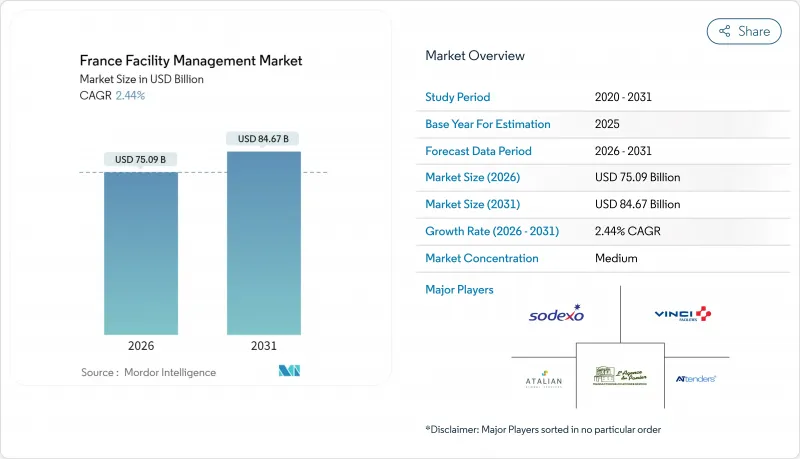
更嚴格的能源效率法規、建築系統的快速數位化以及政府對維修工程的支持,共同推動了這一緩慢但穩定的成長。市場需求集中在智慧化的、以結果為導向的基本契約上,這類合約將供應商的報酬與脫碳和營運績效指標掛鉤。隨著企業最佳化供應商結構,軟硬體一體化的服務包越來越受歡迎;而持續的勞動力短缺則促使供應商轉向自動化、遠端監控和基於狀態的維護。隨著全球巨頭出售非核心業務,以及國內主要企業尋求擴張,競爭日益激烈。同時,中型專業公司正透過物聯網賦能的預測服務、可再生能源技術和ESG合規支援來實現差異化競爭。
法國設施管理市場趨勢與洞察
建築管理系統的技術進步
物聯網感測器、行動電腦化維護管理系統 (CMMS) 平台和人工智慧驅動的分析技術的廣泛應用,正在改變建築物的監控、維護和最佳化方式。一家法國營運商已管理 42,000 個電動車充電樁,並透過結合數位雙胞胎和預測分析技術,將暖通空調 (HVAC) 能耗降低了 15-20%。施耐德電機的 EcoStruxure™ 資源顧問能夠即時追蹤碳排放,從而滿足到 2030 年將第三產業資產的能耗降低 40% 的要求。早期採用者已經體驗到停機時間減少、故障解決速度加快以及檢驗的永續性指標,這提高了那些在技術投資方面落後的供應商的競爭門檻。這一趨勢也推動了基於結果的定價模式,在這種模式下,演算法檢驗服務等級和節能保證。
房地產行業的成長
2025年第一季,商業不動產資本流入達34億歐元,較去年同期成長67%。其中,光是辦公空間就吸引了14億歐元。大巴黎地區的大型企劃持續創造新的辦公室、零售、資料中心和交通樞紐供應,從一運作就需要承包的設施服務。新建專案通常包含綠色租賃條款,其中包含績效儀表板,確保設施管理貫穿設計、施工和營運的各個階段。同時,老舊物業面臨監管規定的維修期限,進一步推動了對機械、電氣和外部升級改造的需求,而這些升級改造通常透過綜合設施管理合約來實現。
勞動市場限制因素與技能短缺
法國勞工部的報告指出,2025年,設施管理(FM)人才招聘計劃仍有一半將面臨挑戰,報告強調了熟悉物聯網平台、建築管理系統(BMS)分析和能源審核通訊協定的技術人員嚴重短缺。為了緩解人手不足,供應商正在實施技能提升培訓、擴增實境(AR)工作指導和機器人技術,但不斷上漲的薪資正在擠壓利潤空間。客戶對全天候運作的需求進一步加劇了人員配置模式的複雜性,並提升了自動化遠端監控的價值。對於需要專業試運行和合規知識的計劃,持續的人才短缺可能會限制其發展。
細分市場分析
到2025年,硬性服務將佔法國設施管理市場收入的61.74%,這主要得益於為滿足日益嚴格的能源強度標準而必須提供的機電管道(MEP)和暖通空調(HVAC)服務。該領域直接受益於67億歐元的「韌性基金」支出以及即將於2025年生效的職業安全法規,該法規要求更新通風和冷凍系統。消防安全合規仍然是必要條件,即使在宏觀經濟放緩時期也能確保市場需求的穩定。由於基於預測分析的狀態維護模式的轉變,資產管理子服務的採用率不斷提高,從而推動了感測器維修和資產延壽研究的支出增加。同時,儘管規模較小,但預計到2031年,軟性服務將以2.59%的複合年成長率成長,這反映了職場向健康和酒店式品牌體驗的轉變。索迪斯2024會計年度的數據顯示,食品服務成長了5.7%,而傳統設施管理業務僅成長了2.4%,這凸顯了服務重點正從商品化的清潔服務轉向以用戶體驗為導向的服務。此外,智慧建築應用程式的出現也進一步推動了軟性服務業務的成長,這些應用程式整合了訪客管理和室內空氣品質儀表板,並將設施管理融入更廣泛的員工參與策略中。
儘管到2031年,硬性服務仍將是法國設施管理市場規模的最大貢獻者,但隨著企業將職場體驗視為人才招募和ESG品牌建設的手段,其與軟性服務之間的差距將逐漸縮小。供應商正透過將清潔機器人與人工智慧驅動的節能技術結合,並將健康分析整合到整合式儀表板中,從而實現交叉銷售協同效應。因此,差異化競爭的關鍵在於如何在資本密集技術維護與以人為本、透過數位化工作流程提供的靈活且便利的服務之間取得平衡。
其他福利
- Excel格式的市場預測(ME)表
- 3個月的分析師支持
目錄
第1章 引言
- 研究假設和市場定義
- 調查範圍
第2章調查方法
第3章執行摘要
第4章 市場情勢
- 市場概覽
- 主要商業地產領域的當前運轉率
- 主要設施管理服務提供者的盈利基準
- 勞動指標-勞動參與率和技能擁有情形
- 按服務類型分類的設施管理市場佔有率(%)
- 以硬體維修服務分類的設施管理市場佔有率(%)
- 以軟性設施管理服務分類的設施管理市場佔有率(%)
- 主要都會區(巴黎、里昂、馬賽、裡爾、圖盧茲)的都市化與人口成長
- 法國國家基礎設施計畫中的部門投資優先事項
- 勞動和安全標準的監管促進因素
- 促進要素
- 建築管理系統的技術進步
- 房地產行業的成長
- 更重視綠建築實踐
- 對軟性FM方法的需求日益成長
- 綜合設施管理(IFM)合約的採用率不斷提高
- 政府為現有建築的節能維修提供獎勵措施
- 抑制因素
- 勞動市場限制因素與技能短缺
- 經濟波動和通膨壓力
- 市場區隔程度過高限制了規模經濟效益。
- 公共部門合約中複雜的競標流程
- 價值鏈分析
- PESTEL 分析
- 新參與企業的監管和法律體制
- 宏觀經濟指標對FM需求的影響
- 波特五力模型
- 供應商的議價能力
- 買方的議價能力
- 新進入者的威脅
- 替代品的威脅
- 競爭對手之間的競爭
- 投資與資金籌措分析
第5章 市場規模與成長預測
- 按服務類型
- 硬服務
- 資產管理
- 機電及暖通空調服務
- 消防系統和安全措施
- 其他硬體維修服務
- 軟服務
- 辦公室支援與安全
- 清潔服務
- 餐飲服務
- 其他軟性調頻服務
- 硬服務
- 按規定表格
- 內部管理
- 外包
- 單頻調頻
- 捆綁式調頻服務
- 整合調頻
- 按最終用戶行業分類
- 商業(IT/通訊、零售/倉儲)
- 飯店餐飲業(飯店、餐廳等)
- 公共及公共基礎設施(政府、教育、交通)
- 醫療保健(公立和私立機構)
- 工業流程(製造業、能源業、採礦業)
- 其他終端用戶產業(多用戶住宅、娛樂、運動和休閒)
第6章 競爭情勢
- 市場集中度
- 策略趨勢
- 市佔率分析
- 公司簡介
- Sodexo Group
- VINCI Facilities
- Atalian Group
- ONET SA
- Veolia Environnement SA
- ISS World Services A/S
- Equans
- SPIE Facilities
- Samsic Facility
- Elis SA
- DEF Network
- Bouygues Energies and Services
- Derichebourg Multiservices
- CBRE GWS France
- ENGIE Solutions
- Seris Group
- Dalkia
- Axima
第7章 市場機會與未來展望
The France facility management market was valued at USD 73.30 billion in 2025 and estimated to grow from USD 75.09 billion in 2026 to reach USD 84.67 billion by 2031, at a CAGR of 2.44% during the forecast period (2026-2031).
Heightened energy-efficiency mandates, the rapid digitalization of building systems, and government stimulus for retrofits underpin this moderate yet resilient expansion. Demand is concentrating around smart, outcome-based contracts that link provider remuneration to decarbonization and operational performance metrics. Integrated hard-and-soft service bundles are gaining traction as enterprises streamline supplier bases, while persistent labor shortages push providers toward automation, remote monitoring, and condition-based maintenance. Competitive intensity is rising as global majors divest non-core portfolios and domestic champions acquire scale; simultaneously, midsize specialists differentiate through IoT-enabled predictive services, renewable-energy know-how, and ESG-compliance support.
France Facility Management Market Trends and Insights
Technological Advancements in Building Management Systems
Widespread deployment of IoT sensors, mobile CMMS platforms, and AI-driven analytics is transforming how buildings are monitored, maintained, and optimized. French operators already manage 42,000 EV charging points, and digital twins combined with predictive analytics are cutting HVAC energy consumption by 15-20%. Schneider Electric's EcoStruxure(TM) Resource Advisor enables real-time carbon tracking that aligns with the 40% energy-reduction mandate for tertiary assets by 2030. Early adopters gain lower downtime, faster fault resolution, and verifiable sustainability metrics, raising competitive thresholds for providers lagging on tech investment. The trend also encourages outcome-based pricing, where algorithms verify service levels and energy-savings guarantees.
Growth of the Real Estate Sector
Commercial real-estate inflows reached EUR 3.4 billion in Q1 2025, up 67% year-on-year, with offices alone attracting EUR 1.4 billion. Mega-projects under the Grand Paris banner continue to create fresh inventories of offices, retail precincts, data centers, and transit hubs requiring turnkey facility services from day one. New-build assets frequently include green-lease clauses that embed performance dashboards, thereby ensuring facility-management engagement across design, construction, and operational phases. Simultaneously, aging stock faces regulatory retrofit deadlines, further lifting demand for mechanical, electrical, and envelope upgrades delivered through integrated FM contracts.
Labor Market Constraints and Skills Shortage
Half of all FM recruitment projects remained difficult in 2025 according to France Travail, underscoring acute scarcity of technicians competent in IoT platforms, BMS analytics, and energy-audit protocols. Providers deploy upskilling academies, augmented-reality work instructions, and robotics to ease manpower strain, yet wage inflation compresses margins. Client expectations around 24/7 uptime further complicate staffing models, amplifying the value of automated remote supervision. Continued shortages may cap growth for projects requiring specialized commissioning and compliance expertise.
Other drivers and restraints analyzed in the detailed report include:
- Increasing Emphasis on Green Building Practices
- Rising Adoption of Integrated Facilities Management Contracts
- Economic Fluctuations and Inflationary Pressures
For complete list of drivers and restraints, kindly check the Table Of Contents.
Segment Analysis
Hard Services delivered 61.74% of France facility management market revenue in 2025, led by MEP and HVAC functions required to meet tightening energy-intensity benchmarks. The segment benefits directly from the EUR 6.7 billion Recovery and Resilience outlay and from impending 2025 worker-safety rules that mandate upgraded ventilation and cooling systems. Fire-safety compliance remains non-discretionary, ensuring steady demand even during macro-slowdowns. Asset-management sub-services show rising adoption as predictive analytics push maintenance toward condition-based regimes, increasing spend on sensor retrofits and asset-life-extension studies. In contrast, Soft Services, while smaller, are the growth pacesetter at a 2.59% CAGR to 2031, reflecting a workplace shift toward health, hospitality, and brand-experience outcomes. Sodexo's FY 2024 data show food services progressing 5.7% versus 2.4% for traditional FM, highlighting a re-weighting from commodity cleaning to user-experience-centric offerings. Soft-service growth is further propelled by smart-building apps that integrate visitor management with indoor-air-quality dashboards, weaving FM into broader employee-engagement agendas.
Hard Services will remain the largest contributor to France facility management market size through 2031, yet Soft Services will progressively narrow the gap as enterprises view workplace experience as a lever for talent attraction and ESG branding. Providers capture cross-selling synergies by merging cleaning robotics with AI-driven energy shedding and by embedding wellness analytics in integrated dashboards. As a result, differentiation hinges on balancing capital-intensive technical maintenance with agile, people-focused touchpoints delivered through digitally-rich workflows.
The France Facility Management Market Report is Segmented by Service Type (Hard Services, and Soft Services), Offering Type (In-House, and Outsourced), End-User Industry (Commercial, Hospitality, Institutional and Public Infrastructure, Healthcare, Industrial and Process, and Other End-User Industries), and Geography. The Market Forecasts are Provided in Terms of Value (USD).
List of Companies Covered in this Report:
- Sodexo Group
- VINCI Facilities
- Atalian Group
- ONET S.A.
- Veolia Environnement S.A.
- ISS World Services A/S
- Equans
- SPIE Facilities
- Samsic Facility
- Elis S.A.
- DEF Network
- Bouygues Energies and Services
- Derichebourg Multiservices
- CBRE GWS France
- ENGIE Solutions
- Seris Group
- Dalkia
- Axima
Additional Benefits:
- The market estimate (ME) sheet in Excel format
- 3 months of analyst support
TABLE OF CONTENTS
1 INTRODUCTION
- 1.1 Study Assumptions and Market Definition
- 1.2 Scope of the Study
2 RESEARCH METHODOLOGY
3 EXECUTIVE SUMMARY
4 MARKET LANDSCAPE
- 4.1 Market Overview
- 4.1.1 Current Occupancy Rates in Key Commercial Real Estate Segments
- 4.1.2 Profitability Benchmarks of Major FM Providers
- 4.1.3 Workforce Indicators - Labour Participation and Skill Availability
- 4.1.4 Facility Management Market Share (%) by Service Type
- 4.1.5 Facility Management Market Share (%) by Hard FM Services
- 4.1.6 Facility Management Market Share (%) by Soft FM Services
- 4.1.7 Urbanisation and Population Growth in Top Metros (Paris, Lyon, Marseille, Lille, Toulouse)
- 4.1.8 Sector Investment Priorities in France's National Infrastructure Pipeline
- 4.1.9 Regulatory Drivers Specific to Labour and Safety Standards
- 4.2 Drivers
- 4.2.1 Technological Advancements in Building Management Systems
- 4.2.2 Growth of the Real Estate Sector
- 4.2.3 Increasing Emphasis on Green Building Practices
- 4.2.4 Growing Demand for Soft FM Practices
- 4.2.5 Rising Adoption of Integrated Facilities Management (IFM) Contracts
- 4.2.6 Government Incentives for Energy-Efficiency Retrofits in Existing Buildings
- 4.3 Restraints
- 4.3.1 Labor Market Constraints and Skills Shortage
- 4.3.2 Economic Fluctuations and Inflationary Pressures
- 4.3.3 High Market Fragmentation Limiting Economies of Scale
- 4.3.4 Complex Tendering Processes in Public Sector Contracts
- 4.4 Value Chain Analysis
- 4.5 PESTEL Analysis
- 4.6 Regulatory and Legislative Framework for Market Entrants
- 4.7 Impact of Macroeconomic Indicators on FM Demand
- 4.8 Porter's Five Forces
- 4.8.1 Bargaining Power of Suppliers
- 4.8.2 Bargaining Power of Buyers
- 4.8.3 Threat of New Entrants
- 4.8.4 Threat of Substitute Services
- 4.8.5 Intensity of Competitive Rivalry
- 4.9 Investment and Funding Analysis
5 MARKET SIZE AND GROWTH FORECASTS (VALUE)
- 5.1 By Service Type
- 5.1.1 Hard Services
- 5.1.1.1 Asset Management
- 5.1.1.2 MEP and HVAC Services
- 5.1.1.3 Fire Systems and Safety
- 5.1.1.4 Other Hard FM Services
- 5.1.2 Soft Services
- 5.1.2.1 Office Support and Security
- 5.1.2.2 Cleaning Services
- 5.1.2.3 Catering Services
- 5.1.2.4 Other Soft FM Services
- 5.1.1 Hard Services
- 5.2 By Offering Type
- 5.2.1 In-house
- 5.2.2 Outsourced
- 5.2.2.1 Single FM
- 5.2.2.2 Bundled FM
- 5.2.2.3 Integrated FM
- 5.3 By End-user Industry
- 5.3.1 Commercial (IT and Telecom, Retail and Warehousing)
- 5.3.2 Hospitality (Hotels, Eateries, Restaurants)
- 5.3.3 Institutional and Public Infrastructure (Govt, Education, Transport)
- 5.3.4 Healthcare (Public and Private Facilities)
- 5.3.5 Industrial and Process (Manufacturing, Energy, Mining)
- 5.3.6 Other End-user Industries (Multi-housing, Entertainment, Sports and Leisure)
6 COMPETITIVE LANDSCAPE
- 6.1 Market Concentration
- 6.2 Strategic Moves
- 6.3 Market Share Analysis
- 6.4 Company Profiles (includes Global level Overview, Market level overview, Core Segments, Financials as available, Strategic Information, Market Rank/Share for key companies, Products and Services, and Recent Developments)
- 6.4.1 Sodexo Group
- 6.4.2 VINCI Facilities
- 6.4.3 Atalian Group
- 6.4.4 ONET S.A.
- 6.4.5 Veolia Environnement S.A.
- 6.4.6 ISS World Services A/S
- 6.4.7 Equans
- 6.4.8 SPIE Facilities
- 6.4.9 Samsic Facility
- 6.4.10 Elis S.A.
- 6.4.11 DEF Network
- 6.4.12 Bouygues Energies and Services
- 6.4.13 Derichebourg Multiservices
- 6.4.14 CBRE GWS France
- 6.4.15 ENGIE Solutions
- 6.4.16 Seris Group
- 6.4.17 Dalkia
- 6.4.18 Axima
7 MARKET OPPORTUNITIES AND FUTURE OUTLOOK
- 7.1 White-space and Unmet-Need Assessment
- 7.2 Technology-led Integrated FM (IoT, BMS, AI-based Predictive Maintenance)
- 7.3 ESG-Compliant FM Solutions Demand
- 7.4 Future Service-Model Shifts (Outcome-Based Contracts)
- 7.5 Data-Driven Energy Optimisation and Carbon Reporting Services

 設施管理市場:2026-2032年全球市場預測(依產品、產品模式、部署類型、公司規模及最終用途分類)設施管理服務市場:2026-2032年全球市場預測(依服務類型、合約類型、服務交付方式、最終用戶和組織規模分類)
 2026年全球地下設施維護與管理市場報告2026年全球硬性服務設施管理市場報告2026年全球設施支援服務市場報告2026年全球設施管理服務市場報告2026年全球軟性服務設施管理市場報告
 設施管理市場規模、佔有率、成長及全球產業分析:按類型、應用和地區分類的洞察,2026-2034 年預測硬設施管理市場:依服務類型、合約類型、所有權類型和最終用戶產業分類-2026-2032年全球市場預測2026年全球電腦輔助設施管理(CAFM)市場報告