


 |
市場調查報告書
商品編碼
1906978
設施管理:市場佔有率分析、產業趨勢與統計、成長預測(2026-2031)Facility Management - Market Share Analysis, Industry Trends & Statistics, Growth Forecasts (2026 - 2031) |
||||||

※ 本網頁內容可能與最新版本有所差異。詳細情況請與我們聯繫。
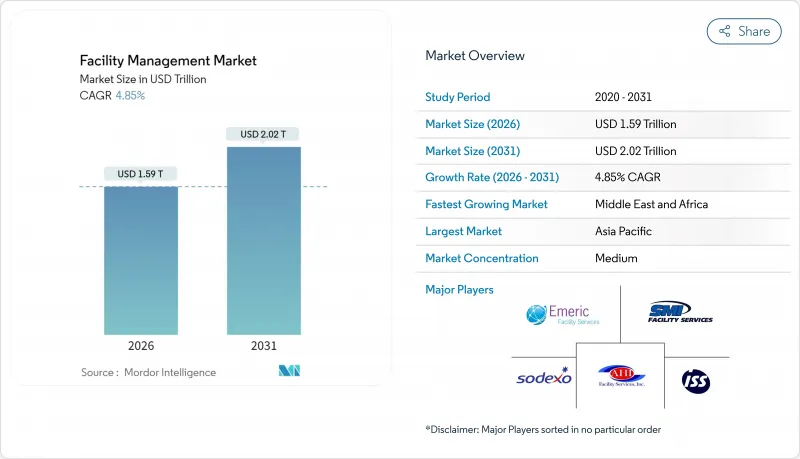
預計到 2026 年,設施管理市場規模將達到 1.59 兆美元,較 2025 年的 1.517 兆美元持續成長。預計到 2031 年,該市場規模將達到 2.02 兆美元,2026 年至 2031 年的複合年成長率為 4.85%。
這種成長動能反映了設施管理定位的轉變,它不再只是支持成本,而是成為提升營運韌性、數位整合和員工生產力的策略槓桿。不斷成長的外包需求、儘管網路安全事件頻繁但仍在加速的雲端遷移,以及對環境、社會和治理(ESG)要求的日益重視,共同推動了潛在需求的擴大。新興市場(尤其是亞太地區)不斷成長的基礎設施投資,進一步強化了設施管理市場的多區域擴張週期。那些將技術平台與基於結果的模式相結合的供應商,正贏得那些尋求透明成本管理和可衡量效率的客戶的高價值合約。
全球設施管理市場趨勢與洞察
越來越重視將非核心職能外包
企業正將設施管理業務外包給專業合作夥伴,從而釋放資金用於核心創新。到2024年,35%的企業將增加設施管理預算,以降低營運複雜性。設施管理市場受益於規模經濟,能夠有效應對供應鏈中斷,並提供多元化的員工。科技和醫療保健產業的需求尤其顯著,支撐了世邦魏理仕(CBRE) 2025年第一季收入淨額成長16%的預期。這種模式也有助於降低供應商風險(29%的企業表示擔憂供應中斷),促使企業更傾向選擇物流能力較強的設施管理夥伴。隨著外包業務量的成長,供應商正將利潤再投資於自動化、預測分析和員工技能提升,強化了設施管理市場良性成長的循環。
利用物聯網進行預測性維護,實現設施數位化。
預測性維護平台預計到2025年將達到55億美元,年成長率達17%,並將推動從被動維修轉向基於狀態的管理模式的結構性轉變。醫療保健產業的部署報告顯示,透過自動產生工單,設施成本降低了10-15%。軟體層(佔支出的44%)整合了預訓練演算法,使中型設施也能在設施管理市場普及應用。一項在工業工廠進行的初步試點計畫表明,廢熱回收率提高了25%,展現了切實的ESG(環境、社會和治理)效益。隨著異常檢測模型的日趨成熟,資料需求不斷降低,使得小規模資產無需龐大的歷史日誌即可參與其中,從而擴大了市場滲透率,涵蓋更廣泛的地區。
設施管理職的薪資上漲
預計到2024年,設施管理職缺的平均時薪將成長4.1%,中位數達到21.74美元。這將對勞動密集型合約的利潤率造成壓力。熟練工種(尤其是暖通空調和電氣工種)的短缺加劇了競標競爭,而康乃爾大學設施管理工人罷工等事件也凸顯了工會活動的活性化。隱性合約費用和後端附加費進一步加重了預算壓力,迫使採購負責人重新評估外包的經濟效益。為此,供應商正在加速採用機器人技術和自主清潔系統,但初始投資和再培訓要求阻礙了這些技術在設施管理市場的短期普及。
細分市場分析
受機械、電氣和管道 (MEP) 設備強制維護以確保資產完整性的驅動,硬性服務將在 2025 年佔據設施管理市場規模的 58.65%。日益嚴格的監管標準和資產複雜性正在推動對認證技術人員需求的穩定成長。在預測期內,客戶對整合管理體驗的日益青睞將推動其與軟性服務的進一步整合,從而為整合供應商創造交叉銷售機會。
儘管軟性服務規模較小,但其複合年成長率高達6.05%,反映出企業日益關注衛生、安全和居住者福祉。清潔合約中已包含抗菌通訊協定和機器人吸塵器,而安保也正朝著人工智慧影像分析的方向發展。隨著ESG(環境、社會和治理)標準擴展至室內空氣品質和餐飲永續性,軟性服務正逐漸獲得經營團隊的認可。能夠整合硬性數據和軟性數據的供應商可以主動調整預防性維護計劃,從而帶來實際的營運效益,並提升其在設施管理市場的佔有率。
截至2025年,以明確責任的綜合設施管理(IFM)合約為支撐的內部管理模式將佔據設施管理市場佔有率的53.20%。擁有多個辦公地點的公司重視單一發票的透明度,並正在推動這種模式的普及。同時,隨著網路安全敏感型產業保留關鍵的管理職能,外包設施管理將以5.71%的複合年成長率成長。混合型結構正變得越來越普遍,它透過將策略規劃保留在公司內部,而將現場執行工作轉移給合作夥伴,從而在柔軟性和風險之間取得平衡。
隨著綜合設施管理(IFM)範圍的擴大,供應商正在整合分析門戶,以可視化方式呈現按地點分類的服務成本,從而實現數據驅動的合約續約。由於客戶要求提供整體價值提案,單一服務選項正在減少,迫使規模較小的承包商進行合併或專業轉型。世邦魏理仕(CBRE)以16億美元收購Industrious,凸顯了其向體驗式訂閱服務的戰略轉型,該服務整合了設施管理、酒店服務和空間分析,重新定義了設施管理市場的競爭格局。
區域分析
預計到2025年,亞太地區將佔據全球設施管理市場41.10%的佔有率,年複合成長率達6.05%,主要得益於政府的獎勵策略和都市區進程。中國高達51.4兆美元的固定資產投資,其中包括基礎設施投資成長5.9%,將支持對設施管理服務的長期需求。印度商業房地產的快速擴張正在推動遠端監控的需求,而東協的智慧城市規劃也正在將設施管理合約納入其總體規劃。能夠建立本地化供應鏈和多語言平台的營運商將獲得先發優勢。
北美市場環境依然成熟且充滿創新活力,雲端運算的普及和ESG合規性推動了高階定價。該地區的設施管理市場面臨勞動力短缺,促使自動化技術得到應用。能源最佳化要求和控制通膨的立法獎勵正在推動設施管理專業人員進行維修。歐洲也在數位化進程中不斷前進,但其特點是嚴格的碳排放法規,例如歐盟環境影響評估指令(EPBD),並且合約正朝著基於績效的補償模式發展。泛歐供應商正在利用跨境管治框架來規範服務品質。
在中東和非洲,公私合營在交通、醫療和教育基礎設施領域的應用正在加速普及。波灣合作理事會(GCC)的大型企劃從設計階段開始納入設施管理(FM)條款,從而提升了專案的全生命週期價值。在南美洲,物流和製造業的擴張推動了穩定的需求,但匯率波動也帶來了彈性價格設定的需求。在所有新興地區,供應商分散化正在推動產業整合,這為擅長併購整合的全球巨頭擴大了設施管理市場。
其他福利:
- Excel格式的市場預測(ME)表
- 3個月的分析師支持
目錄
第1章 引言
- 研究假設和市場定義
- 調查範圍
第2章調查方法
第3章執行摘要
第4章 市場情勢
- 市場概覽
- 市場促進因素
- 越來越重視非核心職能的外包
- 利用物聯網進行預測性維護,實現設施數位化。
- 永續性和ESG相關設施管理合約
- 疫情後混合職場重新設計的必要性
- 新興市場的公私合營基礎建設項目
- 人工智慧主導的能源最佳化要求
- 市場限制
- 行政工作工資上漲
- 在新興市場實現供應商基礎多元化
- 基於雲端的設施管理平台中的網路安全風險
- 中小企業IFM平台的資本固定
- 價值鏈分析
- 監管環境
- 技術展望
- 波特五力分析
- 供應商的議價能力
- 買方的議價能力
- 新進入者的威脅
- 替代品的威脅
- 競爭對手之間的競爭
- 定價分析
- 對宏觀經濟趨勢的市場評估
第5章 市場規模與成長預測
- 按服務類型
- 硬服務
- 資產管理
- 機電及暖通空調
- 防火和安全措施
- 其他硬體服務
- 軟服務
- 打掃
- 安全和辦公支持
- 餐飲
- 其他軟體服務
- 硬服務
- 按規定表格
- 內部
- 外包
- 單服務調頻廣播
- Bundle FM
- 綜合設施管理(IFM)
- 按部署模式
- 本地部署
- 基於雲端的
- 按公司規模
- 主要企業
- 中小企業
- 按最終用戶行業分類
- 商業設施(IT/通訊、零售、倉儲)
- 飯店餐飲業(飯店、餐廳)
- 公共機構和公共
- 衛生保健
- 工業與流程
- 住宅和休閒
- 按地區
- 北美洲
- 美國
- 加拿大
- 墨西哥
- 歐洲
- 英國
- 德國
- 法國
- 義大利
- 西班牙
- 比荷盧經濟聯盟(比利時、荷蘭、盧森堡)
- 北歐國家(瑞典、挪威、丹麥、芬蘭)
- 波蘭
- 俄羅斯
- 其他歐洲地區
- 亞太地區
- 中國
- 印度
- 日本
- 韓國
- 澳洲和紐西蘭
- 亞太其他地區
- 南美洲
- 巴西
- 阿根廷
- 哥倫比亞
- 智利
- 其他南美洲
- 中東和非洲
- 中東
- 海灣合作理事會(沙烏地阿拉伯、阿拉伯聯合大公國、卡達、阿曼、科威特、巴林)
- 土耳其
- 其他中東地區
- 非洲
- 南非
- 奈及利亞
- 埃及
- 肯亞
- 其他非洲地區
- 中東
- 北美洲
第6章 競爭情勢
- 市場集中度
- 策略趨勢
- 市佔率分析
- 公司簡介
- CBRE Group Inc.
- Cushman and Wakefield plc
- JLL(Jones Lang LaSalle Inc.)
- ISS A/S
- Sodexo SA
- Compass Group plc
- Emeric Facility Services
- SMI Facility Services
- AHI Facility Services Inc.
- Aramark Corporation
- ABM Industries Inc.
- G4S Limited
- Atalian Global Services
- Vinci Facilities(VINCI SA)
- EMCOR Group Inc.
- Comfort Systems USA
- Balfour Beatty-Workplace
- Serco Group plc
- Reliance Facilities(India)
- Sinopec Engineering FM(China)
- Unispace Global
第7章 市場機會與未來展望
facility management market size in 2026 is estimated at USD 1.59 trillion, growing from 2025 value of USD 1.517 trillion with 2031 projections showing USD 2.02 trillion, growing at 4.85% CAGR over 2026-2031.
Growth momentum reflects the repositioning of facility management from a support cost to a strategic lever for operational resilience, digital integration, and employee productivity. Heightened outsourcing appetite, rapid cloud migration despite cybersecurity incidents, and the steady pull of ESG mandates are collectively widening addressable demand. Rising infrastructure spending in emerging markets, particularly Asia-Pacific, is reinforcing a multi-regional expansion cycle for the facility management market. Providers that blend technology platforms with outcome-based models are capturing premium contracts as clients seek transparent cost control and measurable efficiency.
Global Facility Management Market Trends and Insights
Growing emphasis on outsourcing non-core operations
Corporations are channeling capital toward core innovation by transferring facilities responsibilities to specialist partners, with 35% of enterprises boosting FM budgets in 2024 to curb operational complexity. The facility management market is benefiting from scale effects that let providers absorb supply-chain shocks and provide diversified labor pools. Demand is pronounced in technology and healthcare, supporting CBRE's 16% net revenue rise from facilities contracts during Q1 2025. The practice also mitigates supplier-risk exposure-29% of firms flagged disruption fears-fueling preference for FM partners with fortified logistics. As outsourcing volume mounts, providers are reinvesting margin gains into automation, predictive analytics, and workforce upskilling, reinforcing a virtuous growth cycle across the facility management market.
Facility digitisation via IoT-enabled predictive maintenance
Predictive maintenance platforms worth USD 5.5 billion in 2025 and expanding 17% annually underpin a structural shift from reactive repairs to condition-based care. Healthcare adopters report 10-15% facility cost savings through automated work-order generation. The software layer-44% of spend-packages pre-trained algorithms that democratize access for midsize sites inside the facility management market. Early pilots in industrial plants reveal 25% faster waste-heat recovery, highlighting tangible ESG payoffs. As anomaly-detection models mature, data prerequisites shrink, enabling smaller assets to participate without dense historical logs, thereby broadening market penetration across geographies.
High wage inflation in custodial labour
Average hourly earnings in facilities support soared 4.1% in 2024, lifting median pay to USD 21.74 and compressing margins for labour-intensive contracts. Skilled-trade shortages, especially HVAC and electrical, intensify bidding wars, while events such as Cornell University's facilities-worker strike underscore rising union activism. Hidden contract fees and backend surcharges further strain budgets, pushing buyers to reconsider outsourcing economics. Providers respond by accelerating robotics and autonomous-cleaning pilots, but up-front capital and retraining requirements weigh on near-term adoption across the facility management market.
Other drivers and restraints analyzed in the detailed report include:
- Sustainability and ESG-linked FM contracting
- Post-pandemic hybrid workplace re-design needs
- Fragmented vendor base in emerging markets
For complete list of drivers and restraints, kindly check the Table Of Contents.
Segment Analysis
Hard Services generated 58.65% of the facility management market size in 2025, buoyed by mandatory mechanical, electrical, and plumbing (MEP) maintenance that safeguards asset integrity. Regulatory codes and rising asset complexity necessitate certified technicians, reinforcing demand stability. Over the forecast horizon, convergence with Soft Services will intensify as clients seek unified experience management, creating cross-selling avenues for integrated vendors.
Soft Services, though smaller, accelerate at a 6.05% CAGR, reflecting heightened focus on hygiene, security, and occupant well-being. Cleaning contracts embed anti-microbial protocols and robotic vacuums, while security shifts toward AI video analytics. As ESG scorecards widen to include indoor air and catering sustainability, Soft Services gain board-level visibility. Providers that fuse Hard and Soft data streams can proactively adjust preventive schedules, creating tangible operational gains and broadening wallet share within the facility management market.
In-house models held 53.20% of the facility management market share in 2025, underpinned by integrated FM (IFM) contracts that streamline accountability. Multisite firms appreciate single-invoice transparency, propelling uptake. Simultaneously, Outsourcing FM expands 5.71% CAGR as cyber-sensitive industries retain critical controls. Hybrid structures are proliferating: strategic planning stays internal, while field execution shifts to partners, balancing flexibility and risk.
As IFM scope widens, vendors embed analytics portals that surface cost-to-serve by location, enabling data-driven renewals. Single-service options erode as clients insist on total-value propositions, nudging smaller contractors toward mergers or specialisation niches. CBRE's USD 1.6 billion Industrious acquisition underscores strategic re-positioning toward experiential subscriptions that bundle facilities, hospitality, and space analytics, thereby redefining competitive contours of the facility management market.
The Facility Management Market Report is Segmented by Service Type (Hard Services, and Soft Services), Offering Type (In-House, and Outsourced), Deployment Model (On-Premise, and Cloud-Based), Organisation Size (Large Enterprises, and Small and Medium Enterprises), End-User Industry (Commercial, Hospitality, Institutional, Healthcare, and More), and Geography. The Market Forecasts are Provided in Terms of Value (USD).
Geography Analysis
Asia-Pacific accounted for 41.10% of the facility management market in 2025 and is set to expand at a 6.05% CAGR, sustained by government stimulus and urban migration. China's USD 51.4 trillion fixed-asset push, including 5.9% growth in infrastructure placements, underpins long-run service pipelines. India's commercial real estate surge adds demand for remote monitoring, while ASEAN smart-city programs embed FM contracts into master planning stages. Providers scaling localized supply chains and multilingual platforms will gain early-mover advantage.
North America maintains a mature yet innovative landscape where cloud penetration and ESG compliance drive premium fees. The facility management market in the region contends with tight labor pools, spurring automation adoption. Energy-optimisation mandates and the Inflation Reduction Act's incentives incentivize retrofits managed by FM specialists. Europe exhibits similar digital sophistication but is distinguished by stringent carbon regulations such as EPBD, steering contracts toward performance-linked remuneration. Pan-European vendors leverage cross-border governance frameworks to standardise service quality.
The Middle East and Africa witness accelerating adoption through public-private partnerships in transport, healthcare, and education infrastructure. Gulf Cooperation Council megaprojects integrate FM provisions from the design stage, anchoring lifecycle value. South America experiences steady demand tied to logistics and manufacturing expansion, though currency volatility necessitates flexible pricing. Across all emerging regions, fragmented supplier landscapes encourage consolidation plays, broadening the facility management market for global majors adept at merger integration.
- CBRE Group Inc.
- Cushman and Wakefield plc
- JLL (Jones Lang LaSalle Inc.)
- ISS A/S
- Sodexo SA
- Compass Group plc
- Emeric Facility Services
- SMI Facility Services
- AHI Facility Services Inc.
- Aramark Corporation
- ABM Industries Inc.
- G4S Limited
- Atalian Global Services
- Vinci Facilities (VINCI SA)
- EMCOR Group Inc.
- Comfort Systems USA
- Balfour Beatty - Workplace
- Serco Group plc
- Reliance Facilities (India)
- Sinopec Engineering FM (China)
- Unispace Global
Additional Benefits:
- The market estimate (ME) sheet in Excel format
- 3 months of analyst support
TABLE OF CONTENTS
1 INTRODUCTION
- 1.1 Study Assumptions and Market Definition
- 1.2 Scope of the Study
2 RESEARCH METHODOLOGY
3 EXECUTIVE SUMMARY
4 MARKET LANDSCAPE
- 4.1 Market Overview
- 4.2 Market Drivers
- 4.2.1 Growing emphasis on outsourcing non-core operations
- 4.2.2 Facility digitisation via IoT-enabled predictive maintenance
- 4.2.3 Sustainability and ESG-linked FM contracting
- 4.2.4 Post-pandemic hybrid workplace re-design needs
- 4.2.5 Public-private infrastructure pipelines in EMs
- 4.2.6 AI-led energy optimisation mandates
- 4.3 Market Restraints
- 4.3.1 High wage inflation in custodial labour
- 4.3.2 Fragmented vendor base in emerging markets
- 4.3.3 Cyber-security risk in cloud-based FM platforms
- 4.3.4 Capital lock-in for IFM platforms among SMEs
- 4.4 Value Chain Analysis
- 4.5 Regulatory Landscape
- 4.6 Technological Outlook
- 4.7 Porter's Five Forces Analysis
- 4.7.1 Bargaining Power of Suppliers
- 4.7.2 Bargaining Power of Buyers
- 4.7.3 Threat of New Entrants
- 4.7.4 Threat of Substitutes
- 4.7.5 Intensity of Competitive Rivalry
- 4.8 Pricing Analysis
- 4.9 Assessment of Macro Economic Trends on the Market
5 MARKET SIZE AND GROWTH FORECASTS (VALUES)
- 5.1 By Service Type
- 5.1.1 Hard Services
- 5.1.1.1 Asset Management
- 5.1.1.2 MEP and HVAC
- 5.1.1.3 Fire and Safety
- 5.1.1.4 Other Hard Services
- 5.1.2 Soft Services
- 5.1.2.1 Cleaning
- 5.1.2.2 Security and Office Support
- 5.1.2.3 Catering
- 5.1.2.4 Other Soft Services
- 5.1.1 Hard Services
- 5.2 By Offering Type
- 5.2.1 In-house
- 5.2.2 Outsourced
- 5.2.2.1 Single-service FM
- 5.2.2.2 Bundled FM
- 5.2.2.3 Integrated FM (IFM)
- 5.3 By Deployment Model
- 5.3.1 On-Premise
- 5.3.2 Cloud-Based
- 5.4 By Organisation Size
- 5.4.1 Large Enterprises
- 5.4.2 Small and Medium Enterprises (SMEs)
- 5.5 By End-User Industry
- 5.5.1 Commercial (IT/Telecom, Retail, Warehouses)
- 5.5.2 Hospitality (Hotels, Restaurants)
- 5.5.3 Institutional and Public Infrastructure
- 5.5.4 Healthcare
- 5.5.5 Industrial and Process
- 5.5.6 Residential and Leisure
- 5.6 By Geography
- 5.6.1 North America
- 5.6.1.1 United States
- 5.6.1.2 Canada
- 5.6.1.3 Mexico
- 5.6.2 Europe
- 5.6.2.1 United Kingdom
- 5.6.2.2 Germany
- 5.6.2.3 France
- 5.6.2.4 Italy
- 5.6.2.5 Spain
- 5.6.2.6 Benelux (Belgium, Netherlands, Luxembourg)
- 5.6.2.7 Nordics (Sweden, Norway, Denmark, Finland)
- 5.6.2.8 Poland
- 5.6.2.9 Russia
- 5.6.2.10 Rest of Europe
- 5.6.3 Asia-Pacific
- 5.6.3.1 China
- 5.6.3.2 India
- 5.6.3.3 Japan
- 5.6.3.4 South Korea
- 5.6.3.5 Australia and New Zealand
- 5.6.3.6 Rest of Asia-Pacific
- 5.6.4 South America
- 5.6.4.1 Brazil
- 5.6.4.2 Argentina
- 5.6.4.3 Colombia
- 5.6.4.4 Chile
- 5.6.4.5 Rest of South America
- 5.6.5 Middle East and Africa
- 5.6.5.1 Middle East
- 5.6.5.1.1 GCC (Saudi Arabia, UAE, Qatar, Oman, Kuwait, Bahrain)
- 5.6.5.1.2 Turkey
- 5.6.5.1.3 Rest of Middle East
- 5.6.5.2 Africa
- 5.6.5.2.1 South Africa
- 5.6.5.2.2 Nigeria
- 5.6.5.2.3 Egypt
- 5.6.5.2.4 Kenya
- 5.6.5.2.5 Rest of Africa
- 5.6.5.1 Middle East
- 5.6.1 North America
6 COMPETITIVE LANDSCAPE
- 6.1 Market Concentration
- 6.2 Strategic Moves
- 6.3 Market Share Analysis
- 6.4 Company Profiles (includes Global level Overview, Market level overview, Core Segments, Financials as available, Strategic Information, Market Rank/Share for key companies, Products and Services, and Recent Developments)
- 6.4.1 CBRE Group Inc.
- 6.4.2 Cushman and Wakefield plc
- 6.4.3 JLL (Jones Lang LaSalle Inc.)
- 6.4.4 ISS A/S
- 6.4.5 Sodexo SA
- 6.4.6 Compass Group plc
- 6.4.7 Emeric Facility Services
- 6.4.8 SMI Facility Services
- 6.4.9 AHI Facility Services Inc.
- 6.4.10 Aramark Corporation
- 6.4.11 ABM Industries Inc.
- 6.4.12 G4S Limited
- 6.4.13 Atalian Global Services
- 6.4.14 Vinci Facilities (VINCI SA)
- 6.4.15 EMCOR Group Inc.
- 6.4.16 Comfort Systems USA
- 6.4.17 Balfour Beatty - Workplace
- 6.4.18 Serco Group plc
- 6.4.19 Reliance Facilities (India)
- 6.4.20 Sinopec Engineering FM (China)
- 6.4.21 Unispace Global
7 MARKET OPPORTUNITIES AND FUTURE OUTLOOK
- 7.1 White-space and Unmet-need Assessment

 設施管理市場:2026-2032年全球市場預測(依產品、產品模式、部署類型、公司規模及最終用途分類)
 設施管理市場規模、佔有率、趨勢和預測:按解決方案、服務、部署類型、組織規模、行業和地區分類,2026-2034 年設施管理服務市場:2026-2032年全球市場預測(依服務類型、合約類型、服務交付方式、最終用戶和組織規模分類)
 2026年全球地下設施維護與管理市場報告2026年全球硬性服務設施管理市場報告2026年全球設施支援服務市場報告2026年全球設施管理服務市場報告2026年全球軟性服務設施管理市場報告
 設施管理市場規模、佔有率、成長及全球產業分析:按類型、應用和地區分類的洞察,2026-2034 年預測硬設施管理市場:依服務類型、合約類型、所有權類型和最終用戶產業分類-2026-2032年全球市場預測