


 |
市場調查報告書
商品編碼
1906197
德國二手車市場:市場佔有率分析、產業趨勢與統計、成長預測(2026-2031)Germany Used Car - Market Share Analysis, Industry Trends & Statistics, Growth Forecasts (2026 - 2031) |
||||||

※ 本網頁內容可能與最新版本有所差異。詳細情況請與我們聯繫。
2025年德國二手車市場價值866.3億美元,預計將從2026年的963.2億美元成長到2031年的1637.5億美元,在預測期(2026-2031年)內複合年成長率為11.19%。
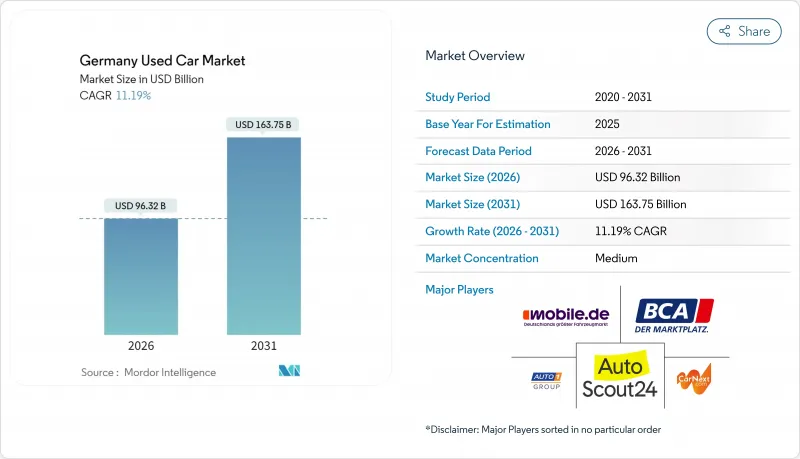
強勁的需求主要源自於新車供應緊張、國內車輛老化以及線上交易平台的快速普及,這些平台降低了車輛採購和銷售的摩擦。歐盟電池法規、低排放區擴大以及原廠認證二手車(CPO)項目等政策因素正在重建消費者信心並縮短更換週期。由於電池狀況透明度的提高,二手電動車(EV)交易正在加速,但汽油動力汽車在銷售方面仍然佔據主導地位。從區域來看,巴登-符騰堡州和巴伐利亞州等南部製造地由於車輛維護記錄完善,保持較高的殘值。競爭格局仍然分散,大規模數位公司利用其規模和數據分析能力超越小規模經銷商,為產業整合留下了空間。
二手車市場趨勢與洞察
車齡更換需求。
目前德國乘用車車隊的平均車齡為10.1年。由於34.17%的車輛車齡超過12年,車主對新安全配置和資訊娛樂系統的需求日益成長,車輛更換壓力可想而知。一些經銷商正利用這一趨勢,將金融和保固服務打包出售,以緩解車主對車輛可靠性的擔憂。南部各州較高的可支配收入有助於維持車隊的新鮮度,而東部地區的更換需求則更為強勁。此外,訂閱服務業者在短期合約到期後,向市場供應準新車,進一步加速了周轉率。
新車供應緊張推二手手車價格
預計2024年美國國內汽車產量將降至數十年來的最低水平,導致交車時間延長,促使消費者轉向認證二手車。高階車型的工廠交貨延遲已達8-12週,正規經銷商正利用這段時間將庫存從供應過剩的地區轉移到需求旺盛的大都會圈。二手車價格依然堅挺,尤其是電動和混合動力汽車,它們正成為填補新車庫存缺口的替代方案。
都市區低排放氣體區的柴油需求下降
歐盟4和歐盟5排放標準的實施降低了主要城市對老舊柴油車的需求。光是在斯圖加特,就有約19萬輛柴油車受到這些標準的約束,導致城市地區車輛價值下降。庫存過剩導致對東歐國家的出口增加,這為貿易業者創造了物流機會,但也減少了國內供應。
細分市場分析
預計SUV的複合年成長率將達到14.63%,顯著高於其他車身類型。轎車市場正在下滑,因為跨界車以更實用的方式提供了類似的舒適性。多用途汽車(MPV)在小眾家庭群體中越來越受歡迎,而敞篷車和跑車則繼續吸引收藏家而非主流消費者。
由於南部各州居民可支配收入較高且多在郊區駕車,這些富裕州的SUV滲透率最高;而北部沿海各州則以緊湊型汽車為主,因為這些地區道路狹窄、停車位有限,小型汽車更受歡迎。這種地域差異為經銷商提供了地域套利的機會。
到2025年,正規經銷商將佔據德國二手車市場62.55%的佔有率,年複合成長率達12.29%。消費者越來越重視保固、融資和可靠的售後服務,而這些正是正規經銷商的優勢所在。非正規經銷商雖然仍能吸引追求低價的顧客,但隨著交易流程日益複雜,其市佔率正不斷下降。
在大都會圈,產業整合正在加速,不斷上漲的房地產成本迫使獨立供應商要麼與大型網路合作,要麼退出市場。數位平台正在擴大連鎖供應商的業務範圍,使他們能夠從全國範圍內採購商品並提供本地化服務,從而加速市場佔有率的擴張。
截至2025年,汽油車將維持60.92%的市佔率。然而,在明確的電池健康標準和不斷擴展的快速充電網路的支持下,電池式電動車(BEV)預計將以驚人的21.93%的複合年成長率成長。由於低排放氣體區政策,柴油車正面臨結構性衰退,但在物流繁忙的農村地區仍有價值。混合動力汽車將填補過渡市場空白,在滿足新的排放氣體法規的同時,提供可靠的續航里程。
南部各州較早採用二手純電動車,受益於製造商的獎勵和密集的充電網路。東部各州雖然落後,但隨著基礎設施差距的縮小,也具有成長潛力。
其他福利:
- Excel格式的市場預測(ME)表
- 分析師支持(3個月)
目錄
第1章 引言
- 研究假設和市場定義
- 調查範圍
第2章調查方法
第3章執行摘要
第4章 市場情勢
- 市場概覽
- 市場促進因素
- 車輛平均車齡不斷上升,推動了車輛更換需求。
- 由於新車供應緊張,二手車價格上漲。
- 線上交易平台的興起
- 歐盟電池法規加速純電動汽車二手車市場發展
- 訂閱模式推動了對準新車的需求。
- OEM認證二手車(CPO)專案發展勢頭強勁
- 市場限制
- 隨著都市區引入低排放區,柴油需求下降
- 高利率限制了貸款的可負擔性。
- 由於數位登記延遲,所有權轉移也隨之延遲。
- 出口會從國內市場吸走價格適中的庫存。
- 價值/價值鏈分析
- 監管環境
- 技術展望
- 波特五力模型
- 新進入者的威脅
- 買方的議價能力
- 供應商的議價能力
- 替代品的威脅
- 競爭對手之間的競爭
第5章 市場規模及成長預測(價值(美元)及銷售量(單位))
- 按車輛類型
- 掀背車車
- 轎車
- 運動型多用途車(SUV)
- 多用途汽車(MPV)
- 其他(敞篷車、小轎車、跨界車、跑車)
- 依供應商類型
- 組織
- 雜亂無章
- 按燃料類型
- 汽油車
- 柴油車
- 混合動力汽車(HEV 和 PHEV)
- 電池式電動車(BEV)
- 其他(液化石油氣、壓縮天然氣等)
- 按車輛型號年份
- 0-2歲
- 3-5年
- 6至8歲
- 9至12歲
- 已經過去12年多了。
- 按價格範圍
- 不到5000美元
- 5,000 美元至 9,999 美元
- 10,000 美元至 14,999 美元
- 15,000 美元至 19,999 美元
- 20,000 美元至 29,999 美元
- 超過3萬美元
- 按銷售管道
- 線上
- 離線
- 依所有權類型
- 原車主轉售
- 多位業主
第6章 競爭情勢
- 市場集中度
- 策略趨勢
- 市佔率分析
- 公司簡介
- AUTO1 Group SE(wirkaufendeinauto.de, AutoHero)
- mobile.de GmbH
- AutoScout24 GmbH
- CarNext.com
- BCA Autoauktionen GmbH
- heycar GmbH
- Driverama Germany GmbH
- Cinch Cars Ltd.
- Cazoo Ltd.
- pkw.de Autoborse GmbH
- OOYYO Corporation
- 12Gebrauchtwagen.de
- FairCar GmbH
- Autobid.de(AlphAuction GmbH)
- Gebrauchtwagen.de AG
- Carsale24 GmbH
- Cargurus Germany GmbH
- Autoscout24 Dealer Financing
- Emil Frey Gruppe(Used-Car Superstores)
第7章 市場機會與未來展望
The German used car market was valued at USD 86.63 billion in 2025 and estimated to grow from USD 96.32 billion in 2026 to reach USD 163.75 billion by 2031, at a CAGR of 11.19% during the forecast period (2026-2031).
Robust demand stems from tight new-car supply, an aging national vehicle fleet, and the rapid uptake of online transaction platforms that reduce friction in vehicle sourcing and sales. Policy drivers such as the European Union Battery Regulation, broader low-emission-zone roll-outs, and OEM-backed certified-pre-owned (CPO) programs are reshaping consumer confidence and shortening replacement cycles. Electric-vehicle (EV) resale activity is accelerating as battery-health transparency improves, while petrol models continue to dominate volumes. Regionally, the southern manufacturing hubs of Baden-Wurttemberg and Bayern benefit from better vehicle maintenance records, supporting premium residual values. Competitive intensity remains fragmented, leaving room for consolidation as larger digital players leverage scale and data analytics to outpace smaller dealers.
Germany Used Car Market Trends and Insights
Rising Average Vehicle Age Boosts Replacement Demand
Germany's passenger-car fleet now averages 10.1 years. Vehicles older than 12 years hold a 34.17% share, creating predictable replacement pressure as owners seek newer safety and infotainment features. Organized dealers capitalize by packaging finance and warranty offerings that mitigate reliability concerns. Southern states, where disposable incomes are higher, keep fleets younger, leaving eastern regions to generate stronger replacement flows. Subscription providers further accelerate turnover by releasing nearly-new stock after each short-term contract cycle.
Tight Supply of New Cars Elevates Used-Car Prices
Domestic vehicle production fell to a decades-low level in 2024, causing extended lead times and steering buyers toward certified pre-owned alternatives. Premium segments face 8-12-week factory delays, a window that organized dealers exploit by moving stock from surplus regions to high-demand metros. Resilient used-car prices are especially evident in electric and hybrid models, which serve as substitutes for out-of-stock new vehicles.
Diesel Demand Falls Amid Urban Low-Emission Zones
Euro 4 and Euro 5 restrictions render older diesel units less attractive in major cities. Stuttgart alone restricts roughly 190,000 diesel cars, depressing valuations within its urban core. Surplus stock is increasingly exported to Eastern Europe, creating logistical opportunities for traders but eroding domestic availability.
Other drivers and restraints analyzed in the detailed report include:
- Proliferation of Online Transaction Platforms
- EU Battery Regulation Accelerates BEV Remarketing
- High Interest Rates Restrict Financing Affordability
For complete list of drivers and restraints, kindly check the Table Of Contents.
Segment Analysis
Hatchbacks currently lead volume at 23.84% share due to their maneuverability in dense urban areas. SUVs are projected to record a 14.63% CAGR, well ahead of any other body style. Sedans face a gradual decline as crossovers satisfy the same comfort demands with greater practicality. Multi-purpose vehicles hold niche family appeal, while convertibles and sports cars sustain collector interest rather than mass-market traction.
Affluent southern states exhibit the highest SUV penetration, supported by disposable income levels and suburban driving patterns. Conversely, compact segments remain dominant in northern coastal regions where narrow streets and tighter parking favor smaller footprints. The differential offers dealers geographical arbitrage opportunities.
Organized players commanded 62.55% of the German used car market size in 2025 and are growing at 12.29% CAGR. Consumers increasingly seek warranty coverage, financing, and reliable after-sales service, advantages that structured dealerships deliver. Unorganized sellers still attract bargain hunters but lose ground as transaction complexity rises.
Metropolitan centers witness faster consolidation; rising real-estate costs push independent lots to partner with larger networks or exit. Digital platforms amplify reach, allowing organized vendors to source nationally while offering localized service, accelerating their market capture.
Petrol models retained 60.92% share in 2025. However, BEVs will expand at a striking 21.93% CAGR, aided by clear battery-health standards and expanding fast-charging grids. Diesel faces structural decline owing to low-emission-zone policies, though it remains valuable in logistics-heavy rural districts. Hybrid vehicles serve a transitional segment, providing range confidence while meeting emerging emissions expectations.
Southern states, benefitting from OEM incentives and dense charger networks, are early adopters of used BEVs. Eastern regions lag yet present upside potential as infrastructure gaps close.
The Germany Used Car Market Report is Segmented by Vehicle Type (Hatchbacks, Sedans, and More), Vendor Type (Organized and Unorganized), Fuel Type (Petrol and More), Vehicle Age (0 To 2 Years and More), Price Segment (Below USD 5, 000 and More), Sales Channel (Online and Offline), and Ownership (First-Owner Resale and Multi-Owner). The Market Forecasts are Provided in Terms of Value (USD) and Volume (Units).
List of Companies Covered in this Report:
- AUTO1 Group SE (wirkaufendeinauto.de, AutoHero)
- mobile.de GmbH
- AutoScout24 GmbH
- CarNext.com
- BCA Autoauktionen GmbH
- heycar GmbH
- Driverama Germany GmbH
- Cinch Cars Ltd.
- Cazoo Ltd.
- pkw.de Autoborse GmbH
- OOYYO Corporation
- 12Gebrauchtwagen.de
- FairCar GmbH
- Autobid.de (AlphAuction GmbH)
- Gebrauchtwagen.de AG
- Carsale24 GmbH
- Cargurus Germany GmbH
- Autoscout24 Dealer Financing
- Emil Frey Gruppe (Used-Car Superstores)
Additional Benefits:
- The market estimate (ME) sheet in Excel format
- 3 months of analyst support
TABLE OF CONTENTS
1 Introduction
- 1.1 Study Assumptions and Market Definition
- 1.2 Scope of the Study
2 Research Methodology
3 Executive Summary
4 Market Landscape
- 4.1 Market Overview
- 4.2 Market Drivers
- 4.2.1 Rising average vehicle age boosts replacement demand
- 4.2.2 Tight supply of new cars elevates used-car prices
- 4.2.3 Proliferation of online transaction platforms
- 4.2.4 EU Battery Regulation accelerates BEV remarketing
- 4.2.5 Subscription models spur demand for nearly-new cars
- 4.2.6 OEM certified-pre-owned (CPO) programs gain traction
- 4.3 Market Restraints
- 4.3.1 Diesel demand falls amid urban Low-Emission Zones
- 4.3.2 High interest rates restrict financing affordability
- 4.3.3 Digital registration backlogs slow title transfers
- 4.3.4 Exports siphon affordable stock from domestic market
- 4.4 Value/Supply-Chain Analysis
- 4.5 Regulatory Landscape
- 4.6 Technological Outlook
- 4.7 Porter's Five Forces
- 4.7.1 Threat of New Entrants
- 4.7.2 Bargaining Power of Buyers
- 4.7.3 Bargaining Power of Suppliers
- 4.7.4 Threat of Substitutes
- 4.7.5 Intensity of Competitive Rivalry
5 Market Size and Growth Forecasts (Value (USD) and Volume (Units))
- 5.1 By Vehicle Type
- 5.1.1 Hatchbacks
- 5.1.2 Sedans
- 5.1.3 Sport-Utility Vehicles (SUVs)
- 5.1.4 Multi-Purpose Vehicles (MPVs)
- 5.1.5 Others (convertibles, coupes, crossovers, sports cars)
- 5.2 By Vendor Type
- 5.2.1 Organised
- 5.2.2 Unorganized
- 5.3 By Fuel Type
- 5.3.1 Petrol
- 5.3.2 Diesel
- 5.3.3 Hybrid Vehicles (HEV and PHEV)
- 5.3.4 Battery-Electric Vehicles (BEV)
- 5.3.5 Others (LPG, CNG, etc.)
- 5.4 By Vehicle Age
- 5.4.1 0 to 2 Years
- 5.4.2 3 to 5 Years
- 5.4.3 6 to 8 Years
- 5.4.4 9 to 12 Years
- 5.4.5 Above 12 Years
- 5.5 By Price Segment
- 5.5.1 Below USD 5,000
- 5.5.2 USD 5,000 to USD 9,999
- 5.5.3 USD 10,000 to USD 14,999
- 5.5.4 USD 15,000 to USD 19,999
- 5.5.5 USD 20,000 to USD 29,999
- 5.5.6 USD 30,000 and Above
- 5.6 By Sales Channel
- 5.6.1 Online
- 5.6.2 Offline
- 5.7 By Ownership
- 5.7.1 First-owner Resale
- 5.7.2 Multi-owner
6 Competitive Landscape
- 6.1 Market Concentration
- 6.2 Strategic Moves
- 6.3 Market Share Analysis
- 6.4 Company Profiles (Includes Global Level Overview, Market Level Overview, Core Segments, Financials as Available, Strategic Information, Market Rank/Share, Products and Services, Recent Developments)
- 6.4.1 AUTO1 Group SE (wirkaufendeinauto.de, AutoHero)
- 6.4.2 mobile.de GmbH
- 6.4.3 AutoScout24 GmbH
- 6.4.4 CarNext.com
- 6.4.5 BCA Autoauktionen GmbH
- 6.4.6 heycar GmbH
- 6.4.7 Driverama Germany GmbH
- 6.4.8 Cinch Cars Ltd.
- 6.4.9 Cazoo Ltd.
- 6.4.10 pkw.de Autoborse GmbH
- 6.4.11 OOYYO Corporation
- 6.4.12 12Gebrauchtwagen.de
- 6.4.13 FairCar GmbH
- 6.4.14 Autobid.de (AlphAuction GmbH)
- 6.4.15 Gebrauchtwagen.de AG
- 6.4.16 Carsale24 GmbH
- 6.4.17 Cargurus Germany GmbH
- 6.4.18 Autoscout24 Dealer Financing
- 6.4.19 Emil Frey Gruppe (Used-Car Superstores)
7 Market Opportunities and Future Outlook
- 7.1 White-space and Unmet-Need Assessment

 2026-2030年全球二手車市場
 二手車市場:2026-2032年全球市場預測(按車輛類型、燃料類型、年份、變速箱類型、所有權、用途和銷售管道)
 全球二手車市場規模、佔有率、趨勢和成長分析報告(2026-2034)
 二手半拖車市場分析及預測(至2035年):按類型、產品類型、服務、技術、組件、應用、流程及最終用戶二手
 東南亞二手車市場:市場佔有率分析、產業趨勢與統計、成長預測(2026-2031)越南二手車市場:市場佔有率分析、產業趨勢與統計、成長預測(2026-2031)非洲二手車市場:市場佔有率分析、產業趨勢與統計、成長預測(2026-2031年)二手車市場規模、佔有率、成長及全球產業分析:按類型、應用和地區分類的洞察,以及2026-2034年的預測
 二手拖車市場-全球產業規模、佔有率、趨勢、機會和預測:按車輛類型、動力類型、銷售管道、地區和競爭格局分類,2021-2031年二手車市場 - 全球產業規模、佔有率、趨勢、競爭格局、機會、預測(按車輛類型、動力類型、銷售管道、最終用途、地區和競爭情況分類),2021-2031年