


 |
市場調查報告書
商品編碼
1844485
日本太陽能:市場佔有率分析、行業趨勢、統計數據和成長預測(2025-2030 年)Japan Solar Energy - Market Share Analysis, Industry Trends & Statistics, Growth Forecasts (2025 - 2030) |
||||||

※ 本網頁內容可能與最新版本有所差異。詳細情況請與我們聯繫。
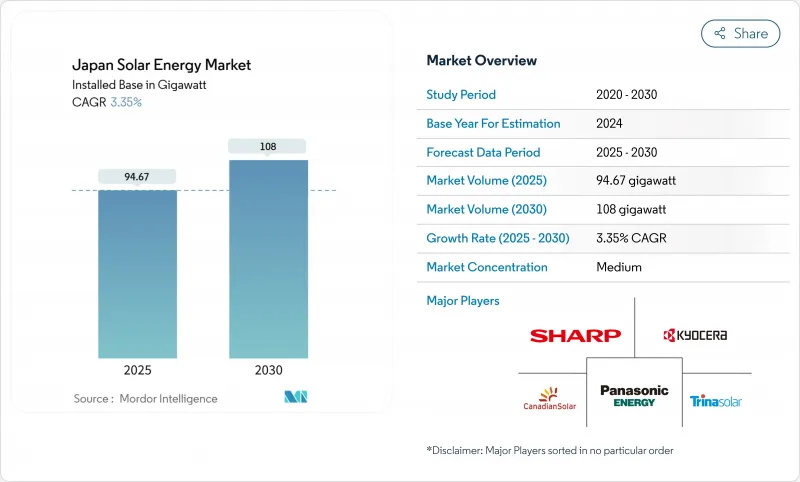
日本太陽能市場的安裝基數預計將從 2025 年的 94.67 吉瓦成長到 2030 年的 108 吉瓦,預測期間(2025-2030 年)的複合年成長率為 3.35%。
從上網電價制度過渡到溢價上網制度後,發展仍在繼續。溢價上網制度鼓勵開發商遵循批發價格訊號,整合電池儲能系統,並降低消費者課稅。屋頂光電陣列許可的加速授權、東京強制實施的自發電規定以及組件和電池價格的下降,正在擴大分散式系統的潛在市場。來自海外製造商的競爭壓力正在壓低硬體成本,而國內企業正在加速鈣鈦礦研究、共置儲能和能源管理軟體的開發,以保值。資料中心電力需求的不斷成長以及企業脫碳目標的實現,正在透過長期購電協議深化企劃案融資管道。
日本太陽能市場趨勢與洞察
2050年淨零排放藍圖和FIT→FIP獎勵
從保證電價到高於批發價的溢價的轉變使日本太陽能市場與標準電力市場經濟重新接軌。截至 2024 年 2 月,FIP 計畫已認證了 1,036 個計劃,其中包括 518 兆瓦的太陽能發電,促進了模組電池組合的發展,以捕捉峰值價差。政府的 2025 財政年度公告確認了早期太陽能投資的新預算撥款,顯示了持續的政策承諾。隨著開發商投資發電和輸電能力以對沖價格波動,計劃結構現在整合了預測軟體、虛擬發電廠能力和配套服務收益。這些調整支持了日本太陽能市場的長期競爭力,並減輕了公共補貼的影響。
《建築基準法》規定屋頂必須安裝光電系統(東京、神奈川)
東京頒布了一項法令,要求自2025年4月起,所有超過2000平方公尺的新建築都必須安裝太陽能板,此舉將改變城市建設的基本原則。現在,合規責任落在了建築商而非最終業主的肩上,這簡化了物流,並規定了年度最低安裝限額。同時,每千瓦最高8萬日圓的補貼也支持高效系統,進一步提高了收益。早期的現場考察數據表明,建築商現在正在將太陽能採購納入其設計工作流程,並規範首都的現場發電。多個縣正在起草類似的法令,這表明日本有可能在全國範圍內推行連鎖監管,以支持日本太陽能市場的永續需求。
九州和北海道電網擁塞、斷電
區域間連接受限,基本負載核子反應爐彈性,導致日間太陽能高峰利用空間有限,因此九州地區2023會計年度的棄電率達6.7%,發電量躍升至176太瓦時。公用事業公司正在試行基於人工智慧的電壓調節器,將穩定器啟動率降低高達70%。政策制定者也正在起草負電價規則以及經濟發電和輸電方案,但具體時間表仍不確定。在基礎設施到位之前,日本太陽能市場參與者必須增設電池儲能系統、遷移發電廠,否則在供應過剩時期將面臨收益蠶食的風險。
細分分析
到2024年,屋頂安裝將佔日本太陽能市場的49.4%,這反映了土地稀缺以及零成本安裝方案的成熟,這些方案能夠引起城市居民的共鳴。該行業的優勢,包括靠近需求點、避免電網連接成本以及簡化的授權,正在鞏固其在日本太陽能市場的主導地位。東京的強制性屋頂安裝規定和全國範圍內的「零日元」合約趨勢消除了前期成本,並為住宅和商業租戶帶來了可預測的節省。這些結構性獎勵將分散式發電與更廣泛的淨零路線藍圖緊密聯繫在一起。
浮體式太陽能光電是成長最快的部署類型,到2030年,其複合年成長率將達到4.1%。安裝在灌溉水庫和東京灣的試點電站已證明其在颱風條件下的技術可行性,並顯示出減少水分蒸發等額外效益。由於過去曾發生邊坡崩塌事故,地面安裝系統的分區面積已趨於嚴格,促使開發商轉向屋頂、車棚和水面等地點。借助可黏貼在建築幕牆和隔音屏障上的更輕的鈣鈦礦層壓板,建築一體化太陽能光電正在興起,為日本太陽能市場提供了另一個成長管道。
日本太陽能市場報告按部署類型(屋頂光伏、地面光伏、浮體式、建築一體化光伏)、應用類型(住宅光伏、商業/工業光伏、公用事業規模光伏、農業光伏)和組件類型(光伏組件/逆變器、支架/追蹤系統、系統平衡、共置電池)進行細分。市場規模和預測以裝置容量(吉瓦)為單位。
其他福利:
- Excel 格式的市場預測 (ME) 表
- 3個月的分析師支持
目錄
第1章 引言
- 研究假設和市場定義
- 調查範圍
第2章調查方法
第3章執行摘要
第4章 市場狀況
- 市場概況
- 市場促進因素
- 2050年淨零排放藍圖及FIT及FIP獎勵
- 《建築基準法》規定屋頂必須安裝光電系統(東京、神奈川)
- 組件和電池價格下降提高計劃內部報酬率
- 資料中心電力激增刺激企業電力購買協議 (PPA)
- 輕質鈣鈦礦太陽能電池裝飾建築幕牆和汽車外殼
- 「零日圓太陽能」統一費率模式讓一般家庭也能享受太陽能
- 市場限制
- 九州、北海道電網擁塞及抑制
- 土地稀缺和地面計劃嚴格分區
- 太陽能廢棄物管理責任與不斷上升的回收成本
- 高壓太陽能加儲能設施缺乏技術純熟勞工
- 供應鏈分析
- 監管狀況
- 技術展望
- 五力分析
- 供應商的議價能力
- 買方的議價能力
- 新進入者的威脅
- 替代品的威脅
- 競爭對手之間的競爭
- PESTLE分析
第5章市場規模及成長預測
- 按部署
- 屋頂
- 地面安裝
- 浮體式太陽能
- 建築一體化光伏(BIPV)
- 按用途
- 住房
- 商業和工業
- 公共產業規模
- 農業太陽能發電
- 按組件
- 光電模組
- 逆變器(串式、中央式、微型逆變器)
- 安裝和追蹤系統
- 系統平衡(電纜、組合器等)
- 附蓄電池
第6章 競爭態勢
- 市場集中度
- 策略性舉措(併購、夥伴關係、購電協議)
- 市場佔有率分析(主要企業的市場排名/佔有率)
- 公司簡介
- Sharp Corporation
- Kyocera Corporation
- Panasonic Energy Co.
- Canadian Solar Inc.
- Trina Solar Co. Ltd.
- JinkoSolar Holding Co. Ltd.
- JA Solar Technology Co. Ltd.
- LONGi Green Energy Technology Co. Ltd.
- Hanwha Q CELLS
- First Solar Inc.
- Mitsubishi Electric Corporation
- Toshiba Energy Systems & Solutions
- Omron Corporation
- Nihon Techno Co. Ltd.
- SoftBank Energy(SB Power)
- Eurus Energy Holdings
- RENOVA Inc.
- Shizen Energy Inc.
- West Holdings Corporation
- Sekisui Chemical(Perovskite R&D)
第7章 市場機會與未來展望
The Japan Solar Energy Market size in terms of installed base is expected to grow from 94.67 gigawatt in 2025 to 108 gigawatt by 2030, at a CAGR of 3.35% during the forecast period (2025-2030).
Growth continues even after the shift from the Feed-in Tariff to the Feed-in Premium scheme, which encourages developers to follow wholesale price signals, integrated battery storage, and lower consumer levies . Faster permitting for rooftop arrays, mandatory on-site generation rules in Tokyo, and falling module plus battery prices have enlarged the addressable base for distributed systems. Competitive pressure from overseas manufacturers decreases hardware costs, while domestic firms accelerate perovskite research, co-located storage, and energy-management software to retain value. Rising power demand from data centers and corporate decarbonization targets deepens the project finance pool through long-term power-purchase agreements.
Japan Solar Energy Market Trends and Insights
Net-zero 2050 roadmap & FIT -> FIP incentives
The move from a guaranteed tariff to a premium above the wholesale price has realigned the Japanese solar energy market with standard power-market economics. By February 2024, the FIP program had accredited 1,036 projects, including 518 MW of solar, driving developers to pair modules with batteries to capture peak-price spreads . Government notices released for fiscal 2025 confirm fresh budget lines for early-stage solar investments, signaling ongoing policy commitment. As developers invest in dispatchable capacity to hedge price risk, project structures now integrate forecasting software, virtual power-plant functions, and ancillary service revenues. These adaptations anchor the long-term competitiveness of the Japanese solar energy market while easing public-subsidy exposure.
Mandatory rooftop-PV building codes (Tokyo, Kanagawa)
Tokyo's regulation that all new buildings above 2,000 m2 must include solar panels from April 2025 has changed the baseline for urban construction. Compliance obligations rest with the builder, not the end-owner, simplifying logistics and placing a floor under annual installation volumes. The city's parallel subsidy of up to JPY 80,000 per kW supports high-efficiency systems, further lifting return profiles. Early site inspection data indicates that builders now embed solar procurement into design workflows, normalizing on-site generation in the capital. Several prefectures are drafting similar ordinances, pointing toward a potential nationwide regulatory cascade that would underpin sustained demand in the Japanese solar energy market.
Grid congestion & curtailment in Kyushu/Hokkaido
Curtailment jumped to 1.76 TWh in fiscal 2023, with Kyushu hitting a 6.7% rate because limited inter-regional links and inflexible baseload reactors leave little room for midday solar peaks. Utilities are piloting AI-based voltage control that has cut stabilizer activations by up to 70%, showing a technical path forward. Policymakers also draft negative-pricing rules and economic dispatch, but timelines remain unsettled. Until infrastructure aligns, Japanese solar energy market developers must add batteries, reposition plants, or accept revenue cannibalization during oversupply events.
Other drivers and restraints analyzed in the detailed report include:
- Falling module and battery prices improve project IRRs
- Data-center electricity surge spurring corporate PPAs
- Skilled-labour gap for HV solar-plus-storage installs
For complete list of drivers and restraints, kindly check the Table Of Contents.
Segment Analysis
Rooftop arrays accounted for 49.4% of the Japanese solar energy market in 2024, reflecting scarce land and maturing zero-cost installation schemes that resonate with city dwellers. The segment benefits from proximity to demand, avoiding grid-upgrade fees, and straightforward permitting, reinforcing its primacy in the Japanese solar energy market. Tokyo's compulsory rooftop rules and the nationwide "zero-yen" subscription trend remove upfront costs and establish predictable savings for households and commercial tenants. These structural incentives tie distributed generation closely to the broader net-zero roadmap.
Floating solar is the fastest-growing deployment class, expanding at 4.1% CAGR through 2030. Pilot plants in irrigation reservoirs and Tokyo Bay demonstrate technical viability under typhoon conditions and show ancillary benefits such as reduced water evaporation. After past slope-failure incidents, ground-mount sites face stricter zoning, steering developers toward rooftops, carports, and water surfaces. Building-integrated photovoltaics are emerging, aided by lighter perovskite laminates that can attach to facades and acoustic barriers, offering another outlet for growth in the Japanese solar energy market.
The Japan Solar Energy Market Report is Segmented by Deployment (Rooftop, Ground-Mounted, Floating Solar, and Building-Integrated PV), Application (Residential, Commercial and Industrial, Utility-Scale, and Agrivoltaics), and Component (PV Modules Inverters, Mounting and Tracking Systems, Balance-Of-System, and Co-Located Battery Storage). The Market Size and Forecasts are Provided in Terms of Installed Capacity (GW).
List of Companies Covered in this Report:
- Sharp Corporation
- Kyocera Corporation
- Panasonic Energy Co.
- Canadian Solar Inc.
- Trina Solar Co. Ltd.
- JinkoSolar Holding Co. Ltd.
- JA Solar Technology Co. Ltd.
- LONGi Green Energy Technology Co. Ltd.
- Hanwha Q CELLS
- First Solar Inc.
- Mitsubishi Electric Corporation
- Toshiba Energy Systems & Solutions
- Omron Corporation
- Nihon Techno Co. Ltd.
- SoftBank Energy (SB Power)
- Eurus Energy Holdings
- RENOVA Inc.
- Shizen Energy Inc.
- West Holdings Corporation
- Sekisui Chemical (Perovskite R&D)
Additional Benefits:
- The market estimate (ME) sheet in Excel format
- 3 months of analyst support
TABLE OF CONTENTS
1 Introduction
- 1.1 Study Assumptions & Market Definition
- 1.2 Scope of the Study
2 Research Methodology
3 Executive Summary
4 Market Landscape
- 4.1 Market Overview
- 4.2 Market Drivers
- 4.2.1 Net-zero 2050 roadmap and FIT and FIP incentives
- 4.2.2 Mandatory rooftop-PV building codes (Tokyo, Kanagawa)
- 4.2.3 Falling module + battery prices improve project IRRs
- 4.2.4 Data-center electricity surge spurring corporate PPAs
- 4.2.5 Lightweight perovskite PV opens facade &and vehicle skins
- 4.2.6 "Zero-Yen Solar" subscription model unlocks households
- 4.3 Market Restraints
- 4.3.1 Grid congestion and curtailment in Kyushu/Hokkaido
- 4.3.2 Scarce land/strict zoning for ground-mount projects
- 4.3.3 PV waste-management liability and recycling cost spike
- 4.3.4 Skilled-labour gap for HV solar-plus-storage installs
- 4.4 Supply-Chain Analysis
- 4.5 Regulatory Landscape
- 4.6 Technological Outlook
- 4.7 Porter's Five Forces
- 4.7.1 Bargaining Power of Suppliers
- 4.7.2 Bargaining Power of Buyers
- 4.7.3 Threat of New Entrants
- 4.7.4 Threat of Substitutes
- 4.7.5 Competitive Rivalry
- 4.8 PESTLE Analysis
5 Market Size & Growth Forecasts
- 5.1 By Deployment
- 5.1.1 Rooftop
- 5.1.2 Ground-mounted
- 5.1.3 Floating Solar
- 5.1.4 Building-Integrated PV (BIPV)
- 5.2 By Application
- 5.2.1 Residential
- 5.2.2 Commercial and Industrial
- 5.2.3 Utility-scale
- 5.2.4 Agrivoltaics
- 5.3 By Component
- 5.3.1 PV Modules
- 5.3.2 Inverters (String, Central and Micro-inverter)
- 5.3.3 Mounting and Tracking Systems
- 5.3.4 Balance-of-System (Cables, Combiner, etc.)
- 5.3.5 Co-located Battery Storage
6 Competitive Landscape
- 6.1 Market Concentration
- 6.2 Strategic Moves (M&A, Partnerships, PPAs)
- 6.3 Market Share Analysis (Market Rank/Share for key companies)
- 6.4 Company Profiles (includes Global level Overview, Market level overview, Core Segments, Financials as available, Strategic Information, Products & Services, and Recent Developments)
- 6.4.1 Sharp Corporation
- 6.4.2 Kyocera Corporation
- 6.4.3 Panasonic Energy Co.
- 6.4.4 Canadian Solar Inc.
- 6.4.5 Trina Solar Co. Ltd.
- 6.4.6 JinkoSolar Holding Co. Ltd.
- 6.4.7 JA Solar Technology Co. Ltd.
- 6.4.8 LONGi Green Energy Technology Co. Ltd.
- 6.4.9 Hanwha Q CELLS
- 6.4.10 First Solar Inc.
- 6.4.11 Mitsubishi Electric Corporation
- 6.4.12 Toshiba Energy Systems & Solutions
- 6.4.13 Omron Corporation
- 6.4.14 Nihon Techno Co. Ltd.
- 6.4.15 SoftBank Energy (SB Power)
- 6.4.16 Eurus Energy Holdings
- 6.4.17 RENOVA Inc.
- 6.4.18 Shizen Energy Inc.
- 6.4.19 West Holdings Corporation
- 6.4.20 Sekisui Chemical (Perovskite R&D)
7 Market Opportunities & Future Outlook
- 7.1 White-space & Unmet-need Assessment

 2026年全球太陽能市場報告
 太陽能發電系統市場分析及預測(至2035年):依類型、產品類型、服務、技術、組件、應用、安裝類型、最終用戶、功能及設備分類
 東南亞太陽能:市場佔有率分析、產業趨勢與統計、成長預測(2026-2031)泰國太陽能:市場佔有率分析、產業趨勢與統計、成長預測(2026-2031)西班牙太陽能:市場佔有率分析、行業趨勢和統計數據、成長預測(2026-2031 年)越南太陽能市場:市場佔有率分析、產業趨勢與統計、成長預測(2026-2031年)
 太陽能解決方案市場 - 全球產業規模、佔有率、趨勢、機會及預測(按類型、應用、地區和競爭格局分類,2021-2031年)印尼太陽能市場:市場佔有率分析、產業趨勢與統計、成長預測(2026-2031)義大利太陽能市場:市場佔有率分析、產業趨勢與統計、成長預測(2026-2031)菲律賓太陽能市場:市場佔有率分析、產業趨勢與統計、成長預測(2026-2031年)