


 |
市場調查報告書
商品編碼
1913389
培養肉市場:市場機會、成長促進因素、產業趨勢分析及預測(2026-2035)Cultured Meat Market Opportunity, Growth Drivers, Industry Trend Analysis, and Forecast 2026 - 2035 |
||||||

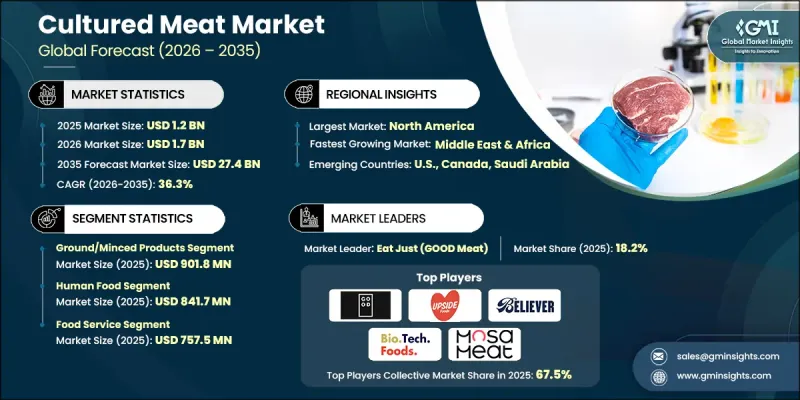
全球培養肉市場預計到 2025 年將達到 12 億美元,到 2035 年將達到 274 億美元,年複合成長率為 36.3%。
培養肉反應器是培養肉產業的核心,它提供了一種可擴展的解決方案,無需屠宰動物即可生產實驗室培養肉。這些生物反應器為動物細胞培養創造了精確的環境,從而實現對細胞生長、營養輸送和壓力管理的精準控制。不同的系統,包括攪拌槽、灌注式、氣升和中空纖維式生物反應器,在擴充性和細胞維護方面各具優勢。生物反應器設計、培養基最佳化和放大技術的最新創新,使得經濟高效的大規模生產成為可能。隨著時間的推移,技術進步有望降低生產成本,提高培養肉的可負擔性和普及性。人造肉質、風味和品質的提升也將推動消費者接受度,並促進市場擴張。日益成長的倫理、環境和永續性問題,以及對肉類替代品需求的不斷成長,是推動該市場發展的關鍵因素。
| 市場覆蓋範圍 | |
|---|---|
| 開始年份 | 2025 |
| 預測期 | 2026-2035 |
| 初始市場規模 | 12億美元 |
| 市場規模預測 | 274億美元 |
| 複合年成長率 | 36.3% |
永續性是培養肉生物反應器市場的關鍵促進因素。實驗室培育肉類為傳統肉類生產提供了一種對環境友善且符合倫理的替代方案,並符合不斷變化的消費者偏好。然而,高昂的初始資本和營運成本構成了挑戰,尤其對於Start-Ups公司和新興企業,儘管市場潛力巨大,但仍會阻礙其商業化進程。
預計到2025年,碎肉製品將佔據最大市場佔有率,達到9.018億美元。這些培養肉之所以能引領市場,是因為與擠壓肉塊相比,它們的生產流程更簡單,規模化生產速度更快。由於其易於組織形成,製造商可以在較小的生物反應器中進行操作,而不會影響質地或感官品質。此外,它們用途廣泛,可用於製作漢堡、肉丸、餃子和雞塊等各種流行食品,因此越來越受到消費者的青睞。這種相容性使生產商能夠瞄準那些能夠承受較高初始價格的大消費群體,同時保持可預測的需求模式。
預計到2025年,人類食品領域的市場規模將達到8.417億美元。以人類消費為重點是培養肉產業發展的主要動力,各公司優先開發符合主流飲食習慣和商業食品服務需求的產品。試吃活動、早期監管核准和有限的零售推廣主要面向人類消費,使公司能夠更大規模地檢驗產品的口味、質地和安全性。這種策略符合永續性和倫理的蛋白質趨勢,有助於將培養肉確立為傳統動物性產品的可行替代品。
美國在北美培養肉市場佔據主導地位,預計2025年將佔38%的市場。這主要得益於強大的細胞農業Start-Ups生態系統、廣泛的創業投資支持以及美國食品藥物管理局(FDA)和農業部(USDA)的早期監管行動。該地區的成長也得益於對大型生產設施的大量投資、主要製造商持續開發商業工廠以及在餐飲服務管道開展的先導計畫,這些項目有助於驗證消費者對人造肉的接受度,並為人造肉的廣泛應用做好準備。
目錄
第1章:分析方法和範圍
第2章執行摘要
第3章業界考察
- 產業生態系分析
- 供應商情況
- 利潤率
- 每個階段的附加價值
- 影響價值鏈的因素
- 中斷
- 產業影響因素
- 促進要素
- 對動物性產品替代品的需求日益成長
- 線上食品配送通路的快速發展
- 技術成熟和成本降低
- 產業潛在風險與挑戰
- 嚴格的法規環境和核准時間表
- 高資本投入與初始成本
- 市場機遇
- 無動物源成分培養基的商業化
- 混合產品開發
- 促進要素
- 成長潛力分析
- 監管環境
- 北美洲
- 歐洲
- 亞太地區
- 拉丁美洲
- 中東和非洲
- 波特五力分析
- PESTEL 分析
- 價格趨勢
- 按地區
- 產品
- 未來市場趨勢
- 科技與創新趨勢
- 當前技術趨勢
- 新興技術
- 專利狀態
- 貿易統計(HS編碼)(註:僅提供主要國家的貿易統計)
- 主要進口國
- 主要出口國
- 永續性和環境方面
- 永續努力
- 減少廢棄物策略
- 生產中的能源效率
- 環保舉措
- 碳足跡考量
第4章 競爭情勢
- 介紹
- 公司市佔率分析
- 按地區
- 北美洲
- 歐洲
- 亞太地區
- 拉丁美洲
- 中東和非洲
- 按地區
- 企業矩陣分析
- 主要企業的競爭分析
- 競爭定位矩陣
- 主要趨勢
- 企業合併(M&A)
- 商業夥伴關係與合作
- 新產品發布
- 擴張計劃
第5章 依產品類型分類的市場估算與預測(2022-2035 年)
- 肉糜製品
- 漢堡
- 肉丸
- 香腸
- 碎肉
- 模製產品
- 金塊
- 條狀/嫩條
- 一塊肉
- 其他
第6章 按應用領域分類的市場估算與預測(2022-2035 年)
- 人類食物
- 寵物食品
- 狗糧
- 貓糧
- 異寵食品
- 研究與發展(R&D)
- 學術研究
- 產品開發
- 監管測試
- 其他
第7章 按分銷管道分類的市場估計和預測(2022-2035 年)
- DTC(直接面對消費者)
- 零售店
- 超級市場和大賣場
- 專賣店
- 便利商店
- 食品服務業
- 餐廳
- 餐飲服務
- 機構餐飲服務
- B2B
第8章 各地區市場估算與預測(2022-2035 年)
- 北美洲
- 美國
- 加拿大
- 歐洲
- 德國
- 英國
- 法國
- 西班牙
- 義大利
- 其他歐洲
- 亞太地區
- 中國
- 印度
- 日本
- 澳洲
- 韓國
- 亞太其他地區
- 拉丁美洲
- 巴西
- 墨西哥
- 其他拉丁美洲
- 中東和非洲
- 沙烏地阿拉伯
- 南非
- 阿拉伯聯合大公國
- 其他中東和非洲地區
第9章:公司簡介
- Mosa Meat
- Upside Foods
- Aleph Farms
- Finless Foods
- Meatable
- Believer Meats(formerly Future Meat Technologies)
- HigherSteaks
- Avant Meats
- BlueNalu
- Eat Just(GOOD Meat)
- BioFood Systems
- Balletic Foods
- Biotech Foods
The Global Cultured Meat Market was valued at USD 1.2 billion in 2025 and is estimated to grow at a CAGR of 36.3% to reach USD 27.4 billion by 2035.
Cultured meat bioreactors are at the heart of the cultivated meat industry, providing scalable solutions for producing lab-grown meat without the need for animal slaughter. These bioreactors create precise environments for animal cell cultivation, enabling controlled growth, nutrient supply, and stress management. Different systems, including stirred-tank, perfusion, airlift, and hollow-fiber bioreactors, offer unique advantages for scalability and cell maintenance. Recent innovations in bioreactor design, culture media optimization, and scale-up techniques have improved cost efficiency, making mass production more feasible. Technological progress is expected to reduce production costs over time, increasing affordability and accessibility. Improved texture, flavor, and quality of cultivated meat will also drive consumer adoption, fueling market expansion. Growing ethical, environmental, and sustainability concerns, coupled with rising demand for meat alternatives, are key factors propelling this market.
| Market Scope | |
|---|---|
| Start Year | 2025 |
| Forecast Year | 2026-2035 |
| Start Value | $1.2 Billion |
| Forecast Value | $27.4 Billion |
| CAGR | 36.3% |
Sustainability is a central driver for the cultured meat bioreactors market. Lab-grown meat provides an environmentally friendly and ethical alternative to traditional meat production, aligning with changing consumer preferences. However, high initial capital and operational costs pose challenges, particularly for startups and emerging companies, slowing commercialization efforts despite strong market potential.
Ground and minced products accounted for a substantial share, valued at USD 901.8 million in 2025. These forms of cultured meat are leading the market due to their simpler production process and faster scalability compared with structured cuts. Their ease of tissue formation allows manufacturers to operate smaller bioreactors without compromising texture or sensory quality. Additionally, their versatility for popular applications such as burgers, meatballs, dumplings, and nuggets boosts consumer adoption. This compatibility enables producers to target high-volume segments that can absorb higher initial pricing while supporting predictable demand patterns.
The human food segment generated USD 841.7 million in 2025. The focus on human consumption drives much of the cultured-meat industry, as companies prioritize products aligned with mainstream diets and commercial foodservice demand. Pilot tastings, early regulatory approvals, and limited retail launches primarily target human consumption, allowing firms to validate taste, texture, and safety on a broader scale. This approach also aligns with sustainability and ethical protein trends, helping cultivated meat establish itself as a viable alternative to conventional animal products.
North America Cultured Meat Market captured 38% share in 2025, with the U.S. leading due to a strong ecosystem of cell-agriculture startups, extensive venture capital support, and initial regulatory engagement from the FDA and USDA. The region's growth is supported by substantial investments in large-scale production facilities, ongoing commercial plant developments by major manufacturers, and continued pilot projects in foodservice channels, which help confirm consumer acceptance and readiness for wider adoption.
Key players in the Global Cultured Meat Market include ABEC, Alfa Laval, Bioengineering AG, Eppendorf AG, Esco Lifesciences Group, GEA, Infors HT, INNOVA Bio-meditech, KBiotech GmbH, Merck KGaA, OLLITAL Technology, Pall Corporation, Sartorius AG, Solaris Biotech, and Vogtlin Instruments GmbH. Companies in the Global Cultured Meat Market are strengthening their foothold through strategic R&D investments to enhance bioreactor efficiency, scalability, and automation. Collaborations with research institutions and startups help accelerate technology development and optimize culture conditions. Expanding manufacturing capacities, developing cost-effective culture media, and offering turnkey solutions for pilot and commercial-scale production enhance market presence. Firms are also diversifying product portfolios to address specific applications in cellular agriculture and cultivated meat production. Regulatory engagement, participation in industry consortia, and sustainability initiatives further reinforce credibility and position companies as leaders in this emerging market.
Table of Contents
Chapter 1 Methodology & Scope
- 1.1 Market scope and definition
- 1.2 Research design
- 1.2.1 Research approach
- 1.2.2 Data collection methods
- 1.3 Data mining sources
- 1.3.1 Global
- 1.3.2 Regional/Country
- 1.4 Base estimates and calculations
- 1.4.1 Base year calculation
- 1.4.2 Key trends for market estimation
- 1.5 Primary research and validation
- 1.5.1 Primary sources
- 1.6 Forecast model
- 1.7 Research assumptions and limitations
Chapter 2 Executive Summary
- 2.1 Industry 3600 synopsis
- 2.2 Key market trends
- 2.2.1 Regional
- 2.2.2 Product Type
- 2.2.3 Application
- 2.2.4 Distribution Channel
- 2.3 TAM Analysis, 2026-2035
- 2.4 CXO perspectives: Strategic imperatives
- 2.4.1 Executive decision points
- 2.4.2 Critical success factors
- 2.5 Future Outlook and Strategic Recommendations
Chapter 3 Industry Insights
- 3.1 Industry ecosystem analysis
- 3.1.1 Supplier Landscape
- 3.1.2 Profit Margin
- 3.1.3 Value addition at each stage
- 3.1.4 Factor affecting the value chain
- 3.1.5 Disruptions
- 3.2 Industry impact forces
- 3.2.1 Growth drivers
- 3.2.1.1 Growing demand for animal-based product alternatives
- 3.2.1.2 Rapid evolution of online food delivery channels
- 3.2.1.3 Technology maturation & cost reduction
- 3.2.2 Industry pitfalls and challenges
- 3.2.2.1 Stringent regulatory environment & approval timelines
- 3.2.2.2 High capital expenditure & setup costs
- 3.2.3 Market opportunities
- 3.2.3.1 Animal-free media commercialization
- 3.2.3.2 hybrid product development
- 3.2.1 Growth drivers
- 3.3 Growth potential analysis
- 3.4 Regulatory landscape
- 3.4.1 North America
- 3.4.2 Europe
- 3.4.3 Asia Pacific
- 3.4.4 Latin America
- 3.4.5 Middle East & Africa
- 3.5 Porter's analysis
- 3.6 PESTEL analysis
- 3.7 Price trends
- 3.7.1 By region
- 3.7.2 Product
- 3.8 Future market trends
- 3.9 Technology and Innovation Landscape
- 3.9.1 Current technological trends
- 3.9.2 Emerging technologies
- 3.10 Patent Landscape
- 3.11 Trade statistics (HS code) (Note: the trade statistics will be provided for key countries only)
- 3.11.1 Major importing countries
- 3.11.2 Major exporting countries
- 3.12 Sustainability and environmental aspects
- 3.12.1 Sustainable practices
- 3.12.2 Waste reduction strategies
- 3.12.3 Energy efficiency in production
- 3.12.4 Eco-friendly initiatives
- 3.13 Carbon footprint considerations
Chapter 4 Competitive Landscape, 2024
- 4.1 Introduction
- 4.2 Company market share analysis
- 4.2.1 By region
- 4.2.1.1 North America
- 4.2.1.2 Europe
- 4.2.1.3 Asia Pacific
- 4.2.1.4 LATAM
- 4.2.1.5 MEA
- 4.2.1 By region
- 4.3 Company matrix analysis
- 4.4 Competitive analysis of major market players
- 4.5 Competitive positioning matrix
- 4.6 Key developments
- 4.6.1 Mergers & acquisitions
- 4.6.2 Partnerships & collaborations
- 4.6.3 New product launches
- 4.6.4 Expansion plans
Chapter 5 Market Estimates and Forecast, By Product Type, 2022 - 2035 (USD Million) (Kilo Tons)
- 5.1 Key trends
- 5.2 Ground/minced products
- 5.2.1 Burgers
- 5.2.2 Meatballs
- 5.2.3 Sausages
- 5.2.4 Ground meat
- 5.3 Structured products
- 5.3.1 Nuggets
- 5.3.2 Strips/tenders
- 5.3.3 Whole cuts
- 5.4 Others
Chapter 6 Market Estimates and Forecast, By Application, 2022 - 2035 (USD million) (Kilo Tons)
- 6.1 Key trends
- 6.2 Human food
- 6.3 Pet food
- 6.3.1 Dog food
- 6.3.2 Cat food
- 6.3.3 Exotic pet food
- 6.4 Research & development
- 6.4.1 Academic research
- 6.4.2 Product development
- 6.4.3 Regulatory testing
- 6.5 Others
Chapter 7 Market Estimates and Forecast, By Distribution Channel, 2022 - 2035 (USD million) (Kilo Tons)
- 7.1 Key trends
- 7.2 Direct-to-Consumer (DTC)
- 7.3 Retail Stores
- 7.3.1 Supermarkets & hypermarkets
- 7.3.2 Specialty stores
- 7.3.3 Convenience stores
- 7.4 Food Service
- 7.4.1 Restaurants
- 7.4.2 Catering Services
- 7.4.3 Institutional Food Service
- 7.5 B2B
Chapter 8 Market Estimates and Forecast, By Region, 2022 - 2035 (USD million) (Kilo Tons)
- 8.1 Key trends
- 8.2 North America
- 8.2.1 U.S.
- 8.2.2 Canada
- 8.3 Europe
- 8.3.1 Germany
- 8.3.2 UK
- 8.3.3 France
- 8.3.4 Spain
- 8.3.5 Italy
- 8.3.6 Rest of Europe
- 8.4 Asia Pacific
- 8.4.1 China
- 8.4.2 India
- 8.4.3 Japan
- 8.4.4 Australia
- 8.4.5 South Korea
- 8.4.6 Rest of Asia Pacific
- 8.5 Latin America
- 8.5.1 Brazil
- 8.5.2 Mexico
- 8.5.3 Rest of Latin America
- 8.6 Middle East and Africa
- 8.6.1 Saudi Arabia
- 8.6.2 South Africa
- 8.6.3 UAE
- 8.6.4 Rest of Middle East and Africa
Chapter 9 Company Profiles
- 9.1 Mosa Meat
- 9.2 Upside Foods
- 9.3 Aleph Farms
- 9.4 Finless Foods
- 9.5 Meatable
- 9.6 Believer Meats (formerly Future Meat Technologies)
- 9.7 HigherSteaks
- 9.8 Avant Meats
- 9.9 BlueNalu
- 9.10 Eat Just (GOOD Meat)
- 9.11 BioFood Systems
- 9.12 Balletic Foods
- 9.13 Biotech Foods

 全球培養肉市場規模、佔有率、趨勢和成長分析報告(2026-2034年)
 培養肉市場-全球產業規模、佔有率、趨勢、機會和預測:按原料、最終用途、分銷通路、地區和競爭格局分類,2021-2031年
 2032年替代蛋白和培養肉市場預測:按產品、成分、分銷管道、技術、應用、最終用戶和地區分類的全球分析精準發酵和細胞培養食品市場預測至2032年:按產品類型、形態、生產方法、技術、應用、最終用戶和地區分類的全球分析
 人造肉配料市場機會、成長促進因素、產業趨勢分析及預測(2025-2034年)全球人造肉類和人造禽市場預測至2032年:按產地、包裝類型、技術、應用、最終用戶和地區分類的分析全球培養肉成分市場預測(至2032年):按肉類型、細胞來源、培養基、支架和組織化技術、技術、應用和地區進行分析全球培養肉市場-2025-2030年預測2032 年培養肉和細胞食品市場預測:按產品類型、分銷管道、最終用戶和地區進行的全球分析2032 年培養肉市場預測:按來源、生產、通路、應用、最終用戶和地區分類的全球分析