


 |
市場調查報告書
商品編碼
2163481
醫療壁紙:市場佔有率分析、行業趨勢和統計數據、成長預測(2026-2031)Healthcare Wall Coverings - Market Share Analysis, Industry Trends & Statistics, Growth Forecasts (2026 - 2031) |
||||||

※ 本網頁內容可能與最新版本有所差異。詳細情況請與我們聯繫。
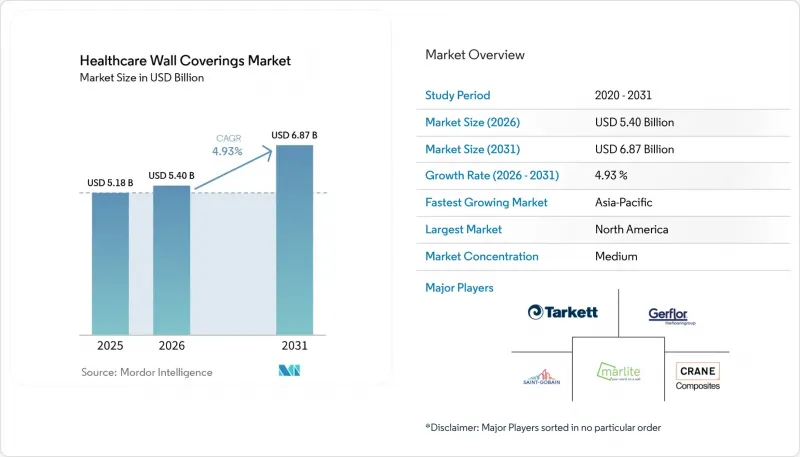
根據 Mordor Intelligence 預測,醫療牆壁材料市場規模預計將在 2025 年達到 51.8 億美元,2026 年達到 54 億美元,到 2031 年達到 68.7 億美元,2026 年至 2031 年的複合年成長率為 4.93%。
全球醫用牆壁材料市場趨勢與洞察
擴大感染控制和清潔要求
感染控制要求如今已成為醫院牆面材料採購的核心考量。 2023年,美國疾病管制與預防中心(CDC)發布報告,指出美國急診醫院的醫療相關感染情況,年度治療費用超過46億美元。世界衛生組織(WHO)的數據顯示,在高所得國家,每100名住院患者中就有7名在住院期間至少發生一次醫療相關感染。因此,醫療牆壁材料市場更青睞那些易於清潔且其有效性已通過認證性能標準的材料。 2026年發表在某學術期刊上的一項研究證實,以鋅為主要成分的抗菌牆壁材料塗料可減少99.8%的大腸桿菌和98%的金黃色葡萄球菌。缺乏抗菌性能和清潔性方面可驗證數據的產品在醫院競標中可能處於劣勢。
醫療設施現代化和維修的需求
許多醫院在繼續提供醫療服務的同時,也需要進行內部維修,這推動了醫療設施牆壁材料市場的發展。根據美國醫院裝修協會 (ASHE) 和《醫療設施管理》雜誌聯合發布的 2025 年調查報告,59% 的受訪者預計 2025 年的維修工程數量將超過 2024 年。 2024 年,維修維修佔醫院資本預算的 35%,超過了先前計畫的 30%。預計到 2025 年,這一比例將上升至 37%。美國建築師協會 (AIA) 預測,2026 年醫療設施建設支出將成長 2.6%,2027 年將成長 4.4%。大規模醫療系統正在進行重建,而預算緊張的醫療系統則優先考慮針對特定區域的維修,以改善感染控制。這一趨勢推動了對無縫乙烯基和熱塑性牆面系統的需求,因為這些系統可以減少接縫維護和與潮濕相關的維修需求。
與油漆和傳統飾面材料相比,該產品和安裝成本的比較。
高昂的產品和安裝成本仍是限制醫用牆壁材料市場的主要因素。與優質醫用塗料相比,規格級乙烯基和熱塑性樹脂系統的每平方英尺應用成本高出3到5倍。此外,它們還需要表面處理、接縫密封、黏合劑固化以及熟練安裝人員的人工。美國醫療建築業的人事費用每年成長6%至8%,進一步加劇了對高技能牆面安裝工作的壓力。在南美洲、東南亞和撒哈拉以南非洲的公共設施中,當預算有限時,特殊飾面有時會被推遲。雖然從生命週期模型來看,在10-15年的週期內,更耐用的牆面系統可能更受歡迎,但許多醫院的資本預算都是以3-5年的規劃週期運作的。
細分市場分析
到2025年,壁紙將佔據醫療機構牆面裝飾市場45.83%的佔有率,成為最大的產品類型。這一地位反映了1980年代至21世紀10年代建造的醫院廣泛採用II型乙烯基材料。這些醫院目前正進入維修週期,產生了更換需求。乙烯基和PVC複合材料作為II型和III型產品仍然被廣泛使用,為臨床區域提供耐用的表面。這些材料能夠抵抗醫院常用的消毒劑,並滿足北美許多醫療機構的防火要求。不織布壁紙因其卓越的尺寸穩定性和可進行數位印刷客製化的特性而日益受到歡迎。
防護和抗衝擊系統是成長最快的產品類型,預計到2031年,該細分市場的醫用牆壁材料將以5.54%的複合年成長率成長。其優點在於能夠防止輪椅、輸液架和病人轉運設備在擁擠的走廊和急診室造成損壞。吸音板、裝飾板和紡織板等衍生產品也適用於面向病人和對聲音敏感的區域。牆磚和牆板在潮濕的房間、手術室、無菌供應區和藥房仍然非常實用。金屬牆壁材料在需要高度消毒的區域和醫院大廳中發揮特殊作用。
區域分析
2025年,北美地區佔全球醫療牆壁材料材料銷售額的33.25%。該地區擁有嚴格的監管執法、成熟的產品生態系統以及大規模的急診設施建設項目。截至2026年5月,美國醫療建設支出預計經季節性已調整的的年化支出將達745億美元。大規模醫療系統正在進行醫院翻新,而其他系統則專注於感染控制方面的維修。
歐洲是醫療牆壁材料的成熟市場,合規性和循環經濟因素影響材料的選擇。 REACH法規對鄰苯二甲酸酯和消防安全的要求,為低品質產品設定了很高的進入門檻。英國國家醫療服務體系(NHS)2025清潔標準對牆壁和天花板的可清洗性提出了具體要求。 VinylPlus正在推廣「材料護照」計劃,作為該地區循環經濟議程的一部分。德國、法國、北歐國家、西班牙、義大利和比荷盧經濟聯盟等國家的需求,主要來自公共醫療機構的維修週期。
預計到2031年,亞太地區將以5.73%的複合年成長率成長,成為醫療壁材市場預期成長最快的地區。中國、印度、日本、韓國、澳洲和東南亞產能的提升,支撐了醫療設施室內裝潢產品的需求。新加坡2026年的公共設施需求目標為90.3億美元至104.3億新元(116億至134億新元),其中包括需要專業室內裝修的醫院開發案。機構需求主要受樟宜機場5號航站樓的推動,其中新登加綜合醫院和區域醫院是重點項目之一。在印度,一些政府醫院的採購框架中已增加了抗菌表面規格。中國正在收緊牆壁材料的室內空氣品質標準,而日本、韓國和澳洲則已製定了強調衛生的建築規範。中東和非洲市場規模仍然較小,但海灣國家、奈及利亞和南非的醫院計畫和維修計畫正在推動醫療牆面材料的逐步普及。
其他好處:
- Excel格式的市場預測(ME)表
- 3個月的分析師支持
目錄
第1章:引言
- 研究假設和市場定義
- 調查範圍
第2章:調查方法
第3章執行摘要
第4章 市場狀況
- 市場概覽
- 市場促進因素
- 擴大感染控制和清潔度規範
- 醫療設施現代化和維修的需求
- 預製模組化醫療設施建設的成長
- 高人流量臨床區域對耐用牆面保護材料的需求
- 設計療癒環境和以病人為中心的室內規劃
- 老舊設施對無縫、防潮表面的維修需求日益成長。
- 市場限制因素
- 先進的安裝技術要求以及與基板準備相關的風險
- 化學品、消防安全、揮發性有機化合物和抗菌劑的合規性問題十分複雜。
- 與油漆和傳統飾面相比,產品和安裝成本更低。
- 廢舊多層PVC和複合板回收利用的限制因素
- 產業價值鏈分析
- 波特五力分析
- 深入了解產業最新趨勢與創新
- 近期產業趨勢分析(新產品發布、策略性舉措、投資、合作、合資、業務擴張、併購等)
- 醫療牆壁材料市場技術趨勢的分析(數位印刷、低 VOC 油墨、生物基基材、抗菌處理、剝離式黏合劑和 AR 視覺化)。
第5章 市場規模與成長預測
- 依產品類型
- 壁紙
- 乙烯基和PVC壁紙
- 不織布壁紙
- 紙壁紙
- 織物和紡織壁紙
- 其他材料
- 牆板
- 吸音牆板
- 裝飾性3D牆板
- 紡織和毛氈牆板
- 木質和植物纖維牆板
- 牆磚和板材
- 金屬牆壁材料
- 防護性和抗衝擊性牆體系統
- 其他產品類型
- 壁紙
- 透過使用
- 新建工程
- 維修和改造
- 透過分銷管道
- 廠商直銷
- 間接銷售(批發商、零售商、經銷商、承包商)
- 按地區
- 北美洲
- 加拿大
- 美國
- 墨西哥
- 南美洲
- 巴西
- 秘魯
- 智利
- 阿根廷
- 其他南美國家
- 歐洲
- 英國
- 德國
- 法國
- 西班牙
- 義大利
- 比荷盧經濟聯盟(比利時、荷蘭、盧森堡)
- 北歐國家(丹麥、芬蘭、冰島、挪威、瑞典)
- 其他歐洲國家
- 亞太地區
- 印度
- 中國
- 日本
- 澳洲
- 韓國
- 東南亞
- 其他亞太國家
- 中東和非洲
- 阿拉伯聯合大公國
- 沙烏地阿拉伯
- 南非
- 奈及利亞
- 其他中東和非洲國家
- 北美洲
第6章 競爭情勢
- 市場集中度概述
- 策略趨勢
- 市佔率分析
- 公司簡介
- Compagnie de Saint-Gobain SA
- Gerflor Group
- Tarkett SA
- Forbo Holding AG
- Crane Composites, Inc.
- Marlite, Inc.
- NUDO Products, Inc.
- Trovex Ltd
- Altro Limited
- BioClad Ltd
- Rearo Commercial Surfaces
- Fundermax GmbH
- Trespa International BV
- Polyrey SAS
- Formica Group
- Wilsonart LLC
- Panolam Industries International, Inc.
- Futrus LLC
- Momentum Textiles and Wallcoverings
- Wolf-Gordon, Inc.
第7章 市場機會與未來展望
According to Mordor Intelligence, the healthcare wall coverings market was valued at USD 5.18 billion in 2025, is estimated at USD 5.40 billion in 2026, and is forecast to reach USD 6.87 billion by 2031, growing at a 4.93% CAGR during 2026-2031.
Global Healthcare Wall Coverings Market Trends and Insights
Expansion of Infection-Control and Cleanability Specifications
Infection-control requirements are now a central consideration in the procurement of hospital wall surfaces. In 2023, the Centers for Disease Control and Prevention reported healthcare-associated infections in acute-care hospitals in the United States, with annual treatment costs exceeding USD 4.6 billion. The World Health Organization reported that 7 in 100 patients in high-income countries acquire at least 1 healthcare-associated infection during hospitalization. The healthcare wall coverings market, therefore, favors materials that can be cleaned effectively and documented against recognized performance standards. A 2026 journal study found that zinc-based antimicrobial wall-covering coatings achieved a 99.8% reduction in E. coli and a 98% reduction in Staphylococcus aureus. Products without documented antimicrobial or cleanability performance may be at a disadvantage in hospital tenders.
Healthcare Facility Modernization and Renovation Demand
Renovation activity supports the healthcare wall coverings market because many hospitals need interior upgrades while remaining operational. The 2025 ASHE and Health Facilities Management survey found that 59% of respondents expected more renovation projects in 2025 than in 2024. Renovation projects received 35% of hospital capital budgets in 2024, above the planned 30%, and the estimated share rose to 37% in 2025. The American Institute of Architects projects healthcare construction spending growth of 2.6% in 2026 and 4.4% in 2027. Large health systems are pursuing replacement facilities, while constrained systems are prioritizing targeted upgrades that improve infection control. This pattern supports seamless vinyl and thermoplastic systems that reduce grout maintenance and moisture-related repair needs.
Product and Installation Cost Versus Paint and Conventional Finishes
Higher product and installation costs remain a major constraint for the healthcare wall coverings market. Specification-grade vinyl and thermoplastic systems cost 3-5 times more per square foot installed than premium healthcare-grade paint. They also require substrate preparation, seam sealing, adhesive curing, and trained installers. The United States healthcare construction labor costs are rising by 6-8% annually, placing further pressure on skill-intensive wall installation work. Public-sector facilities in South America, Southeast Asia, and Sub-Saharan Africa can defer specialized finishes when budgets are limited. Lifecycle models can favor durable wall systems over 10-15 years, but many hospital capital budgets operate on 3-5-year planning cycles.
Other drivers and restraints analyzed in the detailed report include:
- Growth of Prefabricated and Modular Healthcare Construction
- Healing-Environment Design and Patient-Centered Interior Programs
- End-of-Life Recycling Constraints for Multilayer PVC and Composite Panels
For complete list of drivers and restraints, kindly check the Table Of Contents.
Segment Analysis
Wallpapers accounted for 45.83% of the healthcare wall-covering market share in 2025, making them the largest product category. Their position reflects the installed base of Type II vinyl across hospitals built between the 1980s and 2010s. Those facilities are entering renovation cycles, creating replacement demand. Vinyl and PVC formulations remain widely used because Type II and Type III products offer durable surfaces for clinical areas. These materials can resist common hospital disinfectants and meet fire-performance expectations in many North American institutional settings. Non-woven wallpapers are gaining popularity because they provide dimensional stability and support digital-print customization.
Protective and impact-resistant systems are the fastest-growing product category, with the healthcare wall coverings market size for this segment forecast to rise at a 5.54% CAGR through 2031. Their appeal is linked to damage from wheelchairs, IV poles, and patient-transport equipment in busy corridors and emergency departments. Acoustic, decorative, and textile panel variants also support patient-facing and sound-sensitive areas. Wall tiles and slabs remain useful in wet rooms, operating rooms, sterile supply areas, and pharmacies. Metal wall coverings serve a specialized role in high-sterilization areas and hospital lobbies.
Complete Report Scope:
- By Product Type
- Wallpapers
- Vinyl and PVC-Based Wallpapers
- Non-Woven Wallpapers
- Paper-Based Wallpapers
- Fabric and Textile Wallpapers
- Other Materials
- Wall Panels
- Acoustic Wall Panels
- Decorative 3D Wall Panels
- Textile and Felt Wall Panels
- Wood and Plant-Fiber Wall Panels
- Wall Tiles and Slabs
- Metal Wall Coverings
- Protective and Impact-Resistant Wall Systems
- Other Product Types
- Wallpapers
- By Application
- New Construction
- Renovation and Remodeling
- By Distribution Channel
- Direct Sales from Manufacturers
- Indirect Sales (Distributors, Retailers, Dealers, Contractors)
- By Geography
- North America
- Canada
- United States
- Mexico
- South America
- Brazil
- Peru
- Chile
- Argentina
- Rest of South America
- Europe
- United Kingdom
- Germany
- France
- Spain
- Italy
- BENELUX (Belgium, Netherlands, Luxembourg)
- NORDICS (Denmark, Finland, Iceland, Norway, Sweden)
- Rest of Europe
- Asia-Pacific
- India
- China
- Japan
- Australia
- South Korea
- South-East Asia
- Rest of Asia-Pacific
- Middle East and Africa
- United Arab Emirates
- Saudi Arabia
- South Africa
- Nigeria
- Rest of Middle East and Africa
- North America
Geography Analysis
North America accounted for 33.25% of the healthcare wall coverings market revenue in 2025. The region has strong regulatory enforcement, established product ecosystems, and large acute-care construction programs. The United States healthcare construction spending is at a seasonally adjusted annual rate of USD 74.5 billion in May 2026. Large health systems are building replacement hospitals, while other systems are undertaking targeted infection-control renovations.
Europe is a mature healthcare wall coverings market where compliance and circularity shape material selection. REACH restrictions on phthalate groups and fire-performance requirements create a high barrier to entry for low-grade products. NHS England's 2025 cleanliness standards specify cleanability expectations for wall and ceiling surfaces. VinylPlus is advancing material passport work as part of the region's circular-economy agenda. Germany, France, the Nordics, Spain, Italy, and BENELUX support demand through public healthcare renovation cycles.
Asia-Pacific is forecast to grow at a 5.73% CAGR through 2031, giving it the fastest regional outlook in the healthcare wall coverings market. Capacity additions in China, India, Japan, South Korea, Australia, and Southeast Asia support demand for clinical interior products. Singapore's 2026 institutional demand target is USD 9.03-10.43 billion (SGD 11.6-13.4 billion), including hospital developments with specialized interior fit-outs. Institutional demand is driven mainly by Changi Airport Terminal 5, and the New Tengah General & Community Hospital is among the major projects. India is adding antimicrobial surface specifications to some government hospital procurement frameworks. China is tightening indoor air quality standards for wall materials, while Japan, South Korea, and Australia have established hygiene-focused building practices. The Middle East and Africa remain smaller, but hospital projects and renovation programs in Gulf states, Nigeria, and South Africa are supporting gradual adoption.
List of Companies Covered in this Report:
- Compagnie de Saint-Gobain S.A.
- Gerflor Group
- Tarkett S.A.
- Forbo Holding AG
- Crane Composites, Inc.
- Marlite, Inc.
- NUDO Products, Inc.
- Trovex Ltd
- Altro Limited
- BioClad Ltd
- Rearo Commercial Surfaces
- Fundermax GmbH
- Trespa International B.V.
- Polyrey S.A.S.
- Formica Group
- Wilsonart LLC
- Panolam Industries International, Inc.
- Futrus LLC
- Momentum Textiles and Wallcoverings
- Wolf-Gordon, Inc.
Additional Benefits:
- The market estimate (ME) sheet in Excel format
- 3 months of analyst support
TABLE OF CONTENTS
1 Introduction
- 1.1 Study Assumptions & Market Definition
- 1.2 Scope of the Study
2 Research Methodology
3 Executive Summary
4 Market Landscape
- 4.1 Market Overview
- 4.2 Market Drivers
- 4.2.1 Expansion of Infection-Control and Cleanability Specifications
- 4.2.2 Healthcare Facility Modernization and Renovation Demand
- 4.2.3 Growth of Prefabricated and Modular Healthcare Construction
- 4.2.4 Demand for Durable Wall Protection in High-Traffic Clinical Areas
- 4.2.5 Healing-Environment Design and Patient-Centered Interior Programs
- 4.2.6 Retrofit Demand for Seamless, Moisture-Resistant Surfaces in Aging Facilities
- 4.3 Market Restraints
- 4.3.1 High Installation Skill Requirements and Substrate-Preparation Risk
- 4.3.2 Chemical, Fire, VOC, and Antimicrobial Compliance Complexity
- 4.3.3 Product and Installation Cost Versus Paint and Conventional Finishes
- 4.3.4 End-of-Life Recycling Constraints for Multilayer PVC and Composite Panels
- 4.4 Industry Value Chain Analysis
- 4.5 Porter's Five Forces Analysis
- 4.5.1 Threat of New Entrants
- 4.5.2 Bargaining Power of Suppliers
- 4.5.3 Bargaining Power of Buyers
- 4.5.4 Threat of Substitutes
- 4.5.5 Competitive Rivalry
- 4.6 Insights into the Latest Trends and Innovations in the Industry
- 4.7 Insights into the Recent Developments (New Product Launches, Strategic Initiatives, Investments, Partnerships, JVs, Expansion, M&As, etc.) in the Industry
- 4.8 Insights into the Technological Landscape for Healthcare Wall Coverings Market (Digital Printing, Low-VOC Inks, Bio-Based Substrates, Antimicrobial Finishes, Peel-and-Stick Adhesives, AR Visualization)
5 Market Size & Growth Forecasts (Value in USD Billion)
- 5.1 By Product Type
- 5.1.1 Wallpapers
- 5.1.1.1 Vinyl and PVC-Based Wallpapers
- 5.1.1.2 Non-Woven Wallpapers
- 5.1.1.3 Paper-Based Wallpapers
- 5.1.1.4 Fabric and Textile Wallpapers
- 5.1.1.5 Other Materials
- 5.1.2 Wall Panels
- 5.1.2.1 Acoustic Wall Panels
- 5.1.2.2 Decorative 3D Wall Panels
- 5.1.2.3 Textile and Felt Wall Panels
- 5.1.2.4 Wood and Plant-Fiber Wall Panels
- 5.1.3 Wall Tiles and Slabs
- 5.1.4 Metal Wall Coverings
- 5.1.5 Protective and Impact-Resistant Wall Systems
- 5.1.6 Other Product Types
- 5.1.1 Wallpapers
- 5.2 By Application
- 5.2.1 New Construction
- 5.2.2 Renovation and Remodeling
- 5.3 By Distribution Channel
- 5.3.1 Direct Sales from Manufacturers
- 5.3.2 Indirect Sales (Distributors, Retailers, Dealers, Contractors)
- 5.4 By Geography
- 5.4.1 North America
- 5.4.1.1 Canada
- 5.4.1.2 United States
- 5.4.1.3 Mexico
- 5.4.2 South America
- 5.4.2.1 Brazil
- 5.4.2.2 Peru
- 5.4.2.3 Chile
- 5.4.2.4 Argentina
- 5.4.2.5 Rest of South America
- 5.4.3 Europe
- 5.4.3.1 United Kingdom
- 5.4.3.2 Germany
- 5.4.3.3 France
- 5.4.3.4 Spain
- 5.4.3.5 Italy
- 5.4.3.6 BENELUX (Belgium, Netherlands, Luxembourg)
- 5.4.3.7 NORDICS (Denmark, Finland, Iceland, Norway, Sweden)
- 5.4.3.8 Rest of Europe
- 5.4.4 Asia-Pacific
- 5.4.4.1 India
- 5.4.4.2 China
- 5.4.4.3 Japan
- 5.4.4.4 Australia
- 5.4.4.5 South Korea
- 5.4.4.6 South-East Asia
- 5.4.4.7 Rest of Asia-Pacific
- 5.4.5 Middle East and Africa
- 5.4.5.1 United Arab Emirates
- 5.4.5.2 Saudi Arabia
- 5.4.5.3 South Africa
- 5.4.5.4 Nigeria
- 5.4.5.5 Rest of Middle East and Africa
- 5.4.1 North America
6 Competitive Landscape
- 6.1 Market Concentration Overview
- 6.2 Strategic Moves
- 6.3 Market Share Analysis
- 6.4 Company Profiles {(includes Global level Overview, Market level overview, Core Segments, Financials as available, Strategic Information, Market Rank/Share for key companies, Products & Services, and Recent Developments)}
- 6.4.1 Compagnie de Saint-Gobain S.A.
- 6.4.2 Gerflor Group
- 6.4.3 Tarkett S.A.
- 6.4.4 Forbo Holding AG
- 6.4.5 Crane Composites, Inc.
- 6.4.6 Marlite, Inc.
- 6.4.7 NUDO Products, Inc.
- 6.4.8 Trovex Ltd
- 6.4.9 Altro Limited
- 6.4.10 BioClad Ltd
- 6.4.11 Rearo Commercial Surfaces
- 6.4.12 Fundermax GmbH
- 6.4.13 Trespa International B.V.
- 6.4.14 Polyrey S.A.S.
- 6.4.15 Formica Group
- 6.4.16 Wilsonart LLC
- 6.4.17 Panolam Industries International, Inc.
- 6.4.18 Futrus LLC
- 6.4.19 Momentum Textiles and Wallcoverings
- 6.4.20 Wolf-Gordon, Inc.
7 Market Opportunities & Future Outlook
- 7.1 Low-Carbon, Recyclable Healthcare Wall Systems
- 7.2 Seamless Retrofit Systems for Operating and Isolation Rooms

 住宅3D牆板市場:全球市場預測,2026-2032年
 抗指紋美耐板市場報告:趨勢、預測與競爭分析(至2035年)
 全球裝飾層壓板市場
 3D牆板壁紙:市場佔有率分析、產業趨勢與統計、成長預測(2026-2031年)印度裝飾層壓板市場:市場佔有率分析、行業趨勢與統計及成長預測(2026-2031)無PVC壁紙:市場佔有率分析、產業趨勢與統計、成長預測(2026-2031)裝飾層壓板:市場佔有率分析、行業趨勢和統計數據、成長預測(2026-2031)凹版裝飾覆膜油墨:市場佔有率分析、產業趨勢與統計、成長預測(2026-2031)
 牆面藝術和裝飾配件市場預測至2034年——按產品類型、材質、風格、價格範圍、分銷管道、最終用戶和地區分類的全球分析
 高壓層壓和塑膠樹脂市場規模、佔有率和成長分析:按產品類型、應用、分銷管道、最終用戶和地區分類-2026-2033年產業預測