


 |
市場調查報告書
商品編碼
2124032
裝飾層壓板:市場佔有率分析、行業趨勢和統計數據、成長預測(2026-2031)Decorative Laminates - Market Share Analysis, Industry Trends & Statistics, Growth Forecasts (2026 - 2031) |
||||||

※ 本網頁內容可能與最新版本有所差異。詳細情況請與我們聯繫。
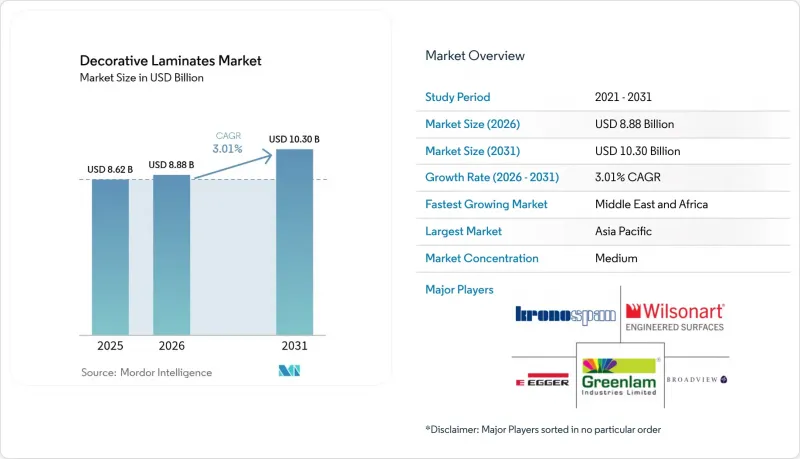
據 Mordor Intelligence 稱,2025 年裝飾層壓板市場價值為 86.2 億美元,預計到 2031 年將達到 103 億美元,而 2026 年為 88.8 億美元,預測期(2026-2031 年)的複合年成長率為 3.01%。
本報告按原料(塑膠樹脂、覆層、黏合劑、木質基材及其他原料)、應用領域(家具、櫥櫃、地板材料、牆板及其他應用)、終端用戶產業(住宅、非住宅、交通運輸)和地區(亞太地區、北美、歐洲及其他)進行細分。市場預測以美元計價。
全球裝飾層壓板市場趨勢與洞察
亞太地區住宅建設快速成長
印度住宅市場持續成長。 2025年上半年,豪華住宅銷售激增,帶動了廚房、衣櫃和牆板用層壓板需求的成長。同時,中國景氣衰退。房地產投資大幅下降,竣工住宅交付量減少,導致該地區層壓板需求放緩。因此,製造商正在重新分配庫存,將重點放在印度的一線城市和新興的二線城市,同時縮減在中國主要沿海城市(供應過剩)的業務。印度的商業室內裝修市場機會不斷擴大,辦公大樓租賃協議數量創歷史新高,零售項目儲備將持續到2028年。此外,東南亞的住宅獎勵策略也為市場帶來了正面訊號,但供應鏈中斷在短期內限制了供應。
經濟實惠的美觀改造正在推動維修。
2024會計年度,日本的裝修支出凸顯了一個趨勢:住宅和開發人員更傾向於維修現有房屋而非新建房屋,尤其是在人口老化的背景下。在木紋飾面材料中,裝飾層壓板是一種成本績效的選擇,深受預算有限的裝修項目的青睞。在印度和東南亞,DIY電商平台已開始向全國配送預切割板材,但由於缺乏安裝人員培訓,其成長潛力受到阻礙,導致復購率下降。在北美,老舊住宅存量持續推動裝修活動。然而,由於預計2025年房屋抵押貸款利率將上升,消費者傾向於選擇中檔層壓板而非高階產品。西歐也出現了類似的成本意識趨勢,儘管有關節能維修的法規在一定程度上緩解了這種降級趨勢。
替代方案:人造石、LVT地板、熱壓膜地板
由於其卓越的防水性能和便捷的卡扣式安裝系統,豪華乙烯基瓷磚(LVT)目前是潮濕地面區域的主流選擇。人造石檯面在高檔廚房和浴室翻新市場佔據主導地位,許多買家認為複合地板是「為了轉售而做出的妥協」。熱壓膜門具有無縫邊緣,被歐洲買家認為比封邊複合門品質更優。為了重新奪回市場佔有率,複合地板製造商正致力於高解析度印刷和深紋理壓花工藝,以縮小美觀方面的差距,但在大批量市場保持價格競爭力仍然是一項挑戰。在新興市場,成本仍然是選擇複合地板的重要因素,儘管全球替代壓力正在緩解,但尚未完全逆轉。
細分市場分析
到2025年,塑膠樹脂將佔裝飾層壓板市場40.96%的佔有率,這反映了其在三聚氰胺樹脂和酚醛樹脂粘合中的核心作用。然而,預計到2031年,覆膜紙的複合年成長率將達到3.43%,成為原料組成中成長率最高的。這一趨勢主要受建築師對高清印刷和同步壓紋的需求所驅動,因為覆膜紙可以在不增加厚度的情況下實現這些功能。在亞太地區,長期合約並不常見,而塑膠樹脂的價格又與化石燃料價格密切相關,因此需要仔細考慮成本轉嫁問題。
歐盟對中國裝飾紙徵收反傾銷稅,進一步推動了覆膜市場的成長。這項措施促使歐洲加工商採用內部浸漬工藝,以確保穩定的供應。同時,黏合劑供應商也正在採用生物基、無甲醛的膠黏劑系統。儘管這些系統成本更高,但它們有助於生產商遵守嚴格的甲醛釋放量上限標準。木質基材仍然至關重要,但由於歐盟的“森林砍伐法規”,審核成本正在上升。然而,獲得FSC或PEFC認證的鋸木廠現在能夠利用價格優勢。隨著認證數量的增加,包括再生木材在內的裝飾層壓板市場預計將比原生纖維市場成長更快。
區域分析
預計到2025年,亞太地區將佔全球銷售額的38.24%,但其成長呈現兩極化。在印度,住宅市場呈現快速成長的跡象,商業租賃價格創歷史新高,帶動了家具和牆板層壓板的快速普及。相較之下,中國2024年1月至10月的住宅交付量大幅下降。這一低迷迫使供應商在確保出口訂單和專注於翻新領域之間做出選擇。同時,日本在翻新方面的巨額支出凸顯了從新建房屋轉向維修的更廣泛趨勢。韓國也出現了類似的趨勢,老舊住宅存量正在推動類似的轉變。
在北美,市場保持穩定,房屋翻新和預製住宅的成長抵消了新建房屋數量的放緩。然而,2025年房屋抵押貸款利率的大幅上漲抑制了一些自願翻新工程。在歐洲,各方正在為2026年8月即將實施的甲醛法規做準備,這將對裝飾層壓板市場產生影響。 EGGER在德國新建的生產線就是一個很好的例子,它體現了遵守新法規所需的資本規模。此外,對來自中國的裝飾紙徵收反傾銷稅也給歐洲各地的加工商帶來了壓力,促使他們對本地浸漬設施的需求增加。
預計到2031年,中東和非洲地區的複合年成長率將達到3.49%,成為所有地區中成長最快的地區。在沙烏地阿拉伯和阿拉伯聯合大公國,大型企劃中對複合地板室內解決方案的採用凸顯了嚴格遵守工期的重要性。同時,人均收入的成長也推動了住宅翻新的激增。南美洲的供應量相對較低,但巴西的都市化趨勢正在推動其成長。鑑於監管環境的變化和建設產業的周期性波動,區域供應商面臨著如何在滿足監管要求所需的資金和靈活部署產能之間保持微妙平衡的挑戰。
其他好處:
- Excel格式的市場預測(ME)表
- 3個月的分析師支持
目錄
第1章:引言
- 研究假設和市場定義
- 調查範圍
第2章:調查方法
第3章執行摘要
第4章 市場狀況
- 市場概覽
- 市場促進因素
- 亞太地區住宅建設快速成長
- 房屋美觀改造的成本效益正在推動房屋翻新需求。
- 數位印刷和套準壓花技術的進步
- 採用層壓整合板的預製獨立式住宅
- 二、三線城市電子商務中DIY單頁紙的採用現狀
- 市場限制因素
- 替代品:人造石、LVT地板、熱壓膜
- 木質材料供應鏈可追溯性相關的成本
- 遵守歐盟 (EU) E1/E0 甲醛排放法規的成本
- 價值鏈分析
- 波特五力模型
第5章 市場規模與成長預測
- 按成分
- 塑膠樹脂
- 覆蓋
- 黏合劑
- 木質基材
- 其他原料
- 透過使用
- 家具
- 內閣
- 地板材料
- 牆板
- 其他用途
- 按最終用戶行業分類
- 住宅
- 非住宅
- 運輸
- 按地區
- 亞太地區
- 中國
- 印度
- 日本
- 韓國
- 其他亞太國家
- 北美洲
- 美國
- 加拿大
- 墨西哥
- 歐洲
- 德國
- 英國
- 法國
- 義大利
- 其他歐洲國家
- 南美洲
- 巴西
- 阿根廷
- 其他南美國家
- 中東和非洲
- 沙烏地阿拉伯
- 南非
- 其他中東和非洲國家
- 亞太地區
第6章 競爭情勢
- 市場集中度
- 策略趨勢
- 市佔率和排名分析
- 公司簡介
- Abet Laminati
- Aica Kogyo Co., Ltd.
- Airolam Decorative Laminates
- Archidply
- Bell Laminates
- Broadview Holding
- Durianlam
- Egger
- Greenlam Industries Limited
- Kronoplus Limited
- Laminex
- Merino Industries Limited
- Rushil Decor Limited
- Sonae Arauco
- Stylam
- The Diller Corporation
- Wilsonart LLC
第7章 市場機會與未來展望
According to Mordor Intelligence, the decorative laminates market size was valued at USD 8.62 billion in 2025 and is estimated to grow from USD 8.88 billion in 2026 to reach USD 10.30 billion by 2031, at a CAGR of 3.01% during the forecast period (2026-2031).
This report is Segmented by Raw Material (Plastic Resin, Overlays, Adhesives, Wood Substrate, and Other Raw Materials), Application (Furniture, Cabinets, Flooring, Wall Panels, and Other Applications), End-User Industry (Residential, Non-Residential, and Transportation), and Geography (Asia-Pacific, North America, Europe, and More). The Market Forecasts are Provided in Terms of Value (USD).
Global Decorative Laminates Market Trends and Insights
Residential Construction Surge in Asia-Pacific
India's residential market is growing. In H1 2025, premium-segment home sales surged, leading to increased demand for laminates in kitchens, wardrobes, and wall paneling. Conversely, China experienced a downturn: real-estate investments plummeted, and finished-home deliveries dropped, dampening the demand for laminates in the region. As a result, producers are reallocating their inventory, focusing on India's tier-I and emerging tier-II cities, while reducing their presence in the oversaturated coastal hubs of China. With record office leasing in India and a retail pipeline extending through 2028, opportunities in commercial fit-outs are expanding. Additionally, while Southeast Asian housing stimulus packages cast a positive light on the market, supply-chain fragmentation is moderating immediate volumes.
Cost-Effective Aesthetics Fueling Renovation Demand
In FY 2024, Japan's renovation expenditure underscored a trend where homeowners and developers lean towards refurbishing existing assets rather than embarking on new constructions, especially in light of the nation's aging demographic. Among wood-look surfaces, decorative laminates stand out for their cost-effectiveness, making them a favored choice in budget-sensitive remodeling endeavors. While DIY e-commerce platforms in India and Southeast Asia have begun shipping cut-to-size panels across the nation, their growth potential is hampered by a lack of installer training, leading to fewer repeat orders. North America's aging housing stock continues to drive remodeling activities. However, with mortgage rates set to rise in 2025, consumers are gravitating towards mid-tier laminate grades instead of premium ones. Western Europe exhibits a similar trend of thriftiness, but the push from landlord regulations on energy retrofits somewhat mitigates this down-trading.
Substitution by Engineered Stone, LVT, and Thermofoils
Luxury vinyl tile now dominates moisture-prone floor zones because it resists water and installs quickly with click-lock systems. Engineered stone countertops capture upmarket kitchen and bath remodels where buyers view laminates as a resale compromise. Thermofoil doors create seamless edges that European buyers perceive as higher quality than edge-banded laminate fronts. To regain share, laminate producers bank on high-resolution prints and deep-textured embossing that narrows the aesthetic gap, but price parity remains elusive in volume segments. Developing markets still opt for laminates on cost grounds, softening global substitution pressure yet not reversing it.
Other drivers and restraints analyzed in the detailed report include:
- Advances in Digital Printing and Emboss-in-Register Tech
- Prefab Single-Family Housing with Laminate-Integrated Panels
- European Union Formaldehyde-Emission Compliance Costs
For complete list of drivers and restraints, kindly check the Table Of Contents.
Segment Analysis
Plastic resin accounted for 40.96% of the decorative laminates market in 2025, reflecting its central role in melamine and phenolic bonding. Yet overlay papers are on track to post a 3.43% CAGR to 2031, the fastest in the raw-material mix. This trend is driven by architects' demand for high-definition prints and synchronized embossing, features that overlays provide without increasing thickness. In Asia-Pacific, where long-term contracts are uncommon, the pricing of plastic resin-tied to fossil feedstocks-necessitates careful cost pass-throughs.
The growth of overlays is further fueled by the EU's imposition of an anti-dumping duty on Chinese decor paper. This move has nudged European converters to adopt in-house impregnation methods, ensuring a steady supply. Meanwhile, adhesive suppliers are introducing bio-based, formaldehyde-free systems. These systems, while commanding a premium, assist producers in adhering to the stringent ceiling. Wood substrates continue to be vital, but the EU's Deforestation Regulation has escalated audit costs. However, mills boasting FSC or PEFC licenses are now positioned to capitalize on a pricing advantage. With an uptick in certified volumes, the segment of the decorative laminates market linked to recycled wood content is anticipated to outpace the growth of virgin-fiber volumes.
Complete Report Scope:
- By Raw Material
- Plastic Resin
- Overlays
- Adhesives
- Wood Substrate
- Other Raw Materials
- By Application
- Furniture
- Cabinets
- Flooring
- Wall Panels
- Other Applications
- By End-user Industry
- Residential
- Non-residential
- Transportation
- By Geography
- Asia-Pacific
- China
- India
- Japan
- South Korea
- Rest of Asia-Pacific
- North America
- United States
- Canada
- Mexico
- Europe
- Germany
- United Kingdom
- France
- Italy
- Rest of Europe
- South America
- Brazil
- Argentina
- Rest of South America
- Middle-East and Africa
- Saudi Arabia
- South Africa
- Rest of Middle-East and Africa
- Asia-Pacific
Geography Analysis
Asia-Pacific commanded 38.24% of revenue in 2025, but growth is bimodal. India is on the brink of a booming housing market, and with record commercial leasing, the country is witnessing a swift adoption of laminates in furniture and wall panels. In contrast, China is grappling with a significant drop in finished-unit deliveries from January to October 2024. This downturn has compelled suppliers to either pursue export orders or shift their focus to refurbishment niches. Meanwhile, Japan's substantial expenditure on renovations highlights a broader trend: a move away from new constructions towards upgrades. This trend is also evident in South Korea, where the aging housing stock is prompting similar shifts.
In North America, a stable market sees remodeling and prefab housing balancing out the slowdown in new builds. However, a spike in mortgage rates in 2025 has curtailed some discretionary upgrades. Europe is bracing for a formaldehyde cap in August 2026, impacting its decorative laminates market. A testament to the capital needed for compliance is EGGER's new production line in Germany. Additionally, anti-dumping duties on Chinese decor paper are putting pressure on converters across the continent, leading to heightened interest in local impregnation assets.
The Middle East and Africa are projected to post the fastest regional CAGR at 3.49% through 2031. In Saudi Arabia and the UAE, megaprojects are turning to laminate-clad interior solutions, emphasizing the need for tight delivery schedules. Concurrently, rising per-capita incomes are fueling a surge in residential refurbishments. While South America may contribute smaller volumes, urbanization trends in Brazil are providing a boost. Given the evolving regulatory landscapes and cyclical nature of construction, regional suppliers are finding themselves in a delicate dance: balancing the capital needed for compliance with the agility required for capacity deployment.
- Abet Laminati
- Aica Kogyo Co., Ltd.
- Airolam Decorative Laminates
- Archidply
- Bell Laminates
- Broadview Holding
- Durianlam
- Egger
- Greenlam Industries Limited
- Kronoplus Limited
- Laminex
- Merino Industries Limited
- Rushil Decor Limited
- Sonae Arauco
- Stylam
- The Diller Corporation
- Wilsonart LLC
Additional Benefits:
- The market estimate (ME) sheet in Excel format
- 3 months of analyst support
TABLE OF CONTENTS
1 Introduction
- 1.1 Study Assumptions and Market Definition
- 1.2 Scope of the Study
2 Research Methodology
3 Executive Summary
4 Market Landscape
- 4.1 Market Overview
- 4.2 Market Drivers
- 4.2.1 Residential construction surge in Asia-Pacific
- 4.2.2 Cost-effective aesthetics fuelling renovation demand
- 4.2.3 Advances in digital printing and emboss-in-register tech
- 4.2.4 Prefab single-family housing with laminate-integrated panels
- 4.2.5 Tier-II/III city e-commerce DIY cut-sheet adoption
- 4.3 Market Restraints
- 4.3.1 Substitution by engineered stone, LVT and thermofoils
- 4.3.2 Supply-chain traceability costs for wood substrates
- 4.3.3 European Union E1/E0 formaldehyde-emission compliance costs
- 4.4 Value Chain Analysis
- 4.5 Porter's Five Forces
- 4.5.1 Threat of New Entrants
- 4.5.2 Bargaining Power of Buyers
- 4.5.3 Bargaining Power of Suppliers
- 4.5.4 Threat of Substitute Products
- 4.5.5 Degree of Competition
5 Market Size and Growth Forecasts (Value)
- 5.1 By Raw Material
- 5.1.1 Plastic Resin
- 5.1.2 Overlays
- 5.1.3 Adhesives
- 5.1.4 Wood Substrate
- 5.1.5 Other Raw Materials
- 5.2 By Application
- 5.2.1 Furniture
- 5.2.2 Cabinets
- 5.2.3 Flooring
- 5.2.4 Wall Panels
- 5.2.5 Other Applications
- 5.3 By End-user Industry
- 5.3.1 Residential
- 5.3.2 Non-residential
- 5.3.3 Transportation
- 5.4 By Geography
- 5.4.1 Asia-Pacific
- 5.4.1.1 China
- 5.4.1.2 India
- 5.4.1.3 Japan
- 5.4.1.4 South Korea
- 5.4.1.5 Rest of Asia-Pacific
- 5.4.2 North America
- 5.4.2.1 United States
- 5.4.2.2 Canada
- 5.4.2.3 Mexico
- 5.4.3 Europe
- 5.4.3.1 Germany
- 5.4.3.2 United Kingdom
- 5.4.3.3 France
- 5.4.3.4 Italy
- 5.4.3.5 Rest of Europe
- 5.4.4 South America
- 5.4.4.1 Brazil
- 5.4.4.2 Argentina
- 5.4.4.3 Rest of South America
- 5.4.5 Middle-East and Africa
- 5.4.5.1 Saudi Arabia
- 5.4.5.2 South Africa
- 5.4.5.3 Rest of Middle-East and Africa
- 5.4.1 Asia-Pacific
6 Competitive Landscape
- 6.1 Market Concentration
- 6.2 Strategic Moves
- 6.3 Market Share(%)/Ranking Analysis
- 6.4 Company Profiles (includes Global Overview, Market Overview, Core Segments, Financials, Strategic Information, Products and Services, Recent Developments)
- 6.4.1 Abet Laminati
- 6.4.2 Aica Kogyo Co., Ltd.
- 6.4.3 Airolam Decorative Laminates
- 6.4.4 Archidply
- 6.4.5 Bell Laminates
- 6.4.6 Broadview Holding
- 6.4.7 Durianlam
- 6.4.8 Egger
- 6.4.9 Greenlam Industries Limited
- 6.4.10 Kronoplus Limited
- 6.4.11 Laminex
- 6.4.12 Merino Industries Limited
- 6.4.13 Rushil Decor Limited
- 6.4.14 Sonae Arauco
- 6.4.15 Stylam
- 6.4.16 The Diller Corporation
- 6.4.17 Wilsonart LLC
7 Market Opportunities and Future Outlook
- 7.1 White-space and Unmet-need Assessment

 印度裝飾層壓板市場:市場佔有率分析、行業趨勢與統計及成長預測(2026-2031)無PVC壁紙:市場佔有率分析、產業趨勢與統計、成長預測(2026-2031)凹版裝飾覆膜油墨:市場佔有率分析、產業趨勢與統計、成長預測(2026-2031)
 牆面藝術和裝飾配件市場預測至2034年——按產品類型、材質、風格、價格範圍、分銷管道、最終用戶和地區分類的全球分析
 2026-2030年全球裝飾配件市場
 裝飾層壓板市場規模、佔有率、趨勢和預測:按產品類型、應用、最終用途、紋理、價格、行業和地區分類(2026-2034 年)
 高壓層壓和塑膠樹脂市場規模、佔有率和成長分析:按產品類型、應用、分銷管道、最終用戶和地區分類-2026-2033年產業預測
 裝飾層壓板市場:按產品類型、材料類型、厚度、最終用途和分銷管道分類-2026年至2032年全球預測
 全球裝飾層壓板市場規模、佔有率、趨勢和成長分析報告(2026-2034年)日本覆膜市場規模、佔有率、趨勢和預測:按產品類型、應用和地區分類,2026-2034年