


 |
市場調查報告書
商品編碼
2073063
凹版裝飾覆膜油墨:市場佔有率分析、產業趨勢與統計、成長預測(2026-2031)Gravure Decorative Laminate Inks - Market Share Analysis, Industry Trends & Statistics, Growth Forecasts (2026 - 2031) |
||||||

※ 本網頁內容可能與最新版本有所差異。詳細情況請與我們聯繫。
據 Mordor Intelligence 稱,凹版裝飾覆膜油墨市場在 2025 年的價值為 1.7241 億美元,預計到 2031 年將達到 2.253 億美元,而 2026 年為 1.8027 億美元,預測期(2026-2031 年)的複合年成長率為 4.56%。
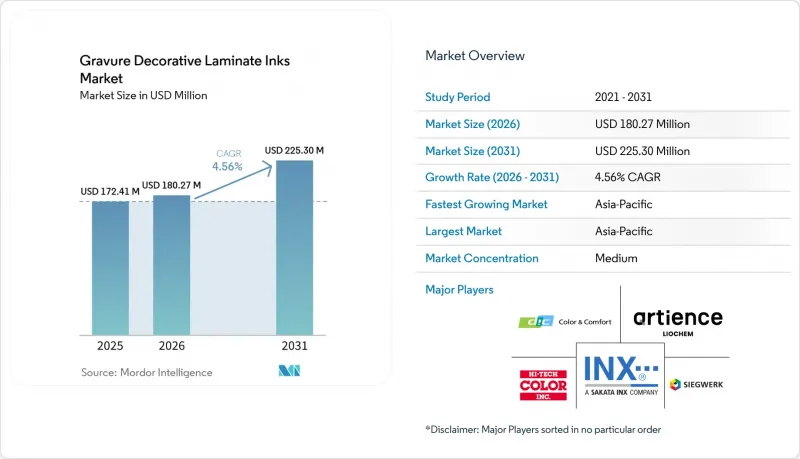
本報告按油墨類型(溶劑型凹版油墨和水性凹版油墨)、應用領域(家具層壓板和室內裝飾板、地板材料、牆面層壓板及其他應用)和地區(亞太地區、北美地區、歐洲地區、南美地區以及中東和非洲地區)進行細分。市場預測以美元計價。
全球凹版裝飾覆膜油墨市場趨勢與洞察
家具和室內裝飾應用領域對裝飾層壓板的需求正在擴大。
家具和室內板材製造商正擴大採用高壓裝飾層壓板,這種層壓板能夠再現天然木材、大理石和紡織品的飾面效果,同時符合 ISO 4586-2:2018 的性能標準。凹版印刷可實現微米等級的圖案精度,並透過珠光、金屬和套準壓紋等效果提升產品的附加價值。 DIC 公司等供應商提供不含硝化纖維素的「FINART AP」油墨,在保持每分鐘 200 公尺以上印刷速度的同時,也避免了甲苯和丁酮的使用。此外,當板材工廠採用無墨印刷系統時,裝飾紙可以與塑合板一起回收利用,使裝飾層壓板符合零售商對循環經濟的承諾。
快速的都市化正在推動亞洲新興市場對高階裝修材料的需求。
中國和印度的都市區正從普通層壓板轉向高品質的同步穿孔產品。這些產品需要凹版印刷油墨,以實現細膩的色調漸層和低同色異譜現象。雷射雕刻滾筒如今可提供10微米或更高的深度解析度,從而提高顏料分散性,即使在長時間連續生產中也能確保光澤均勻一致。高層住宅、模組化廚房和有序零售空間的增加,為多班次凹版印刷作業提供了支持,不到三小時的設置週期最佳化了整體設備效率 (OEE)。
加強歐盟和加州對揮發性有機化合物(VOC)和全氟烷基和多氟烷基物質(PFAS)的監管
歐洲印刷油墨協會 (EuPIA) 2026 年章程規定,自 2027 年 4 月起禁止使用甲醇、氯代溶劑和三甲基苯甲醯二苯基氧化膦,並要求對傳統凹版油墨進行重組。在加州,第 1117 號規則規定揮發性有機化合物 (VOC) 的限量為每公升 300 克 (g/L),第 1130 號規則將清潔溶劑的限量降低至每公升 25 克 (g/L)。這些法規要求加工商安裝再生式熱氧化設備或過渡到水性系統。同時,歐洲化學品管理局 (ECHA) 提出的關於全氟烷基和多氟烷基物質 (PFAS) 的法規草案規定,PFAS 的閾值每公斤 25 微克 (µg/kg),並給予 13.5 年的豁免期,但需接受年度審核並提交針對特定場所的控制計劃。遵守這些規定將導致與檢驗、文件編制和原料調整相關的成本增加,尤其會對中小規模的加工商造成影響。
細分市場分析
至2025年,溶劑型油墨系統將佔據凹版裝飾複合油墨市場58.89%的佔有率。這主要歸功於其對低表面能薄膜優異的附著力以及快速乾燥的特性。配備熱氧化系統的生產設施可將總碳氫化合物排放控制在50ppm(百萬分之50)以下,確保符合當地空氣品質法規。硝化纖維素或聚氨酯黏合劑溶解於醇酯混合物中,可達到DIN-4黏度25秒,且運作速度超過250公尺/分鐘,不會出現油墨暈染或印刷缺陷。
水性凹版油墨預計將以5.23%的複合年成長率(CAGR)實現最高成長,主要得益於其無溶劑配方以及歐洲的監管支持。 StarColor的中性pH值複合油墨系列運作速度高達每分鐘180公尺(m/min),並可承受高達150°C的印刷溫度,從而減少了對烘箱改造的需求。醇溶可溶性油墨被定位為過渡性產品,它以異丙醇取代苯,同時保持溶劑的快速揮發特性。利用AGFA的自由基專利技術,能量固化凹版油墨致力於實現無溶劑配方,預計一旦LED-UV模組的輸出功率達到每公分25瓦(W/cm),其成長率將達到發光二極體。
區域分析
預計到2025年,亞太地區將佔據40.12%的市場佔有率,並在2031年之前以5.33%的複合年成長率成長。在中國,儘管GDP成長放緩,但國內生產總值板材製造商仍繼續運作兩班印刷。在印度,住宅建設項目推動了室內板材安裝量的成長,尤其是在二線城市。越南、馬來西亞和泰國憑藉其戰略物流樞紐和自由貿易協定,正成為裝飾紙印刷企業遷址的熱門目的地。區域供應商正在投資酒精回收系統,以應對即將訂定的揮發性有機化合物(VOC)法規,該法規以日本的自我規範為藍本。
北美市場雖然不如亞太地區,但由於美國國內覆膜製程對預印紙的進口量龐大,因此仍是一個重要的市場。加州的「1130號規則」正在推廣水性凹版油墨和醇溶可溶性混合油墨的應用,美國西南部的水性油墨產能也逐漸提升。在墨西哥,板材製造商依賴從美國墨西哥灣沿岸工廠採購的溶劑型油墨,但他們正面臨不斷上漲的運費,並開始探索當地契約製造的可能性。在加拿大,翻新市場正在推動對帶有金屬裝飾的特種高壓層壓板(HPL)的需求,從而維持了對特種顏料分散體的需求。
在歐洲,設計創新與嚴格的監管要求並存。在德國和義大利的印刷廠,為了符合預防事故法規,封閉回路型黏度控制和低溶劑、快乾混合油墨的引進正在逐步推進。為了迎接歐洲印刷油墨協會 (EuPIA) 章程規定的 2027 年逐步淘汰光引發劑的計劃,義大利的加工商正在探索 LED-UV 凹版印刷的試點生產,該技術能夠在裝飾紙上實現發光二極體分鐘 350 公尺的印刷速度。波蘭憑藉其位置斯堪地那維亞零售商的優勢,運作多色凹版印刷生產線,其產量約佔歐洲消費量的 9%。然而,東歐的成長受到薪資上漲的限制。國內對成本績效實惠的中密度纖維板 (MDF) 家具的需求有助於維持較高的油墨銷售。
其他好處
- Excel格式的市場預測(ME)表
- 3個月的分析師支持
目錄
第1章:引言
- 研究假設和市場定義
- 調查範圍
第2章:調查方法
第3章執行摘要
第4章 市場狀況
- 市場概覽
- 市場促進因素
- 家具和室內裝潢應用領域對裝飾層壓板的需求日益成長。
- 快速的都市化正在推動亞洲新興國家對高階、美觀的裝修材料的需求。
- 大規模客製化的趨勢提高了凹版印刷的重複性。
- 給予家具出口優惠待遇,並擴大在越南和波蘭的生產基地
- 生物溶劑的技術進步減少了揮發性有機化合物的排放,並擴大了監管空間。
- 市場限制因素
- 歐盟和加州加強了對揮發性有機化合物和全氟烷基物質的監管。
- 單一途徑工業噴墨印表機在小批量生產的應用日益廣泛。
- 硝化纖維素價格的波動給利潤率帶來了壓力。
- 價值鏈分析
- 波特五力模型
第5章 市場規模與成長預測
- 按墨水類型
- 溶劑型凹版油墨
- 水性凹版油墨
- 透過使用
- 家具層壓板和室內面板
- 地板材料
- 牆面層壓板
- 其他用途(門、型材等)
- 按地區
- 亞太地區
- 中國
- 印度
- 日本
- 韓國
- 其他亞太國家
- 北美洲
- 美國
- 加拿大
- 墨西哥
- 歐洲
- 德國
- 英國
- 西班牙
- 義大利
- 法國
- 其他歐洲國家
- 南美洲
- 巴西
- 阿根廷
- 其他南美國家
- 中東和非洲
- 沙烏地阿拉伯
- 南非
- 其他中東和非洲國家
- 亞太地區
第6章 競爭情勢
- 市場集中度
- 策略趨勢
- 市佔率和排名分析
- 公司簡介
- DIC CORPORATION
- Flint Group
- Hi-Tech Color Inc.(Dainichiseika Color & Chemicals Mfg. Co., Ltd.)
- hubergroup
- Lio Chem(Toyo Printing Ink)
- Marabu Printing Ink
- Polytex Environmental Inks, Inc.
- SAKATA INX CORPORATION
- Siegwerk Druckfarben AG & Co. KGaA
- Sioen
- T&K TOKA Corporation
- Wikoff Color Corporation
第7章 市場機會與未來趨勢
- 對未開發市場和未滿足需求的評估
According to Mordor Intelligence, the gravure decorative laminate inks market size was valued at USD 172.41 million in 2025 and is estimated to grow from USD 180.27 million in 2026 to reach USD 225.30 million by 2031, at a CAGR of 4.56% during the forecast period (2026-2031).
This report is Segmented by Ink Type (Solvent-Based Gravure Inks and Water-Based Gravure Inks), Application (Furniture Laminates and Interior Panels, Flooring, Wall Covering Laminates, and Other Applications), and Geography (Asia-Pacific, North America, Europe, South America, and Middle-East and Africa). The Market Forecasts are Provided in Terms of Value (USD).
Global Gravure Decorative Laminate Inks Market Trends and Insights
Growing Demand for Decorative Laminates in Furniture and Interior Applications
Furniture and interior panel manufacturers are increasingly adopting high-pressure decorative laminates that replicate natural wood, marble, and textile finishes while adhering to ISO 4586-2:2018 performance standards. Gravure printing enables micron-level pattern precision, allowing for pearlescent, metallic, and emboss-in-register effects that enhance perceived value. Suppliers such as DIC Corporation offer nitrocellulose-free FINART AP inks, which exclude toluene and methyl ethyl ketone while maintaining press speeds above 200 meters per minute. Additionally, decorative laminates align with retailers' circular-economy initiatives, as decor paper can be recycled alongside particleboard when de-inking systems are utilized at panel mills.
Rapid Urbanization Boosting Premium Aesthetic Finishes in Emerging Asia
Urban households in China and India are increasingly replacing standard laminates with premium synchronized-pore products. These products require gravure inks capable of achieving fine tonal gradients and low metamerism. Laser-engraved cylinders now provide over 10-micron depth resolution, improving pigment dispersion and ensuring consistent gloss uniformity across extended production runs. The growth of residential towers, modular kitchens, and organized retail spaces supports multi-shift gravure operations, where set-up cycles under three hours optimize overall equipment effectiveness.
Stricter VOC and PFAS Limits in European Union and California
The 2026 European Printing Ink Association (EuPIA) Charter prohibits the use of methanol, chlorinated solvents, and trimethylbenzoyl diphenylphosphine oxide starting April 2027, requiring reformulation of traditional gravure inks. In California, Rule 1117 imposes a 300 grams per liter (g/L) Volatile Organic Compound (VOC) limit, while Rule 1130 reduces cleaning solvent limits to 25 g/L. These regulations necessitate converters to either install regenerative thermal oxidizers or transition to water-based systems. Simultaneously, the European Chemicals Agency's draft Per- and Polyfluoroalkyl Substances (PFAS) restriction sets a threshold of 25 micrograms per kilogram (µg/kg), with a 13.5-year derogation available only if annual audits and site-specific management plans are submitted. Compliance with these regulations increases costs due to testing, documentation, and raw material adjustments, particularly affecting smaller converters.
Other drivers and restraints analyzed in the detailed report include:
- Mass-Customization Trend Favoring Gravure's Repeat Print Accuracy
- Bio-Solvent Breakthroughs Lowering VOCs
- Rising Adoption of Single-Pass Industrial Inkjet for Short Runs
For complete list of drivers and restraints, kindly check the Table Of Contents.
Segment Analysis
Solvent-based systems represented 58.89% of the gravure decorative laminate inks market share in 2025, attributed to their strong adhesion and fast drying properties on low-surface-energy films. Facilities equipped with thermal oxidizers maintain total hydrocarbon emissions below 50 parts per million (ppm), ensuring compliance with regional air-quality regulations. Nitrocellulose or polyurethane binders dissolved in alcohol-ester blends achieve DIN-4 viscosities of 25 seconds and operate at speeds exceeding 250 meters per minute (m/min) without dirty-print defects.
Water-based gravure inks are expected to grow at the highest CAGR of 5.23%, driven by their solvent-free composition and regulatory support in Europe. StarColor's neutral-pH lamination series operates at 180 m/min and withstands press temperatures of up to 150 degrees Celsius (°C), reducing the need for oven retrofits. Alcohol-soluble inks serve as a transitional category, replacing benzene with isopropanol while retaining fast solvent evaporation. Energy-curable gravure inks, leveraging AGFA's free-radical patent, aim for solvent-free formulations and are projected for double-digit growth once light-emitting diode ultraviolet (LED-UV) modules achieve 25 watts per centimeter (W/cm) output.
Complete Report Scope:
- By Ink Type
- Solvent-based Gravure Inks
- Water-based Gravure Inks
- By Application
- Furniture Laminates and Interior Panels
- Flooring
- Wall Covering Laminates
- Other Applications (doors, profiles, misc.)
- By Geography
- Asia-Pacific
- China
- India
- Japan
- South Korea
- Rest of Asia-Pacific
- North America
- United States
- Canada
- Mexico
- Europe
- Germany
- United Kingdom
- Spain
- Italy
- France
- Rest of Europe
- South America
- Brazil
- Argentina
- Rest of South America
- Middle-East and Africa
- Saudi Arabia
- South Africa
- Rest of Middle-East and Africa
- Asia-Pacific
Geography Analysis
Asia-Pacific accounted for 40.12% of the market share in 2025 and is projected to grow at a compound annual growth rate (CAGR) of 5.33% through 2031. In China, domestic panel mills continue operating double-shift presses despite slower gross domestic product (GDP) growth. India's housing programs are driving increased interior panel installations, particularly in Tier-2 cities. Vietnam, Malaysia, and Thailand are attracting the relocation of decor-paper printing operations due to their strategic logistics hubs and free-trade agreements. Regional suppliers are investing in alcohol-recovery systems to meet upcoming volatile organic compound (VOC) regulations modeled on Japan's voluntary limits.
North America, while trailing Asia-Pacific, remains an important market due to the United States' high imports of pre-printed papers for domestic lamination. California's Rule 1130 is encouraging the adoption of water-based gravure or hybrid alcohol-soluble formulations, leading to incremental increases in installed capacity for aqueous inks in the Southwest. In Mexico, panel producers rely on solvent-based inks sourced from U.S. Gulf Coast plants but are facing rising freight costs, prompting consideration of regional toll-manufacturing options. In Canada, the renovation market is driving demand for niche high-pressure laminate (HPL) grades with metallic accents, sustaining the need for specialty pigment dispersions.
Europe combines design innovation with stringent regulatory requirements. German and Italian pressrooms are implementing closed-loop viscosity controls and reduced-solvent, fast-flash mixes to comply with accident-prevention regulations. The European Printing Ink Association (EuPIA) Charter's 2027 photoinitiator phase-out is pushing Italian converters to explore light-emitting diode ultraviolet (LED-UV) gravure pilots capable of achieving speeds of 350 meters per minute (m/min) on decor paper. Poland benefits from its proximity to Scandinavian retailers, operating multi-color gravure lines that account for approximately 9% of European consumption. However, growth in Eastern Europe is constrained by wage inflation, though domestic demand for cost-effective medium-density fiberboard (MDF) furniture helps maintain core ink volumes.
- DIC CORPORATION
- Flint Group
- Hi-Tech Color Inc. (Dainichiseika Color & Chemicals Mfg. Co., Ltd.)
- hubergroup
- Lio Chem (Toyo Printing Ink)
- Marabu Printing Ink
- Polytex Environmental Inks, Inc.
- SAKATA INX CORPORATION
- Siegwerk Druckfarben AG & Co. KGaA
- Sioen
- T&K TOKA Corporation
- Wikoff Color Corporation
Additional Benefits:
- The market estimate (ME) sheet in Excel format
- 3 months of analyst support
TABLE OF CONTENTS
1 Introduction
- 1.1 Study Assumptions and Market Definition
- 1.2 Scope of the Study
2 Research Methodology
3 Executive Summary
4 Market Landscape
- 4.1 Market Overview
- 4.2 Market Drivers
- 4.2.1 Growing demand for decorative laminates in furniture and interior applications
- 4.2.2 Rapid urbanisation boosting premium aesthetic finishes in emerging Asia
- 4.2.3 Mass-customisation trend favouring gravure's repeat print accuracy
- 4.2.4 Furniture export incentives in Vietnam and Poland expanding production bases
- 4.2.5 Bio-solvent breakthroughs lowering VOCs and widening regulatory head-room
- 4.3 Market Restraints
- 4.3.1 Stricter VOC and PFAS limits in European Union and California
- 4.3.2 Rising adoption of single-pass industrial ink-jet for short runs
- 4.3.3 Volatile nitro-cellulose prices squeezing margins
- 4.4 Value Chain Analysis
- 4.5 Porter's Five Forces
- 4.5.1 Buyer Power
- 4.5.2 Supplier Power
- 4.5.3 Threat of Substitutes
- 4.5.4 Threat of New Entrants
- 4.5.5 Competitive Rivalry
5 Market Size and Growth Forecasts (Value)
- 5.1 By Ink Type
- 5.1.1 Solvent-based Gravure Inks
- 5.1.2 Water-based Gravure Inks
- 5.2 By Application
- 5.2.1 Furniture Laminates and Interior Panels
- 5.2.2 Flooring
- 5.2.3 Wall Covering Laminates
- 5.2.4 Other Applications (doors, profiles, misc.)
- 5.3 By Geography
- 5.3.1 Asia-Pacific
- 5.3.1.1 China
- 5.3.1.2 India
- 5.3.1.3 Japan
- 5.3.1.4 South Korea
- 5.3.1.5 Rest of Asia-Pacific
- 5.3.2 North America
- 5.3.2.1 United States
- 5.3.2.2 Canada
- 5.3.2.3 Mexico
- 5.3.3 Europe
- 5.3.3.1 Germany
- 5.3.3.2 United Kingdom
- 5.3.3.3 Spain
- 5.3.3.4 Italy
- 5.3.3.5 France
- 5.3.3.6 Rest of Europe
- 5.3.4 South America
- 5.3.4.1 Brazil
- 5.3.4.2 Argentina
- 5.3.4.3 Rest of South America
- 5.3.5 Middle-East and Africa
- 5.3.5.1 Saudi Arabia
- 5.3.5.2 South Africa
- 5.3.5.3 Rest of Middle-East and Africa
- 5.3.1 Asia-Pacific
6 Competitive Landscape
- 6.1 Market Concentration
- 6.2 Strategic Moves
- 6.3 Market Share(%)/Ranking Analysis
- 6.4 Company Profiles (includes Global Overview, Market Overview, Core Segments, Financials, Strategic Information, Products and Services, and Recent Developments)
- 6.4.1 DIC CORPORATION
- 6.4.2 Flint Group
- 6.4.3 Hi-Tech Color Inc. (Dainichiseika Color & Chemicals Mfg. Co., Ltd.)
- 6.4.4 hubergroup
- 6.4.5 Lio Chem (Toyo Printing Ink)
- 6.4.6 Marabu Printing Ink
- 6.4.7 Polytex Environmental Inks, Inc.
- 6.4.8 SAKATA INX CORPORATION
- 6.4.9 Siegwerk Druckfarben AG & Co. KGaA
- 6.4.10 Sioen
- 6.4.11 T&K TOKA Corporation
- 6.4.12 Wikoff Color Corporation
7 Market Opportunities and Future Trends
- 7.1 White-space and Unmet-Need Assessment

 印度裝飾層壓板市場:市場佔有率分析、行業趨勢與統計及成長預測(2026-2031)無PVC壁紙:市場佔有率分析、產業趨勢與統計、成長預測(2026-2031)裝飾層壓板:市場佔有率分析、行業趨勢和統計數據、成長預測(2026-2031)
 牆面藝術和裝飾配件市場預測至2034年——按產品類型、材質、風格、價格範圍、分銷管道、最終用戶和地區分類的全球分析
 2026-2030年全球裝飾配件市場
 裝飾層壓板市場規模、佔有率、趨勢和預測:按產品類型、應用、最終用途、紋理、價格、行業和地區分類(2026-2034 年)
 高壓層壓和塑膠樹脂市場規模、佔有率和成長分析:按產品類型、應用、分銷管道、最終用戶和地區分類-2026-2033年產業預測
 裝飾層壓板市場:按產品類型、材料類型、厚度、最終用途和分銷管道分類-2026年至2032年全球預測
 全球裝飾層壓板市場規模、佔有率、趨勢和成長分析報告(2026-2034年)日本覆膜市場規模、佔有率、趨勢和預測:按產品類型、應用和地區分類,2026-2034年