


 |
市場調查報告書
商品編碼
2119770
印度裝飾層壓板市場:市場佔有率分析、行業趨勢與統計及成長預測(2026-2031)India Decorative Laminates - Market Share Analysis, Industry Trends & Statistics, Growth Forecasts (2026 - 2031) |
||||||

※ 本網頁內容可能與最新版本有所差異。詳細情況請與我們聯繫。
據 Mordor Intelligence 稱,2025 年印度裝飾層壓板市值為 13.2 億美元,預計到 2031 年將從 2026 年的 13.9 億美元成長至 18.1 億美元,預測期(2026-2031 年)複合年成長率為 5.35%。
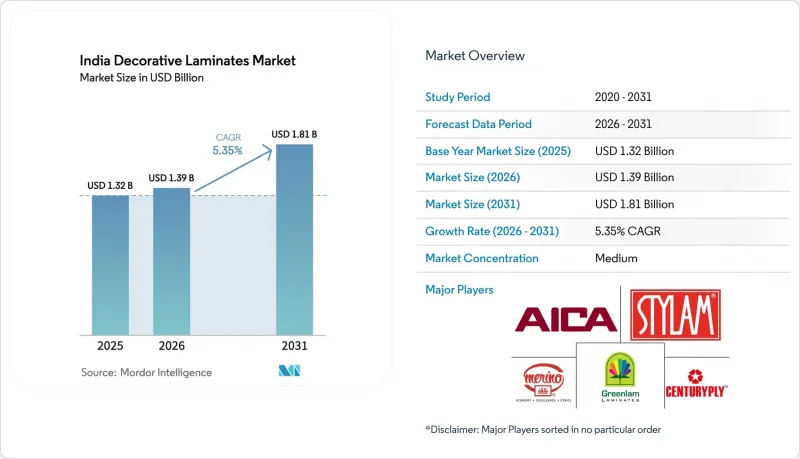
本報告按原料(塑膠樹脂、覆層、黏合劑、木質基材)和應用領域(家具、櫥櫃、地板、牆板及其他應用)進行細分。市場預測以美元計價。
印度裝飾層壓板市場趨勢與洞察。
住宅房地產和經濟適用住宅計劃的快速擴張
印度預計2025會計年度將新建406,889套住宅,年增33%。同時,主要大都會圈的豪華住宅市場預計將實現28%至85%的銷售貼合加工。這棟建築熱潮刺激了廚房、衣櫃和牆板等場所對層壓板的直接需求。開發人員傾向於使用預貼面塑合板和中密度纖維板(MDF)來縮短工期並控制預算,從而確保從正規經銷商批量採購。諸如「總理住房計劃」(Pradhan Mantri Awas Yojana)等政府項目進一步推動了500萬盧比以下價位段市場的擴張。隨著都市化進程的推進,預計到2030年印度城市人口將超過6億,與承包室內裝修承包商簽訂供貨合約的製造商預計將實現板材銷售量的持續成長。
向模組化家具和有組織的零售通路過渡
工廠生產的模組化單元正在取代現場木工,徹底改變了層壓板的規格和分銷方式。宜家、Pepperfry 和 Godrej Interio 等大型連鎖店正在將業務拓展到二線城市,對符合平板包裝物流要求的、品質統一且經過認證的層壓板提出了更高的要求。像 CenturyPly 的「Fix Day Fix Route」這樣的經銷商擴張模式,每年新增門市超過 500 家,鞏固了銷售管道的覆蓋範圍。在都市區,每個模組化廚房套裝平均使用 15 到 25 種層壓板,據估計,在大都會圈的住宅中,層壓板的滲透率已上升至 25%。消費者對防指紋塗層和一致木紋紋理的日益成長的需求,迫使非正式生產商在設備現代化和退出市場之間做出選擇。
來自PVC板材和人造石材的競爭加劇。
聚氯乙烯(PVC)板材和木塑複合材料具有防白蟻和防潮性能,在沿海地區的廚房和浴室市場佔據了相當大的佔有率。人造石英石檯面,價格在每平方英尺565至1400印度盧比之間,與每平方英尺約150印度盧比的層壓板相比,正吸引著高階消費者,尤其是在大都會圈裝修市場,追求石材飾面。層壓板製造商正與高密度板材和阻燃板材競爭,但這些細分市場需要對消費者進行教育,且生產成本更高。
細分市場分析
預計到2025年,木質基材將佔印度裝飾層壓板市場的42.02%。塑合板和中密度纖維板(MDF)的成本優勢是支撐這一趨勢的主要因素。國內板材生產商能夠以每平方英尺25-35印度盧比的價格供貨,這進一步鞏固了他們在成本敏感型項目中的優勢。儘管黏合劑目前僅佔很小一部分收入,但預計其複合年成長率將達到6.05%,這主要得益於強制過渡到無甲醛化學品的政策。漢高和皮迪萊特等跨國公司正在採用大豆基和木質素基黏合劑,使製造商能夠在不降低黏合強度的前提下達到E0級環保標準。
像Greenlam在安得拉邦實施的那種連續壓制塑合板生產線,透過生產更高密度、更高精度的板材,幫助層壓板公司減少打磨損耗並提高成品率。同時,整合到黏合劑層中的貼合加工添加劑,例如Century Ply的“ViroKill”,正在醫療和酒店項目中創造高階銷售機會。隨著永續性審核的普及,提供FSC和PEFC產銷監管鏈(CoC)認證的板材和樹脂供應商正在獲得出口訂單和進入綠色建築專案的機會,從而提升後向整合的策略價值。
其他好處:
- Excel格式的市場預測(ME)表
- 3個月的分析師支持
目錄
第1章:引言
- 研究假設和市場定義
- 調查範圍
第2章:調查方法
第3章執行摘要
第4章 市場狀況
- 市場概覽
- 市場促進因素
- 住宅房地產和經濟適用住宅供應計劃的快速擴張
- 模組化家具的興起和有組織的零售通路的崛起
- 數位印刷技術能夠大規模生產高品質的客製化裝飾品。
- 政府對低VOC/E0級表面材料的激勵措施
- 受「中國+1」籌資策略推動,印度出口蓬勃發展。
- 市場限制因素
- 來自PVC板材和人造石材的競爭加劇。
- 酚醛樹脂和三聚氰胺樹脂的價格波動
- 更嚴格的甲醛排放標準(IS 12592-2023)
- 價值鏈分析
- 波特五力模型
第5章 市場規模與成長預測
- 按成分
- 塑膠樹脂
- 覆蓋
- 黏合劑
- 木質基材
- 透過使用
- 家具
- 內閣
- 地板材料
- 牆板
- 其他用途(桌面和檯面)
第6章 競爭情勢
- 市場集中度
- 策略趨勢
- 市佔率/排名分析
- 公司簡介
- Advance Decorative Laminates Pvt. Ltd.
- Aica Laminates India Pvt. Ltd.
- Archidply
- Bloom Dekor Ltd.
- CenturyPly
- Faus Group Inc.
- Formica Group
- FunderMax GmbH
- Greenlam Industries Limited
- Kronospan(Kronotex)
- Merino India
- Olympic Decor LLP
- OMNOVA Solutions Inc.
- Stylam
- Wilsonart LLC.
第7章 市場機會與未來展望
According to Mordor Intelligence, the India decorative laminates market size was valued at USD 1.32 billion in 2025 and estimated to grow from USD 1.39 billion in 2026 to reach USD 1.81 billion by 2031, at a CAGR of 5.35% during the forecast period (2026-2031).
This report is Segmented by Raw Material (Plastic Resin, Overlays, Adhesives, and Wood Substrate) and Application (Furniture, Cabinets, Flooring, Wall Panels, and Other Applications). The Market Forecasts are Provided in Terms of Value (USD).
India Decorative Laminates Market Trends and Insights
Rapid Expansion of Residential Real-Estate and Affordable-Housing Schemes
India delivered 406,889 new homes in fiscal 2025, representing a 33% year-over-year increase, while the luxury category saw sales growth of 28-85% across major metros. This build-out feeds direct demand for laminates in kitchens, wardrobes, and wall panels. Developers favor pre-laminated particle board and MDF to shorten project cycles and control budgets, locking in high-volume purchases from organized distributors. Government programs such as Pradhan Mantri Awas Yojana enhance momentum in the sub-₹50 lakh bracket. As urbanization pushes India's city population above 600 million by 2030, manufacturers that secure supply agreements with turnkey fit-out firms are positioned for sustained sheet-volume gains.
Shift to Modular Furniture and Organised Retail Channels
Factory-built modular units are replacing on-site carpentry, reshaping laminate specification and distribution. Large chains, including IKEA, Pepperfry, and Godrej Interio, are scaling into tier-2 cities, demanding certified laminates with uniform quality for flat-pack logistics. Dealer expansion models such as CenturyPly's "Fix Day Fix Route" have added more than 500 outlets in a single fiscal year, cementing channel reach. Each urban modular kitchen consumes 15-25 sheets, and penetration has risen to an estimated 25% of new homes in metropolitan areas. Rising expectations around anti-fingerprint coatings and synchronized wood-grain textures are pushing unorganized mills to either upgrade or exit.
Intensifying Competition from PVC Boards and Engineered Stone
Polyvinyl chloride boards and wood-plastic composites offer termite and moisture resistance, capturing a significant share of the kitchen and bath market in coastal states. Engineered quartz worktops, priced at INR (565-1,400) per sq ft versus laminates at about INR 150, are pulling premium consumers toward stone finishes, especially in metropolitan renovations. Laminate producers are countering with compact panels and fire-retardant grades, but these niches require customer education and higher production costs.
Other drivers and restraints analyzed in the detailed report include:
- Digital-Printing Tech Enabling Mass-Premium Custom Decors
- Government Incentives for Low-VOC / E0 Grade Surfaces
- Volatility in Phenolic/Melamine Resin Prices
For complete list of drivers and restraints, kindly check the Table Of Contents.
Segment Analysis
Wood substrate held a 42.02% India decorative laminates market share in 2025, anchored by the cost advantage of particle board and MDF. Domestic board makers can deliver at INR (25-35) per sq ft, reinforcing their grip on value-conscious projects. Adhesives, though a smaller revenue pool today, are forecast to post a 6.05% CAGR, supported by the mandated shift to formaldehyde-free chemistries. Multinationals such as Henkel and Pidilite have introduced soy- and lignin-based binders that enable manufacturers to hit E0 thresholds without compromising bond strength.
Continuous-press particle-board lines, like the one Greenlam is installing in Andhra Pradesh, produce denser panels with tighter tolerances, helping laminators reduce sanding loss and improve yield. In parallel, antimicrobial additive packages embedded in adhesive layers, exemplified by CenturyPly's ViroKill, open premium price windows in healthcare and hospitality projects. As sustainability audits become mainstream, board and resin suppliers offering FSC or PEFC chain-of-custody documentation will unlock access to export orders and green-building projects, raising the strategic value of backward integration.
Complete Report Scope:
- By Raw Material
- Plastic Resin
- Overlays
- Adhesives
- Wood Substrate
- By Application
- Furniture
- Cabinets
- Flooring
- Wall Panels
- Other Applications (Table Tops and Counter Tops)
List of Companies Covered in this Report:
- Advance Decorative Laminates Pvt. Ltd.
- Aica Laminates India Pvt. Ltd.
- Archidply
- Bloom Dekor Ltd.
- CenturyPly
- Faus Group Inc.
- Formica Group
- FunderMax GmbH
- Greenlam Industries Limited
- Kronospan (Kronotex)
- Merino India
- Olympic Decor LLP
- OMNOVA Solutions Inc.
- Stylam
- Wilsonart LLC.
Additional Benefits:
- The market estimate (ME) sheet in Excel format
- 3 months of analyst support
TABLE OF CONTENTS
1 Introduction
- 1.1 Study Assumptions & Market Definition
- 1.2 Scope of the Study
2 Research Methodology
3 Executive Summary
4 Market Landscape
- 4.1 Market Overview
- 4.2 Market Drivers
- 4.2.1 Rapid expansion of residential real-estate and affordable-housing schemes
- 4.2.2 Shift to modular furniture and organised retail channels
- 4.2.3 Digital-printing tech enabling mass-premium custom decors
- 4.2.4 Government incentives for low-VOC / E0 grade surfaces
- 4.2.5 Export boom from India under "China-plus-one" sourcing
- 4.3 Market Restraints
- 4.3.1 Intensifying competition from PVC boards and engineered stone
- 4.3.2 Volatility in phenolic/melamine resin prices
- 4.3.3 Tightening formaldehyde-emission norms (IS 12592-2023)
- 4.4 Value Chain Analysis
- 4.5 Porter's Five Forces
- 4.5.1 Bargaining Power of Suppliers
- 4.5.2 Bargaining Power of Buyers
- 4.5.3 Threat of New Entrants
- 4.5.4 Threat of Substitutes
- 4.5.5 Degree of Competition
5 Market Size & Growth Forecasts (Value)
- 5.1 By Raw Material
- 5.1.1 Plastic Resin
- 5.1.2 Overlays
- 5.1.3 Adhesives
- 5.1.4 Wood Substrate
- 5.2 By Application
- 5.2.1 Furniture
- 5.2.2 Cabinets
- 5.2.3 Flooring
- 5.2.4 Wall Panels
- 5.2.5 Other Applications (Table Tops and Counter Tops)
6 Competitive Landscape
- 6.1 Market Concentration
- 6.2 Strategic Moves
- 6.3 Market Share/Ranking Analysis
- 6.4 Company Profiles (includes Global level Overview, Market level overview, Core Segments, Financials as available, Strategic Information, Products & Services, Recent Developments)
- 6.4.1 Advance Decorative Laminates Pvt. Ltd.
- 6.4.2 Aica Laminates India Pvt. Ltd.
- 6.4.3 Archidply
- 6.4.4 Bloom Dekor Ltd.
- 6.4.5 CenturyPly
- 6.4.6 Faus Group Inc.
- 6.4.7 Formica Group
- 6.4.8 FunderMax GmbH
- 6.4.9 Greenlam Industries Limited
- 6.4.10 Kronospan (Kronotex)
- 6.4.11 Merino India
- 6.4.12 Olympic Decor LLP
- 6.4.13 OMNOVA Solutions Inc.
- 6.4.14 Stylam
- 6.4.15 Wilsonart LLC.
7 Market Opportunities and Future Outlook
- 7.1 White-space and Unmet-Need Assessment

 無PVC壁紙:市場佔有率分析、產業趨勢與統計、成長預測(2026-2031)裝飾層壓板:市場佔有率分析、行業趨勢和統計數據、成長預測(2026-2031)凹版裝飾覆膜油墨:市場佔有率分析、產業趨勢與統計、成長預測(2026-2031)
 牆面藝術和裝飾配件市場預測至2034年——按產品類型、材質、風格、價格範圍、分銷管道、最終用戶和地區分類的全球分析
 2026-2030年全球裝飾配件市場
 裝飾層壓板市場規模、佔有率、趨勢和預測:按產品類型、應用、最終用途、紋理、價格、行業和地區分類(2026-2034 年)
 高壓層壓和塑膠樹脂市場規模、佔有率和成長分析:按產品類型、應用、分銷管道、最終用戶和地區分類-2026-2033年產業預測
 裝飾層壓板市場:按產品類型、材料類型、厚度、最終用途和分銷管道分類-2026年至2032年全球預測
 全球裝飾層壓板市場規模、佔有率、趨勢和成長分析報告(2026-2034年)日本覆膜市場規模、佔有率、趨勢和預測:按產品類型、應用和地區分類,2026-2034年