


 |
市場調查報告書
商品編碼
2119266
無PVC壁紙:市場佔有率分析、產業趨勢與統計、成長預測(2026-2031)PVC-Free Wall Coverings - Market Share Analysis, Industry Trends & Statistics, Growth Forecasts (2026 - 2031) |
||||||

※ 本網頁內容可能與最新版本有所差異。詳細情況請與我們聯繫。
根據 Mordor Intelligence 預測,不含 PVC 的牆壁材料市場規模將從 2025 年的 19.2 億美元和 2026 年的 20.5 億美元成長到 2031 年的 29.6 億美元,2026 年至 2031 年的年複合成長率(CAGR)為 7.6%。
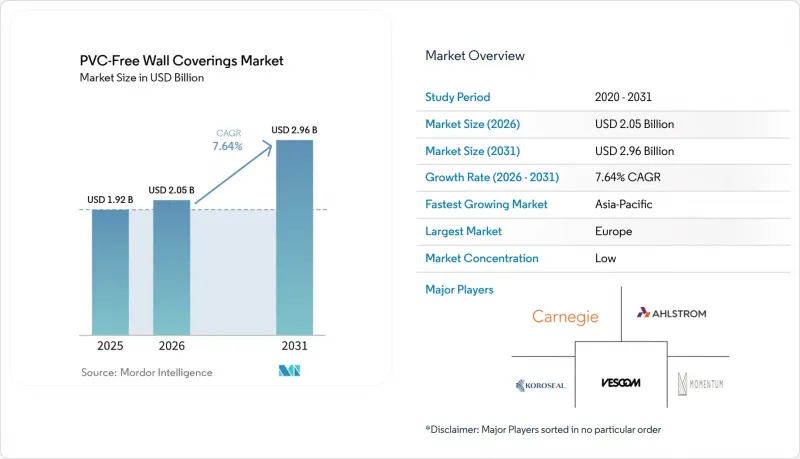
本報告按產品類型(壁紙、牆板、牆磚和板材、金屬及防護牆體系統)、施工類型(新建、維修/整修)、最終用戶(住宅、商業)、配銷通路(B2C、B2B)和地區(北美、南美、歐洲、亞太、中東和非洲)進行細分。預測值以美元計。
全球無PVC壁材市場趨勢及洞察
適用於注重健康的商業設施室內裝潢的PVC替代品
醫療保健、高等教育和養老住宅的買家在選擇牆面裝飾材料時,越來越重視室內空氣品質和材料透明度。這促使一些商業規範從傳統的乙烯基材料轉向經認證的無PVC替代品。 ANSI/NSF 342標準是美國專門針對壁紙所製定的永續性評估標準。目前,該標準於2024年發布,美國壁紙協會和Wolf-Gordon公司表示,2025年的修訂流程將進一步加強與人類健康和福祉相關的標準。經批准的產品清單將在鞏固這一轉變中發揮作用,因為它即使在產品審查完成後仍將指南許多項目。據Carnegie Fabrics公司稱,他們的替代產品「Noragi Stripe」包含80%的烯烴複合材料和20%源自工業廢棄物的再生烯烴,並且完全不含PVC、PFAS和鹵代阻燃劑。隨著更多產品無需依賴乙烯基即可滿足商業性性能要求,無PVC壁紙市場將從中受益。
綠建築中低揮發性有機化合物(VOC)和紅色清單材料的規範
綠色建築專案將環境目標轉化為眾多專案中可記錄的材料要求。到2025年,全球將有7,500個商業項目(總面積達1.47億平方公尺)獲得LEED認證,其中中國當地、印度和加拿大是主要的國際中心。這些項目為低排放量室內材料和產品文件奠定了至關重要的基礎。當專案要求能夠透過聲明和認證來滿足時,無PVC壁紙市場的需求就會得到支撐。 LEED v4包含NSF/ANSI 342試點認證,該認證認可合格壁紙作為合規的一種方式。這激勵製造商投資於排放文件、材料資訊揭露和檢驗的產品特性。在永續性要求是設計要求而非只是可選採購標準的項目中,這種影響最為顯著。
與通用乙烯基產品相比,交付較高。
由於烯烴、不織布和生物基原料的成本結構不同,不含PVC的產品可能比傳統乙烯基產品更貴。這種價格差異對於東南亞中端市場的旅館項目和南美的住宅而言是一個重要因素。在這些情況下,除非合約或項目要求明確規定,否則買家可能不會選擇替代品。此外,通用乙烯基產品還享有成熟的石化供應鏈和承包商的廣泛認可等優勢。因此,不含PVC的壁紙市場取決於供應商能否在不影響耐用性和設計的前提下縮小成本差距。 Momentum Textiles和Versa公司推出了“Circon”,這是一種生物基II型基材,在某些應用中,其價格與市售乙烯基產品相當。這種價格更實惠且性能符合要求的產品,預計將在預算有限的項目中得到更廣泛的應用。
細分市場分析
到2025年,壁紙將佔無PVC壁材市場價值的48.6%。這一地位反映了其在消費者零售通路和商業規範通路的廣泛應用。不織布產品兼具尺寸穩定性、易剝離性和與低VOC水性黏合劑的兼容性。此外,它們還省去了某些紙背產品所需的浸泡時間。這些應用優勢降低了商業設施翻新所需的人力成本。由於乙烯基材料易於操作和更換,該類別現在也滿足了以往更傾向於使用乙烯基材料的專案需求。
牆板是成長最快的產品類型,預計2026年至2031年間,該領域不含PVC的壁材市場規模將以7.8%的複合年成長率成長。木質和植物纖維製成的牆板適用於飯店和健康中心等偏好天然材料的場所。 2026年6月,Spinneybeck推出了“Sould Fragments”,這是一款由丹麥海藻碎屑製成的模組化吸音牆磚。織物和紡織壁紙常用於高階酒店和辦公室項目,這些場所對飾面品質要求較高。吸音板則用於開放式職場和醫療機構等對聲學控制要求極高的場所。牆磚、板材、金屬飾面和防護系統則廣泛應用於走廊、餐廳和護理機構等對衛生和表面耐久性要求較高的場所。
2025年,維修整修工程佔無PVC牆壁材料市場佔有率的61.3%。這反映了歐洲商業設施持續維修以及政策主導的建築維修計劃。人流量大的商業空間牆壁材料通常每7到10年更換一次。每次更換週期都涉及選擇新的材料和安裝方法。設施管理人員和室內設計師通常會在既定的維修預算內做出這些決定。這使得供應商能夠展示非PVC產品在已完成專案中的實際應用效果。
預計2026年至2031年間,新建建築市場將以7.7%的複合年成長率成長。設計團隊可以在採購開始前,在專案文件中最終確定所用材料。因此,健康產品聲明、聲明標籤和環境產品文件可以從早期階段影響產品陣容。如果供應商能夠在專案進入競標階段之前滿足這些要求,將對無PVC壁材產業大有裨益。由於企業會重複應用其標準,認證和文件在多個項目中都具有價值。因此,在設計階段確保合規性對於長期使用規範至關重要。
區域分析
到2025年,歐洲將佔據無PVC壁紙市場37.1%的佔有率。該地區擁有大規模商業維修項目,建築認證系統已廣泛應用。歐盟委員會對維修計畫的評估表明,各成員國對建築維修的政策關注度仍然很高。德國、英國和北歐國家支撐著對不織布和高檔壁紙的需求。 AS 壁紙 Tapeten和Marburger Tapetenfabrik在不織布壁紙生產領域佔據了穩固的地位。 Graham & Brown和Sanderson Design Group則為高階住宅和酒店業的買家提供產品。歐洲仍然是一個至關重要的市場,因為維修、認證和材料文件往往相輔相成。
北美是全球第二大無PVC壁紙市場區域貢獻者。商業辦公大樓和酒店業的翻新改造、LEED認證標準的普及以及人們對不含鄰苯二甲酸酯的乙烯基材料日益成長的興趣,共同推動了市場需求。在加州,2025年預計將有470個LEED認證項目,認證面積達9,830萬平方英尺。機構買家也認可無PVC牆壁材料的價值,他們需要有記錄在案的防火安全和健康檢測結果,並且產品易於清潔。備受矚目的維修項目有望提高人們對認證材料的認知。該地區的供應商正透過商業分銷商,在產品性能、透明度、文件記錄和供應鏈等方面競爭。
亞太地區是成長最快的地區,預計2026年至2031年間,無PVC壁材市場將以8.5%的複合年成長率成長。這一成長與建設活動、商業房地產擴張以及綠色建築的普及密切相關。在南美部分地區,價格敏感度限制了住宅和中型商業項目對無PVC牆面材料的應用。在中東和非洲,飯店、醫療保健和綜合用途開發項目為高性能商業產品進入市場創造了機會。
其他好處:
- Excel格式的市場預測(ME)表
- 3個月的分析師支持
目錄
第1章:引言
- 研究假設和市場定義
- 調查範圍
第2章:調查方法
第3章執行摘要
第4章 市場狀況
- 市場概覽
- 市場促進因素
- 在注重健康的商業設施室內裝潢中,PVC 的替代品
- 綠建築中低揮發性有機化合物(VOC)和紅色清單材料的規範
- 商業設施改造與飯店品牌差異化
- 採用不含PVC的材料進行數位印刷,並可小批量客製化。
- 由於 II 型產品的性能等效性,非乙烯基規格得以擴展
- 再生纖維和生物基材料的創新
- 市場限制因素
- 與一般黑膠唱片相比,運費較高。
- 防火性、耐洗性和抗衝擊性認證的障礙。
- 多材質壁紙的回收處理系統有其限制。
- 與施工公司的技能水準和工程品質相關的風險。
- 產業價值鏈分析
- 波特五力分析
- 深入了解產業最新趨勢與創新
- 近期產業趨勢分析(新產品發布、策略性舉措、投資、合作、合資、業務擴張、併購等)
- 對無PVC壁紙市場技術趨勢的分析(數位印刷、低VOC油墨、生物基基材、抗菌處理、剝離式黏合劑和AR視覺化)。
第5章 市場規模與成長預測
- 依產品類型
- 壁紙
- 生物基複合複合材料與植物纖維壁紙
- 不織布纖維素和合成纖維壁紙
- 由紙和再生纖維製成的壁紙
- 織物和紡織壁紙
- 其他材料
- 牆板
- 吸音牆板
- 裝飾性3D牆板
- 紡織和氈制牆板
- 木質和植物纖維牆板
- 牆磚和板材
- 金屬牆壁材料
- 防護性和抗衝擊性牆體系統
- 其他產品類型
- 壁紙
- 依建築類型
- 新建工程
- 維修/改造
- 最終用戶
- 住宅
- 商業的
- 透過分銷管道
- B2C通路
- 大賣場和超級市場
- 壁紙專賣店
- 家居建材商店
- 線上
- 本地零售商(非正規通路)
- 其他分銷管道
- B2B通路(承包商和建築商、室內設計師和建築師、專案採購和機構銷售)
- B2C通路
- 按地區
- 北美洲
- 加拿大
- 美國
- 墨西哥
- 南美洲
- 巴西
- 秘魯
- 智利
- 阿根廷
- 其他南美國家
- 歐洲
- 英國
- 德國
- 法國
- 西班牙
- 義大利
- 比荷盧經濟聯盟(比利時、荷蘭、盧森堡)
- 北歐國家(丹麥、芬蘭、冰島、挪威、瑞典)
- 其他歐洲國家
- 亞太地區
- 印度
- 中國
- 日本
- 澳洲
- 韓國
- 東南亞
- 其他亞太國家
- 中東和非洲
- 阿拉伯聯合大公國
- 沙烏地阿拉伯
- 南非
- 奈及利亞
- 其他中東和非洲國家
- 北美洲
第6章 競爭情勢
- 市場集中度
- 策略趨勢
- 市佔率分析
- 公司簡介
- Carnegie Fabrics, LLC
- Momentum Textiles and Wallcovering
- Koroseal Interior Products, LLC
- Designtex, Inc.
- Vescom BV
- Ahlstrom Oyj
- Monadnock Paper Mills, Inc.
- Ultraflex Systems Inc.
- Len-Tex Corporation
- AS Creation Tapeten AG
- Asian Paints Limited
- Brewster Home Fashions LLC
- F. Schumacher and Co.
- Graham and Brown Limited
- Grandeco Wallfashion Group NV
- Marburger Tapetenfabrik JB Schaefer GmbH and Co. KG
- Rasch GmbH and Co. KG
- Sangetsu Corporation
- Sanderson Design Group plc
- The Romo Group
第7章 市場機會與未來展望
According to Mordor Intelligence, the PVC-free wall coverings market size is projected to expand from USD 1.92 billion in 2025 and USD 2.05 billion in 2026 to USD 2.96 billion by 2031, registering a CAGR of 7.6% between 2026 and 2031.
This report is Segmented by Product Type (Wallpapers, Wall Panels, Wall Tiles and Slabs, Metal and Protective Wall Systems), Construction Type (New Construction, Renovation/Retrofit), End-User (Residential, Commercial), Distribution Channel (B2C, B2B), and Geography (North America, South America, Europe, Asia-Pacific, Middle East and Africa). Forecasts are Provided in Terms of Value (USD).
Global PVC-Free Wall Coverings Market Trends and Insights
PVC Substitution in Health-Conscious Commercial Interiors
Healthcare, higher education, and senior living buyers are placing greater weight on indoor air quality and material transparency when selecting wall finishes. This is moving some commercial specifications away from conventional vinyl and toward verified PVC-free alternatives. The ANSI/NSF 342 standard is the wallcovering-specific sustainability assessment used in the United States. It's 2024, and the 2025 revision process considered stronger human health and wellness criteria, according to the Wallcoverings Association and Wolf-Gordon. Approved product lists make this shift durable because the list can guide many projects after a product has been reviewed. Carnegie Fabrics states that its Noragi Stripe alternative contains 80% olefin composite and 20% post-industrial recycled olefin, and is free of PVC, PFAS, and halogenated flame retardants. The PVC-free wall coverings market benefits when more products can meet commercial performance needs without relying on vinyl.
Low-VOC and Red-List Material Specifications in Green Buildings
Green building programs turn environmental targets into documented material requirements for many projects. In 2025, 7,500 commercial projects received LEED certification across 147 million square meters globally, with mainland China, India, and Canada among the leading international locations. These projects create a substantial setting for low-emitting interior materials and product documentation. The PVC-free wall coverings market is supported when such coverings can meet project requirements through declarations and recognized certifications. LEED v4 includes an NSF/ANSI 342 pilot credit that recognizes qualifying wallcoverings as a compliance route. This gives manufacturers a reason to invest in emissions documentation, material disclosure, and verified product attributes. The effect is strongest in projects where sustainability requirements are part of the design brief rather than an optional purchasing preference.
Higher Delivered Cost Versus Commodity Vinyl
PVC-free products can cost more than conventional vinyl because olefin, non-woven, and bio-based inputs have different cost structures. The gap is important in mid-market hospitality projects in Southeast Asia and residential construction in South America. In these settings, buyers may choose alternatives only when a contract or project requirement calls for them. Commodity vinyl also benefits from established petrochemical supply chains and broad familiarity among installers. The PVC-free wall coverings market, therefore, depends on suppliers narrowing cost gaps without compromising durability or design. Momentum Textiles and Versa presented Circon as a bio-sourced Type II substrate with commercial vinyl price equivalence in selected applications. Products that meet the required performance at a more accessible price can extend adoption to budget-constrained projects.
Other drivers and restraints analyzed in the detailed report include:
- Commercial Renovation and Hospitality Brand Differentiation
- Digital Printing and Short-Run Customization on PVC-Free Substrates
- Fire, Cleanability, and Impact-Performance Qualification Barriers
For complete list of drivers and restraints, kindly check the Table Of Contents.
Segment Analysis
Wallpapers accounted for 48.6% of the value of PVC-free wall coverings in 2025. Their position reflects availability across consumer retail and commercial specification channels. Non-woven products combine dimensional stability, strippability, and compatibility with low-VOC water-based adhesives. They can also eliminate the soak time for some paper-backed products. These application advantages can reduce installation effort during commercial renovation. The category now serves projects that previously favored vinyl for practical handling and replacement needs.
Wall panels are the fastest-growing product type, with the value of PVC-free wall coverings for this segment forecast to grow at a 7.8% CAGR from 2026 to 2031. Wood and plant-fiber panels support hospitality and wellness interiors that favor natural materials. In June 2026, Spinneybeck introduced Sould Fragments, a modular acoustic wall tile made from Danish eelgrass offcuts. Fabric and textile wallpapers are used in premium hospitality and office projects where tactile finishes are valued. Acoustic panels are used in open-plan workplaces and healthcare settings where sound control matters. Wall tiles, slabs, metal finishes, and protective systems are used in corridors, food service spaces, and care facilities where hygiene and surface life are central requirements.
Renovation and retrofit accounted for 61.3% of the PVC-free wall coverings market in 2025. This reflects ongoing commercial refurbishment and the policy-led pipeline of building upgrades in Europe. Wallcoverings in high-traffic commercial spaces are commonly replaced every 7 to 10 years. Each replacement cycle creates a new material and installation decision. Facility managers and interior designers typically make these decisions within defined renovation budgets. This allows suppliers to show how non-vinyl products perform in completed projects.
New construction is forecast to grow at a 7.7% CAGR from 2026 to 2031. Design teams can lock material choices into project documents before procurement begins. Health product declarations, declare labels, and environmental product documentation can therefore influence the product set at an early stage. The PVC-free wall coverings industry benefits when suppliers can meet these requirements before a project reaches the tender stage. Certification and documentation can have value across multiple projects because firms apply their standards repeatedly. This makes design-stage compliance important for long-term access to specifications.
Complete Report Scope:
- By Product Type
- Wallpapers
- Bio-Based Composite and Plant-Fiber Wallpapers
- Non-Woven Cellulose and Synthetic Fiber Wallpapers
- Paper and Recycled-Fiber Wallpapers
- Fabric and Textile Wallpapers
- Other Materials
- Wall Panels
- Acoustic Wall Panels
- Decorative 3D Wall Panels
- Textile and Felt Wall Panels
- Wood and Plant-Fiber Wall Panels
- Wall Tiles and Slabs
- Metal Wall Coverings
- Protective and Impact-Resistant Wall Systems
- Other Product Types
- Wallpapers
- By Construction Type
- New Construction
- Renovation/Retrofit
- By End-user
- Residential
- Commercial
- By Distribution Channel
- B2C Channels
- Hypermarkets and Supermarkets
- Specialty Wallpaper Stores
- Home Centers
- Online
- Local Shops (unorganized channels)
- Other Distribution Channels
- B2B Channels (Contractors and Installers, Interior Designers and Architects, Project Procurement and Institutional Sales)
- B2C Channels
- By Geography
- North America
- Canada
- United States
- Mexico
- South America
- Brazil
- Peru
- Chile
- Argentina
- Rest of South America
- Europe
- United Kingdom
- Germany
- France
- Spain
- Italy
- BENELUX (Belgium, Netherlands, Luxembourg)
- NORDICS (Denmark, Finland, Iceland, Norway, Sweden)
- Rest of Europe
- Asia-Pacific
- India
- China
- Japan
- Australia
- South Korea
- South-East Asia
- Rest of Asia-Pacific
- Middle East & Africa
- United Arab Emirates
- Saudi Arabia
- South Africa
- Nigeria
- Rest of Middle East & Africa
- North America
Geography Analysis
Europe accounted for 37.1% of the PVC-free wall coverings market in 2025. The region has a substantial commercial retrofit base and strong use of building certification systems. The European Commission's assessment of renovation plans shows continued policy attention to building upgrades across member states. Germany, the United Kingdom, and the Nordic countries support demand for non-woven and premium wallcoverings. A.S. Creation Tapeten and Marburger Tapetenfabrik have established positions in non-woven wallpaper production. Graham & Brown and Sanderson Design Group serve premium residential and hospitality buyers. Europe remains important because renovation, certification, and materials documentation often reinforce one another.
North America is the second-largest regional contributor to the PVC-free wall coverings market. Demand is supported by commercial office and hospitality renovations, the adoption of LEED, and greater attention to phthalate-containing vinyl. California recorded 470 LEED-certified projects in 2025, representing 98.3 million square feet of certified space. The value of PVC-free wall coverings is also supported by institutional buyers who require documented fire and health testing, as well as cleanability. High-profile renovation projects can raise the visibility of certified materials. Suppliers in the region compete on performance, transparency, documentation, and availability through commercial distributors.
Asia-Pacific is the fastest-growing region, with the value of PVC-free wall coverings forecast to rise at an 8.5% CAGR from 2026 to 2031. Growth is linked to construction activity, the expansion of commercial real estate, and the broader adoption of green building. Price sensitivity limits adoption in some South American residential and mid-market commercial projects. In the Middle East and Africa, hospitality, healthcare, and mixed-use developments create entry points for performance-grade commercial products.
- Carnegie Fabrics, LLC
- Momentum Textiles and Wallcovering
- Koroseal Interior Products, LLC
- Designtex, Inc.
- Vescom B.V.
- Ahlstrom Oyj
- Monadnock Paper Mills, Inc.
- Ultraflex Systems Inc.
- Len-Tex Corporation
- A.S. Creation Tapeten AG
- Asian Paints Limited
- Brewster Home Fashions LLC
- F. Schumacher and Co.
- Graham and Brown Limited
- Grandeco Wallfashion Group NV
- Marburger Tapetenfabrik J.B. Schaefer GmbH and Co. KG
- Rasch GmbH and Co. KG
- Sangetsu Corporation
- Sanderson Design Group plc
- The Romo Group
Additional Benefits:
- The market estimate (ME) sheet in Excel format
- 3 months of analyst support
TABLE OF CONTENTS
1 Introduction
- 1.1 Study Assumptions & Market Definition
- 1.2 Scope of the Study
2 Research Methodology
3 Executive Summary
4 Market Landscape
- 4.1 Market Overview
- 4.2 Market Drivers
- 4.2.1 PVC Substitution in Health-Conscious Commercial Interiors
- 4.2.2 Low-VOC and Red-List Material Specifications in Green Buildings
- 4.2.3 Commercial Renovation and Hospitality Brand Differentiation
- 4.2.4 Digital Printing and Short-Run Customization on PVC-Free Substrates
- 4.2.5 Type II Performance Parity Expanding Non-Vinyl Specification
- 4.2.6 Recycled-Fiber and Bio-Based Substrate Innovation
- 4.3 Market Restraints
- 4.3.1 Higher Delivered Cost Versus Commodity Vinyl
- 4.3.2 Fire, Cleanability, and Impact-Performance Qualification Barriers
- 4.3.3 Limited End-of-Life Collection for Multi-Material Wallcoverings
- 4.3.4 Installer Familiarity and Application-Quality Risk
- 4.4 Industry Value Chain Analysis
- 4.5 Porter's Five Forces Analysis
- 4.5.1 Threat of New Entrants
- 4.5.2 Bargaining Power of Suppliers
- 4.5.3 Bargaining Power of Buyers
- 4.5.4 Threat of Substitutes
- 4.5.5 Competitive Rivalry
- 4.6 Insights into the Latest Trends and Innovations in the Industry
- 4.7 Insights into the Recent Developments (New Product Launches, Strategic Initiatives, Investments, Partnerships, JVs, Expansion, M&As, etc.) in the Industry
- 4.8 Insights into the Technological Landscape for PVC-free Wallcovering Market (Digital Printing, Low-VOC Inks, Bio-Based Substrates, Antimicrobial Finishes, Peel-and-Stick Adhesives, AR Visualization)
5 Market Size & Growth Forecasts (Value)
- 5.1 By Product Type
- 5.1.1 Wallpapers
- 5.1.1.1 Bio-Based Composite and Plant-Fiber Wallpapers
- 5.1.1.2 Non-Woven Cellulose and Synthetic Fiber Wallpapers
- 5.1.1.3 Paper and Recycled-Fiber Wallpapers
- 5.1.1.4 Fabric and Textile Wallpapers
- 5.1.1.5 Other Materials
- 5.1.2 Wall Panels
- 5.1.2.1 Acoustic Wall Panels
- 5.1.2.2 Decorative 3D Wall Panels
- 5.1.2.3 Textile and Felt Wall Panels
- 5.1.2.4 Wood and Plant-Fiber Wall Panels
- 5.1.3 Wall Tiles and Slabs
- 5.1.4 Metal Wall Coverings
- 5.1.5 Protective and Impact-Resistant Wall Systems
- 5.1.6 Other Product Types
- 5.1.1 Wallpapers
- 5.2 By Construction Type
- 5.2.1 New Construction
- 5.2.2 Renovation/Retrofit
- 5.3 By End-user
- 5.3.1 Residential
- 5.3.2 Commercial
- 5.4 By Distribution Channel
- 5.4.1 B2C Channels
- 5.4.1.1 Hypermarkets and Supermarkets
- 5.4.1.2 Specialty Wallpaper Stores
- 5.4.1.3 Home Centers
- 5.4.1.4 Online
- 5.4.1.5 Local Shops (unorganized channels)
- 5.4.1.6 Other Distribution Channels
- 5.4.2 B2B Channels (Contractors and Installers, Interior Designers and Architects, Project Procurement and Institutional Sales)
- 5.4.1 B2C Channels
- 5.5 By Geography
- 5.5.1 North America
- 5.5.1.1 Canada
- 5.5.1.2 United States
- 5.5.1.3 Mexico
- 5.5.2 South America
- 5.5.2.1 Brazil
- 5.5.2.2 Peru
- 5.5.2.3 Chile
- 5.5.2.4 Argentina
- 5.5.2.5 Rest of South America
- 5.5.3 Europe
- 5.5.3.1 United Kingdom
- 5.5.3.2 Germany
- 5.5.3.3 France
- 5.5.3.4 Spain
- 5.5.3.5 Italy
- 5.5.3.6 BENELUX (Belgium, Netherlands, Luxembourg)
- 5.5.3.7 NORDICS (Denmark, Finland, Iceland, Norway, Sweden)
- 5.5.3.8 Rest of Europe
- 5.5.4 Asia-Pacific
- 5.5.4.1 India
- 5.5.4.2 China
- 5.5.4.3 Japan
- 5.5.4.4 Australia
- 5.5.4.5 South Korea
- 5.5.4.6 South-East Asia
- 5.5.4.7 Rest of Asia-Pacific
- 5.5.5 Middle East & Africa
- 5.5.5.1 United Arab Emirates
- 5.5.5.2 Saudi Arabia
- 5.5.5.3 South Africa
- 5.5.5.4 Nigeria
- 5.5.5.5 Rest of Middle East & Africa
- 5.5.1 North America
6 Competitive Landscape
- 6.1 Market Concentration
- 6.2 Strategic Moves
- 6.3 Market Share Analysis
- 6.4 Company Profiles {(includes Global level Overview, Market level overview, Core Segments, Financials as available, Strategic Information, Market Rank/Share for key companies, Products & Services, and Recent Developments)}
- 6.4.1 Carnegie Fabrics, LLC
- 6.4.2 Momentum Textiles and Wallcovering
- 6.4.3 Koroseal Interior Products, LLC
- 6.4.4 Designtex, Inc.
- 6.4.5 Vescom B.V.
- 6.4.6 Ahlstrom Oyj
- 6.4.7 Monadnock Paper Mills, Inc.
- 6.4.8 Ultraflex Systems Inc.
- 6.4.9 Len-Tex Corporation
- 6.4.10 A.S. Creation Tapeten AG
- 6.4.11 Asian Paints Limited
- 6.4.12 Brewster Home Fashions LLC
- 6.4.13 F. Schumacher and Co.
- 6.4.14 Graham and Brown Limited
- 6.4.15 Grandeco Wallfashion Group NV
- 6.4.16 Marburger Tapetenfabrik J.B. Schaefer GmbH and Co. KG
- 6.4.17 Rasch GmbH and Co. KG
- 6.4.18 Sangetsu Corporation
- 6.4.19 Sanderson Design Group plc
- 6.4.20 The Romo Group
7 Market Opportunities & Future Outlook
- 7.1 PVC-Free Type II Products for Healthcare and Senior Living
- 7.2 Recycled-Fiber Wall Graphics for Retail and Hospitality

 印度裝飾層壓板市場:市場佔有率分析、行業趨勢與統計及成長預測(2026-2031)裝飾層壓板:市場佔有率分析、行業趨勢和統計數據、成長預測(2026-2031)凹版裝飾覆膜油墨:市場佔有率分析、產業趨勢與統計、成長預測(2026-2031)
 牆面藝術和裝飾配件市場預測至2034年——按產品類型、材質、風格、價格範圍、分銷管道、最終用戶和地區分類的全球分析
 2026-2030年全球裝飾配件市場
 裝飾層壓板市場規模、佔有率、趨勢和預測:按產品類型、應用、最終用途、紋理、價格、行業和地區分類(2026-2034 年)
 高壓層壓和塑膠樹脂市場規模、佔有率和成長分析:按產品類型、應用、分銷管道、最終用戶和地區分類-2026-2033年產業預測
 裝飾層壓板市場:按產品類型、材料類型、厚度、最終用途和分銷管道分類-2026年至2032年全球預測
 全球裝飾層壓板市場規模、佔有率、趨勢和成長分析報告(2026-2034年)日本覆膜市場規模、佔有率、趨勢和預測:按產品類型、應用和地區分類,2026-2034年