


 |
市場調查報告書
商品編碼
2163424
資料中心設施管理:市場佔有率分析、產業趨勢與統計、成長預測(2026-2031)Data Center Facility Management - Market Share Analysis, Industry Trends & Statistics, Growth Forecasts (2026 - 2031) |
||||||

※ 本網頁內容可能與最新版本有所差異。詳細情況請與我們聯繫。
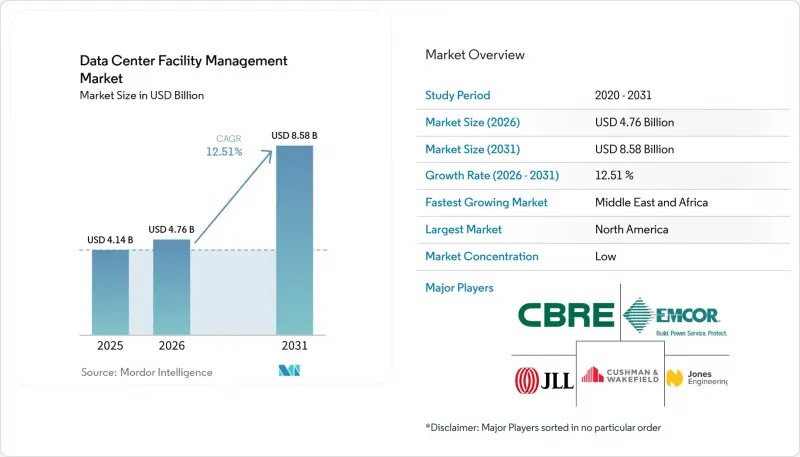
根據 Mordor Intelligence 預測,資料中心設施管理市場規模將從 2025 年的 41.4 億美元成長到 2026 年的 47.6 億美元,到 2031 年將達到 85.8 億美元,2026 年至 2031 年的年複合成長率(CAGR)為 12.51%。
全球資料中心設施管理市場趨勢與洞察
人工智慧工作負載密度的不斷增加,為現場操作帶來了複雜性。
隨著人工智慧系統推動機架密度和冷卻需求的不斷成長,資料中心設施管理市場面臨獨特的營運挑戰。到2026年,標準設施機架的功耗約為15kW,而人工智慧密集區域的功耗將達到300kW至600kW,將降低日常維護的可靠性,並凸顯持續狀態監測的重要性。預計新建設施將擴大採用液冷技術,從而增加冷卻液狀態檢查、洩漏檢測和熱交換器維護等任務。即使擁有風冷設施的經驗,不具備液冷能力的供應商也可能被排除在新廠計畫之外。此外,維護計劃必須與人工智慧訓練工作負載相匹配,因為任何中斷都可能影響客戶的營運。因此,能夠將工程洞察與即時設備數據相結合的供應商的價值將大大提升。
超大規模和託管園區運轉率的要求更加嚴格。
隨著對正常運作保障的需求日益成長,資料中心設施管理市場將從中受益,因為嚴格的維運支援至關重要。 Uptime Institute 發布的執行時間年報告指出,儘管整體停機時間有所改善,但仍有十分之一的停機事件會達到「嚴重」或「關鍵」等級。託管協議通常保證 99.99% 的月度電力可用性,這進一步增加了對高可靠性工程團隊的需求。超大規模客戶也正在從基於信用的補償模式轉向共用維運責任。擁有經獨立審計的運轉率記錄和平均修復時間 (MTTR) 證明的供應商將在合約續約時獲得競爭優勢。因此,在營運商評估風險時,與現場工程團隊建立長期合作關係可能與價格同等重要。
高昂的轉換成本和複雜的遷移流程會延緩外包決策。
在資料中心設施管理市場,運作中設施更換服務商時可能會出現延誤。遷移可能需要人員調動、CMMS(設施管理系統)遷移、存取權限核准以及並行運作。對於大規模園區而言,這個過程可能需要 6 到 18 個月,引發人們對成本和服務連續性的擔憂。現場人員和專有系統的存在,使得客戶難以管理服務商切換流程。因此,即使其他服務商提供更優惠的商業提案,現有服務商在合約續約時往往仍佔優勢。此外,目前自行管理設施的營運商可能會推遲首次外包嘗試。
細分市場分析
到2025年,關鍵基礎設施維護服務將佔總收入的38.12%,成為資料中心設施管理市場中最大的細分市場。這些服務包括對UPS系統、發電機、冷卻系統、高壓開關設備和配電設備的計劃內和響應式維護。這些資產需要人工干預,無法虛擬化。隨著人工智慧密度的提高,需要檢查的資產數量將會增加,而維護的可用性將會降低。 EN 50600-3-1:2026將維護、事件管理和變更管理定義為核心營運流程。
在資料中心設施管理產業,預計到2031年,數位化監控和最佳化服務將以17.94%的複合年成長率成長。這些服務將使營運模式從基於日曆的任務轉向基於狀態的維護。 2026年1月,Vertiv發布了“Next Predict”,該軟體具備跨電力、冷卻和IT系統的異常檢測功能。據Schneider Electric,用戶能夠將意外停機時間減少高達75%,並將營運成本降低20%。營運負責人表示,他們對感測器分析和預測性維護的信心高於對自主人工智慧應用的信心。
區域分析
到2025年,北美將佔全球營收的47.1%,並持續維持資料中心設施管理市場規模最大的區域貢獻。該地區成熟的超大規模和託管園區基礎設施支撐著設施合約交易的持續成長。大部分業務活動集中在美國,加拿大和墨西哥則提供了次要機會。以巴西和阿根廷為首的南美洲仍處於起步階段,但對超大規模和託管的投資正在為專業外包業務累積資產規模。
歐洲資料中心設施管理市場的需求正日益受到監管驅動。能源監控和報告要求正在擴展服務營運範圍,使其涵蓋審計、PUE最佳化和餘熱管理。根據執行時間 Institute預測,2026年業界平均PUE將達到1.52。這將催生對能源管理服務的需求。亞太地區的擴張主要由印度和澳洲推動,除了現有的一線城市外,區域性城市也湧現新的需求。
預計到2031年,中東和非洲地區的資料中心設施管理市場將以18.03%的複合年成長率成長,成為各地區中成長最快的市場。沙烏地阿拉伯的資料中心裝置容量在2026年第一季達到467兆瓦,高於2021年的68兆瓦。該國數位基礎設施總投資額達562億沙烏地里亞爾(約148.7億美元)。 2025年3月,仲量聯行(JLL)取得契約,負責管理Pure DC位於阿布達比亞斯島的45兆瓦資料中心園區的綜合設施營運。雖然沙烏地阿拉伯政府營運商正在組建內部團隊,但阿拉伯聯合大公國和非洲的多租戶營運商往往嚴重依賴外包。
其他好處:
- Excel格式的市場預測(ME)表
- 3個月的分析師支持
目錄
第1章:引言
- 研究假設和市場定義
- 調查範圍
第2章:調查方法
第3章執行摘要
第4章 市場狀況
- 市場概覽
- 市場促進因素
- 人工智慧工作負載密度的不斷增加,使得現場操作變得更加複雜。
- 超大規模和託管資料中心對運作的要求越來越高。
- 跨多個地點的標準化正在推動設施管理 (FM) 營運外包的普及。
- 關鍵任務工程師的短缺正在推動對託管服務的需求。
- 碳彙報和能源強度目標正在推動對專業設施管理服務的需求。
- 遠端監控和預測性管理提高了投資組合的可見性。
- 市場限制因素
- 高昂的轉換成本和複雜的實施流程正在延緩外包決策。
- 客戶方嚴格的安全和存取控制限制了供應商業務範圍的擴展。
- 超大規模設施中對內部營運人員的偏好限制了外包的比例。
- 合格技術人員短缺限制了服務品質和業務擴張。
- 宏觀經濟因素對市場的影響
- 產業供應鏈分析
- 科技趨勢
- 監理情勢
- 波特五力分析
第5章 市場規模與成長預測
- 按服務類型
- 關鍵設施營運服務
- 關鍵基礎設施的維護服務
- 試運行和運行準備服務
- 數位監控和最佳化服務
- 最終用戶
- 超大規模營運商
- 託管服務提供者
- 企業營運商
- 電信營運商
- 政府/國防
- 按地區
- 北美洲
- 美國
- 加拿大
- 墨西哥
- 南美洲
- 巴西
- 阿根廷
- 其他南美國家
- 歐洲
- 德國
- 英國
- 法國
- 俄羅斯
- 其他歐洲國家
- 亞太地區
- 中國
- 日本
- 印度
- 澳洲
- 其他亞太國家
- 中東和非洲
- 中東
- 沙烏地阿拉伯
- 阿拉伯聯合大公國
- 以色列
- 土耳其
- 其他中東國家
- 非洲
- 南非
- 奈及利亞
- 肯亞
- 其他非洲國家
- 中東
- 北美洲
第6章 競爭情勢
- 市場集中度
- 策略趨勢
- 市佔率分析
- 公司簡介
- CBRE Group, Inc.
- Jones Lang LaSalle Incorporated
- Jones Engineering
- BGIS
- RED Engineering
- Cushman and Wakefield plc
- ISS A/S
- Sodexo SA
- ENGIE SA
- Dalkia
- Mitie Group plc
- OCS Group
- EMCOR Group, Inc.
第7章 市場機會與未來展望
According to Mordor Intelligence, the data center facility management market size is projected to expand from USD 4.14 billion in 2025 to USD 4.76 billion in 2026, and to USD 8.58 billion by 2031, registering a CAGR of 12.51% between 2026 and 2031.
Global Data Center Facility Management Market Trends and Insights
Rising AI Workload Density Increases On-Site Operational Complexity
The Data Center Facility Management Market faces distinct operating requirements as AI systems increase rack densities and cooling demands. Standard facilities had racks near 15 kW, while AI-heavy zones ranged from 300 kW to 600 kW in 2026, making scheduled maintenance less dependable than continuous condition monitoring. New facilities are expected to use more liquid cooling, which adds work related to coolant condition, leak detection, and heat exchanger servicing. Providers without liquid-cooling capability may be excluded from new-build assignments despite their experience with air-cooled sites. Maintenance windows must also be planned around AI training workloads, where an interruption can affect client operations. This places greater value on providers that can combine engineering judgment with real-time equipment data.
Stricter Uptime Expectations Across Hyperscale and Colocation Campuses
The Data Center Facility Management Market benefits when uptime commitments require more rigorous operational support. The Uptime Institute reported in 2026 that 1 in 10 outages remained serious or severe, even as overall outage frequency improved. Colocation agreements commonly guarantee 99.99% monthly power availability, which increases the need for dependable engineering coverage. Hyperscale customers are also moving beyond credit-based remedies toward shared accountability for operations. Providers with independently audited uptime records and evidence of mean time to repair can strengthen their position at renewal. Longstanding on-site engineering relationships can therefore matter as much as price when operators assess risk.
High Switching Costs and Complex Mobilization Delay Outsourcing Decisions
The Data Center Facility Management Market can face delays when a live facility changes providers. A transition may require staff mobilization, CMMS migration, access approvals, and periods of parallel operation. On a large campus, this work can take 6 to 18 months and raise concerns about cost and service continuity. Embedded personnel and proprietary systems can make the replacement process harder for the client to manage. This often benefits an incumbent at renewal, even when another provider offers a stronger commercial proposal. It can also postpone first-time outsourcing by operators that currently manage facilities internally.
Other drivers and restraints analyzed in the detailed report include:
- Multi-Site Standardization Pushes Outsourced FM Adoption
- Talent Scarcity for Mission-Critical Engineers Supports Managed Services
- Stringent Client Security and Access Controls Limit Vendor Scope Expansion
For complete list of drivers and restraints, kindly check the Table Of Contents.
Segment Analysis
Critical Infrastructure Maintenance Services accounted for 38.12% of revenue in 2025, making it the largest segment of the Data Center Facility Management Market. The service includes planned and reactive work on UPS systems, generators, cooling equipment, high-voltage switchgear, and electrical distribution. These assets require physical intervention and cannot be virtualized. Higher AI density increases the number of assets requiring inspection and narrows maintenance windows. EN 50600-3-1:2026 identifies maintenance, incident management, and change management as core operating processes.
Digital Monitoring and Optimization Services is projected to expand at a 17.94% CAGR through 2031 in the Data Center Facility Management Industry. The service shifts work from calendar-based tasks to condition-based maintenance. Vertiv launched Next Predict in January 2026 with anomaly detection across power, cooling, and IT systems. Schneider Electric stated that users achieved reductions of up to 75% in unplanned downtime and 20% in operating expenditure. Operators reported greater trust in sensor analytics and predictive maintenance than in autonomous AI applications.
Complete Report Scope:
- By Service Type
- Critical Facility Operations Services (includes Includes energy management, sustainability, compliance, and risk management)
- Critical Infrastructure Maintenance Services
- Commissioning and Operational Readiness Services
- Digital Monitoring and Optimization Services
- By End User
- Hyperscale Operators (includes cloud services providers)
- Colocation Providers
- Enterprise Operators
- Telecom Operators
- Government and Defense
- By Geography
- North America
- United States
- Canada
- Mexico
- South America
- Brazil
- Argentina
- Rest of South America
- Europe
- Germany
- United Kingdom
- France
- Russia
- Rest of Europe
- Asia-Pacific
- China
- Japan
- India
- Australia
- Rest of Asia-Pacific
- Middle East and Africa
- Middle East
- Saudi Arabia
- United Arab Emirates
- Israel
- Turkey
- Rest of Middle East
- Africa
- South Africa
- Nigeria
- Kenya
- Rest of Africa
- Middle East
- North America
Geography Analysis
North America held 47.1% of global revenue in 2025 and remained the largest regional contributor to the Data Center Facility Management Market size. Its mature hyperscale and colocation campus base supports sustained volume in facilities contracts. The United States accounted for most activity, while Canada and Mexico provided secondary opportunities. South America, led by Brazil and Argentina, remained at an earlier stage, while hyperscale and colocation investments built asset scale for specialized outsourcing.
Europe has a regulatory-led demand profile within the Data Center Facility Management Market. Energy monitoring and reporting requirements are extending service work into auditing, PUE optimization, and waste-heat activities. The Uptime Institute reported an industry-wide average PUE of 1.52 in 2026. This creates demand for energy-management services. Asia-Pacific expansion is led by India and Australia, with secondary cities creating new requirements beyond established tier-1 locations.
The Middle East and Africa are projected to expand at an 18.03% CAGR through 2031, the highest regional rate in the Data Center Facility Management Market. Saudi Arabia's installed capacity reached 467 MW in Q1 2026, compared with 68 MW in 2021. National digital infrastructure commitments totaled SR 56.2 billion, or USD 14.87 billion. JLL received the integrated facilities appointment for Pure DC's 45 MW Yas Island campus in Abu Dhabi in March 2025. Saudi sovereign-backed operators are building internal teams, while UAE and African multi-tenant operators more often use external sourcing.
- CBRE Group, Inc.
- Jones Lang LaSalle Incorporated
- Jones Engineering
- BGIS
- RED Engineering
- Cushman and Wakefield plc
- ISS A/S
- Sodexo S.A.
- ENGIE SA
- Dalkia
- Mitie Group plc
- OCS Group
- EMCOR Group, Inc.
Additional Benefits:
- The market estimate (ME) sheet in Excel format
- 3 months of analyst support
TABLE OF CONTENTS
1 INTRODUCTION
- 1.1 Study Assumptions and Market Definition
- 1.2 Scope of the Study
2 RESEARCH METHODOLOGY
3 EXECUTIVE SUMMARY
4 MARKET LANDSCAPE
- 4.1 Market Overview
- 4.2 Market Drivers
- 4.2.1 Rising AI Workload Density Increases On-Site Operational Complexity
- 4.2.2 Stricter Uptime Expectations Across Hyperscale And Colocation Campuses
- 4.2.3 Multi-Site Standardization Pushes Outsourced FM Adoption
- 4.2.4 Talent Scarcity For Mission-Critical Engineers Supports Managed Services
- 4.2.5 Carbon Reporting And Energy Intensity Targets Elevate Specialist FM Demand
- 4.2.6 Remote Monitoring And Predictive Operations Improve Portfolio Visibility
- 4.3 Market Restraints
- 4.3.1 High Switching Costs And Complex Mobilization Delay Outsourcing Decisions
- 4.3.2 Stringent Client Security And Access Controls Limit Vendor Scope Expansion
- 4.3.3 In-House Operator Preference In Hyperscale Facilities Caps Outsourced Share
- 4.3.4 Shortage Of Qualified Technicians Constrains Service Quality And Expansion
- 4.4 Impact of Macroeconomic Factors on the Market
- 4.5 Industry Supply-Chain Analysis
- 4.6 Technology Outlook
- 4.7 Regulatory Landscape
- 4.8 Porter's Five Forces Analysis
- 4.8.1 Threat of New Entrants
- 4.8.2 Bargaining Power of Suppliers
- 4.8.3 Bargaining Power of Buyers
- 4.8.4 Threat of Substitutes
- 4.8.5 Intensity of Competitive Rivalry
5 MARKET SIZE AND GROWTH FORECASTS (Value)
- 5.1 By Service Type
- 5.1.1 Critical Facility Operations Services (includes Includes energy management, sustainability, compliance, and risk management)
- 5.1.2 Critical Infrastructure Maintenance Services
- 5.1.3 Commissioning and Operational Readiness Services
- 5.1.4 Digital Monitoring and Optimization Services
- 5.2 By End User
- 5.2.1 Hyperscale Operators (includes cloud services providers)
- 5.2.2 Colocation Providers
- 5.2.3 Enterprise Operators
- 5.2.4 Telecom Operators
- 5.2.5 Government and Defense
- 5.3 By Geography
- 5.3.1 North America
- 5.3.1.1 United States
- 5.3.1.2 Canada
- 5.3.1.3 Mexico
- 5.3.2 South America
- 5.3.2.1 Brazil
- 5.3.2.2 Argentina
- 5.3.2.3 Rest of South America
- 5.3.3 Europe
- 5.3.3.1 Germany
- 5.3.3.2 United Kingdom
- 5.3.3.3 France
- 5.3.3.4 Russia
- 5.3.3.5 Rest of Europe
- 5.3.4 Asia-Pacific
- 5.3.4.1 China
- 5.3.4.2 Japan
- 5.3.4.3 India
- 5.3.4.4 Australia
- 5.3.4.5 Rest of Asia-Pacific
- 5.3.5 Middle East and Africa
- 5.3.5.1 Middle East
- 5.3.5.1.1 Saudi Arabia
- 5.3.5.1.2 United Arab Emirates
- 5.3.5.1.3 Israel
- 5.3.5.1.4 Turkey
- 5.3.5.1.5 Rest of Middle East
- 5.3.5.2 Africa
- 5.3.5.2.1 South Africa
- 5.3.5.2.2 Nigeria
- 5.3.5.2.3 Kenya
- 5.3.5.2.4 Rest of Africa
- 5.3.5.1 Middle East
- 5.3.1 North America
6 COMPETITIVE LANDSCAPE
- 6.1 Market Concentration
- 6.2 Strategic Moves
- 6.3 Market Share Analysis
- 6.4 Company Profiles (includes Global Level Overview, Market Level Overview, Core Segments, Financials as available, Strategic Information, Market Rank/Share, Products and Services, Recent Developments)
- 6.4.1 CBRE Group, Inc.
- 6.4.2 Jones Lang LaSalle Incorporated
- 6.4.3 Jones Engineering
- 6.4.4 BGIS
- 6.4.5 RED Engineering
- 6.4.6 Cushman and Wakefield plc
- 6.4.7 ISS A/S
- 6.4.8 Sodexo S.A.
- 6.4.9 ENGIE SA
- 6.4.10 Dalkia
- 6.4.11 Mitie Group plc
- 6.4.12 OCS Group
- 6.4.13 EMCOR Group, Inc.
7 MARKET OPPORTUNITIES AND FUTURE OUTLOOK
- 7.1 White-Space and Unmet-Need Assessment

 設施管理系統市場報告:趨勢、預測與競爭分析(至2035年)設施管理軟體工具市場報告:趨勢、預測和競爭分析(至2035年)
 醫療設施管理軟體市場:全球市場預測,2026-2032年
 整合性機構管理市場規模、佔有率和趨勢分析報告:按服務類型、企業規模、最終用途、地區和細分市場預測(2026-2035 年)
 2026-2030年全球設施管理市場
 設施管理(FM)軟體:市場佔有率分析、行業趨勢和統計數據以及成長預測(2026-2031 年)北美設施管理:市場佔有率分析、產業趨勢與統計、成長預測(2026-2031 年)亞太地區硬設施管理:市場佔有率分析、產業趨勢與統計及成長預測(2026-2031)硬設施管理:市場佔有率分析、產業趨勢與統計、成長預測(2026-2031 年)日本設施管理:市場佔有率分析、產業趨勢與統計及成長預測(2026-2031)