


 |
市場調查報告書
商品編碼
2163369
亞太地區工業壓平機:市佔率分析、產業趨勢與統計及成長預測(2026-2031)Asia-Pacific Industrial Press Machines - Market Share Analysis, Industry Trends & Statistics, Growth Forecasts (2026 - 2031) |
||||||

※ 本網頁內容可能與最新版本有所差異。詳細情況請與我們聯繫。
根據 Mordor Intelligence 預測,亞太地區工業壓平機市場規模預計在 2025 年達到 85.6 億美元,2026 年達到 90.6 億美元,到 2031 年達到 123.5 億美元,2026 年至 2031 年的複合年成長率為 6.39%。
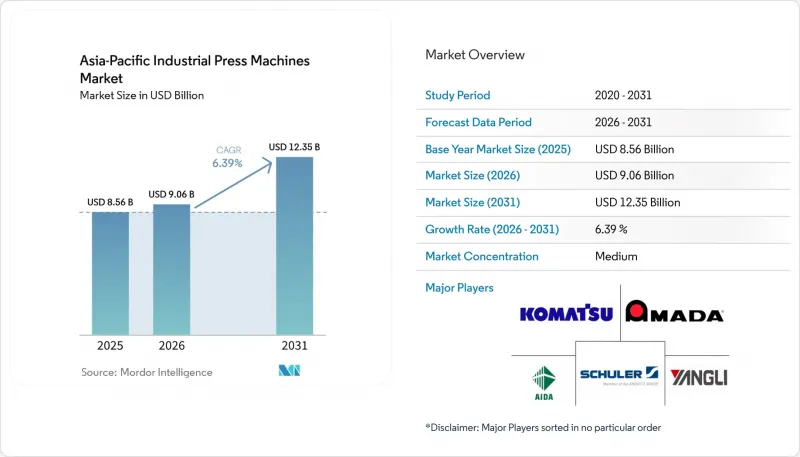
亞太地區工業壓平機市場的趨勢與見解。
擴大在中國、印度和東南亞的生產能力
2025年9月,中國發布了《2025-2026年機械工業穩定成長規劃》。該規劃設定了機械產業營業收入超過10兆元人民幣(約1.4兆美元)和年均複合成長率超過3.5%的目標。規劃還包括設備現代化和工業主控技術的目標。這些措施將支持中國製造群內壓力機、鍛造設備和液壓設備的採購。印度2026-2027會計年度的預算提案包括122兆盧比(約1400.2億美元)的公共資本支出,而2025會計年度印度對機械設備的私人投資增加了6%。根據印度的生產連結獎勵計畫計劃,新建廠通常需要在投資決策後的12至24個月內配備大噸位壓力機生產線。泰國、越南和印尼正在擴大汽車和電子產品的專用生產能力,這使得亞太地區的工業壓平機市場不再局限於傳統市場。
電氣化和電池組件製造
在電池生產中,壓機設備用於電極壓縮、電池外殼成型和模組組裝。如此廣泛的應用使得能夠提供電池級成型設備的供應商擁有顯著優勢。 2025年6月,寧德時代(CATL)與印尼電池公司(Indonesia Battery Corporation)在西爪哇省卡拉旺啟動了一項價值59億美元的電池整合計畫。該計畫一期目標是在2026年底前實現6.9吉瓦時的產能。同年6月,馬來西亞在檳城開設了東協地區首個商業化鋰離子電池隔膜生產廠,投資金額達32億馬幣(約7.6億美元)。 2025年6月,愛達工程(AIDA Engineering)推出了用於圓柱形電池外殼的「DIS Former」成型機。該機器以每分鐘90次沖程的速度提供15,380焦耳的連續工作能量。這些項目表明,電池供應鏈是亞太地區工業壓平機市場的重要需求來源。
高昂的資本投資成本和較長的投資回收期
大型伺服沖壓生產線,包括自動化、模具和整合,可能需要超過500萬美元的資本投資。對於東南亞和南亞的中型製造商而言,這筆費用難以資金籌措。由於大型設備採購通常以5至7年的投資回收期為基礎進行估值,因此在需求前景不明朗的情況下,決策可能會被推遲。在印度,2025-2026會計年度留存收益佔資本投資資金籌措的65.35%,這限制了中小企業在重型機械方面的支出。租賃和付費使用制等方案可以擴大小規模沖壓企業的設備取得管道。在資金籌措變得更加便利之前,購置成本很可能仍將是亞太地區部分工業壓平機市場採用先進系統的限制因素。
細分市場分析
截至2025年,傳統機械壓力機佔總銷售量的35.3%。由於其購置成本低、操作簡便且適用於大規模生產,傳統機械壓力機在中國汽車和家電產業集群中仍被廣泛應用。液壓壓平機在需要長行程、可控壓力的應用中仍然發揮著至關重要的作用。它們被用於深拉延、複合材料壓縮和重型鍛造等工藝,這些工藝是印度工程基礎的基石。氣壓壓平機則用於電子產品組裝和小噸位輕型加工。
預計從2026年到2031年,伺服機械壓力機的複合年成長率將達到9.6%。 「其他」和混合型壓力機結合了伺服驅動滑桿和液壓力放大功能,以滿足既需要力控制又需要頻繁循環操作的任務。在2025年東京機械製造展(MF-Tokyo 2025)上,SEYI展示了一款用於成型超薄金屬雙極板的160噸整體框架伺服壓力機。 SEYI的SD1和SNS2壓力機基於符合ISO 14001標準的項目,於2025年獲得了能源效率「金標」認證。在亞太工業壓平機市場,預計下一波伺服壓力機用戶將包括中國、印度和東南亞國協的二、三線供應商,他們將以伺服壓力機取代傳統的機械壓平機。
至2025年,101-500噸級壓力機將佔亞太地區工業壓平機市場規模的33.4%。這一地位得益於其在汽車車身面板、家用電器機殼和小型商業產品製造領域的廣泛應用。 100噸以下的壓平機應用於電子、醫療設備和精密五金等領域。由於電子產品生產的擴張,越南和馬來西亞對該噸級壓力機的需求呈現穩定成長。 501-1000噸級壓力機用於加工中型汽車結構件,而1001-2000噸級壓力機則用於加工較重型的汽車和工業機械部件。
預計到2031年,噸位超過2000噸的壓平機將以7%的複合年成長率成長。大型一體成型汽車零件和高抗張強度鋼電池機殼的需求不斷成長,推動了對這類設備的需求。 2025年2月,亞東3,500噸壓平機在每分鐘8-30次沖程的速度下,工作台定位精度達到±0.05毫米。此次交付表明,中國製造商能夠提供滿足日本一級供應商要求的超大型壓平機。隨著巨型鑄造技術的普及,亞太地區工業壓平機市場對501-2000噸汽車壓力機的需求在預測期後半段可能會放緩。
其他好處:
- Excel格式的市場預測(ME)表
- 3個月的分析師支持
目錄
第1章:引言
- 研究假設和市場定義
- 調查範圍
第2章:調查方法
第3章執行摘要
第4章 市場狀況
- 市場概覽
- 市場促進因素
- 擴大在中國、印度和東南亞的生產能力
- 電氣化和電池組件製造
- 對自動化、高精度和能源效率的需求。
- 汽車輕量化與電動車平台轉型
- 電子產品和契約製造供應鏈的在地化
- 對現有機械壓力設備進行維修的需求。
- 市場限制因素
- 資金成本高,投資回收期長
- 熟練的服務和應用工程師短缺
- 對進口零件的依賴以及外匯波動
- 老式印刷機的修改介面標準化程度有限。
- 價值和供應鏈分析
- 結構部件、框架、鑄件
- 機械驅動裝置、液壓系統、馬達及控制系統
- 壓床的製造和組裝
- 模具和夾俱生態系統
- 自動化和沖壓線整合
- 配送、安裝和試運行
- 售後市場、備件、再製造及改裝服務。
- 監理情勢
- 機器和功能安全要求
- 印刷機防護裝置及工人安全要求
- 能源效率和環境要求
- 機械設備的區域標準和認證
- 有關出口、進口和貿易的法規
- 技術展望
- 伺服驅動機械壓力機技術
- 先進的液壓機技術
- 混合式和高效能驅動系統
- 自動化沖壓生產線和機器人物料輸送
- 利用感測器封閉回路型過程控制
- 互聯媒體和工業IoT
- 預測性維護和狀態監測
- 成型仿真與數位孿生
- 人工智慧驅動的流程和品質最佳化
- 工業和製造業趨勢
- 向靈活、高混合生產模式轉型
- 壓平機與自動化生產單元的整合
- 對先進材料成型製程的需求日益成長
- 印刷機製造的本地化和區域化
- 永續性和能源效率趨勢
- 地緣政治和貿易趨勢的影響
- 關稅和進口限制
- 關鍵部件供應鏈中斷
- 設備和零件製造的本地化
第5章 市場規模及成長預測(以金額為準;如有數量數據,亦會列出)
- 透過驅動/操作技術
- 傳統機械壓力機
- 伺服驅動機械壓力機
- 油壓機
- 氣壓壓力機
- 其他和混合型印刷機
- 壓力/按產能
- 不到100噸
- 101-500噸
- 501至1000噸
- 1001-2000噸
- 超過2000噸
- 透過申請/流程
- 壓制、沖壓、沖孔
- 深拉延和鈑金成形
- 鍛造
- 正畸和一般矯正
- 壓縮成型
- 粉末成型
- 組裝、壓入配合、連接
- 其他新聞申請
- 按最終用途行業分類
- 汽車和運輸業
- 航太/國防
- 工業機械和設備
- 電氣和電子設備
- 家用電器耐用消費品
- 建築和重型機械
- 能源和電力設備
- 金屬製品及一般製造業
- 醫療和精密製造
- 其他終端用戶產業
- 按地區
- 中國
- 日本
- 印度
- 韓國
- 東協(新加坡、馬來西亞、印尼、泰國、越南、菲律賓、緬甸、柬埔寨、寮國、汶萊)
- 澳洲
- 其他亞太國家
第6章 競爭情勢
- 市場集中度
- 策略趨勢
- 市佔率分析
- 公司簡介
- AIDA ENGINEERING, LTD.
- Komatsu Ltd.
- Schuler AG
- Yangli Group
- AMADA CO., LTD.
- Sumitomo Heavy Industries, Ltd.
- Chin Fong Machine Industrial Co., Ltd.
- SEYI Precision Machinery Co., Ltd.
- Hefei Metalforming Intelligent Manufacturing Co., Ltd.
- JIER Machine-Tool Group Co., Ltd.
- Chongqing Jiangdong Machinery Co., Ltd.
- LIEN CHIEH HYDRAULIC INDUSTRIAL CO., LTD.
- Taitian Machinery
- Jingda Machine(Ningbo)Co., Ltd.
- Nantong Guosheng Intelligence Technology Group Co., Ltd.
- Haco Group
- Prima Industrie SpA
- TOX PRESSOTECHNIK GmbH & Co. KG
- Kistler Group
- Bosch Rexroth AG
第7章 市場機會與未來展望
According to Mordor Intelligence, the Asia-Pacific industrial press machines market size is projected to be USD 8.56 billion in 2025, USD 9.06 billion in 2026, and reach USD 12.35 billion by 2031, growing at a CAGR of 6.39% from 2026 to 2031.
Asia-Pacific Industrial Press Machines Market Trends and Insights
Manufacturing Capacity Expansion in China, India, and Southeast Asia
China issued the Machinery Industry Stable Growth Plan for 2025 and 2026 in September 2025. The plan targets machinery-sector operating revenue above CNY 10 trillion (USD 1.4 trillion), and average annual growth above 3.5%. It also includes equipment renewal and industrial mother-machine technology goals. These measures support the procurement of stamping, forging, and hydraulic equipment within Chinese manufacturing clusters. India's FY 2026-27 budget proposed INR 12.2 lakh crore (USD 140.02 billion) in public capital outlay, while private investment in machinery and equipment expanded 6% in FY2025. New factories under India's production-linked incentive programs commonly need high-tonnage press lines 12 to 24 months after an investment commitment. Thailand, Vietnam, and Indonesia are adding specialized automotive and electronics capacity, which broadens the Asia-Pacific industrial press machines market beyond its established bases.
Electrification and Battery Component Manufacturing
Battery production uses press equipment in electrode compaction, cell-case forming, and module assembly. This range of uses favors suppliers that can provide equipment for battery-grade forming tasks. CATL and Indonesia Battery Corporation began a USD 5.9 billion battery integration project in Karawang, West Java, in June 2025. Its first phase targets 6.9 GWh of capacity by late 2026. Malaysia opened the ASEAN region's first commercial lithium-ion battery separator facility in Penang in June 2025, supported by an RM 3.2 billion investment, equivalent to USD 760 million. AIDA Engineering launched the DIS Former in June 2025 for cylindrical storage battery cases, with 15,380 joules of continuous working energy at 90 strokes per minute. These projects make battery supply chains a distinct source of demand for the Asia-Pacific industrial press machines market.
High Capital Cost and Long Payback Periods
Large-tonnage servo press lines can require capital commitments above USD 5 million when automation, tooling, and integration are included. This cost is difficult for mid-tier fabricators in Southeast Asia and South Asia to finance. Major equipment purchases are commonly assessed against 5 to 7-year payback periods, which can delay decisions where demand visibility is limited. Internal accruals represented 65.35% of total capital-expenditure financing in India during 2025-26, limiting heavy-equipment spending by smaller companies. Leasing and pay-per-use options could widen access to equipment for smaller stamping firms. Until financing becomes more accessible, acquisition cost will restrain adoption of advanced systems in parts of the Asia-Pacific industrial press machines market.
Other drivers and restraints analyzed in the detailed report include:
- Automation, Precision, and Energy-Efficiency Requirements
- Automotive Lightweighting and Electric Vehicle Platform Changes
- Skilled-Service and Application-Engineering Shortages
For complete list of drivers and restraints, kindly check the Table Of Contents.
Segment Analysis
Conventional mechanical presses held 35.3% of revenue in 2025. Their lower purchase cost, simple operation, and fit with high-volume stamping underpin continued use in China's automotive and appliance clusters. Hydraulic presses remain important where controlled force is needed over a long stroke. They are used in deep drawing, composite compression, and heavy forging applications that support India's engineering base. Pneumatic presses serve electronics assembly and light fabrication at lower tonnage levels.
Servo-mechanical presses are forecast to grow at a 9.6% CAGR from 2026 to 2031. Other and hybrid presses combine servo-driven slides with hydraulic force amplification for tasks that need both force control and frequent cycling. SEYI demonstrated a 160-ton solid-frame servo press for ultra-thin metallic bipolar plate forming at MF-Tokyo 2025. SEYI's SD1 and SNS2 presses received energy-conservation Gold Label certification in 2025 under a program aligned with ISO 14001. The next group of servo buyers in the Asia-Pacific industrial press machines market is likely to include second- and third-tier suppliers in China, India, and ASEAN that are replacing mechanical fleets.
The 101-500-ton category held 33.4% of the Asia-Pacific industrial press machines market size in 2025. Its broad use in automotive body panels, appliance shells, and light commercial fabrication supports that position. Presses up to 100 tons serve electronics, medical devices, and precision hardware. This range is gaining steady demand in Vietnam and Malaysia as electronics production expands. The 501-1,000-ton range serves mid-tier automotive structural components, while the 1,001-2,000-ton range handles heavier vehicle and industrial machinery parts.
Presses above 2,000 tons are projected to grow at a 7% CAGR through 2031. Larger monolithic vehicle parts and high-strength steel battery enclosures are increasing the demand for this equipment. Yadon's 3,500-ton press achieved +-0.05 mm worktable positioning accuracy at 8 to 30 strokes per minute in February 2025. The delivery showed that Chinese manufacturers can supply ultra-large presses that meet Japanese Tier 1 requirements. Gigacasting could moderate demand for 501-2,000-ton automotive stamping equipment in the Asia-Pacific industrial press machines market later in the forecast period.
Complete Report Scope:
- By Drive / Actuation Technology
- Conventional Mechanical Presses
- Servo-Mechanical Presses
- Hydraulic Presses
- Pneumatic Presses
- Other and Hybrid Presses
- By Press Force / Capacity
- Up to 100 Tons
- 101-500 Tons
- 501-1,000 Tons
- 1,001-2,000 Tons
- Above 2,000 Tons
- By Application / Process
- Stamping, Blanking and Punching
- Deep Drawing and Sheet Forming
- Forging
- Straightening and General Forming
- Compression Molding
- Powder Compaction
- Assembly, Press-Fitting and Joining
- Other Press Applications
- By End-Use Industry
- Automotive and Transportation
- Aerospace and Defense
- Industrial Machinery and Equipment
- Electrical and Electronics
- Appliances and Consumer Durables
- Construction and Heavy Equipment
- Energy and Power Equipment
- Metal Products and General Manufacturing
- Medical and Precision Manufacturing
- Other End-Use Industries
- By Geography
- China
- Japan
- India
- South Korea
- ASEAN(Singapore, Malaysia, Indonesia, Thailand, Vietnam, Philippines, Myanmar, Cambodia, Laos, Brunei)
- Australia
- Rest of Asia-Pacific
List of Companies Covered in this Report:
- AIDA ENGINEERING, LTD.
- Komatsu Ltd.
- Schuler AG
- Yangli Group
- AMADA CO., LTD.
- Sumitomo Heavy Industries, Ltd.
- Chin Fong Machine Industrial Co., Ltd.
- SEYI Precision Machinery Co., Ltd.
- Hefei Metalforming Intelligent Manufacturing Co., Ltd.
- JIER Machine-Tool Group Co., Ltd.
- Chongqing Jiangdong Machinery Co., Ltd.
- LIEN CHIEH HYDRAULIC INDUSTRIAL CO., LTD.
- Taitian Machinery
- Jingda Machine (Ningbo) Co., Ltd.
- Nantong Guosheng Intelligence Technology Group Co., Ltd.
- Haco Group
- Prima Industrie S.p.A.
- TOX PRESSOTECHNIK GmbH & Co. KG
- Kistler Group
- Bosch Rexroth AG
Additional Benefits:
- The market estimate (ME) sheet in Excel format
- 3 months of analyst support
TABLE OF CONTENTS
1 Introduction
- 1.1 Study Assumptions and Market Definition
- 1.2 Scope of the Study
2 Research Methodology
3 Executive Summary
4 Market Landscape
- 4.1 Market Overview
- 4.2 Market Drivers
- 4.2.1 Manufacturing Capacity Expansion in China, India, and Southeast Asia
- 4.2.2 Electrification and Battery Component Manufacturing
- 4.2.3 Automation, Precision, and Energy-Efficiency Requirements
- 4.2.4 Automotive Lightweighting and Electric Vehicle Platform Changes
- 4.2.5 Regionalization of Electronics and Contract Manufacturing Supply Chains
- 4.2.6 Retrofit Demand from Installed Mechanical Press Bases
- 4.3 Market Restraints
- 4.3.1 High Capital Cost and Long Payback Periods
- 4.3.2 Skilled-Service and Application-Engineering Shortages
- 4.3.3 Imported Component Dependence and Currency Volatility
- 4.3.4 Limited Standardization of Retrofit Interfaces Across Legacy Presses
- 4.4 Value and Supply-Chain Analysis
- 4.4.1 Structural Components, Frames and Castings
- 4.4.2 Mechanical Drive, Hydraulic, Motor and Control Systems
- 4.4.3 Press Machine Manufacturing and Assembly
- 4.4.4 Tooling and Die Ecosystem
- 4.4.5 Automation and Press-Line Integration
- 4.4.6 Distribution, Installation and Commissioning
- 4.4.7 Aftermarket, Spare Parts, Rebuild and Retrofit Services
- 4.5 Regulatory Landscape
- 4.5.1 Machinery and Functional Safety Requirements
- 4.5.2 Press Guarding and Operator Safety Requirements
- 4.5.3 Energy Efficiency and Environmental Requirements
- 4.5.4 Regional Machinery Standards and Certifications
- 4.5.5 Import, Export and Trade Regulations
- 4.6 Technological Outlook
- 4.6.1 Servo-Mechanical Press Technologies
- 4.6.2 Advanced Hydraulic Press Technologies
- 4.6.3 Hybrid and Energy-Efficient Drive Systems
- 4.6.4 Automated Press Lines and Robotic Material Handling
- 4.6.5 Sensor-Based and Closed-Loop Process Control
- 4.6.6 Connected Presses and Industrial IoT
- 4.6.7 Predictive Maintenance and Condition Monitoring
- 4.6.8 Forming Simulation and Digital Twins
- 4.6.9 AI-Based Process and Quality Optimization
- 4.7 Industry and Manufacturing Trends
- 4.7.1 Shift Toward Flexible and High-Mix Production
- 4.7.2 Integration of Presses with Automated Manufacturing Cells
- 4.7.3 Increasing Demand for Advanced Material Forming
- 4.7.4 Localization and Regionalization of Press Manufacturing
- 4.7.5 Sustainability and Energy-Efficiency Trends
- 4.8 Impact of Geopolitical and Trade Developments
- 4.8.1 Tariffs and Import Restrictions
- 4.8.2 Supply-Chain Disruptions for Critical Components
- 4.8.3 Localization of Equipment and Component Manufacturing
5 Market Size & Growth Forecasts (value; with volume where available)
- 5.1 By Drive / Actuation Technology
- 5.1.1 Conventional Mechanical Presses
- 5.1.2 Servo-Mechanical Presses
- 5.1.3 Hydraulic Presses
- 5.1.4 Pneumatic Presses
- 5.1.5 Other and Hybrid Presses
- 5.2 By Press Force / Capacity
- 5.2.1 Up to 100 Tons
- 5.2.2 101-500 Tons
- 5.2.3 501-1,000 Tons
- 5.2.4 1,001-2,000 Tons
- 5.2.5 Above 2,000 Tons
- 5.3 By Application / Process
- 5.3.1 Stamping, Blanking and Punching
- 5.3.2 Deep Drawing and Sheet Forming
- 5.3.3 Forging
- 5.3.4 Straightening and General Forming
- 5.3.5 Compression Molding
- 5.3.6 Powder Compaction
- 5.3.7 Assembly, Press-Fitting and Joining
- 5.3.8 Other Press Applications
- 5.4 By End-Use Industry
- 5.4.1 Automotive and Transportation
- 5.4.2 Aerospace and Defense
- 5.4.3 Industrial Machinery and Equipment
- 5.4.4 Electrical and Electronics
- 5.4.5 Appliances and Consumer Durables
- 5.4.6 Construction and Heavy Equipment
- 5.4.7 Energy and Power Equipment
- 5.4.8 Metal Products and General Manufacturing
- 5.4.9 Medical and Precision Manufacturing
- 5.4.10 Other End-Use Industries
- 5.5 By Geography
- 5.5.1 China
- 5.5.2 Japan
- 5.5.3 India
- 5.5.4 South Korea
- 5.5.5 ASEAN(Singapore, Malaysia, Indonesia, Thailand, Vietnam, Philippines, Myanmar, Cambodia, Laos, Brunei)
- 5.5.6 Australia
- 5.5.7 Rest of Asia-Pacific
6 Competitive Landscape
- 6.1 Market Concentration
- 6.2 Strategic Moves
- 6.3 Market Share Analysis
- 6.4 Company Profiles (Includes Global Level Overview, Market Level Overview, Core Segments, Financials as Available, Strategic Information, Products and Services, Recent Developments)
- 6.4.1 AIDA ENGINEERING, LTD.
- 6.4.2 Komatsu Ltd.
- 6.4.3 Schuler AG
- 6.4.4 Yangli Group
- 6.4.5 AMADA CO., LTD.
- 6.4.6 Sumitomo Heavy Industries, Ltd.
- 6.4.7 Chin Fong Machine Industrial Co., Ltd.
- 6.4.8 SEYI Precision Machinery Co., Ltd.
- 6.4.9 Hefei Metalforming Intelligent Manufacturing Co., Ltd.
- 6.4.10 JIER Machine-Tool Group Co., Ltd.
- 6.4.11 Chongqing Jiangdong Machinery Co., Ltd.
- 6.4.12 LIEN CHIEH HYDRAULIC INDUSTRIAL CO., LTD.
- 6.4.13 Taitian Machinery
- 6.4.14 Jingda Machine (Ningbo) Co., Ltd.
- 6.4.15 Nantong Guosheng Intelligence Technology Group Co., Ltd.
- 6.4.16 Haco Group
- 6.4.17 Prima Industrie S.p.A.
- 6.4.18 TOX PRESSOTECHNIK GmbH & Co. KG
- 6.4.19 Kistler Group
- 6.4.20 Bosch Rexroth AG
7 Market Opportunities & Future Outlook
- 7.1 White-Space and Unmet-Need Assessment
- 7.1.1 Affordable Servo-Hydraulic Retrofits for Small and Mid-Sized Manufacturers
- 7.1.2 Localized Aftermarket Parts and Service Networks
- 7.1.3 Battery-Grade Forming and Compression Equipment
- 7.1.4 Low-Carbon Press Manufacturing and Energy Monitoring
- 7.1.5 Flexible Press Lines for High-Mix, Low-Volume Production
- 7.1.6 Composite and Lightweight-Material Forming Systems

 壓縮機市場:全球市場預測,2026-2032年冷擠壓與雙作用液壓機市場:全球市場預測,2026-2032年壓平機市場:全球市場預測,2026-2032年
 美國液壓機:市場佔有率分析、行業趨勢和統計數據、成長預測(2026-2031)越南液壓機市場:市場佔有率分析、產業趨勢與統計及成長預測(2026-2031)北美液壓機市場:市佔率分析、產業趨勢與統計及成長預測(2026-2031 年)日本液壓機市場:市場佔有率分析、產業趨勢與統計、成長預測(2026-2031)歐洲液壓機:市場佔有率分析、產業趨勢與統計、成長預測(2026-2031)液壓機:市佔率分析、產業趨勢與統計、成長預測(2026-2031)
 2026-2030年全球液壓壓平機市場