


 |
市場調查報告書
商品編碼
2157064
北美液壓機市場:市佔率分析、產業趨勢與統計及成長預測(2026-2031 年)North America Hydraulic Presses - Market Share Analysis, Industry Trends & Statistics, Growth Forecasts (2026 - 2031) |
||||||

※ 本網頁內容可能與最新版本有所差異。詳細情況請與我們聯繫。
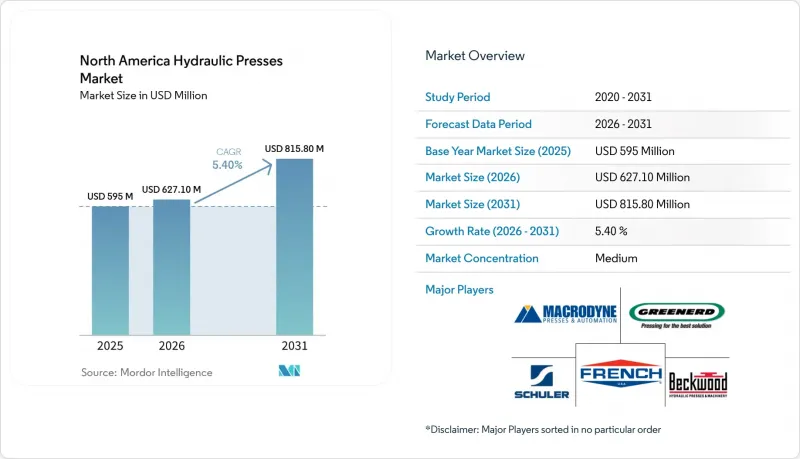
據 Mordor Intelligence 稱,2025 年北美液壓機市值為 5.95 億美元,預計到 2031 年將達到 8.158 億美元,而 2026 年為 6.271 億美元,預測期(2026-2031 年)的複合年成長率為 5.40%。
北美液壓機市場趨勢與洞察
汽車輕量化和先進材料的成型
北美液壓機市場正受惠於汽車產業在車身結構和電池系統中大量採用鋁、高抗張強度鋼及其他材料的項目。例如,電池托盤、側樑和碰撞安全部件在成型過程中需要精確控制壓力和保壓時間。據諾貝麗斯公司稱,與同等鋼製設計相比,鋁製電池托盤的重量可減輕高達 50%,單位能量密度可提高 30%。液壓系統可透過控制滑塊速度、全行程噸位和保壓時間來滿足這些要求。位於密西根州、安大略省和科阿韋拉州的 Tier 1 和 Tier 2 供應商正在升級老舊的生產線,以加工強度高達 1200 MPa 的先進高抗張強度鋼。因此,北美液壓機市場對規格的要求越來越高,需要電池組工程師和沖壓廠模具團隊更深入參與,從而導致更長的交貨週期和更高的設備要求。
將生產活動轉移回國內並擴大國內生產能力
對新建工廠的投資正在推動北美生產基地對成型設備的需求。根據「回流計劃」報告,63%的受訪目的地設備製造商(OEM)計劃在2026年或2027年投資美國,以實現生產回流或擴大國內生產規模。舉措宣佈在北卡羅來納州克納斯維爾新建一家挖土機工廠,投資額達7,000萬美元,這是其未來十年200億美元美國製造業投資計畫的一部分。為不斷擴張的OEM廠商提供設備的契約製造(CMO)可能需要在最終車輛或設備的大規模生產開始之前確保沖壓產能。這一趨勢使得新建工廠建設計畫成為北美液壓機市場的重點,甚至在設備訂單下達之前就已經如此。這也支撐了對用於結構沖壓和鍛造生產線的H型框架和四柱系統的需求。
設備初始投資高,投資回收期長。
高昂的資本需求會限制中小型製造商的採購。客製化的高噸位系統,包括自動化、模具和安裝,需要數百萬美元的投資,投資回收期長達七到十二年。美國國家標準與技術研究院 (NIST) 已將資本成本和設備投資回收期的可預測性列為美國製造商面臨的重大競爭阻礙因素。如果買家無法為新生產線找到操作人員和維修人員,人員配備問題會進一步加劇這一困境。雖然租賃、收費和政府設備融資可以降低初始准入門檻,但對於許多中型企業而言,這些方式的應用仍然有限。因此,儘管北美液壓機市場擁有充足的項目儲備,但一些計劃中的投資可能需要一段時間才能轉化為實際訂單。
細分市場分析
2025年,H型框架和直邊式液壓機佔據了北美液壓機市場48%的佔有率。這些液壓機採用滑塊導向結構,即使在偏心負荷下也能輕鬆保持平行度。因此,這種結構適用於對尺寸一致性要求較高的汽車沖壓件和航太結構件的大批量生產。 2026年1月,安德里茨·舒勒公司推出了「HFA plus+」系列精密沖裁機,其額定載重範圍為3,200至15,500 kN,並採用伺服控制液壓幫浦驅動。據該公司稱,這種新型驅動系統可實現兩位數的能源效率提升。此外,H型框架結構的大尺寸設計延長了設備的使用壽命,維修和控制系統升級更加經濟。
C型框架和間隙框架壓力機是成長最快的配置,預計2026年至2031年的複合年成長率將達到8.2%。它們的開放式喉部設計允許三向進料,並可容納手動或機器人裝載的生產單元。其面積小,使其適用於電子、醫療設備和小批量汽車零件供應商的工廠。電池單元組件組裝、連接器鉚接和感測器外殼成型等應用領域對20-150噸級C型框架壓力機的需求不斷成長。四柱和雙柱配置在複合材料成型、粉末成型和橡膠成型中繼續發揮至關重要的作用。桌上型壓力機用於研究和原型製作,而專用系統則滿足航太領域的等溫成型和超塑性成型需求。
到2025年,101-500噸級液壓機將佔該細分市場銷售額的48.3%。此噸位範圍涵蓋鈑金沖壓、深拉延、折彎和一般製造流程。它能夠處理汽車行業一級和二級供應商常用的多種鋁材和先進高抗張強度鋼應用。此噸位範圍已成為北美液壓機市場新建生產線的通用規格。美國本土製造商和歐洲系統整合商均提供此噸位範圍的設備,這不僅保持了市場競爭的活躍性,也使價格相對透明。廣泛的基本客群有助於穩定市場需求,即使某個終端用戶行業的需求放緩。
噸超過2000噸的壓力機是噸位成長最快的細分市場,預計到2031年複合年成長率將達到6.8%。航太和國防客戶正在使用這些系統一次性成型大型鈦和鋁結構。這種方法可以減少飛機機身和船艦平台的緊固件數量和組裝時間。戰鬥機、造船和高超音速系統專案的需求噸位從2000噸到30000噸不等。 501-1000噸和1001-2000噸級的壓力機支援大型結構的鍛造和成型。 100噸以下的壓力機仍然適用於工作台組裝、硬幣成型和小批量原型製作,但安全要求會影響所有噸位等級壓力機的試運行和安裝成本。
其他好處:
- Excel格式的市場預測(ME)表
- 3個月的分析師支持
目錄
第1章:引言
- 研究假設和市場定義
- 調查範圍
第2章:調查方法
第3章執行摘要
第4章 市場狀況
- 市場概覽
- 市場促進因素
- 汽車輕量化和先進材料的成型
- 將生產活動轉移回國內並擴大國內生產能力
- 自動化、機器人技術以及與智慧印刷機的整合
- 航太和國防領域對高強度模塑件的需求
- 現有印刷設備的維修需求及各區域的服務要求
- 能源效率法規和對伺服液壓機升級的需求
- 市場限制因素
- 設備初始投資高,投資回收期長。
- 液壓元件、鋼材和能源成本的波動
- 關稅、貿易政策和跨境供應鏈的不確定性
- 熟練勞動力短缺和工程師招募受限
- 市場促進因素
- 價值鍊和供應鏈分析
- 原料和結構件
- 液壓單元、幫浦、閥門、油缸
- 控制設備、感測器和自動化組件
- 模具和夾俱生態系統
- 安裝、維護、維修和重建服務
- 監理情勢
- 壓床及職業安全健康要求
- 液壓油、噪音和環境法規的要求
- 區域對機械安全性和適用性的要求
- 技術展望
- 伺服液壓和高效驅動系統
- 先進的控制和封閉回路型力與位置控制
- 自動化、機器人和自動化物料輸送系統
- 互聯媒體、工業物聯網與狀態監控
- 預測性維護和過程可追溯性
- 液壓和電動混合壓力機技術
- 先進材料和複合材料的成型技術
- 地緣政治和貿易趨勢的影響
- 關稅和進口限制
- 液壓和控制元件的供應鏈風險
- 液壓機製造本地化
- 工業和製造業趨勢
- 永續性和能源效率
第5章 市場規模與成長預測
- 框架/結構配置
- C型框架/間隙框架液壓機
- H型框架/直邊/導軌式液壓機
- 四柱/四柱液壓機
- 雙柱式液壓機
- 桌上型/車間液壓機
- 其他特殊液壓機配置
- 按噸位/壓力
- 不到100噸
- 101-500噸
- 501至1000噸
- 1001-2000噸
- 超過2000噸
- 透過應用/成型工藝
- 鈑金成形與深拉延
- 鍛造
- 彎曲和伸直
- 沖孔、打孔和壓印
- 壓縮成型
- 粉末成型
- 液壓成型
- 組裝、壓入配合和一般壓接作業
- 其他特殊用途
- 按最終用途行業分類
- 汽車和運輸業
- 航太/國防
- 工業機械及一般製造業
- 電氣和電子設備
- 塑膠、橡膠、複合材料
- 建築和重型機械
- 能源和電力設備
- 鐵路和船舶
- 粉末冶金、陶瓷和先進材料
- 其他終端用戶產業
- 按地區
- 美國
- 加拿大
- 墨西哥
第6章 競爭情勢
- 策略趨勢
- 市佔率分析
- 公司簡介
- ANDRITZ Schuler
- Macrodyne Technologies Inc.
- Beckwood Press Company
- Greenerd Press & Machine Company, Inc.
- French Oil Mill Machinery Co.
- Enerpac Tool Group Corp.
- Pacific Press Technologies
- HPM North America
- Neff Press
- Dake Corp.
- Betenbender Manufacturing, Inc.
- Multipress, Inc.
- Sutherland Presses
- Eagle Press & Equipment Co. Ltd.
- AIDA Engineering, Ltd.
- Komatsu Ltd.
- JIER Machine-Tool Group Co., Ltd.
- Fagor Arrasate
- Siempelkamp
- LASCO Umformtechnik GmbH
第7章 市場機會與未來展望
According to Mordor Intelligence, the North America hydraulic presses market size was valued at USD 595 million in 2025 and is estimated to grow from USD 627.10 million in 2026 to reach USD 815.80 million by 2031, at a CAGR of 5.40% during the forecast period (2026-2031).
North America Hydraulic Presses Market Trends and Insights
Automotive Lightweighting and Advanced Material Forming
The North America hydraulic presses market benefits from vehicle programs that use aluminum, ultra-high-strength steel, and other materials in body structures and battery systems. Battery trays, side sills, and crash-management parts need controlled force and dwell time during forming. Novelis stated that aluminum battery enclosures can reduce weight by up to 50% compared with equivalent steel designs and improve energy density by 30% per unit. Hydraulic systems can use programmed ram speed, full-stroke tonnage, and controlled dwell to support these requirements. Tier 1 and Tier 2 suppliers in Michigan, Ontario, and Coahuila are updating older lines to process 1,200 MPa advanced high-strength steel grades. The North America hydraulic presses market, therefore, faces specifications that increasingly involve battery-pack engineers as well as press-shop tooling teams, which can extend procurement while raising equipment requirements.
Reshoring and Domestic Manufacturing Capacity Expansion
New factory investment is increasing the need for forming equipment in North American production locations. The Reshoring Initiative reported that 63% of surveyed original equipment manufacturers planned United States capital expenditure in 2026 or 2027 for reshoring or domestic expansion. John Deere announced a USD 70 million excavator factory in Kernersville, North Carolina, within a USD 20 billion United States manufacturing commitment over 10 years. Contract manufacturers that supply expanding original equipment manufacturers may need press capacity before final vehicle or equipment production reaches scale. This sequence makes new plant plans relevant to the North America hydraulic presses market before equipment orders are placed. It also supports demand for H-frame and four-column systems used in structural stamping and forging lines.
High Initial Investment and Long Equipment Payback
High capital requirements can limit purchases by small and medium-sized fabricators. Custom high-tonnage systems that include automation, tooling, and installation can require multi-million-dollar commitments and payback periods of 7 to 12 years. NIST identified capital-cost predictability and equipment payback horizons as important competitiveness constraints for United States manufacturers. Staffing concerns can compound this issue when a buyer cannot secure operators and maintenance personnel for a new line. Leasing, pay-per-part arrangements, and public equipment financing can reduce the initial barrier, although their use remains limited in many mid-sized businesses. The North America hydraulic presses market can therefore have a strong project pipeline, while some planned investments take longer to become firm orders.
Other drivers and restraints analyzed in the detailed report include:
- Automation, Robotics, and Smart-Press Integration
- Demand for High-Force Forming in Aerospace and Defense
- Hydraulic Component, Steel, and Energy Cost Volatility
For complete list of drivers and restraints, kindly check the Table Of Contents.
Segment Analysis
H-Frame and Straight-Side presses held 48% of the North America hydraulic presses market share in 2025. Their gib-guided ram architecture helps maintain parallelism under eccentric loading. This makes the configuration suitable for high-volume automotive stamping and aerospace structural parts that need consistent dimensions. ANDRITZ Schuler launched the HFA plus+ fineblanking press series in January 2026, with force ratings from 3,200 to 15,500 kN and a servo-controlled hydraulic-pump drive. The company stated that the new drive provides double-digit energy-efficiency improvements. H-frame scale also makes rebuilds and control upgrades more economical over longer equipment lifecycles.
C-Frame and Gap-Frame presses represent the fastest-growing configuration, with an 8.2% CAGR from 2026 to 2031. Their open-throat design provides access from 3 sides, which supports manual work and robot-loaded manufacturing cells. The smaller footprint can suit electronics, medical-device, and small-batch automotive supplier facilities. Battery-cell component assembly, connector staking, and sensor-housing forming are adding demand for C-frame presses in the 20 to 150 ton range. Four-Post and Two-Post configurations remain relevant for composite molding, powder compaction, and rubber forming. Benchtop presses serve research and prototype work, while specialized systems cover isothermal and superplastic aerospace forming.
The 101-500 ton class accounted for 48.3% of segment revenue in 2025. This capacity range serves sheet-metal stamping, deep drawing, bending, and general fabrication. It can handle many aluminum and advanced high-strength steel applications used by automotive Tier 1 and Tier 2 suppliers. The range is a common specification for new stamping lines across the North America hydraulic presses market. Domestic builders and European integrators both offer equipment in this range, which keeps competition active and prices relatively transparent. Its broad customer base helps stabilize demand even when a single end-use sector slows.
Presses above 2,000 tons are the fastest-growing tonnage segment, with a forecast 6.8% CAGR through 2031. Aerospace and defense customers use these systems for large titanium and aluminum structures formed in a single cycle. This approach can reduce fastener counts and assembly time on airframes and naval platforms. Programs for fighter aircraft, shipbuilding, and hypersonic systems support requirements from 2,000 to 30,000 tons. The 501-1,000 ton and 1,001-2,000 ton classes support forging and heavy structural forming. Presses up to 100 tons remain useful for bench assembly, coining, and low-volume prototype work, while safety requirements influence commissioning and installation costs across every force class.
Complete Report Scope:
- By Frame / Structural Configuration
- C-Frame / Gap-Frame Hydraulic Presses
- H-Frame / Straight-Side / Gib-Guided Hydraulic Presses
- Four-Post / Four-Column Hydraulic Presses
- Two-Post / Column Hydraulic Presses
- Benchtop / Workshop Hydraulic Presses
- Other Specialized Hydraulic Press Configurations
- By Tonnage / Press Force
- Up to 100 Tons
- 101-500 Tons
- 501-1,000 Tons
- 1,001-2,000 Tons
- Above 2,000 Tons
- By Application / Forming Process
- Sheet Metal Forming and Deep Drawing
- Forging
- Bending and Straightening
- Punching, Blanking, and Coining
- Compression Molding
- Powder Compaction
- Hydroforming
- Assembly, Press-Fitting, and General Pressing
- Other Specialized Applications
- By End-Use Industry
- Automotive and Transportation
- Aerospace and Defense
- Industrial Machinery and General Manufacturing
- Electrical and Electronics
- Plastics, Rubber, and Composites
- Construction and Heavy Equipment
- Energy and Power Equipment
- Rail and Marine
- Powder Metallurgy, Ceramics, and Advanced Materials
- Other End-Use Industries
- By Geography
- United States
- Canada
- Mexico
List of Companies Covered in this Report:
- ANDRITZ Schuler
- Macrodyne Technologies Inc.
- Beckwood Press Company
- Greenerd Press & Machine Company, Inc.
- French Oil Mill Machinery Co.
- Enerpac Tool Group Corp.
- Pacific Press Technologies
- HPM North America
- Neff Press
- Dake Corp.
- Betenbender Manufacturing, Inc.
- Multipress, Inc.
- Sutherland Presses
- Eagle Press & Equipment Co. Ltd.
- AIDA Engineering, Ltd.
- Komatsu Ltd.
- JIER Machine-Tool Group Co., Ltd.
- Fagor Arrasate
- Siempelkamp
- LASCO Umformtechnik GmbH
Additional Benefits:
- The market estimate (ME) sheet in Excel format
- 3 months of analyst support
TABLE OF CONTENTS
1 Introduction
- 1.1 Study Assumptions and Market Definition
- 1.2 Scope of the Study
2 Research Methodology
3 Executive Summary
4 Market Landscape
- 4.1 Market Overview
- 4.1.1 Market Drivers
- 4.1.1.1 Automotive Lightweighting and Advanced Material Forming
- 4.1.1.2 Reshoring and Domestic Manufacturing Capacity Expansion
- 4.1.1.3 Automation, Robotics, and Smart-Press Integration
- 4.1.1.4 Demand for High-Force Forming in Aerospace and Defense
- 4.1.1.5 Retrofit Demand from Installed Press Bases and Local Service Requirements
- 4.1.1.6 Energy Efficiency Mandates and Demand for Servo-Hydraulic Press Upgrades
- 4.1.2 Market Restraints
- 4.1.2.1 High Initial Investment and Long Equipment Payback
- 4.1.2.2 Hydraulic Component, Steel, and Energy Cost Volatility
- 4.1.2.3 Tariff, Trade-Policy, and Cross-Border Supply-Chain Uncertainty
- 4.1.2.4 Skilled Workforce Shortage and Technician Availability Constraints
- 4.1.1 Market Drivers
- 4.2 Value Chain and Supply Chain Analysis
- 4.2.1 Raw Materials and Structural Components
- 4.2.2 Hydraulic Power Units, Pumps, Valves, and Cylinders
- 4.2.3 Controls, Sensors and Automation Components
- 4.2.4 Tooling and Die Ecosystem
- 4.2.5 Installation, Maintenance, Retrofit, and Rebuild Services
- 4.3 Regulatory Landscape
- 4.3.1 Hydraulic Press Machinery and Occupational Safety Requirements
- 4.3.2 Hydraulic Fluid, Noise, and Environmental Compliance Requirements
- 4.3.3 Regional Machinery Safety and Conformity Requirements
- 4.4 Technological Outlook
- 4.4.1 Servo-Hydraulic and Energy-Efficient Drive Systems
- 4.4.2 Advanced Controls and Closed-Loop Force/Position Control
- 4.4.3 Automation, Robotics, and Automated Material Handling
- 4.4.4 Connected Presses, IIoT, and Condition Monitoring
- 4.4.5 Predictive Maintenance and Process Traceability
- 4.4.6 Hybrid Hydraulic-Electric Press Technologies
- 4.4.7 Advanced Material and Composite Forming Technologies
- 4.5 Impact of Geopolitical and Trade Developments
- 4.5.1 Tariffs and Import Restrictions
- 4.5.2 Supply-Chain Risks for Hydraulic and Control Components
- 4.5.3 Localization of Hydraulic Press Manufacturing
- 4.6 Industry and Manufacturing Trends
- 4.7 Sustainability and Energy Efficiency
5 Market Size & Growth Forecasts
- 5.1 By Frame / Structural Configuration
- 5.1.1 C-Frame / Gap-Frame Hydraulic Presses
- 5.1.2 H-Frame / Straight-Side / Gib-Guided Hydraulic Presses
- 5.1.3 Four-Post / Four-Column Hydraulic Presses
- 5.1.4 Two-Post / Column Hydraulic Presses
- 5.1.5 Benchtop / Workshop Hydraulic Presses
- 5.1.6 Other Specialized Hydraulic Press Configurations
- 5.2 By Tonnage / Press Force
- 5.2.1 Up to 100 Tons
- 5.2.2 101-500 Tons
- 5.2.3 501-1,000 Tons
- 5.2.4 1,001-2,000 Tons
- 5.2.5 Above 2,000 Tons
- 5.3 By Application / Forming Process
- 5.3.1 Sheet Metal Forming and Deep Drawing
- 5.3.2 Forging
- 5.3.3 Bending and Straightening
- 5.3.4 Punching, Blanking, and Coining
- 5.3.5 Compression Molding
- 5.3.6 Powder Compaction
- 5.3.7 Hydroforming
- 5.3.8 Assembly, Press-Fitting, and General Pressing
- 5.3.9 Other Specialized Applications
- 5.4 By End-Use Industry
- 5.4.1 Automotive and Transportation
- 5.4.2 Aerospace and Defense
- 5.4.3 Industrial Machinery and General Manufacturing
- 5.4.4 Electrical and Electronics
- 5.4.5 Plastics, Rubber, and Composites
- 5.4.6 Construction and Heavy Equipment
- 5.4.7 Energy and Power Equipment
- 5.4.8 Rail and Marine
- 5.4.9 Powder Metallurgy, Ceramics, and Advanced Materials
- 5.4.10 Other End-Use Industries
- 5.5 By Geography
- 5.5.1 United States
- 5.5.2 Canada
- 5.5.3 Mexico
6 Competitive Landscape
- 6.1 Strategic Moves
- 6.2 Market Share Analysis
- 6.3 Company Profiles (Includes Global Level Overview, Market Level Overview, Core Segments, Financials as Available, Strategic Information, Products and Services, Recent Developments)
- 6.3.1 ANDRITZ Schuler
- 6.3.2 Macrodyne Technologies Inc.
- 6.3.3 Beckwood Press Company
- 6.3.4 Greenerd Press & Machine Company, Inc.
- 6.3.5 French Oil Mill Machinery Co.
- 6.3.6 Enerpac Tool Group Corp.
- 6.3.7 Pacific Press Technologies
- 6.3.8 HPM North America
- 6.3.9 Neff Press
- 6.3.10 Dake Corp.
- 6.3.11 Betenbender Manufacturing, Inc.
- 6.3.12 Multipress, Inc.
- 6.3.13 Sutherland Presses
- 6.3.14 Eagle Press & Equipment Co. Ltd.
- 6.3.15 AIDA Engineering, Ltd.
- 6.3.16 Komatsu Ltd.
- 6.3.17 JIER Machine-Tool Group Co., Ltd.
- 6.3.18 Fagor Arrasate
- 6.3.19 Siempelkamp
- 6.3.20 LASCO Umformtechnik GmbH
7 Market Opportunities & Future Outlook
- 7.1 White-Space and Unmet-Need Assessment
- 7.1.1 Energy-Efficient and Servo-Hydraulic Presses
- 7.1.2 Retrofit and Modernization of Legacy Presses
- 7.1.3 Automated and Connected Hydraulic Press Systems
- 7.1.4 Emerging-Market Manufacturing Expansion
- 7.1.5 High-Tonnage Applications
- 7.1.6 Advanced Materials and Composite Forming
- 7.1.7 Replacement vs. New-Capacity Demand Outlook

 壓縮機市場:全球市場預測,2026-2032年冷擠壓與雙作用液壓機市場:全球市場預測,2026-2032年壓平機市場:全球市場預測,2026-2032年
 亞太地區工業壓平機:市佔率分析、產業趨勢與統計及成長預測(2026-2031)美國液壓機:市場佔有率分析、行業趨勢和統計數據、成長預測(2026-2031)越南液壓機市場:市場佔有率分析、產業趨勢與統計及成長預測(2026-2031)日本液壓機市場:市場佔有率分析、產業趨勢與統計、成長預測(2026-2031)歐洲液壓機:市場佔有率分析、產業趨勢與統計、成長預測(2026-2031)液壓機:市佔率分析、產業趨勢與統計、成長預測(2026-2031)
 2026-2030年全球液壓壓平機市場