

 |
市場調查報告書
商品編碼
2157067
日本液壓機市場:市場佔有率分析、產業趨勢與統計、成長預測(2026-2031)Japan Hydraulic Presses - Market Share Analysis, Industry Trends & Statistics, Growth Forecasts (2026 - 2031) |
||||||

※ 本網頁內容可能與最新版本有所差異。詳細情況請與我們聯繫。
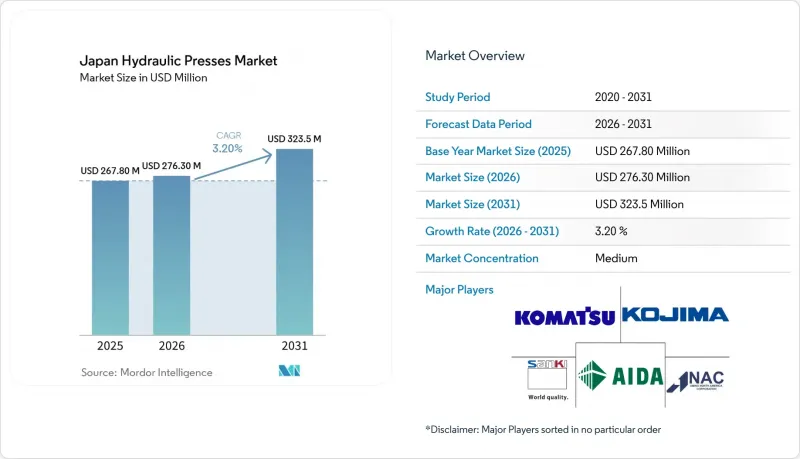
根據 Mordor Intelligence 預測,日本液壓機市場規模預計在 2025 年達到 2.678 億美元,2026 年達到 2.763 億美元,到 2031 年達到 3.235 億美元,2026 年至 2031 年的複合年成長率為 3.20%。
日本液壓機市場趨勢與分析
電動汽車電池外殼和電池組件的成型
電池外殼生產是日本液壓機市場對深拉成型設備的主要需求來源。 AIDA Engineering 於 2025 年 6 月推出了用於圓柱形電池外殼的「DIS-1600」和用於矩形電池外殼的「DPH Former」。 2025 年 9 月,馬自達簽署協議,將在岩國建造電池模組及包裝工廠,目標年產能為 10 GWh。日產也正在投資 1,533 億日圓(約 10.2 億美元)在北九州市建設一座磷酸鐵鋰電池工廠,計劃於 2025 會計年度開工建設,並於 2028 會計年度投產。由於多個電池項目同時進入建造階段,成型生產線的訂單可能會集中,從而增加設備和模具供應商的規劃負擔。
引入自動化、機器人和連網壓力機
日本正將自動化和人工智慧機器人技術定位為解決因勞動年齡人口減少而導致的製造業生產力缺口的方案。根據日本機器人協會預測,2025年機器人出貨量將達到211,139台,較2024年成長16.4%,出口成長率將達到28.2%。對於沖壓機用戶而言,機器人操作需要一個能夠協調沖壓機運作、裝卸和安全功能的控制系統。 AIDA公司於2025年7月推出的「A-1Y手入式模內協作機器人」旨在與現有的通用沖壓機配合使用。這為那些需要自動化但又無法負擔更換整條沖壓生產線的工廠提供了一個切實可行的解決方案。因此,日本液壓機市場不僅可以從新設備的銷售中獲益,還可以從控制系統和自動化升級中獲益。
高昂的資本投資成本和漫長的投資審核週期
液壓機的採購是製造業預算中需要嚴格審查的項目,尤其對於中小企業而言更是如此。一台來自日本主要供應商的標準250噸液壓精密沖裁機的價格在6,000萬日圓(約40萬美元)至9,000萬日圓(約60萬美元)之間,而配備伺服液壓和工業物聯網(IIoT)功能的機型價格則可能超過1.5億日元(約100萬美元)。根據日本金融公社的一項調查,到2025年,機械設備將佔中小企業投資計畫的57.3%,但企業對整體投資策略仍持謹慎態度。由於許多買家在補助申請獲批前暫緩下單,市場需求不穩定。此外,根據日本《工業安全衛生法》,定期檢查和安全裝置認證也會導致採購和升級專案的延誤。因此,即使工廠意識到設備升級的必要性,在日本液壓機市場,決策延遲仍然十分普遍。
細分市場分析
到2025年,C型壓力機將佔據日本液壓機市場31%的佔有率,成為最大的結構類型。它們適用於中型市場的沖壓加工、組裝和通用操作等多種應用。其開放式喉部結構和緊湊的面積使其適用於電子、塑膠和輕型組裝作業。使用者重視快速換模和跨多班次彈性操作。 H型和直邊模壓機正成為鍛造、落料和深拉延等應用領域下一個主要的獲利來源。汽車行業的買家優先考慮機架剛性和滑塊平行度,這些特性使其適用於重型作業。
預計到2031年,四柱四列壓平機的複合年成長率將達到5.1%,在所有結構型壓力機中成長率最高。其設計適用於電池外殼和複合材料成型等應用,在這些應用中,均勻的壓力分佈在較大的支撐區域至關重要。在這些製程中,壓板的平行度比C型框架的柔軟性更為重要。雙柱壓力機和桌上型壓力機仍然用於原型製作室、維護區域和小批量特種產品製造商。這些小型壓力機不易受大規模投資週期的影響,並提供了穩定的基準需求。所有結構型壓力機均須遵守《職業安全與健康法》規定的安全義務,這將增加每種設備類型的合規成本。
2025年,101-500噸級液壓機佔據了日本液壓機市場34%的佔有率,主要應用於汽車沖壓成型、中型鍛造和工業組裝。成熟的模具、模具組件和自動化介面降低了這些廣泛應用系統的擁有成本。 100噸以下級液壓機在電子、醫療設備和精密儀器產業中保持穩定的需求。在這些應用中,緊湊的面積和高循環速度比高壓力更為重要。 501噸至2000噸級的液壓機則用於汽車結構件、船舶製造和大型鍛造。
預計到2031年,2000噸級以上的設備將以5.8%的複合年成長率成長,在所有噸位級別中成長率最高。海洋結構、起落架和重型能源設備需要強大的成型能力。這些採購通常與長期專案承諾和特殊技術要求密切相關。 JIS B 6411-3:2025於2025年3月修訂了液壓機的安全要求,使其符合ISO 16092-3標準。該標準提高了所有容量範圍的技術要求。無法經濟地進行升級的老舊系統可能會比預期更早被替換,這將支撐對最高功率等級設備的需求。
其他好處:
- Excel格式的市場預測(ME)表
- 3個月的分析師支持
目錄
第1章:引言
- 研究假設和市場定義
- 調查範圍
第2章:調查方法
第3章執行摘要
第4章 市場狀況
- 市場概覽
- 市場促進因素
- 電動汽車電池外殼和電池組件的成型
- 引入自動化、機器人和連網壓力機
- 航太、國防、造船和能源相關設施的投資
- 由於能源、安全和控制系統老化,對棕地印刷機進行升級改造。
- 用於先進輕量材料的精密成型
- 一個專注於模具、夾具和製程檢驗的本地化網路。
- 市場限制因素
- 高昂的資本成本和漫長的投資核准流程
- 基於機械、電氣、伺服和其他成型技術的競爭。
- 液壓、控制、編程和試運行的專家短缺。
- 對進口零件的依賴以及跨境服務的延誤
- 價值鍊和供應鏈分析
- 原料和結構件
- 液壓單元、幫浦、閥門、油缸
- 控制設備、感測器和自動化組件
- 模具和夾俱生態系統
- 安裝、維護、維修和重建服務
- 監理情勢
- JIS B 6411-3:2025 液壓機的安全要求
- JIS B 6403:2020 液壓機的精度和檢驗要求
- 日本壓床職業安全健康要求
- 安全防護裝置、光柵、連鎖裝置和定期檢查的要求
- 噪音、液壓油和環境法規的合規要求
- 技術展望
- 伺服液壓和高效驅動系統
- 先進的控制和封閉回路型力與位置控制
- 自動化、機器人和自動化物料輸送系統
- 互聯媒體、工業物聯網與狀態監控
- 預測性維護和過程可追溯性
- 液壓和電動混合壓力機技術
- 先進材料和複合材料的成型技術
- 地緣政治和貿易趨勢的影響
- 中國在標準化印刷應用領域的設備競爭
- 液壓和電子元件的進口依賴性
- 印刷機關鍵部件的本地化
- 日本製造商將製造地遷往海外,並增加海外產量。
- 工業和製造業趨勢
- 汽車和工業設備的電氣化
- 高品種、小批量生產
- 能源效率和碳中和工廠計劃
- 自動化取代了熟練勞動力。
第5章 市場規模與成長預測
- 框架/結構配置
- C型框架/間隙框架液壓機
- H型框架/直邊/導軌式液壓機
- 四柱/四柱液壓機
- 雙柱式液壓機
- 桌上型/車間液壓機
- 其他特殊液壓機配置
- 按噸位/壓力
- 不到100噸
- 101-500噸
- 501至1000噸
- 1001-2000噸
- 超過2000噸
- 透過應用/成型工藝
- 鈑金成形與深拉延
- 鍛造
- 彎曲和伸直
- 沖孔、打孔和壓印
- 壓縮成型
- 粉末成型
- 液壓成型
- 組裝、壓入配合和一般壓接作業
- 其他特殊用途
- 按最終用途行業分類
- 汽車和運輸業
- 航太/國防
- 工業機械及一般製造業
- 電氣和電子設備
- 塑膠、橡膠、複合材料
- 建築和重型機械
- 能源和電力設備
- 鐵路和船舶
- 粉末冶金、陶瓷和先進材料
- 其他終端用戶產業
第6章 競爭情勢
- 市場集中度
- 策略趨勢
- 市佔率分析
- 公司簡介
- Komatsu Ltd.
- AIDA ENGINEERING, LTD.
- Kojima Iron Works Co., Ltd.
- SANKI SEIKO CO., LTD.
- Amino Corporation
- Japan Automatic Machine Co., Ltd.
- Kuroda Precision Industries Ltd.
- Osaka Jack Co., Ltd.
- Yamada Dobby Co., Ltd.
- AMADA CO., LTD.
- Mitsubishi Heavy Industries Machine Tool Co., Ltd.
- Kawasaki Heavy Industries, Ltd.
- Sumitomo Heavy Industries, Ltd.
- Daikin Industries, Ltd.
- Nippon Pneumatic Mfg. Co., Ltd.
- Asai Corporation
- Sugino Machine Limited
- Takashima Sangyo Co., Ltd.
- Meiki Co., Ltd.
- Shibuya Corporation
- Niigata Machine Techno Co., Ltd.
第7章 市場機會與未來展望
According to Mordor Intelligence, the Japan hydraulic presses market size is projected to be USD 267.80 million in 2025, USD 276.30 million in 2026, and reach USD 323.5 million by 2031, growing at a CAGR of 3.20% from 2026 to 2031.
Japan Hydraulic Presses Market Trends and Insights
Electric-Vehicle Battery Case and Battery Component Forming
Battery case production has become a central source of demand for deep-drawing equipment in the Japan hydraulic presses market. AIDA ENGINEERING introduced the DIS-1600 for cylindrical storage battery cases and the DPH Former for prismatic cases in June 2025. Mazda signed an agreement in September 2025 to build its Iwakuni battery module-pack plant, which targets an annual capacity of 10GWh. Nissan also committed JPY 153.3 billion (USD 1.02 billion) to an LFP battery factory in Kitakyushu, with construction beginning in fiscal year 2025 and operations planned for fiscal year 2028. Several battery projects moving into construction at the same time can concentrate orders for forming lines and place greater planning demands on equipment and tooling suppliers.
Automation, Robotics, and Connected Press Adoption
Japan has positioned automation and AI-enabled robotics as a response to manufacturing productivity gaps caused by a smaller working-age population. The Japan Robot Association reported shipments of 211,139 robots in 2025, up 16.4% from 2024, while export growth reached 28.2%. For press users, robotic handling requires controls that can coordinate the press with loading, unloading, and safety functions. AIDA's A-1Y Hand-in-Die Collaborative Robot, launched in July 2025, was designed to work with existing general-purpose presses. This creates a practical route for factories that need automation but cannot justify replacing an entire press line. The Japan hydraulic presses market can therefore benefit from controls and automation upgrades as well as sales of new equipment.
High Capital Cost and Extended Investment Approval Cycles
Hydraulic press purchases are closely reviewed in manufacturing budgets, particularly among small and medium-sized enterprises. A standard 250-ton hydraulic fine-blanking press from a leading domestic supplier is priced at JPY 60 million (USD 0.40 million) to JPY 90 million (USD 0.60 million), while servo-hydraulic or IIoT-equipped versions can exceed JPY 150 million (USD 1 million). Japan Finance Corporation found that machinery and equipment represented 57.3% of planned SME investment in 2025, although firms remained cautious about their overall commitments. Many buyers wait for subsidy decisions before releasing orders, which makes demand uneven. Periodic inspection and safety-device certification also add time to procurement and replacement projects under Japan's industrial safety requirements. The Japan hydraulic presses market is therefore exposed to delayed decisions even when factories recognize the need to upgrade equipment.
Other drivers and restraints analyzed in the detailed report include:
- Aerospace, Defense, Shipbuilding, and Energy-Equipment Investment
- Brownfield Press Replacement for Energy, Safety, and Controls Obsolescence
- Competition from Mechanical, Electric, Servo, and Alternative Forming Technologies
For complete list of drivers and restraints, kindly check the Table Of Contents.
Segment Analysis
C-frame presses held 31% of Japan hydraulic presses market share in 2025, making them the largest structural configuration. They serve broad mid-market stamping, assembly, and general-purpose work. Their open-throat layout and compact footprint suit electronics, plastics, and light-assembly operations. Users value quick die changes and flexible use across several shifts. H-frame and straight-side machines formed the next major revenue group for forging, blanking, and deep drawing. Automotive buyers favor their frame rigidity and ram parallelism for heavier-duty work.
Four-post and four-column machines are forecast to grow at a 5.1% CAGR through 2031, the fastest rate among structural configurations. Their design supports battery-case forming and composite molding, where even pressure over larger bolster areas is important. Platen parallelism matters more in these processes than the access flexibility of a C-frame. Two-post and benchtop presses continued to serve prototype rooms, maintenance areas, and small-batch specialty fabricators. These smaller formats are less exposed to broad investment cycles and provide a stable baseline demand. Safety obligations under the Industrial Safety and Health Act apply across the configuration range and add compliance cost to each equipment type.
The 101-500-ton class held 34% share of the Japan hydraulic presses market in 2025 because it serves automotive stamping, medium forging, and industrial assembly. Established tooling, die sets, and automation interfaces reduce the ownership cost of these widely used systems. The up-to-100-ton category retained steady volumes from electronics, medical devices, and precision instruments. Compact footprints and fast cycling are more important than high press force in these applications. Presses rated from 501 tons to 2,000 tons serve structural automotive work, shipbuilding, and heavy forging.
Above-2,000-ton equipment is forecast to grow at a 5.8% CAGR through 2031, the fastest rate among tonnage classes. Naval structures, landing gear, and large energy equipment require substantial forming force. These purchases are usually linked to long-term program commitments and specialized engineering requirements. JIS B 6411-3:2025 updated safety requirements for hydraulic presses in March 2025 and aligns with ISO 16092-3. The standard raises engineering expectations across all capacity bands. Older systems that cannot be upgraded economically may be replaced sooner, which supports demand in the highest-force categories.
Complete Report Scope:
- By Frame / Structural Configuration
- C-Frame / Gap-Frame Hydraulic Presses
- H-Frame / Straight-Side / Gib-Guided Hydraulic Presses
- Four-Post / Four-Column Hydraulic Presses
- Two-Post / Column Hydraulic Presses
- Benchtop / Workshop Hydraulic Presses
- Other Specialized Hydraulic Press Configurations
- By Tonnage / Press Force
- Up to 100 Tons
- 101-500 Tons
- 501-1,000 Tons
- 1,001-2,000 Tons
- Above 2,000 Tons
- By Application / Forming Process
- Sheet Metal Forming and Deep Drawing
- Forging
- Bending and Straightening
- Punching, Blanking, and Coining
- Compression Molding
- Powder Compaction
- Hydroforming
- Assembly, Press-Fitting, and General Pressing
- Other Specialized Applications
- By End-Use Industry
- Automotive and Transportation
- Aerospace and Defense
- Industrial Machinery and General Manufacturing
- Electrical and Electronics
- Plastics, Rubber, and Composites
- Construction and Heavy Equipment
- Energy and Power Equipment
- Rail and Marine
- Powder Metallurgy, Ceramics, and Advanced Materials
- Other End-Use Industries
List of Companies Covered in this Report:
- Komatsu Ltd.
- AIDA ENGINEERING, LTD.
- Kojima Iron Works Co., Ltd.
- SANKI SEIKO CO., LTD.
- Amino Corporation
- Japan Automatic Machine Co., Ltd.
- Kuroda Precision Industries Ltd.
- Osaka Jack Co., Ltd.
- Yamada Dobby Co., Ltd.
- AMADA CO., LTD.
- Mitsubishi Heavy Industries Machine Tool Co., Ltd.
- Kawasaki Heavy Industries, Ltd.
- Sumitomo Heavy Industries, Ltd.
- Daikin Industries, Ltd.
- Nippon Pneumatic Mfg. Co., Ltd.
- Asai Corporation
- Sugino Machine Limited
- Takashima Sangyo Co., Ltd.
- Meiki Co., Ltd.
- Shibuya Corporation
- Niigata Machine Techno Co., Ltd.
Additional Benefits:
- The market estimate (ME) sheet in Excel format
- 3 months of analyst support
TABLE OF CONTENTS
1 Introduction
- 1.1 Study Assumptions and Market Definition
- 1.2 Scope of the Study
2 Research Methodology
3 Executive Summary
4 Market Landscape
- 4.1 Market Overview
- 4.2 Market Drivers
- 4.2.1 Electric-Vehicle Battery Case and Battery Component Forming
- 4.2.2 Automation, Robotics, and Connected Press Adoption
- 4.2.3 Aerospace, Defense, Shipbuilding, and Energy-Equipment Investment
- 4.2.4 Brownfield Press Replacement for Energy, Safety, and Controls Obsolescence
- 4.2.5 Precision Forming for Advanced and Lightweight Materials
- 4.2.6 Localized Tooling, Die, and Process Validation Networks
- 4.3 Market Restraints
- 4.3.1 High Capital Cost and Extended Investment Approval Cycles
- 4.3.2 Competition from Mechanical, Electric, Servo, and Alternative Forming Technologies
- 4.3.3 Shortage of Hydraulic, Controls, Programming, and Commissioning Specialists
- 4.3.4 Imported Component Dependence and Cross-Border Service Delays
- 4.4 Value Chain and Supply Chain Analysis
- 4.4.1 Raw Materials and Structural Components
- 4.4.2 Hydraulic Power Units, Pumps, Valves, and Cylinders
- 4.4.3 Controls, Sensors, and Automation Components
- 4.4.4 Tooling and Die Ecosystem
- 4.4.5 Installation, Maintenance, Retrofit, and Rebuild Services
- 4.5 Regulatory Landscape
- 4.5.1 JIS B 6411-3:2025 Safety Requirements for Hydraulic Presses
- 4.5.2 JIS B 6403:2020 Hydraulic Press Accuracy and Inspection Requirements
- 4.5.3 Japan Occupational Safety and Health Requirements for Press Machinery
- 4.5.4 Safety Guards, Light Curtains, Interlocks, and Periodic Inspection Requirements
- 4.5.5 Noise, Hydraulic Fluid, and Environmental Compliance Requirements
- 4.6 Technological Outlook
- 4.6.1 Servo-Hydraulic and Energy-Efficient Drive Systems
- 4.6.2 Advanced Controls and Closed-Loop Force/Position Control
- 4.6.3 Automation, Robotics, and Automated Material Handling
- 4.6.4 Connected Presses, IIoT, and Condition Monitoring
- 4.6.5 Predictive Maintenance and Process Traceability
- 4.6.6 Hybrid Hydraulic-Electric Press Technologies
- 4.6.7 Advanced Material and Composite Forming Technologies
- 4.7 Impact of Geopolitical and Trade Developments
- 4.7.1 Chinese Equipment Competition in Standardized Press Applications
- 4.7.2 Import Exposure for Hydraulic and Electronic Components
- 4.7.3 Localization of Critical Press Components
- 4.7.4 Manufacturing Relocation and Overseas Production by Japanese OEMs
- 4.8 Industry and Manufacturing Trends
- 4.8.1 Electrification of Automotive and Industrial Equipment
- 4.8.2 High-Mix Low-Volume Production
- 4.8.3 Energy-Efficiency and Carbon-Neutral Factory Programs
- 4.8.4 Skilled-Labor Substitution Through Automation
5 Market Size & Growth Forecasts
- 5.1 By Frame / Structural Configuration
- 5.1.1 C-Frame / Gap-Frame Hydraulic Presses
- 5.1.2 H-Frame / Straight-Side / Gib-Guided Hydraulic Presses
- 5.1.3 Four-Post / Four-Column Hydraulic Presses
- 5.1.4 Two-Post / Column Hydraulic Presses
- 5.1.5 Benchtop / Workshop Hydraulic Presses
- 5.1.6 Other Specialized Hydraulic Press Configurations
- 5.2 By Tonnage / Press Force
- 5.2.1 Up to 100 Tons
- 5.2.2 101-500 Tons
- 5.2.3 501-1,000 Tons
- 5.2.4 1,001-2,000 Tons
- 5.2.5 Above 2,000 Tons
- 5.3 By Application / Forming Process
- 5.3.1 Sheet Metal Forming and Deep Drawing
- 5.3.2 Forging
- 5.3.3 Bending and Straightening
- 5.3.4 Punching, Blanking, and Coining
- 5.3.5 Compression Molding
- 5.3.6 Powder Compaction
- 5.3.7 Hydroforming
- 5.3.8 Assembly, Press-Fitting, and General Pressing
- 5.3.9 Other Specialized Applications
- 5.4 By End-Use Industry
- 5.4.1 Automotive and Transportation
- 5.4.2 Aerospace and Defense
- 5.4.3 Industrial Machinery and General Manufacturing
- 5.4.4 Electrical and Electronics
- 5.4.5 Plastics, Rubber, and Composites
- 5.4.6 Construction and Heavy Equipment
- 5.4.7 Energy and Power Equipment
- 5.4.8 Rail and Marine
- 5.4.9 Powder Metallurgy, Ceramics, and Advanced Materials
- 5.4.10 Other End-Use Industries
6 Competitive Landscape
- 6.1 Market Concentration
- 6.2 Strategic Moves
- 6.3 Market Share Analysis
- 6.4 Company Profiles (Includes Global Level Overview, Market Level Overview, Core Segments, Financials as Available, Strategic Information, Products and Services, Recent Developments)
- 6.4.1 Komatsu Ltd.
- 6.4.2 AIDA ENGINEERING, LTD.
- 6.4.3 Kojima Iron Works Co., Ltd.
- 6.4.4 SANKI SEIKO CO., LTD.
- 6.4.5 Amino Corporation
- 6.4.6 Japan Automatic Machine Co., Ltd.
- 6.4.7 Kuroda Precision Industries Ltd.
- 6.4.8 Osaka Jack Co., Ltd.
- 6.4.9 Yamada Dobby Co., Ltd.
- 6.4.10 AMADA CO., LTD.
- 6.4.11 Mitsubishi Heavy Industries Machine Tool Co., Ltd.
- 6.4.12 Kawasaki Heavy Industries, Ltd.
- 6.4.13 Sumitomo Heavy Industries, Ltd.
- 6.4.14 Daikin Industries, Ltd.
- 6.4.15 Nippon Pneumatic Mfg. Co., Ltd.
- 6.4.16 Asai Corporation
- 6.4.17 Sugino Machine Limited
- 6.4.18 Takashima Sangyo Co., Ltd.
- 6.4.19 Meiki Co., Ltd.
- 6.4.20 Shibuya Corporation
- 6.4.21 Niigata Machine Techno Co., Ltd.
7 Market Opportunities & Future Outlook
- 7.1 White-Space and Unmet-Need Assessment
- 7.1.1 Energy-Efficient and Servo-Hydraulic Presses
- 7.1.2 Retrofit and Modernization of Legacy Presses
- 7.1.3 Automated and Connected Hydraulic Press Systems
- 7.1.4 Battery Case and Advanced Material Forming
- 7.1.5 Compact Presses for High-Mix Japanese Manufacturing
- 7.1.6 High-Tonnage Forging and Special-Purpose Applications

 壓縮機市場:全球市場預測,2026-2032年冷擠壓與雙作用液壓機市場:全球市場預測,2026-2032年壓平機市場:全球市場預測,2026-2032年
 亞太地區工業壓平機:市佔率分析、產業趨勢與統計及成長預測(2026-2031)美國液壓機:市場佔有率分析、行業趨勢和統計數據、成長預測(2026-2031)越南液壓機市場:市場佔有率分析、產業趨勢與統計及成長預測(2026-2031)北美液壓機市場:市佔率分析、產業趨勢與統計及成長預測(2026-2031 年)歐洲液壓機:市場佔有率分析、產業趨勢與統計、成長預測(2026-2031)液壓機:市佔率分析、產業趨勢與統計、成長預測(2026-2031)
 2026-2030年全球液壓壓平機市場