


 |
市場調查報告書
商品編碼
2157062
液壓機:市佔率分析、產業趨勢與統計、成長預測(2026-2031)Hydraulic Presses - Market Share Analysis, Industry Trends & Statistics, Growth Forecasts (2026 - 2031) |
||||||

※ 本網頁內容可能與最新版本有所差異。詳細情況請與我們聯繫。
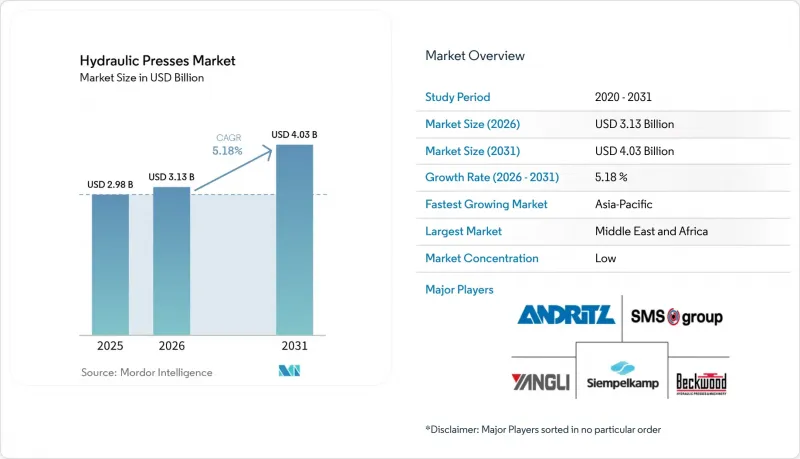
根據 Mordor Intelligence 預測,液壓機市場預計將從 2025 年的 29.8 億美元成長到 2026 年的 31.3 億美元,到 2031 年達到 40.3 億美元,2026 年至 2031 年的複合年成長率預計為 5.18%。
全球液壓機市場趨勢及洞察
汽車電氣化和輕量化零件成型
電動車 (EV) 的發展正在改變沖壓車間的工作性質。這包括車身結構所用材料、零件尺寸、品管和生產過程。在電池式電動車車身結構中,傳統沖壓成型零件的使用在某些領域正在減少。然而,對大型型材、電池機殼組件以及必須在嚴格控制的組裝中安裝的馬達相關組件的需求仍然很高。這些組件通常需要深拉延和長行程的精確成型,尤其是在尺寸一致性會影響連接、密封和後續組裝操作的情況下。液壓機可以為這項工作提供可程式設計的負載和行程曲線,使製程能夠針對特定零件進行客製化,而不是採用標準生產週期。一個產業協會在 2026 年進行的一項調查研究了 1500 MPa 級冷彎型鋼的應用,在這些應用中,回彈和成形性方面的可控成形條件至關重要。因此,液壓機市場正在向噸位更大、定位控制更精確、行程更長、力傳遞更可重複以及具有特定應用規格的機器轉變。
高強度先進材料的更廣泛應用
先進高抗張強度鋼、鋁、鈦、複合材料和先進陶瓷對成形設備提出了不同的要求,因為它們對壓力、溫度、沖頭運動和保壓時間的反應各不相同。通用壓力機系統可能無法在不進行額外設計的情況下,為這些材料提供所需的階梯式壓縮、沖頭控制或保壓循環。雙相鋼需要精確控制沖頭速度,而複合材料的加工則要求在整個成形週期和整個加工表面上保持壓力的一致性。 2025年,盧布爾雅那大學報告稱,伺服液壓機已逐步擴大了雙相鋼DP590的板材成形能力。這些需求推動了對等溫鈦鍛造、複合材料熱壓和粉末成形設備的投資,因為傳統的製程設定無法滿足這些需求。此外,這些需求也推動了液壓機市場對更高價值的設備、更專業的工程設計、更長的更換週期和客製化系統的需求。
大型客製化液壓機系統的初始投資成本較高
大型液壓機系統需要大量的預付資金,尤其是在買家需要客製化模具、先進的控制系統、安裝、培訓、驗證、現場工程和性能測試的情況下。如果某個生產項目需要進口或客製化生產設備,且生產量、品質標準和交貨期限都已明確規定,那麼購買決策就更具挑戰性。對於噸位超過2000噸的設備,在投產之前可能需要進行多年的資本規劃、專業的場地準備和供應商協調。液壓和伺服驅動部件的較長交貨週期會給買家帶來規劃風險,並使專案進度安排更加困難。這些因素限制了中小製造商的投資,並影響了東南亞和南美等成本敏感地區的需求,因為資金籌措可能會限制設備的購買決策。此外,在液壓機市場,如果買家能夠維護、改造現有液壓機或推遲添加高產能設備,那麼升級決策往往會被推遲。
細分市場分析
到2025年,H型框架/直邊/導軌式液壓機將佔據液壓機市場佔有率的32.50%。其普及率反映了汽車和金屬加工行業多年來對具備滑塊導向功能和結構剛性的液壓機設計的投入。這些液壓機非常適合精密深拉延和生產線應用。在白車身和結構件的生產中,滑塊之間的嚴格平行度仍然至關重要。因此,這種配置在現有生產線和升級需求中仍然佔據核心地位。
四柱/四列式熱壓機是成長最快的配置,預計到2031年將達到5.90%的複合年成長率。其均勻的壓板負荷有利於複合材料的熱壓、大規模橡膠成型以及航太層壓板的粘合。這些操作需要在寬大的模具區域內保持穩定的負荷。 2025年11月,羅德斯國際成型公司(Rhodes Interform)簽署了一份契約,訂購三台用於航太複合材料結構的四柱式熱壓機。 C型框架設備因其易於操作和面積小,在車間和一般製造環境中仍然非常重要。液壓機產業採用雙柱式、桌上型、拉桿式和整體式設計,用於輕型組裝、實驗室應用、粉末成型和其他特殊用途。
截至2025年,101-500噸級液壓機將佔液壓機市場規模的42%。此噸位級液壓機適用於結構件壓製、鋁成型和粉末壓制等中等複雜程度的加工需求。汽車零件供應商、家電製造商和通用加工商在許多生產基地都使用這一噸位級的壓平機。如此廣泛的應用基礎支撐著穩定的供應鏈。此外,此噸位級液壓機也是標準配備組合的核心。
預計噸位超過2000噸的液壓機將實現最快成長,到2031年複合年成長率將達到6.10%。其需求主要來自飛機引擎的鈦鍛件、國防平台的重型成型件以及卡車和農業機械的封閉式模鍛件。賽峰集團的3萬噸級液壓機計畫清楚展現了該產能範圍內的投資規模。噸位低於100噸的液壓機仍主要用於桌上型、組裝和輕型成型應用。噸位在501至1000噸和1001至2000噸之間的液壓機則用於汽車結構件和大型複合材料模具。這項需求與汽車平臺的變化以及航太領域對複合材料黏合技術的投資密切相關,並貫穿整個液壓機市場。
區域分析
到2025年,亞太地區將佔全球液壓機市場佔有率的48%。中國既是液壓機設備的主要生產國,也是主要的消費國。其國內供應商在滿足本地製造業需求的同時,也以具競爭力的價格出口產品。在印度,汽車和國防領域的產能正在擴張,包括對高階鍛造設備的需求。韓國仍然是電子和汽車行業精密沖壓成型設備的重要供應商。在越南、泰國和印尼,隨著供應鏈向中國以外的地區多元化發展,沖壓密集型製造業正在成長。印度的「印度製造」政策和生產連結獎勵計畫(PLI)計畫正在促進汽車和電子產品生產的採購。
北美和歐洲仍是技術密集地區,對伺服液壓系統、連網生產線和航太鍛造能力的需求仍然強勁。德國和義大利仍然是歐洲重要的設備製造中心。歐盟機械法規2023/1230將於2027年1月全面實施,取代指令2006/42/EC。該法規加強了對安全關鍵控制系統的技術要求,並強制要求面向歐洲市場的供應商在其設備設計中考慮合規性。
中東和非洲地區是液壓機市場成長最快的地區,預計到2031年將達到6.40%的年複合成長率(CAGR)。海灣國家製造業多元化以及摩洛哥和南非對汽車組裝的投資,支撐了對成型設備的需求。南美洲仍與農業機械和重型卡車的生產週期緊密相關,巴西鍛造業的投資在特定應用領域展現出較高的產能,這與全部區域較保守的投資策略形成鮮明對比。
其他好處:
- Excel格式的市場預測(ME)表
- 3個月的分析師支持
目錄
第1章:引言
- 研究假設和市場定義
- 調查範圍
第2章:調查方法
第3章執行摘要
第4章 市場狀況
- 市場概覽
- 汽車、金屬成型、航太、複合材料、塑膠和一般製造業的需求結構
- 按印刷機噸位和客戶群分類的市場成熟度
- 對標準液壓機和訂單液壓機的需求
- 市場促進因素
- 汽車電氣化和輕量化零件成型
- 擴大高強度先進材料的應用
- 成型和製造流程的自動化
- 擴大航太、國防和重工業領域的生產能力。
- 業界現代化與老舊印刷設備的更換
- 節能液壓系統的需求
- 市場限制因素
- 大型和特殊設計的水壓機系統需要高昂的資本成本。
- 對熟練的維護和控制工程師的要求
- 長期投資和更新週期
- 符合液壓油、噪音和能源效率方面的法規。
- 價值鍊和供應鏈分析
- 原料和結構件
- 液壓單元、幫浦、閥門、油缸
- 控制設備、感測器和自動化組件
- 模具和夾俱生態系統
- 安裝、維護、維修和重建服務
- 監理情勢
- 壓床及職業安全健康要求
- 液壓油、噪音和環境法規的要求
- 區域對機械安全性和適用性的要求
- 技術展望
- 伺服液壓和高效驅動系統
- 先進的控制和封閉回路型力與位置控制
- 自動化、機器人和自動化物料輸送系統
- 互聯媒體、工業物聯網與狀態監控
- 預測性維護和過程可追溯性
- 液壓和電動混合壓力機技術
- 先進材料和複合材料的成型技術
- 地緣政治和貿易趨勢的影響
- 關稅和進口限制
- 液壓和控制元件的供應鏈風險
- 液壓機製造本地化
- 工業和製造業趨勢
- 永續性和能源效率
第5章 市場規模與成長預測
- 框架/結構配置
- C型/間隙型液壓機
- H型框架/直邊/導軌式液壓機
- 四柱/四柱液壓機
- 雙柱式液壓機
- 桌上型/車間液壓機
- 其他特殊液壓機配置
- 按噸位/壓力
- 不到100噸
- 101-500噸
- 501至1000噸
- 1001-2000噸
- 超過2000噸
- 透過應用/成型工藝
- 鈑金成形與深拉延
- 鍛造
- 彎曲和伸直
- 沖孔、打孔和壓印
- 壓縮成型
- 粉末成型
- 液壓成型
- 組裝、壓入配合和一般壓接作業
- 其他特殊用途
- 按最終用途行業分類
- 汽車和運輸業
- 航太/國防
- 工業機械及一般製造業
- 電氣和電子設備
- 塑膠、橡膠、複合材料
- 建築和重型機械
- 能源和電力設備
- 鐵路和船舶
- 粉末冶金、陶瓷和先進材料
- 其他終端用戶產業
- 按地區
- 北美洲
- 美國
- 加拿大
- 墨西哥
- 南美洲
- 巴西
- 阿根廷
- 其他南美國家
- 歐洲
- 德國
- 義大利
- 法國
- 英國
- 西班牙
- 俄羅斯
- 其他歐洲國家
- 亞太地區
- 中國
- 日本
- 印度
- 韓國
- 東協(新加坡、馬來西亞、印尼、泰國、越南、菲律賓、緬甸、柬埔寨、寮國、汶萊)
- 澳洲
- 其他亞太國家
- 中東和非洲
- 沙烏地阿拉伯
- 阿拉伯聯合大公國
- 土耳其
- 南非
- 其他中東和非洲國家
- 北美洲
第6章 競爭情勢
- 市場集中度
- 策略趨勢
- Product Launches and Technology Upgrades
- Partnerships and Customer Programs
- 收購與合資
- 市佔率分析
- 公司簡介
- ANDRITZ Schuler
- SMS group
- Siempelkamp Maschinen-und Anlagenbau GmbH
- Jiangsu Yangli Group
- Beckwood Press Company
- LASCO Umformtechnik GmbH
- Tianjin Tianduan Press Co., Ltd.(GENERTEC Tianduan)
- JIER Machine-Tool Group Co., Ltd.
- Hefei Metalforming Intelligent Manufacturing Co., Ltd.
- Macrodyne Technologies Inc.
- Greenerd Press & Machine Company
- French Oil Mill Machinery Company
- Wabash MPI
- Gasbarre Products, Inc.
- DORST Technologies GmbH & Co. KG
- Santec Exim Pvt. Ltd
第7章 市場機會與未來展望
According to Mordor Intelligence, the hydraulic presses market size is expected to increase from USD 2.98 billion in 2025 to USD 3.13 billion in 2026 and reach USD 4.03 billion by 2031, growing at a CAGR of 5.18% over 2026-2031.
Global Hydraulic Presses Market Trends and Insights
Automotive Electrification and Lightweight Component Forming
Electric vehicle programs are changing the type of work performed by press shops, including the materials, part dimensions, quality controls, and production sequences used in vehicle structures. Battery-electric vehicle structures use fewer conventional stampings in some areas. Still, they need more large aluminum sections, battery enclosure parts, and motor-related components that must fit within closely controlled assemblies. These parts often need deep drawing or control forming over a longer stroke, particularly where dimensional consistency affects joining, sealing, and later assembly work. Hydraulic equipment can provide programmable force and travel profiles for that work, allowing the process to be set for a particular part rather than a standard production cycle. According to an industry association, published in 2026 study examined 1,500 MPa-class cold-forming steel applications where controlled forming conditions matter for spring back and formability. The hydraulic presses market is therefore shifting toward machines with higher tonnage, closer position control, longer stroke capability, repeatable force delivery, and application-specific specifications.
Increasing Use of High-Strength and Advanced Materials
Advanced high-strength steel, aluminum, titanium, composites, and advanced ceramics place different demands on forming equipment because they respond differently to pressure, temperature, ram movement, and time under load. Generic press systems may not provide the staged compression, ram control, or hold-pressure cycles needed for these materials without additional engineering. Dual-phase steel requires careful control of ram velocity, while composite processing requires consistent pressure through the forming cycle and across the working surface. The University of Ljubljana reported in 2025 that a servo-hydraulic press expanded incremental sheet-forming capability for dual-phase DP590 steel. These requirements support investment in isothermal titanium forging, composite hot pressing, and powder compaction equipment, where conventional process settings are not sufficient. They also support higher equipment value, more specialized engineering work, longer replacement cycles, and demand for tailored systems in the hydraulic presses market.
High Capital Cost of Large and Engineered Hydraulic Press Systems
Large hydraulic press systems require substantial upfront spending, especially when buyers need custom tooling, advanced controls, installation, training, validation, site-specific engineering, and performance testing. The purchase decision becomes more difficult when a machine must be imported or built for a single production program with a defined volume, quality standard, and delivery schedule. Equipment above 2,000 tons can require a multiyear capital plan, specialized site preparation, and coordination with the supplier before production can begin. Long delivery times for hydraulic and servo-drive components can add planning risk for buyers and make the timing of a project more difficult to manage. These conditions limit investment among smaller manufacturers and affect demand in cost-sensitive parts of Southeast Asia and South America, where financing can constrain equipment decisions. The hydraulic presses market also faces slower replacement decisions when a buyer can maintain an existing press, add a retrofit, or defer a large capacity addition.
Other drivers and restraints analyzed in the detailed report include:
- Automation of Forming and Manufacturing Processes
- Expansion of Aerospace, Defense, and Heavy Manufacturing Capacity
- Skilled Maintenance and Controls Engineering Requirements
For complete list of drivers and restraints, kindly check the Table Of Contents.
Segment Analysis
H-frame/straight-side/gib-guided equipment held 32.50% of the 2025 hydraulic presses market share. Their installed base reflects long-standing automotive and metal-fabrication investment in designs that provide ram guidance and structural rigidity. These presses are well-suited to precision deep drawing and transfer-line applications. Tight ram parallelism remains important for body-in-white and structural-component production. This configuration consequently remains central to established press lines and replacement demand.
Four-post/four-column machines are the fastest-growing configurations, registering a 5.90% CAGR through 2031. Their uniform platen loading supports composite hot pressing, large rubber molding, and aerospace laminate bonding. These operations need consistent loading over wide die areas. Rhodes Interform secured a November 2025 contract for three four-column hot-platen presses for aerospace composite structures. C-Frame equipment remains important for workshops and general manufacturing because it provides access and a compact footprint. Two-post, benchtop, tie-rod, and monoblock designs serve light assembly, laboratory, powder compaction, and other specialized tasks in the hydraulic presses industry.
The 101-500 ton class accounted for 42% of the hydraulic presses market size in 2025. It fits the needs of mid-complexity structural stamping, aluminum forming, and powder compaction. Automotive suppliers, appliance manufacturers, and general fabricators use this capacity range across many production settings. This broad application base supports consistent replenishment demand. It also makes the class a core part of standard equipment portfolios.
The above-2,000-ton category is projected to grow fastest, registering a 6.10% CAGR through 2031. Demand comes from titanium forging for aero engines, heavy forming for defense platforms, and closed-die forging for trucks and agricultural equipment. Safran's 30,000-metric-ton press project shows the scale of investment in this capacity range. The Up-to-100-ton category continues to serve benchtop, assembly, and light-forming applications. The 501-1,000 ton and 1,001-2,000 ton groups serve automotive structural components and larger composite tooling. Their demand is tied to vehicle platform changes and aerospace composite-bonding investment across the hydraulic presses market.
Complete Report Scope:
- By Frame / Structural Configuration
- C-Frame / Gap-Frame Hydraulic Presses
- H-Frame / Straight-Side / Gib-Guided Hydraulic Presses
- Four-Post / Four-Column Hydraulic Presses
- Two-Post / Column Hydraulic Presses
- Benchtop / Workshop Hydraulic Presses
- Other Specialized Hydraulic Press Configurations
- By Tonnage / Press Force
- Up to 100 Tons
- 101-500 Tons
- 501-1,000 Tons
- 1,001-2,000 Tons
- Above 2,000 Tons
- By Application / Forming Process
- Sheet Metal Forming and Deep Drawing
- Forging
- Bending and Straightening
- Punching, Blanking, and Coining
- Compression Molding
- Powder Compaction
- Hydroforming
- Assembly, Press-Fitting, and General Pressing
- Other Specialized Applications
- By End-Use Industry
- Automotive and Transportation
- Aerospace and Defense
- Industrial Machinery and General Manufacturing
- Electrical and Electronics
- Plastics, Rubber, and Composites
- Construction and Heavy Equipment
- Energy and Power Equipment
- Rail and Marine
- Powder Metallurgy, Ceramics, and Advanced Materials
- Other End-Use Industries
- By Geography
- North America
- United States
- Canada
- Mexico
- South America
- Brazil
- Argentina
- Rest of South America
- Europe
- Germany
- Italy
- France
- United Kingdom
- Spain
- Russia
- Rest of Europe
- Asia-Pacific
- China
- Japan
- India
- South Korea
- ASEAN(Singapore, Malaysia, Indonesia, Thailand, Vietnam, Philippines, Myanmar, Cambodia, Laos, Brunei)
- Australia
- Rest of Asia-Pacific
- Middle East and Africa
- Saudi Arabia
- United Arab Emirates
- Turkey
- South Africa
- Rest of Middle East and Africa
- North America
Geography Analysis
Asia-Pacific accounted for 48% of the global hydraulic presses market share in 2025. China is both a large producer and consumer of press equipment. Its domestic supplier base serves local manufacturing demand and exports at competitive prices. India is adding automotive and defense manufacturing capacity, including demand for higher-end forging equipment. South Korea remains important for precision equipment used in electronics and automotive stamping. Vietnam, Thailand, and Indonesia are receiving more press-intensive manufacturing as supply chains diversify beyond China. India's Make in India policy and Production Linked Incentive programs support procurement in automotive and electronics production.
North America and Europe remain technology-intensive regions with demand for servo-hydraulic systems, connected production lines, and aerospace forging capacity. Germany and Italy remain important centers for European equipment manufacturing. The European Union Machinery Regulation 2023/1230 becomes fully applicable in January 2027 and replaces Directive 2006/42/EC. This rule increases the engineering requirements for safety-critical control systems and requires suppliers serving Europe to account for compliance in equipment design.
The Middle East and Africa region is the fastest-growing region in the hydraulic presses market, registering a 6.40% CAGR through 2031. Manufacturing diversification in Gulf states and automotive assembly investment in Morocco and South Africa support demand for forming equipment. South America remains linked to agricultural equipment and heavy-truck production cycles, with Brazilian forging investment showing a higher level of capability in selected applications and a contrast with the region's generally conservative capital-spending posture.
- ANDRITZ Schuler
- SMS group
- Siempelkamp Maschinen- und Anlagenbau GmbH
- Jiangsu Yangli Group
- Beckwood Press Company
- LASCO Umformtechnik GmbH
- Tianjin Tianduan Press Co., Ltd. (GENERTEC Tianduan)
- JIER Machine-Tool Group Co., Ltd.
- Hefei Metalforming Intelligent Manufacturing Co., Ltd.
- Macrodyne Technologies Inc.
- Greenerd Press & Machine Company
- French Oil Mill Machinery Company
- Wabash MPI
- Gasbarre Products, Inc.
- DORST Technologies GmbH & Co. KG
- Santec Exim Pvt. Ltd
Additional Benefits:
- The market estimate (ME) sheet in Excel format
- 3 months of analyst support
TABLE OF CONTENTS
1 INTRODUCTION
- 1.1 Study Assumptions and Market Definition
- 1.2 Scope of the Study
2 RESEARCH METHODOLOGY
3 EXECUTIVE SUMMARY
4 MARKET LANDSCAPE
- 4.1 Market Overview
- 4.1.1 Demand Structure Across Automotive, Metal Forming, Aerospace, Composites, Plastics, and General Manufacturing
- 4.1.2 Market Maturity Across Press Tonnage and Customer Segments
- 4.1.3 Demand for Standardized vs. Engineered-to-Order Hydraulic Presses
- 4.2 Market Drivers
- 4.2.1 Automotive Electrification and Lightweight Component Forming
- 4.2.2 Increasing Use of High-Strength and Advanced Materials
- 4.2.3 Automation of Forming and Manufacturing Processes
- 4.2.4 Expansion of Aerospace, Defense, and Heavy Manufacturing Capacity
- 4.2.5 Industrial Modernization and Replacement of Aging Press Equipment
- 4.2.6 Demand for Energy-Efficient Hydraulic Systems
- 4.3 Market Restraints
- 4.3.1 High Capital Cost of Large and Engineered Hydraulic Press Systems
- 4.3.2 Skilled Maintenance and Controls Engineering Requirements
- 4.3.3 Long Investment and Replacement Cycles
- 4.3.4 Hydraulic Fluid, Noise, and Energy-Efficiency Compliance
- 4.4 Value Chain and Supply Chain Analysis
- 4.4.1 Raw Materials and Structural Components
- 4.4.2 Hydraulic Power Units, Pumps, Valves, and Cylinders
- 4.4.3 Controls, Sensors, and Automation Components
- 4.4.4 Tooling and Die Ecosystem
- 4.4.5 Installation, Maintenance, Retrofit, and Rebuild Services
- 4.5 Regulatory Landscape
- 4.5.1 Hydraulic Press Machinery and Occupational Safety Requirements
- 4.5.2 Hydraulic Fluid, Noise, and Environmental Compliance Requirements
- 4.5.3 Regional Machinery Safety and Conformity Requirements
- 4.6 Technological Outlook
- 4.6.1 Servo-Hydraulic and Energy-Efficient Drive Systems
- 4.6.2 Advanced Controls and Closed-Loop Force/Position Control
- 4.6.3 Automation, Robotics, and Automated Material Handling
- 4.6.4 Connected Presses, IIoT, and Condition Monitoring
- 4.6.5 Predictive Maintenance and Process Traceability
- 4.6.6 Hybrid Hydraulic-Electric Press Technologies
- 4.6.7 Advanced Material and Composite Forming Technologies
- 4.7 Impact of Geopolitical and Trade Developments
- 4.7.1 Tariffs and Import Restrictions
- 4.7.2 Supply-Chain Risks for Hydraulic and Control Components
- 4.7.3 Localization of Hydraulic Press Manufacturing
- 4.8 Industry and Manufacturing Trends
- 4.9 Sustainability and Energy Efficiency
5 MARKET SIZE AND GROWTH FORECASTS
- 5.1 By Frame / Structural Configuration
- 5.1.1 C-Frame / Gap-Frame Hydraulic Presses
- 5.1.2 H-Frame / Straight-Side / Gib-Guided Hydraulic Presses
- 5.1.3 Four-Post / Four-Column Hydraulic Presses
- 5.1.4 Two-Post / Column Hydraulic Presses
- 5.1.5 Benchtop / Workshop Hydraulic Presses
- 5.1.6 Other Specialized Hydraulic Press Configurations
- 5.2 By Tonnage / Press Force
- 5.2.1 Up to 100 Tons
- 5.2.2 101-500 Tons
- 5.2.3 501-1,000 Tons
- 5.2.4 1,001-2,000 Tons
- 5.2.5 Above 2,000 Tons
- 5.3 By Application / Forming Process
- 5.3.1 Sheet Metal Forming and Deep Drawing
- 5.3.2 Forging
- 5.3.3 Bending and Straightening
- 5.3.4 Punching, Blanking, and Coining
- 5.3.5 Compression Molding
- 5.3.6 Powder Compaction
- 5.3.7 Hydroforming
- 5.3.8 Assembly, Press-Fitting, and General Pressing
- 5.3.9 Other Specialized Applications
- 5.4 By End-Use Industry
- 5.4.1 Automotive and Transportation
- 5.4.2 Aerospace and Defense
- 5.4.3 Industrial Machinery and General Manufacturing
- 5.4.4 Electrical and Electronics
- 5.4.5 Plastics, Rubber, and Composites
- 5.4.6 Construction and Heavy Equipment
- 5.4.7 Energy and Power Equipment
- 5.4.8 Rail and Marine
- 5.4.9 Powder Metallurgy, Ceramics, and Advanced Materials
- 5.4.10 Other End-Use Industries
- 5.5 By Geography
- 5.5.1 North America
- 5.5.1.1 United States
- 5.5.1.2 Canada
- 5.5.1.3 Mexico
- 5.5.2 South America
- 5.5.2.1 Brazil
- 5.5.2.2 Argentina
- 5.5.2.3 Rest of South America
- 5.5.3 Europe
- 5.5.3.1 Germany
- 5.5.3.2 Italy
- 5.5.3.3 France
- 5.5.3.4 United Kingdom
- 5.5.3.5 Spain
- 5.5.3.6 Russia
- 5.5.3.7 Rest of Europe
- 5.5.4 Asia-Pacific
- 5.5.4.1 China
- 5.5.4.2 Japan
- 5.5.4.3 India
- 5.5.4.4 South Korea
- 5.5.4.5 ASEAN(Singapore, Malaysia, Indonesia, Thailand, Vietnam, Philippines, Myanmar, Cambodia, Laos, Brunei)
- 5.5.4.6 Australia
- 5.5.4.7 Rest of Asia-Pacific
- 5.5.5 Middle East and Africa
- 5.5.5.1 Saudi Arabia
- 5.5.5.2 United Arab Emirates
- 5.5.5.3 Turkey
- 5.5.5.4 South Africa
- 5.5.5.5 Rest of Middle East and Africa
- 5.5.1 North America
6 COMPETITIVE LANDSCAPE
- 6.1 Market Concentration
- 6.2 Strategic Moves
- 6.2.1 Product Launches and Technology Upgrades
- 6.2.2 Partnerships and Customer Programs
- 6.2.3 Acquisitions and Joint Ventures
- 6.3 Market Share Analysis
- 6.4 Company Profiles (includes Global Level Overview, Market Level Overview, Core Segments, Financials as available, Strategic Information, Products and Services, Recent Developments)
- 6.4.1 ANDRITZ Schuler
- 6.4.2 SMS group
- 6.4.3 Siempelkamp Maschinen- und Anlagenbau GmbH
- 6.4.4 Jiangsu Yangli Group
- 6.4.5 Beckwood Press Company
- 6.4.6 LASCO Umformtechnik GmbH
- 6.4.7 Tianjin Tianduan Press Co., Ltd. (GENERTEC Tianduan)
- 6.4.8 JIER Machine-Tool Group Co., Ltd.
- 6.4.9 Hefei Metalforming Intelligent Manufacturing Co., Ltd.
- 6.4.10 Macrodyne Technologies Inc.
- 6.4.11 Greenerd Press & Machine Company
- 6.4.12 French Oil Mill Machinery Company
- 6.4.13 Wabash MPI
- 6.4.14 Gasbarre Products, Inc.
- 6.4.15 DORST Technologies GmbH & Co. KG
- 6.4.16 Santec Exim Pvt. Ltd
7 MARKET OPPORTUNITIES AND FUTURE OUTLOOK
- 7.1 White-Space and Unmet-Need Assessment
- 7.1.1 Energy-Efficient and Servo-Hydraulic Presses
- 7.1.2 Retrofit and Modernization of Legacy Presses
- 7.1.3 Automated and Connected Hydraulic Press Systems
- 7.1.4 Emerging-Market Manufacturing Expansion
- 7.1.5 High-Tonnage Applications
- 7.1.6 Advanced Materials and Composite Forming
- 7.1.7 Replacement vs. New-Capacity Demand Outlook

 壓縮機市場:全球市場預測,2026-2032年冷擠壓與雙作用液壓機市場:全球市場預測,2026-2032年壓平機市場:全球市場預測,2026-2032年
 亞太地區工業壓平機:市佔率分析、產業趨勢與統計及成長預測(2026-2031)美國液壓機:市場佔有率分析、行業趨勢和統計數據、成長預測(2026-2031)越南液壓機市場:市場佔有率分析、產業趨勢與統計及成長預測(2026-2031)北美液壓機市場:市佔率分析、產業趨勢與統計及成長預測(2026-2031 年)日本液壓機市場:市場佔有率分析、產業趨勢與統計、成長預測(2026-2031)歐洲液壓機:市場佔有率分析、產業趨勢與統計、成長預測(2026-2031)
 2026-2030年全球液壓壓平機市場