


 |
市場調查報告書
商品編碼
2157065
歐洲液壓機:市場佔有率分析、產業趨勢與統計、成長預測(2026-2031)Europe Hydraulic Presses - Market Share Analysis, Industry Trends & Statistics, Growth Forecasts (2026 - 2031) |
||||||

※ 本網頁內容可能與最新版本有所差異。詳細情況請與我們聯繫。
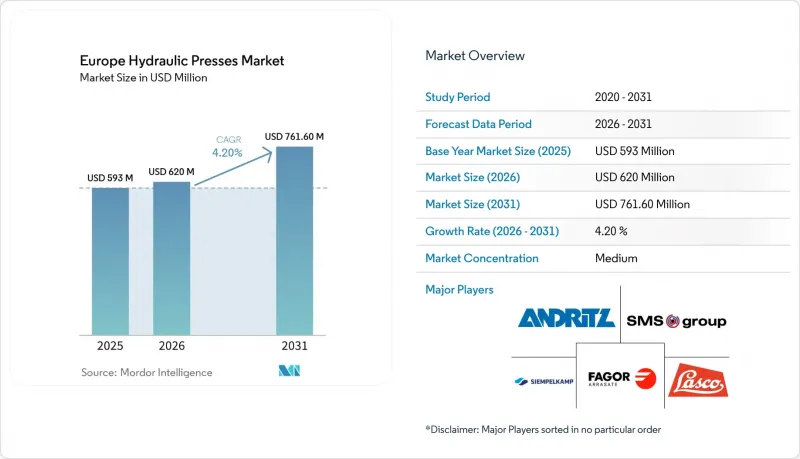
據 Mordor Intelligence 稱,2025 年歐洲液壓機市值為 5.93 億美元,預計到 2031 年將達到 7.616 億美元,而 2026 年為 6.2 億美元,預測期(2026-2031 年)的複合年成長率為 4.20%。
歐洲液壓機市場的趨勢與洞察
電動汽車電池、重量減輕和結構部件平台重新設計
平台電氣化正在推動歐洲汽車供應鏈對液壓機的投資需求不斷成長。 PowerCo位於薩爾茨吉特的整合式電池製造工廠計劃於2025年投入運作,這將催生當地對電池外殼和底盤結構托盤的需求,而這些零件需要新的模具和成型流程。大型棱柱形電池和電池包一體化設計所需的電池結構形狀與內燃機汽車所使用的電池結構截然不同。鋁製封閉面板和高抗張強度鋼搖臂結構也需要不同的壓力、壓機床尺寸和壓邊圈設定。僅靠改造現有模具可能無法滿足這些要求。液壓系統能夠對整個工作行程中的壓力和速度可程式設計控制,從而支援複雜結構件的成型。這在歐洲液壓機市場創造了持續的升級需求,其影響遠遠超過汽車產量的正常波動。
工業4.0:沖壓廠的自動化和預測性維護
2025年,歐洲沖壓廠採用數位化系統的比例將進一步擴大。在哈勒的“智慧沖壓廠”,Metris視覺模具保護系統投入使用,該系統利用攝影機監控模具,一旦檢測到異物、廢料堆積或裂紋,便會立即停止生產線。該系統有助於防止模具損壞,避免長時間的生產中斷。在馬托雷爾的SEAT和CUPRA工廠,每個沖壓週期都會產生3000個資料點,這些數據用於支援生產監控,為2026年開始的純電池式電動車(BEV)生產做好準備。 2026年發布的一項研究表明,利用沖壓感測器數據的混合模式可以估算關鍵模塑零件的剩餘使用壽命。這些功能凸顯了模具保護、自動換模和網路化監控在新沖壓規範中的重要性日益凸顯。能夠提供機械設備、控制系統和持續支援的供應商的價值也在不斷提升。
高昂的資本投資成本和較長的更換週期
工業液壓機在所有噸位層級都需要大量的資本投入。即使是中型系統,造價也可能高達數十萬歐元,而航太和鍛造系統則可能需要數千萬歐元。賽峰集團在熱內維利耶投資1.5億歐元(1.7645億美元),充分展現了戰略性鍛造能力所需的巨額投入。歐盟第2023/1230號法規(將於2027年1月20日生效)將冷加工壓力機列為高風險機械設備類別之一,並要求對其進行合格評定。遵守該法規可能會增加新計畫的設計工作量、認證成本和試運行週期。中小製造商通常會在購買成本和認證要求都很高的情況下推遲設備升級。由於液壓機的使用壽命可達20至30年,因此僅基於正常的更換週期來評估需求是有限的。
細分市場分析
截至2025年,C型和開口式液壓機佔據了歐洲液壓機市場31.5%的佔有率。這些液壓機採用三面開放式結構,適用於一般沖壓加工、組裝、汽車車體面板以及其他需要高效率物料輸送的應用。這種佈局也便於工廠在頻繁換模的情況下快速更換模具。 H型和直邊式液壓機適用於對剛性要求更高、壓闆對準精度要求更高的作業。它們用於精密落料、深拉延和馬達疊片等。四柱和四立柱式液壓機將力分散到更大的壓板上,用於鍛造和複合材料成型。雙柱式和桌上型液壓機在工具車間、組裝作業和低負荷生產中仍然發揮著重要作用。
預計到2031年,歐洲液壓機產業其他專用配置將以5.1%的複合年成長率成長。這些系統包括客製化的多軸傳送壓力機、液壓-電力混合裝置以及用於航太應用的熱壓板設計。這種成長不僅反映了產量的增加,也反映了零件複雜性的增加。專用壓力機可以幫助使用者應對複雜的材料、多樣化的生產過程以及特定應用的品質要求。複合材料和先進材料的製造需要在整個成型週期中控制溫度、閉合速度和壓力。這種需求需要客製化的壓力機設計,而這些設計並非總是能在標準產品目錄中找到。擁有應用工程專業知識的供應商在訂單這些專案方面具有競爭優勢。因此,除了廣泛的通用壓力機市場外,歐洲液壓機市場也正在經歷高階細分市場的擴張。
截至2025年,101-500噸級液壓機將佔歐洲液壓機市場規模的34%。此噸位範圍涵蓋汽車車身面板、結構件、工業機械零件和一般加工,代表了歐洲製造業中最大的生產規模。 100噸以下的液壓機適用於小規模沖壓作業、電子元件和實驗室工作。 501-1000噸和1001-2000噸級的液壓機則適用於重型車輛結構件、鐵路零件和施工機械零件。這些噸位的買家會綜合考慮所需的沖壓力、面積、循環時間和模具需求。此外,此噸位也滿足了中歐和東歐供應商日益成長的需求。
在歐洲液壓機產業,預計到2031年,噸位超過2,000噸的液壓機市場將以5.2%的複合年成長率成長。需求主要來自航太領域的鍛造、大型複合材料零件以及其他需要高壓力和壓板容量的應用。賽峰集團計劃建造的3萬噸級液壓機清楚地展現了專注於這些大型專案的價值。此類採購涉及較長的前置作業時間、技術規格要求以及長期服務合約。客戶也要求材料可追溯性和完善的品管系統。由於目錄產品無法滿足所有高負載需求,訂單的製造商具有優勢。因此,高負載市場高度依賴數量有限的認證供應商。即使訂單量有限,這也為歐洲液壓機市場創造了價值成長的來源。
其他好處:
- Excel格式的市場預測(ME)表
- 3個月的分析師支持
目錄
第1章:引言
- 研究假設和市場定義
- 調查範圍
第2章:調查方法
第3章執行摘要
第4章 市場狀況
- 市場概覽
- 市場促進因素
- 電動汽車電池、重量減輕和結構部件平台重新設計
- 工業4.0:沖壓廠的自動化和預測性維護
- 將生產能力遷回中歐和投資於中東歐
- 對航太、國防和高可靠性鍛造的需求
- 受脫碳驅動的節能型伺服液壓系統升級。
- 複合材料與先進材料的壓縮成型
- 市場限制因素
- 高昂的資本成本和較長的更新週期
- 液壓、控制和維護方面技術純熟勞工短缺。
- CNC工具機、電力電子產品及高等級鋼材供應風險
- 透過伺服機械、電動和其他成型技術展開競爭。
- 價值和供應鏈分析
- 液壓單元和油缸供應商
- 控制設備、感測器、驅動裝置和軟體
- 印刷機製造商和系統整合商的經濟學
- 模具、自動化和物料輸送的生態系統
- 售後市場現代化、服務和備件
- 監理情勢
- 符合歐盟機械法規 2023/1230 和 CE 標準。
- 壓平機的EN及ISO安全標準
- 生態設計、電機效率與工業能源管理
- 職業安全、防護措施與功能安全
- 循環經濟、產品可追溯性和永續性報告
- 技術展望
- 伺服液壓系統和變速泵浦系統
- 數控、多軸控制以及封閉回路型力與位置控制
- 機器人技術、運輸系統和自動化裝載
- 工業物聯網、數位孿生和預測性維護
- 低排放量液壓油和洩漏監測
- 液壓和電動混合式壓力機結構
- 地緣政治和貿易趨勢的影響
- 關稅和進口限制
- 液壓和控制元件的供應鏈風險
- 液壓機製造本地化
- 工業和製造業趨勢
- 永續性和能源效率
第5章 市場規模與成長預測
- 框架/結構配置
- C型框架/間隙框架液壓機
- H型框架/直邊/導軌式液壓機
- 四柱/四柱液壓機
- 雙柱式液壓機
- 桌上型/車間液壓機
- 其他特殊液壓機配置
- 按噸位/壓力
- 不到100噸
- 101-500噸
- 501至1000噸
- 1001-2000噸
- 超過2000噸
- 透過應用/成型工藝
- 鈑金成形與深拉延
- 鍛造
- 彎曲和伸直
- 沖孔、打孔和壓印
- 壓縮成型
- 粉末成型
- 液壓成型
- 組裝、壓入配合和一般壓接作業
- 其他特殊用途
- 按最終用途行業分類
- 汽車和運輸業
- 航太/國防
- 工業機械及一般製造業
- 電氣和電子設備
- 塑膠、橡膠、複合材料
- 建築和重型機械
- 能源和電力設備
- 鐵路和船舶
- 粉末冶金、陶瓷和先進材料
- 其他終端用戶產業
- 按地區
- 德國
- 義大利
- 法國
- 英國
- 西班牙
- 俄羅斯
- 芬蘭
- 其他歐洲國家
第6章 競爭情勢
- 市場集中度
- 策略趨勢
- 市佔率分析
- 公司簡介
- ANDRITZ Schuler Group
- SMS group GmbH
- Siempelkamp
- Fagor Arrasate
- LASCO Umformtechnik GmbH
- DORST Technologies GmbH & Co. KG
- Mecolpress SpA
- Enerpac Tool Group Corp.
- Aida Engineering, Ltd.
- Komatsu Ltd.
- Gasbarre Products, Inc.
- Beckwood Press Company
- French Oil Mill Machinery Company
- Neff Press, Inc.
- Dake Corporation
- Grabener Pressensysteme GmbH
- Hidraulica y Mecanica SA
- Hare Press Services
- Mecomec FP srl
- Mitsubishi Heavy Industries, Ltd.
- Jier Machine-Tool Group Co., Ltd.
第7章 市場機會與未來展望
According to Mordor Intelligence, the Europe hydraulic presses market size was valued at USD 593.0 million in 2025, and is estimated to grow from USD 620.0 million in 2026 to reach USD 761.6 million by 2031, at a CAGR of 4.20% during the forecast period (2026-2031).
Europe Hydraulic Presses Market Trends and Insights
EV Battery, Lightweighting, and Structural-Component Replatforming
Platform electrification is increasing demand for hydraulic press investment across European automotive supply chains. PowerCo commissioned its Salzgitter unified-cell facility in 2025, creating local requirements for battery housing and structural underbody trays that need new tooling and forming processes. Large-format prismatic cells and cell-to-pack designs require battery structures with different geometries from those used in internal-combustion vehicles. Aluminum closure panels and high-strength-steel rocker structures also require different force, bed size, and blank-holder settings. Press shops cannot always address those requirements through simple changes to existing tooling. Hydraulic systems provide programmable force and speed over the working stroke, which supports the forming of complex structural parts. This gives the Europe hydraulic presses market a durable replacement opportunity beyond normal changes in vehicle production volumes.
Industry 4.0 Press-Shop Automation and Predictive Maintenance
Digital systems became more established in European press shops during 2025. Smart Press Shop in Halle uses Metris Visual Die Protection to monitor tools with cameras and stop lines when it detects foreign objects, scrap accumulation, or cracks. The system helps prevent die damage before it leads to a longer production interruption. The SEAT and CUPRA facility in Martorell generates 3,000 data points during each stamping cycle and uses them to support production monitoring as the plant prepares for full battery electric vehicle output from 2026. Research published in 2026 showed that hybrid models using press sensor data can estimate the remaining useful life of critical forming components. These capabilities are making die protection, automated die change, and connected monitoring more important in new press specifications. They also increase the value of suppliers that can combine machinery, controls, and ongoing support.
High Capital Cost and Long Replacement Cycles
Industrial hydraulic presses require substantial capital commitments across all tonnage classes. Mid-range systems cost hundreds of thousands of euros, while aerospace and forging systems can require investments in the tens of millions of euros. Safran's EUR 150 million (USD 176.45 million) Gennevilliers commitment illustrates the scale of spending possible for strategically important forging capacity. Regulation (EU) 2023/1230 applies from January 20, 2027, and identifies cold-metalworking presses among the high-risk machinery categories subject to conformity assessment requirements.Compliance can add engineering work, certification costs, and commissioning time to new projects. Small and medium-sized manufacturers often delay replacement when acquisition costs and qualification requirements rise together. Hydraulic presses can remain in service for 20-30 years, which limits demand based solely on normal replacement cycles.
Other drivers and restraints analyzed in the detailed report include:
- Reshoring and Central and Eastern European Capacity Investment
- Aerospace, Defense, and High-Integrity Forging Demand
- Skilled Hydraulic, Controls, and Maintenance Labor Shortage
For complete list of drivers and restraints, kindly check the Table Of Contents.
Segment Analysis
C-frame and gap-frame presses held 31.5% of the Europe hydraulic presses market size in 2025. Their open, three-sided access supports general stamping, assembly work, automotive body panels, and other applications that require efficient material handling. This layout also supports fast die changes in plants with frequent production changes. H-frame and straight-side presses serve work that needs greater rigidity and repeatable platen alignment. They are used for precision blanking, deep drawing, and electric-motor lamination stacking. Four-post and four-column presses distribute force across larger platens for forging and composite molding. Two-post and benchtop systems remain relevant for toolrooms, assembly work, and lower-force production.
Other specialized configurations are forecast to grow at a 5.1% CAGR through 2031 within the Europe hydraulic presses industry. These systems include custom multi-axis transfer presses, hybrid hydraulic-electric equipment, and hot-platen designs for aerospace work. Their growth reflects rising part complexity instead of the highest unit volumes. Specialized presses help users manage complex materials, different production sequences, and application-specific quality requirements. Composite and advanced-material programs need controlled temperature, closing speed, and pressure across the full forming cycle. That need supports custom press designs that standard catalog systems cannot always provide. Suppliers with application engineering expertise are better placed to compete for these projects. The Europe hydraulic presses market, therefore, has a growing premium segment alongside its broader general-purpose press base.
The 101-500 ton class held 34% of the Europe hydraulic presses market size in 2025. This range covers automotive body panels, structural components, industrial machinery parts, and general fabrication. It serves the broadest set of production volumes within European manufacturing. Presses up to 100 tons support smaller stamping, electrical components, and laboratory operations. The 501-1,000 ton and 1,001-2,000 ton classes serve heavier vehicle structures, rail components, and construction-equipment parts. Buyers in these ranges balance force requirements with footprint, cycle time, and tooling needs. The range also matches demand from growing suppliers in Central and Eastern Europe.
Presses above 2,000 tons are forecast to expand at a 5.2% CAGR through 2031 in the Europe hydraulic presses industry. Demand comes from aerospace forging, large composite parts, and other applications that require substantial force and platen capacity. Safran's planned 30,000-ton press demonstrates the value concentrated in these larger projects. These purchases involve long lead times, technical specifications, and extended service arrangements. Customers also expect material traceability and established quality systems. Engineering-to-order manufacturers have an advantage because catalog systems do not meet every high-force requirement. This makes the high-force segment more dependent on a limited group of qualified suppliers. It also gives the Europe hydraulic presses market a source of value growth even when order volumes remain limited.
Complete Report Scope:
- By Frame / Structural Configuration
- C-Frame / Gap-Frame Hydraulic Presses
- H-Frame / Straight-Side / Gib-Guided Hydraulic Presses
- Four-Post / Four-Column Hydraulic Presses
- Two-Post / Column Hydraulic Presses
- Benchtop / Workshop Hydraulic Presses
- Other Specialized Hydraulic Press Configurations
- By Tonnage / Press Force
- Up to 100 Tons
- 101-500 Tons
- 501-1,000 Tons
- 1,001-2,000 Tons
- Above 2,000 Tons
- By Application / Forming Process
- Sheet Metal Forming and Deep Drawing
- Forging
- Bending and Straightening
- Punching, Blanking, and Coining
- Compression Molding
- Powder Compaction
- Hydroforming
- Assembly, Press-Fitting, and General Pressing
- Other Specialized Applications
- By End-Use Industry
- Automotive and Transportation
- Aerospace and Defense
- Industrial Machinery and General Manufacturing
- Electrical and Electronics
- Plastics, Rubber, and Composites
- Construction and Heavy Equipment
- Energy and Power Equipment
- Rail and Marine
- Powder Metallurgy, Ceramics, and Advanced Materials
- Other End-Use Industries
- By Geography
- Germany
- Italy
- France
- United Kingdom
- Spain
- Russia
- Finland
- Rest of Europe
List of Companies Covered in this Report:
- ANDRITZ Schuler Group
- SMS group GmbH
- Siempelkamp
- Fagor Arrasate
- LASCO Umformtechnik GmbH
- DORST Technologies GmbH & Co. KG
- Mecolpress S.p.A.
- Enerpac Tool Group Corp.
- Aida Engineering, Ltd.
- Komatsu Ltd.
- Gasbarre Products, Inc.
- Beckwood Press Company
- French Oil Mill Machinery Company
- Neff Press, Inc.
- Dake Corporation
- Grabener Pressensysteme GmbH
- Hidraulica y Mecanica S.A.
- Hare Press Services
- Mecomec F.P. srl
- Mitsubishi Heavy Industries, Ltd.
- Jier Machine-Tool Group Co., Ltd.
Additional Benefits:
- The market estimate (ME) sheet in Excel format
- 3 months of analyst support
TABLE OF CONTENTS
1 INTRODUCTION
- 1.1 Study Assumptions and Market Definition
- 1.2 Scope of the Study
2 RESEARCH METHODOLOGY
3 EXECUTIVE SUMMARY
4 MARKET LANDSCAPE
- 4.1 Market Overview
- 4.2 Market Drivers
- 4.2.1 EV Battery, Lightweighting, and Structural-Component Replatforming
- 4.2.2 Industry 4.0 Press-Shop Automation and Predictive Maintenance
- 4.2.3 Reshoring and Central and Eastern European Capacity Investment
- 4.2.4 Aerospace, Defense, and High-Integrity Forging Demand
- 4.2.5 Energy-Efficient Servo-Hydraulic Upgrades Driven by Decarbonization
- 4.2.6 Composite and Advanced-Material Compression Molding
- 4.3 Market Restraints
- 4.3.1 High Capital Cost and Long Replacement Cycles
- 4.3.2 Skilled Hydraulic, Controls, and Maintenance Labor Shortage
- 4.3.3 CNC, Power-Electronics, and High-Grade Steel Supply Exposure
- 4.3.4 Competition from Servo-Mechanical, Electric, and Alternative Forming Technologies
- 4.4 Value and Supply-Chain Analysis
- 4.4.1 Hydraulic Power Unit and Cylinder Suppliers
- 4.4.2 Controls, Sensors, Drives, and Software
- 4.4.3 Press Builder and Systems Integrator Economics
- 4.4.4 Tooling, Die, Automation, and Material-Handling Ecosystem
- 4.4.5 Aftermarket Modernization, Service, and Spare Parts
- 4.5 Regulatory Landscape
- 4.5.1 Machinery Regulation (EU) 2023/1230 and CE Conformity
- 4.5.2 EN and ISO Safety Standards for Presses
- 4.5.3 Ecodesign, Motor Efficiency, and Industrial Energy Management
- 4.5.4 Occupational Safety, Guarding, and Functional Safety
- 4.5.5 Circular Economy, Product Traceability, and Sustainability Reporting
- 4.6 Technological Outlook
- 4.6.1 Servo-Hydraulic and Variable-Speed Pump Systems
- 4.6.2 CNC, Multi-Axis, and Closed-Loop Force and Position Control
- 4.6.3 Robotics, Transfer Systems, and Automated Loading
- 4.6.4 IIoT, Digital Twins, and Predictive Maintenance
- 4.6.5 Low-Emission Hydraulic Fluids and Leak Monitoring
- 4.6.6 Hybrid Hydraulic-Electric Press Architectures
- 4.7 Impact of Geopolitical and Trade Developments
- 4.7.1 Tariffs and Import Restrictions
- 4.7.2 Supply-Chain Risks for Hydraulic and Control Components
- 4.7.3 Localization of Hydraulic Press Manufacturing
- 4.8 Industry and Manufacturing Trends
- 4.9 Sustainability and Energy Efficiency
5 MARKET SIZE AND GROWTH FORECASTS (VALUE, IN USD MILLION)
- 5.1 By Frame / Structural Configuration
- 5.1.1 C-Frame / Gap-Frame Hydraulic Presses
- 5.1.2 H-Frame / Straight-Side / Gib-Guided Hydraulic Presses
- 5.1.3 Four-Post / Four-Column Hydraulic Presses
- 5.1.4 Two-Post / Column Hydraulic Presses
- 5.1.5 Benchtop / Workshop Hydraulic Presses
- 5.1.6 Other Specialized Hydraulic Press Configurations
- 5.2 By Tonnage / Press Force
- 5.2.1 Up to 100 Tons
- 5.2.2 101-500 Tons
- 5.2.3 501-1,000 Tons
- 5.2.4 1,001-2,000 Tons
- 5.2.5 Above 2,000 Tons
- 5.3 By Application / Forming Process
- 5.3.1 Sheet Metal Forming and Deep Drawing
- 5.3.2 Forging
- 5.3.3 Bending and Straightening
- 5.3.4 Punching, Blanking, and Coining
- 5.3.5 Compression Molding
- 5.3.6 Powder Compaction
- 5.3.7 Hydroforming
- 5.3.8 Assembly, Press-Fitting, and General Pressing
- 5.3.9 Other Specialized Applications
- 5.4 By End-Use Industry
- 5.4.1 Automotive and Transportation
- 5.4.2 Aerospace and Defense
- 5.4.3 Industrial Machinery and General Manufacturing
- 5.4.4 Electrical and Electronics
- 5.4.5 Plastics, Rubber, and Composites
- 5.4.6 Construction and Heavy Equipment
- 5.4.7 Energy and Power Equipment
- 5.4.8 Rail and Marine
- 5.4.9 Powder Metallurgy, Ceramics, and Advanced Materials
- 5.4.10 Other End-Use Industries
- 5.5 By Geography
- 5.5.1 Germany
- 5.5.2 Italy
- 5.5.3 France
- 5.5.4 United Kingdom
- 5.5.5 Spain
- 5.5.6 Russia
- 5.5.7 Finland
- 5.5.8 Rest of Europe
6 COMPETITIVE LANDSCAPE
- 6.1 Market Concentration
- 6.2 Strategic Moves
- 6.3 Market Share Analysis
- 6.4 Company Profiles (includes Global Level Overview, Market Level Overview, Core Segments, Financials as available, Strategic Information, Products and Services, Recent Developments)
- 6.4.1 ANDRITZ Schuler Group
- 6.4.2 SMS group GmbH
- 6.4.3 Siempelkamp
- 6.4.4 Fagor Arrasate
- 6.4.5 LASCO Umformtechnik GmbH
- 6.4.6 DORST Technologies GmbH & Co. KG
- 6.4.7 Mecolpress S.p.A.
- 6.4.8 Enerpac Tool Group Corp.
- 6.4.9 Aida Engineering, Ltd.
- 6.4.10 Komatsu Ltd.
- 6.4.11 Gasbarre Products, Inc.
- 6.4.12 Beckwood Press Company
- 6.4.13 French Oil Mill Machinery Company
- 6.4.14 Neff Press, Inc.
- 6.4.15 Dake Corporation
- 6.4.16 Grabener Pressensysteme GmbH
- 6.4.17 Hidraulica y Mecanica S.A.
- 6.4.18 Hare Press Services
- 6.4.19 Mecomec F.P. srl
- 6.4.20 Mitsubishi Heavy Industries, Ltd.
- 6.4.21 Jier Machine-Tool Group Co., Ltd.
7 MARKET OPPORTUNITIES AND FUTURE OUTLOOK
- 7.1 White-Space and Unmet-Need Assessment
- 7.1.1 Energy-Efficient and Servo-Hydraulic Presses
- 7.1.2 Retrofit and Modernization of Legacy Presses
- 7.1.3 Automated and Connected Hydraulic Press Systems
- 7.1.4 Emerging-Market Manufacturing Expansion
- 7.1.5 High-Tonnage Applications
- 7.1.6 Advanced Materials and Composite Forming
- 7.1.7 Replacement vs. New-Capacity Demand Outlook

 壓縮機市場:全球市場預測,2026-2032年冷擠壓與雙作用液壓機市場:全球市場預測,2026-2032年壓平機市場:全球市場預測,2026-2032年
 亞太地區工業壓平機:市佔率分析、產業趨勢與統計及成長預測(2026-2031)美國液壓機:市場佔有率分析、行業趨勢和統計數據、成長預測(2026-2031)越南液壓機市場:市場佔有率分析、產業趨勢與統計及成長預測(2026-2031)北美液壓機市場:市佔率分析、產業趨勢與統計及成長預測(2026-2031 年)日本液壓機市場:市場佔有率分析、產業趨勢與統計、成長預測(2026-2031)液壓機:市佔率分析、產業趨勢與統計、成長預測(2026-2031)
 2026-2030年全球液壓壓平機市場