


 |
市場調查報告書
商品編碼
2156866
國際CEP在南美洲的市佔率分析、產業趨勢與統計、成長預測(2026-2031年)South America International CEP - Market Share Analysis, Industry Trends & Statistics, Growth Forecasts (2026 - 2031) |
||||||

※ 本網頁內容可能與最新版本有所差異。詳細情況請與我們聯繫。
據 Mordor Intelligence 稱,2025 年南美洲國際 CEP 市值為 40.9 億美元,預計將從 2026 年的 43.6 億美元成長到 2031 年的 57.9 億美元,2026 年至 2031 年的複合年成長率為 5.84%。
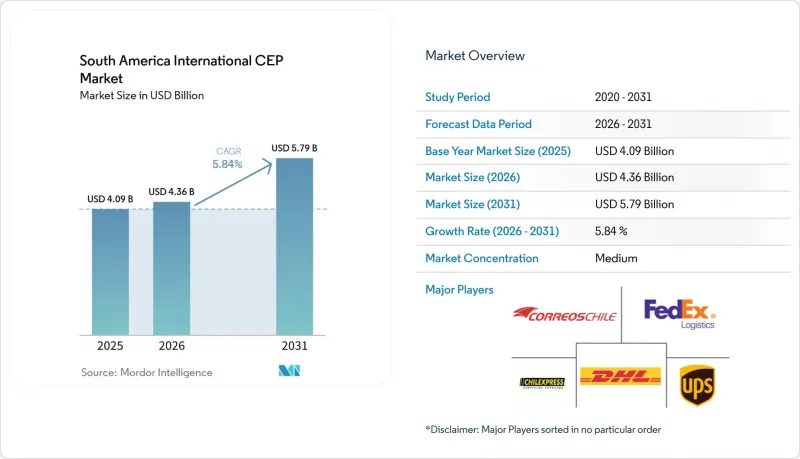
跨境電子商務、履約網路的擴張以及海關業務的現代化正在推動全部區域的小包裹流動。本報告按遞送速度(快遞、非快遞)、經營模式(B2B、B2C、C2C)、包裹重量(輕型、中型、其他)、運輸方式(空運、陸運、其他)、終端用戶行業(電子商務、金融服務/銀行、金融服務和保險、醫療保健、其他)以及國家/地區(阿根廷、巴西、智利、其他)進行細分。市場預測以美元計價。
南美國際CEP市場趨勢與洞察
跨境電子商務與數位貿易的擴張
跨境數位貿易的擴張正在推動南美洲對國際宅配、速遞和小包裹服務的需求。中國平台、歐洲時尚品牌和北美零售商正在全部區域拓展直接面對消費者 (D2C) 的服務。巴西的支付系統 Pix 正在幫助商家減少支付延遲並加快訂單處理速度。預計到 2025 年,秘魯的電子商務銷售額將達到 156 億美元,年增 21.2%。這一銷售額將佔其國內生產總值(GDP) 的 5.5%。頻繁的小額網購增加了每個家庭的包裹遞送次數。這一趨勢正在推動南美洲國際快遞、速遞和包裹服務 (CEP) 市場的發展,因為即使平均訂單金額有限,小包裹遞送頻率也會增加。
對限時國際運輸的需求日益成長。
對可靠配送日益成長的需求正推動服務產品轉型為指定配送時段的快遞貨物。製造商需要可預測的零件運輸,以保障按時生產。醫療保健機構也需要可靠的配送服務來進口對溫度敏感的藥品。這些需求使得服務品質、路線可靠性和清關流程比單純提案最低價格更為重要。承運商與工業和醫療保健客戶簽訂長期合約有利於南美國際快遞市場,因為這些合約可以降低收入受電子商務配送量短期波動的影響。
宏觀經濟波動與外匯風險
外匯波動使得跨境定價和承運商合約管理更加複雜。承運商可能以該地貨幣收取貨款,卻以美元支付燃油成本和飛機租賃費用。即使貨運量增加,這種貨幣錯配也會降低利潤率。亞洲和巴西之間不斷上漲的運輸成本限制了對低價進口商品的需求。阿根廷的財政狀況仍容易受到貿易波動和商品價格變動的影響。因此,南美國際快遞運輸市場必須在客戶的支付能力和保護承運商利潤率的需求之間取得平衡。
細分市場分析
2025年,非快遞服務佔南美洲國際快遞市場規模的76.70%。這種情況反映了對成本敏感的電子商務進口的重要性,以及服務分散人口所面臨的挑戰。經濟型服務對於無需固定送達時間的小包裹仍然發揮著至關重要的作用。阿根廷的農村地區、巴西內陸地區以及秘魯的高地走廊仍然依賴廣泛的郵政和公路網路。在預測期內,非特快服務的絕對量預計不會下降。由於該類別為大批量小包裹運輸提供了一種低成本的選擇,因此它將繼續對南美洲國際快遞市場至關重要。
預計到2031年,快遞服務將以6.76%的複合年成長率成長。這一成長主要由製造業和製藥業客戶的需求驅動,他們需要對進口貨物的時效性有較高要求。此外,願意為更短的交貨時間支付額外費用的消費者也青睞快遞服務。連接聖保羅、聖地牙哥和利馬與海外樞紐的新航空貨運航線將加速國際貨運速度。摩羯座雙洋走廊將成為未來跨越特定邊境路線的陸路運輸選擇。因此,預計南美國際快遞市場將在維持經濟型服務強勁基礎的同時,對營收成長做出更顯著的貢獻。
到2025年,B2C模式將佔據南美國際快遞市場52.66%的佔有率,預計到2031年將以6.93%的複合年成長率成長。這是最大的經營模式細分市場,也是成長最快的細分市場。直接面對消費者(D2C)模式使國際經銷商無需透過傳統的本地門市網路即可觸及買家。這也導致小包裹運輸頻率增加,需要進行清關、幹線運輸和最後一公里配送協調。在數位支付和平台履約日益普及的地區,B2C需求最為強勁。南美國際快遞業越來越依賴這種持續的小包裹需求。
對於進口零件、電子組件和化學原料的製造商而言,B2B 仍然至關重要。這些客戶通常使用合約式配送服務,並可能需要有保障的服務水準。 C2C 雖然規模較小,但主要服務於非正式的跨境經銷商,尤其是在巴西和巴拉圭之間以及阿根廷和智利之間的路線上。隨著平台將貨物運送到更靠近買家的位置,預置庫存正逐漸成為一種趨勢。這縮短了從下單到小包裹的交貨時間。在南美洲的國際快遞市場,由於 B2C、B2B 和 C2C 貨運對服務的要求和運輸模式各不相同,因此需要靈活的網路容量。
其他好處:
- Excel格式的市場預測(ME)表
- 3個月的分析師支持
目錄
第1章:引言
- 研究假設和市場定義
- 調查範圍
第2章:調查方法
第3章執行摘要
第4章 市場狀況
- 市場概覽
- 關鍵宏觀經濟指標(GDP、通貨膨脹率、國際貿易等)及其對市場的影響
- 市場促進因素
- 跨境電子商務與數位貿易的擴張
- 國際準時交貨的需求日益成長
- 海關數位化與貿易便利化改革
- 投資電子商務平台的履約
- 發展從南美洲到亞洲的航空貨運走廊
- 保稅微型樞紐和邊境履約
- 市場限制因素
- 宏觀經濟波動與外匯風險
- 道路、機場、邊境等基礎建設發展不平衡。
- 貨物竊盜和不斷上漲的安保成本
- 海關、稅務和承運人的數據標準存在差異。
- 價值鍊和通路分析
- 法律規範
- 技術展望
- 電子商務行業表現及概覽
- 波特五力分析
- 地緣政治事件對市場的影響
第5章 市場規模與成長預測
- 配送速度
- 表達
- 非加速
- 按經營模式
- 企業對企業 (B2B) 交易
- Business-to-Consumer(B2C)
- 個人對個人(C2C)交易
- 按運輸重量
- 輕量產品的出貨量
- 中等重量貨物
- 重型物品運輸
- 透過運輸方式
- 航空
- 路
- 其他
- 按最終用戶行業分類
- 電子商務
- 金融服務(BFSI)
- 衛生保健
- 製造業
- 一級產業
- 批發和零售貿易(線下)
- 其他
- 國家
- 阿根廷
- 巴西
- 智利
- 哥倫比亞
- 秘魯
- 其他南美國家
第6章 競爭情勢
- 市場集中度
- 關鍵策略趨勢
- 市佔率分析
- 公司簡介
- Empresa Brasileira de Correios e Telegrafos
- DHL Group
- FedEx Corporation
- United Parcel Service, Inc.
- Correo Argentino
- Correos de Chile
- Chilexpress SA
- Aramex International
- DSV A/S(Including DB Schenker)
- La Poste Group(Including GeoPost SA)
- CH Robinson Worldwide, Inc.
- Kuehne+Nagel International AG
- Nippon Express Co., Ltd.
- CMA CGM Group(Including CEVA Logistics)
- Mercado Libre, Inc.
- Total Express
- Andreani Logistica
- Azul Cargo Express
- SkyPostal, Inc.
- Alibaba Group(Including Cainiao Network)
- Urbano Express
- SF Express
第7章 市場機會與未來展望
According to Mordor Intelligence, the South America international CEP market size was valued at USD 4.09 billion in 2025, and it is expected to grow from USD 4.36 billion in 2026 to reach USD 5.79 billion in 2031, growing at a CAGR of 5.84% from 2026 to 2031.
Cross-border e-commerce, larger fulfillment networks, and customs modernization are supporting parcel flows across the region. This report is Segmented by Speed of Delivery (Express, Non-Express), by Business Model (B2B, B2C, C2C), by Shipment Weight (Light-Weight, Medium, and More), by Mode of Transport (Air, Road, Others), by End-User Industry (E-Commerce, Financial Services/BFSI, Healthcare, and More), and by Country (Argentina, Brazil, Chile, and More). The Market Forecasts are Provided in Terms of Value (USD).
South America International CEP Market Trends and Insights
Cross-Border E-Commerce and Digital-Trade Expansion
Cross-border digital trade is increasing the demand for international courier, express, and parcel services in South America. Chinese platforms, European fashion brands, and North American retailers are expanding direct-to-consumer fulfillment across the region. Brazil's Pix payment system reduces settlement delays for merchants and supports faster order processing. Peru recorded USD 15.6 billion in e-commerce sales in 2025, a 21.2% increase from the previous year, and those sales represented 5.5% of the national GDP. Smaller and more frequent online purchases are increasing the number of shipment events per household. This pattern supports the South America International CEP market because parcel frequency can rise even when the average order value remains limited.
Growing Demand for Time-Definite International Delivery
Demand for delivery certainty is shifting the service mix toward express products with specified delivery windows. Manufacturers need predictable transport for inbound parts that support scheduled production. Healthcare providers also need dependable delivery for temperature-sensitive pharmaceutical imports. These requirements make service quality, route reliability, and customs handling more important than a simple lowest-price offer. The South America International CEP market benefits when carriers secure longer-term contracts with industrial and healthcare customers. Such contracts can make revenue less exposed to changes in short-term e-commerce shipping volumes.
Macroeconomic Volatility and Foreign-Exchange Exposure
Currency movements make cross-border pricing and carrier contract management more difficult. Carriers may receive payment in local currencies while paying for fuel and aircraft leases in USD. This mismatch can reduce margins even when shipment volumes increase. Rising freight costs on the Asia-Brazil corridor are a constraint on lower-value import demand. Argentina's monetary conditions remain vulnerable to changes in trade conditions and commodity prices. The South America International CEP market must therefore balance customer affordability with the need to protect carrier margins.
Other drivers and restraints analyzed in the detailed report include:
- Customs Digitization and Trade-Facilitation Reforms
- E-Commerce Marketplace Fulfillment Investment
- Cargo Theft and Security-Cost Inflation
For complete list of drivers and restraints, kindly check the Table Of Contents.
Segment Analysis
Non-express services held 76.70% of the South America International CEP market size in 2025. This position reflects the importance of cost-sensitive e-commerce imports and the challenge of serving dispersed populations. Economy services remain relevant for parcels that do not require a fixed delivery time. Rural Argentina, inland Brazil, and Peru's highland corridors continue to depend on broad postal and road networks. Non-express volumes are not expected to decline in absolute terms during the forecast period. The category remains essential to the South America International CEP market because it provides the lower-cost option for high-volume parcel traffic.
Express services are forecast to grow at a 6.76% CAGR through 2031. This growth is supported by industrial and pharmaceutical customers that need time-defined inbound delivery. Express products also appeal to consumers willing to pay for shorter delivery windows. New air-cargo connections between Sao Paulo, Santiago, Lima, and overseas hubs can support faster international routing. The Capricorn Bi-Oceanic Corridor is a future surface option for selected cross-border routes. The South America International CEP market is therefore likely to retain a large economy-service base while express services make a larger contribution to revenue growth.
B2C held 52.66% of the South America International CEP market share in 2025 and is projected to grow at a 6.93% CAGR through 2031. It is the largest business-model segment and the fastest-growing segment. Direct-to-consumer retail gives international sellers access to buyers without a traditional local store network. It also creates a high frequency of smaller shipments that require customs, linehaul, and last-mile coordination. B2C demand is strongest where digital payments and platform fulfillment are becoming more widely used. The South America International CEP industry depends increasingly on this type of recurring parcel demand.
B2B remains important for manufacturers that import components, electronics subassemblies, and chemical inputs. These customers often use contracted delivery services and may require service-level commitments. C2C is smaller but serves informal cross-border sellers, especially on the Brazil-Paraguay and Argentina-Chile corridors. A gradual shift toward pre-positioned inventory as platforms move goods closer to buyers. This can reduce delivery time between order placement and parcel collection. The South America International CEP market will need flexible network capacity because B2C, B2B, and C2C shipments have different service expectations and shipment patterns.
Complete Report Scope:
- By Speed of Delivery
- Express
- Non-Express
- By Business Model
- Business-to-Business (B2B)
- Business-to-Consumer (B2C)
- Consumer-to-Consumer (C2C)
- By Shipment Weight
- Light-Weight Shipments
- Medium-Weight Shipments
- Heavy-Weight Shipments
- By Mode of Transport
- Air
- Road
- Others
- By End-User Industry
- E-Commerce
- Financial Services (BFSI)
- Healthcare
- Manufacturing
- Primary Industry
- Wholesale and Retail Trade (Offline)
- Others
- By Country
- Argentina
- Brazil
- Chile
- Colombia
- Peru
- Rest of South America
List of Companies Covered in this Report:
- Empresa Brasileira de Correios e Telegrafos
- DHL Group
- FedEx Corporation
- United Parcel Service, Inc.
- Correo Argentino
- Correos de Chile
- Chilexpress S.A.
- Aramex International
- DSV A/S (Including DB Schenker)
- La Poste Group (Including GeoPost SA)
- C.H. Robinson Worldwide, Inc.
- Kuehne + Nagel International AG
- Nippon Express Co., Ltd.
- CMA CGM Group (Including CEVA Logistics)
- Mercado Libre, Inc.
- Total Express
- Andreani Logistica
- Azul Cargo Express
- SkyPostal, Inc.
- Alibaba Group (Including Cainiao Network)
- Urbano Express
- SF Express
Additional Benefits:
- The market estimate (ME) sheet in Excel format
- 3 months of analyst support
TABLE OF CONTENTS
1 INTRODUCTION
- 1.1 Study Assumptions and Market Definition
- 1.2 Scope of the Study
2 RESEARCH METHODOLOGY
3 EXECUTIVE SUMMARY
4 MARKET LANDSCAPE
- 4.1 Market Overview
- 4.2 Key Macroeconomic Factors (GDP, Inflation, International Trades etc.) and their Impact on the Market
- 4.3 Market Drivers
- 4.3.1 Cross-Border E-Commerce and Digital-Trade Expansion
- 4.3.2 Growing Demand for Time-Definite International Delivery
- 4.3.3 Customs Digitization and Trade-Facilitation Reforms
- 4.3.4 E-Commerce Marketplace Fulfillment Investment
- 4.3.5 South America-to-Asia Air-Cargo Corridor Development
- 4.3.6 Bonded Micro-Hubs and Border-Adjacent Fulfillment
- 4.4 Market Restraints
- 4.4.1 Macroeconomic Volatility and Foreign-Exchange Exposure
- 4.4.2 Uneven Road, Airport and Border Infrastructure
- 4.4.3 Cargo Theft and Security-Cost Inflation
- 4.4.4 Fragmented Customs, Tax and Carrier-Data Standards
- 4.5 Value Chain and Distribution Channel Analysis
- 4.6 Regulatory Framework
- 4.7 Technological Outlook
- 4.8 E-commerce Industry Performance and Profile
- 4.9 Porter's Five Forces Analysis
- 4.9.1 Threat of New Entrants
- 4.9.2 Bargaining Power of Suppliers
- 4.9.3 Bargaining Power of Buyers
- 4.9.4 Threat of Substitutes
- 4.9.5 Competitive Rivalry
- 4.10 Impact of Geopolitical Events on the Market
5 MARKET SIZE AND GROWTH FORECASTS (Value, USD)
- 5.1 By Speed of Delivery
- 5.1.1 Express
- 5.1.2 Non-Express
- 5.2 By Business Model
- 5.2.1 Business-to-Business (B2B)
- 5.2.2 Business-to-Consumer (B2C)
- 5.2.3 Consumer-to-Consumer (C2C)
- 5.3 By Shipment Weight
- 5.3.1 Light-Weight Shipments
- 5.3.2 Medium-Weight Shipments
- 5.3.3 Heavy-Weight Shipments
- 5.4 By Mode of Transport
- 5.4.1 Air
- 5.4.2 Road
- 5.4.3 Others
- 5.5 By End-User Industry
- 5.5.1 E-Commerce
- 5.5.2 Financial Services (BFSI)
- 5.5.3 Healthcare
- 5.5.4 Manufacturing
- 5.5.5 Primary Industry
- 5.5.6 Wholesale and Retail Trade (Offline)
- 5.5.7 Others
- 5.6 By Country
- 5.6.1 Argentina
- 5.6.2 Brazil
- 5.6.3 Chile
- 5.6.4 Colombia
- 5.6.5 Peru
- 5.6.6 Rest of South America
6 COMPETITIVE LANDSCAPE
- 6.1 Market Concentration
- 6.2 Key Strategic Moves
- 6.3 Market Share Analysis
- 6.4 Company Profiles (includes Global Level Overview, Market Level Overview, Core Segments, Financials as available, Strategic Information, Geographic Coverage, Products and Services, Recent Developments)
- 6.4.1 Empresa Brasileira de Correios e Telegrafos
- 6.4.2 DHL Group
- 6.4.3 FedEx Corporation
- 6.4.4 United Parcel Service, Inc.
- 6.4.5 Correo Argentino
- 6.4.6 Correos de Chile
- 6.4.7 Chilexpress S.A.
- 6.4.8 Aramex International
- 6.4.9 DSV A/S (Including DB Schenker)
- 6.4.10 La Poste Group (Including GeoPost SA)
- 6.4.11 C.H. Robinson Worldwide, Inc.
- 6.4.12 Kuehne + Nagel International AG
- 6.4.13 Nippon Express Co., Ltd.
- 6.4.14 CMA CGM Group (Including CEVA Logistics)
- 6.4.15 Mercado Libre, Inc.
- 6.4.16 Total Express
- 6.4.17 Andreani Logistica
- 6.4.18 Azul Cargo Express
- 6.4.19 SkyPostal, Inc.
- 6.4.20 Alibaba Group (Including Cainiao Network)
- 6.4.21 Urbano Express
- 6.4.22 SF Express
7 MARKET OPPORTUNITIES AND FUTURE OUTLOOK
- 7.1 White-Space and Unmet-Need Assessment

 文件遞送服務市場:全球市場預測,2026-2032年
 本地化包裹退回集中服務市場預測至2034年-按收集點類型、退回處理服務、運輸模式、客戶類型、服務覆蓋範圍和區域分類的全球分析本地小包裹聚合服務市場:預測(至 2034 年)-按服務類型、配送模式、客戶類型、配送週期、最終用戶和地區分類的全球分析城市配送服務市場:全球市場預測,2026-2032年
 南美國內CEP:市場佔有率分析、產業趨勢與統計、成長預測(2026-2031年)美國國際快遞小包裹宅配(CEP):市場佔有率分析、行業趨勢和統計數據以及成長預測(2026-2031 年)印度國內宅配和小包裹(CEP):市場佔有率分析、行業趨勢和統計數據以及成長預測(2026-2031 年)日本國內宅配、快捷郵件和小包裹:市場佔有率分析、行業趨勢和統計數據以及成長預測(2026-2031 年)
 小包裹遞送市場規模、佔有率和成長分析:按服務類型、遞送速度、小包裹重量、最終用戶、運輸方式和地區分類-2026-2033年產業預測視訊串流平台:市場佔有率分析、產業趨勢與統計、成長預測(2026-2031)