


 |
市場調查報告書
商品編碼
2155681
南美國內CEP:市場佔有率分析、產業趨勢與統計、成長預測(2026-2031年)South America Domestic CEP - Market Share Analysis, Industry Trends & Statistics, Growth Forecasts (2026 - 2031) |
||||||

※ 本網頁內容可能與最新版本有所差異。詳細情況請與我們聯繫。
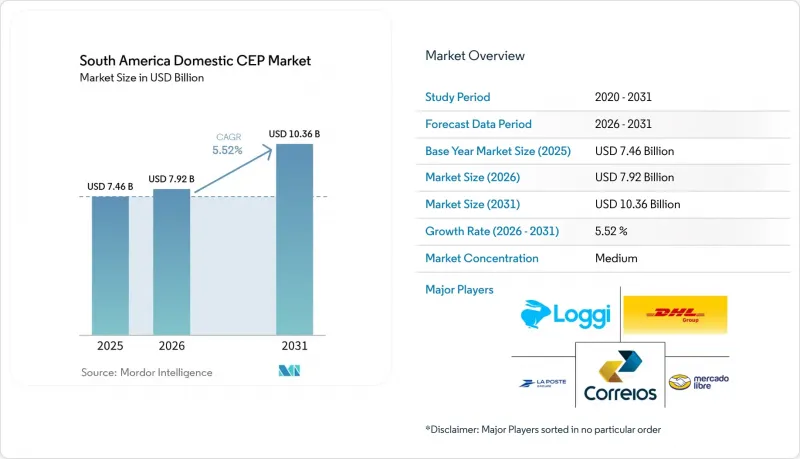
據 Mordor Intelligence 稱,2025 年南美洲 CEP 市值為 74.6 億美元,預計到 2031 年將從 2026 年的 79.2 億美元成長至 103.6 億美元,預測期(2026-2031 年)複合年成長率為 5.52%。
南美CEP市場的趨勢與洞察
電子商務小包裹密度與市場驅動的履約擴張
在南美CEP市場,電子商務仍是國內小包裹需求的主要來源。 MercadoLibre在2025年第四季每秒處理95個訂單,並將履約中心擴展至27個地點,使得巴西境內75%的訂單在48小時內送達。該公司宣布了2026年投資計劃,目標是建造42個配送中心,顯示其平台履約能力將持續擴張。 Shopee在2026年開設了三個履約中心,其履約網路的訂單量在過去12個月中增加了15倍。根據Loggi的數據顯示,2026年上半年,巴西中小企業使用PUDO(自提點)的數量較去年同期成長了53%。隨著對平台的投資,網路容量的責任正從承運商向平台轉移,數位化和營運整合對於承運商處理大量包裹變得日益重要。
即時支付的廣泛應用使得訂單出貨速度更快。
巴西的Pix系統在2025年處理了約800億筆交易,比2024年成長了25.7%。其中,消費者對企業的支付佔總交易量的43%。即時驗證消除了以往因匹配延遲而導致的訂單出貨前積壓問題。 DHL Express巴西公司於2026年2月整合了dLocal和Pix的支付處理系統,整合後,Pix的支付量成長了400%。 DHL也報告稱,線上支付率提高了31%,小包裹遞送時間也縮短了。 Ebanx預測,到2026年底,Pix在巴西線上銷售的佔比將達到45%,高於2025年的42%。哥倫比亞和智利的支付系統也可能出現類似的改進,但這些國家的普及速度預計將落後於巴西。
燃油價格、稅金和外匯波動
2026年初的供應中斷導致石油成本上漲,巴西柴油價格飆漲超過20%。巴西國家運輸和運輸管理局(ANTT)設定了公路貨運費率4.8%至7%的最低漲幅,但柴油成本對長途運輸公司而言仍然是一筆不小的開支。智利在燃油價格穩定計畫逐步取消後,也經歷了燃油價格的急劇上漲。對於淨利率在3%至7%之間的業者而言,應對這些價格波動的空間有限。在阿根廷,外匯波動增加了以該地貨幣的業者進口原料的成本。如果中小運輸公司的合約中沒有包含應對燃油價格或通貨膨脹的保護條款,它們將面臨更大的行業整合壓力。
細分市場分析
至2025年,非特快服務在南美洲國內快遞市場中佔比高達77.40%。經濟型配送非常適合對成本敏感的消費者以及優先考慮總運輸成本而非速度的供應鏈。這項收入基礎使承運商能夠提高航線密度並維持廣泛的網路覆蓋範圍。如此龐大的貨運量也支撐了主要航線上高速服務的獲利能力。這使得營運商能夠利用其龐大的貨運基礎,開發速度更快的服務。
預計2026年至2031年間,快遞業務將以6.44%的複合年成長率成長。對更短配送時間的需求正從巴西主要城市蔓延至區域城市和鄰國。 MercadoLibre在2025年創下的48小時送達紀錄,充分展現了該平台營運商的服務標準。預計在人口稠密的都市區,快遞服務的普及率將保持最高,因為這些地區的配送量足以支撐其成本。同時,預計小規模的城市將更加依賴非快遞服務。這種差異促使營運商需要在同一網路中管理不同的服務模式。
2025年,B2C模式在南美洲國內包裹遞送(CEP)市場規模中佔比達53.17%。 B2C也是成長最快的經營模式,預計到2031年複合年成長率將達到6.61%。消費者電子商務帶來了穩定的小包裹需求,這得益於小規模線上經銷商群體的不斷壯大。 Pix簡化了結帳流程,縮短了從支付完成訂單到配送網路的交貨時間。此外,它還強調了賣家和承運商之間可靠的即時數據交換的重要性。
B2B業務繼續為零件補貨、工業物流和文件運輸提供支援。然而,隨著數位化採購和履約取代部分傳統批發流程,其相對貢獻下降。 C2C服務由轉售平台和零工物流應用提供支持,但規模仍然較小,單小包裹收入也較低。關於消費者退貨,巴西《消費者保護法》帶來了新的營運要求。承運商需要準確計算退貨運費,以維持B2C業務的盈利。這些營運要求對消費者通路提出了比單純基於貨運量預期更為嚴格的要求。
其他好處:
- Excel格式的市場預測(ME)表
- 3個月的分析師支持
目錄
第1章:引言
- 研究假設和市場定義
- 調查範圍
第2章:調查方法
第3章執行摘要
第4章 市場狀況
- 市場概覽
- 關鍵宏觀經濟指標(GDP、通貨膨脹率等)及其對市場的影響
- 市場促進因素
- 電子商務小包裹密度與市場驅動的履約擴張
- 引入即時支付方式將加快訂單處理速度。
- 主要都會區對當日/隔日送達的期望
- 對交通走廊和多模態基礎設施的投資
- 暗店和微型倉配的擴張
- 醫療用品、生鮮食品和溫控小包裹。
- 市場限制因素
- 燃油價格、稅制和外匯的波動
- 道路品質、交通堵塞以及向偏遠地區運送物資的限制
- 小包裹盜竊、詐騙和安全成本
- 電池單元供應狀況及電氣化準備狀況
- 價值鍊和通路分析
- 法律規範
- 技術展望
- 電子商務行業表現及概覽
- 波特五力分析
- 地緣政治事件對市場的影響
第5章 市場規模與成長預測
- 配送速度
- 表達
- 非加速
- 按經營模式
- 企業對企業 (B2B) 交易
- Business-to-Consumer(B2C)
- 個人對個人(C2C)交易
- 按運輸重量
- 輕量產品的出貨量
- 中等重量貨物
- 重型物品運輸
- 透過運輸方式
- 航空
- 路
- 其他
- 按最終用戶行業分類
- 電子商務
- 金融服務(BFSI)
- 衛生保健
- 製造業
- 一級產業
- 批發和零售貿易(線下)
- 其他
- 國家
- 阿根廷
- 巴西
- 智利
- 哥倫比亞
- 秘魯
- 其他南美國家
第6章 競爭情勢
- 市場集中度
- 關鍵策略趨勢
- 市佔率分析
- 公司簡介
- Empresa Brasileira de Correios e Telegrafos
- MercadoLibre, Inc.
- Loggi Tecnologia Ltda.
- Total Express
- La Poste Group(Including DPD Group)
- DHL Group
- FedEx
- United Parcel Service of America, Inc.(UPS)
- Azul Linhas Aereas Brasileiras SA
- GOL Linhas Aereas SA
- Braspress Transportes Urgentes Ltda.
- Jamef Transportes Ltda.
- Rodonaves Transportes e Encomendas Ltda.
- Sequoia Logistica e Transportes SA
- Grupo Logistico Andreani
- Correo Argentino
- Chilexpress SA
- Correos de Chile
- Patrus Transportes
- DSV A/S
- Alfa Transportes
第7章 市場機會與未來展望
According to Mordor Intelligence, the South America domestic CEP market size was valued at USD 7.46 billion in 2025 and is estimated to grow from USD 7.92 billion in 2026 to reach USD 10.36 billion by 2031, at a CAGR of 5.52% during the forecast period (2026-2031).
South America Domestic CEP Market Trends and Insights
E-Commerce Parcel Density and Marketplace Fulfillment Expansion
E-commerce remained the primary source of domestic parcel demand across the South America domestic CEP market. MercadoLibre processed 95 orders per second in the fourth quarter of 2025 and delivered 75% of Brazilian orders within 48 hours after expanding to 27 fulfillment centers. The company announced an investment plan for 2026 targeting 42 distribution centers, and indicating continued expansion of marketplace fulfillment capacity. Shopee opened 3 fulfillment centers in 2026, and its fulfillment-network order volume increased 15 times over the preceding 12 months. Loggi reported that PUDO point use among Brazilian small and medium-sized businesses increased 53% year over year in the first half of 2026. Platform investment shifted more responsibility for network capacity from carriers to marketplaces, making carrier access to volume more dependent on digital and operational integration.
Instant-Payment Adoption Enabling Faster Order Release
Brazil's Pix system processed nearly 80 billion transactions in 2025, up 25.7% from 2024, while consumer-to-business payments represented 43% of its transactions. Immediate confirmation removed reconciliation delays that had previously held orders before dispatch. DHL Express Brazil integrated Pix processing with dLocal in February 2026, and its Pix payment volume increased 400% after the integration. DHL also reported a 31% rise in its online payment rate and shorter parcel release times. Ebanx plans Pix to account for 45% of Brazil's online sales by the end of 2026, compared with 42% in 2025. Payment systems in Colombia and Chile could support comparable improvements, although their adoption curves were expected to follow Brazil's later.
Fuel-Price, Tax, and Currency Volatility
A supply disruption in early 2026 raised oil costs and lifted diesel prices in Brazil by more than 20%. Brazil's ANTT required minimum road freight rate increases of 4.8% to 7%, but diesel remained a major cost for long-haul carriers. Chile also faced sharp fuel-price increases after its fuel-stabilization scheme was wound down. Operators with net margins of 3% to 7% had limited capacity to absorb these changes. Currency movements in Argentina raised the cost of imported inputs for providers earning local-currency revenue. Smaller carriers faced greater consolidation pressure where contracts lacked fuel or inflation protection.
Other drivers and restraints analyzed in the detailed report include:
- Same-Day and Next-Day Delivery Expectations in Major Urban Corridors
- Dark-Store and Micro-Fulfillment Expansion
- Road Quality, Congestion, and Remote-Area Delivery Constraints
For complete list of drivers and restraints, kindly check the Table Of Contents.
Segment Analysis
Non-express services held 77.40% of the South America domestic CEP market share in 2025. Economy shipping suited cost-sensitive consumers and supply chains that placed greater weight on total freight expense than speed. This revenue base helped carriers build route density and retain broad network coverage. The scale of these flows also supported the economics of faster services on common routes. It gave providers a broad shipment base from which to develop higher-speed products.
Express delivery was forecast to grow at a 6.44% CAGR from 2026 to 2031. Demand for shorter delivery windows was spreading from the largest Brazilian cities toward secondary cities and neighboring countries. MercadoLibre's 48-hour performance in 2025 illustrated the service standard that platform operations were setting. Express adoption was likely to remain strongest in dense urban areas where delivery volumes could support the required cost base. Smaller cities were expected to retain a greater reliance on non-express services. This difference required providers to manage separate service models within the same network.
B2C accounted for 53.17% of the South America domestic CEP market size in 2025. It was also the fastest-growing business model, with a forecast CAGR of 6.61% through 2031. Consumer e-commerce created steady parcel demand across a growing base of small online sellers. Pix reduced checkout friction and shortened the time needed to release paid orders to the delivery network. It also increased the importance of dependable real-time data exchange between sellers and carriers.
B2B continued to support parts replenishment, industrial distribution, and document transport. Its relative contribution was under pressure as digital procurement and marketplace fulfillment replaced some traditional wholesale flows. C2C services were supported by resale platforms and gig-delivery applications, although they remained smaller and had lower revenue per parcel. Consumer returns created an additional operating requirement under Brazil's Consumer Defense Code. Carriers needed to price return movements accurately to protect B2C profitability. These operational needs made consumer channels more demanding than simple outbound delivery volumes suggested.
Complete Report Scope:
- By Speed of Delivery
- Express
- Non-Express
- By Business Model
- Business-to-Business (B2B)
- Business-to-Consumer (B2C)
- Consumer-to-Consumer (C2C)
- By Shipment Weight
- Light-Weight Shipments
- Medium-Weight Shipments
- Heavy-Weight Shipments
- By Mode of Transport
- Air
- Road
- Others
- By End-User Industry
- E-Commerce
- Financial Services (BFSI)
- Healthcare
- Manufacturing
- Primary Industry
- Wholesale and Retail Trade (Offline)
- Others
- By Country
- Argentina
- Brazil
- Chile
- Colombia
- Peru
- Rest of South America
List of Companies Covered in this Report:
- Empresa Brasileira de Correios e Telegrafos
- MercadoLibre, Inc.
- Loggi Tecnologia Ltda.
- Total Express
- La Poste Group (Including DPD Group)
- DHL Group
- FedEx
- United Parcel Service of America, Inc. (UPS)
- Azul Linhas Aereas Brasileiras S.A.
- GOL Linhas Aereas S.A.
- Braspress Transportes Urgentes Ltda.
- Jamef Transportes Ltda.
- Rodonaves Transportes e Encomendas Ltda.
- Sequoia Logistica e Transportes S.A.
- Grupo Logistico Andreani
- Correo Argentino
- Chilexpress S.A.
- Correos de Chile
- Patrus Transportes
- DSV A/S
- Alfa Transportes
Additional Benefits:
- The market estimate (ME) sheet in Excel format
- 3 months of analyst support
TABLE OF CONTENTS
1 INTRODUCTION
- 1.1 Study Assumptions and Market Definition
- 1.2 Scope of the Study
2 RESEARCH METHODOLOGY
3 EXECUTIVE SUMMARY
4 MARKET LANDSCAPE
- 4.1 Market Overview
- 4.2 Key Macroeconomic Factors (GDP, Inflation, etc.) and their Impact on the Market
- 4.3 Market Drivers
- 4.3.1 E-Commerce Parcel Density and Marketplace Fulfillment Expansion
- 4.3.2 Instant-Payment Adoption Enabling Faster Order Release
- 4.3.3 Same-Day and Next-Day Delivery Expectations in Major Urban Corridors
- 4.3.4 Transport-Corridor and Multimodal Infrastructure Investment
- 4.3.5 Dark-Store and Micro-Fulfillment Expansion
- 4.3.6 Healthcare, Perishables and Temperature-Controlled Parcel Demand
- 4.4 Market Restraints
- 4.4.1 Fuel-Price, Tax and Currency Volatility
- 4.4.2 Road Quality, Congestion and Remote-Area Delivery Constraints
- 4.4.3 Parcel-Theft, Fraud and Security Costs
- 4.4.4 Battery-Cell Availability and Electrification Readiness
- 4.5 Value Chain and Distribution Channel Analysis
- 4.6 Regulatory Framework
- 4.7 Technological Outlook
- 4.8 E-commerce Industry Performance and Profile
- 4.9 Porter's Five Forces Analysis
- 4.9.1 Threat of New Entrants
- 4.9.2 Bargaining Power of Suppliers
- 4.9.3 Bargaining Power of Buyers
- 4.9.4 Threat of Substitutes
- 4.9.5 Competitive Rivalry
- 4.10 Impact of Geopolitical Events on the Market
5 MARKET SIZE AND GROWTH FORECASTS (Value, USD)
- 5.1 By Speed of Delivery
- 5.1.1 Express
- 5.1.2 Non-Express
- 5.2 By Business Model
- 5.2.1 Business-to-Business (B2B)
- 5.2.2 Business-to-Consumer (B2C)
- 5.2.3 Consumer-to-Consumer (C2C)
- 5.3 By Shipment Weight
- 5.3.1 Light-Weight Shipments
- 5.3.2 Medium-Weight Shipments
- 5.3.3 Heavy-Weight Shipments
- 5.4 By Mode of Transport
- 5.4.1 Air
- 5.4.2 Road
- 5.4.3 Others
- 5.5 By End-User Industry
- 5.5.1 E-Commerce
- 5.5.2 Financial Services (BFSI)
- 5.5.3 Healthcare
- 5.5.4 Manufacturing
- 5.5.5 Primary Industry
- 5.5.6 Wholesale and Retail Trade (Offline)
- 5.5.7 Others
- 5.6 By Country
- 5.6.1 Argentina
- 5.6.2 Brazil
- 5.6.3 Chile
- 5.6.4 Colombia
- 5.6.5 Peru
- 5.6.6 Rest of South America
6 COMPETITIVE LANDSCAPE
- 6.1 Market Concentration
- 6.2 Key Strategic Moves
- 6.3 Market Share Analysis
- 6.4 Company Profiles (Includes Global Level Overview, Market Level Overview, Core Segments, Financials as Available, Strategic Information, Geographic Coverage, Products and Services, Recent Developments)
- 6.4.1 Empresa Brasileira de Correios e Telegrafos
- 6.4.2 MercadoLibre, Inc.
- 6.4.3 Loggi Tecnologia Ltda.
- 6.4.4 Total Express
- 6.4.5 La Poste Group (Including DPD Group)
- 6.4.6 DHL Group
- 6.4.7 FedEx
- 6.4.8 United Parcel Service of America, Inc. (UPS)
- 6.4.9 Azul Linhas Aereas Brasileiras S.A.
- 6.4.10 GOL Linhas Aereas S.A.
- 6.4.11 Braspress Transportes Urgentes Ltda.
- 6.4.12 Jamef Transportes Ltda.
- 6.4.13 Rodonaves Transportes e Encomendas Ltda.
- 6.4.14 Sequoia Logistica e Transportes S.A.
- 6.4.15 Grupo Logistico Andreani
- 6.4.16 Correo Argentino
- 6.4.17 Chilexpress S.A.
- 6.4.18 Correos de Chile
- 6.4.19 Patrus Transportes
- 6.4.20 DSV A/S
- 6.4.21 Alfa Transportes
7 MARKET OPPORTUNITIES AND FUTURE OUTLOOK
- 7.1 White-Space and Unmet-Need Assessment

 文件遞送服務市場:全球市場預測,2026-2032年
 本地化包裹退回集中服務市場預測至2034年-按收集點類型、退回處理服務、運輸模式、客戶類型、服務覆蓋範圍和區域分類的全球分析本地小包裹聚合服務市場:預測(至 2034 年)-按服務類型、配送模式、客戶類型、配送週期、最終用戶和地區分類的全球分析城市配送服務市場:全球市場預測,2026-2032年
 國際CEP在南美洲的市佔率分析、產業趨勢與統計、成長預測(2026-2031年)美國國際快遞小包裹宅配(CEP):市場佔有率分析、行業趨勢和統計數據以及成長預測(2026-2031 年)印度國內宅配和小包裹(CEP):市場佔有率分析、行業趨勢和統計數據以及成長預測(2026-2031 年)日本國內宅配、快捷郵件和小包裹:市場佔有率分析、行業趨勢和統計數據以及成長預測(2026-2031 年)
 小包裹遞送市場規模、佔有率和成長分析:按服務類型、遞送速度、小包裹重量、最終用戶、運輸方式和地區分類-2026-2033年產業預測視訊串流平台:市場佔有率分析、產業趨勢與統計、成長預測(2026-2031)