


 |
市場調查報告書
商品編碼
2118021
視訊串流平台:市場佔有率分析、產業趨勢與統計、成長預測(2026-2031)Video Delivery Platform - Market Share Analysis, Industry Trends & Statistics, Growth Forecasts (2026 - 2031) |
||||||

※ 本網頁內容可能與最新版本有所差異。詳細情況請與我們聯繫。
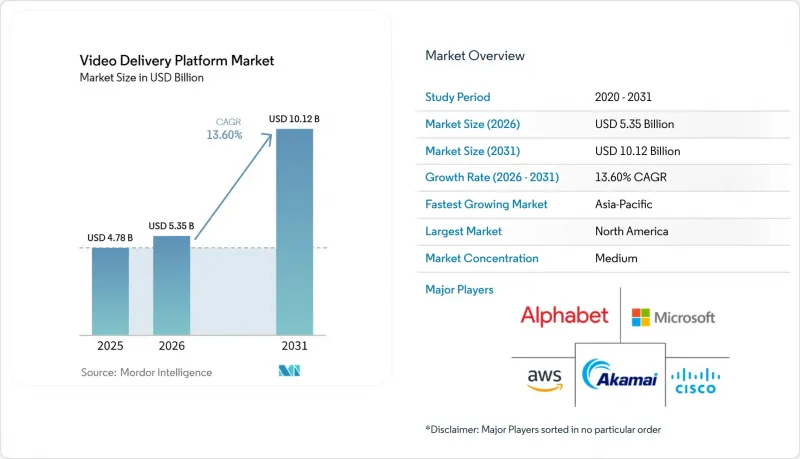
根據 Mordor Intelligence 預測,影片串流平台市場規模將從 2025 年的 47.8 億美元成長到 2026 年的 53.5 億美元,到 2031 年達到 101.2 億美元,2026 年至 2031 年的複合年成長率為 13.60%。
本報告按組件(平台和服務)、串流媒體類型(直播和視訊點播 (VOD))、收入模式(訂閱式視訊點播 (SVOD)、廣告支援式串流媒體 (AVOD)、混合盈利模式等)、最終用戶(媒體和娛樂、數位學習和教育、金融、保險和證券 (BFSI) 等)以及地區進行細分。市場預測以美元 (USD) 計價。
全球影片串流平台市場趨勢及洞察
體育賽事轉播和直播的商業化正在推動基礎設施投資。
直播體育賽事和高階活動是影片串流平台市場需求的核心。這是因為版權所有擁有者需要在短時間內集中出現的收視高峰期擁有可靠的容量。預計到2026年,串流媒體服務在體育賽事轉播權上的支出將達到142億美元,高於2025年的132億美元。 2026年,亞馬遜Prime Video預計將佔串流服務體育賽事轉播權總支出的38億美元(27%)。每份轉播權協定都需要用於內容擷取、轉碼、來源站和內容傳遞網路(CDN)的容量。即使賽事舉辦頻率不高,平台也需要在流量高峰確保容量。這為服務提供者提供了透過CDN即服務出租閒置容量的機會。
對低延遲直播日益成長的需求正在重塑協議標準。
觀眾對延遲的期望已經超過了傳統HTTP自我調整串流媒體所能承受的水平,這使得整個影片串流平台市場迫切需要升級。基於QUIC的媒體傳輸技術於2026年5月開始商業化生產,BEAM Media Corp.報告稱,其在210個國家的直播串流中實現了低於100毫秒的端到端延遲。 2026年, Oracle擴展了其視訊邊緣架構,並利用基於QUIC的媒體傳輸技術作為協作手段,以支援跨第三方內容傳遞網路和網際服務供應商(ISP)網路的繼電器部署。該協議消除了HLS和DASH中存在的固定分段時間限制。此外,物件式的傳輸方式允許以更短的間隔調整影像質量,這在互動式影片和社交商務環境中至關重要,因為延遲會影響觀眾的參與度和交易完成度。
頻寬、轉碼和出口成本的激增正在阻礙利潤率的成長。
大規模影片傳輸成本仍然是營運商面臨的一大挑戰,影片傳輸平台市場必須在不影響傳輸品質的前提下應對這一壓力。截至2026年,AWS CloudFront對每月前10TB的傳輸流量收取每GB 0.085美元的收費。亞太和南美地區的出口流量費用是北美基準值的2到4倍。歐盟資料法預計2027年1月起禁止符合資格的供應商向歐盟客戶收取雲端交換和出口流量費用。這項規定可能會改變與歐洲供應商的談判,但並不能解決其他地區的結構性傳輸成本問題。為了遏止成本上漲,電信業者正在採用內容感知編碼、邊緣快取和儲存配置等方式來規避出口流量費用。
細分市場分析
到2025年,平台細分市場將佔據影片串流平台市場佔有率的58.36%,涵蓋內容擷取、擷取、處理、編碼、轉碼、分析、體驗品質 (QoE) 監控和內容安全等各個面向。企業負責人傾向於選擇整合式供應商技術堆疊,以減少整個影片工作流程中的整合工作,並明確營運職責。平台細分市場也專注於影響影片串流平台市場交付品質的技術,包括內容採集、播放保護和會話監控等。隨著企業內部營運模式管理難度日益增加,包括專業服務和託管服務在內的服務市場預計將以14.18%的複合年成長率成長至2031年。由於需要進行多CDN整合、AI模型管理和持續的即時運營,專家支援對於沒有大規模專業團隊的組織而言價值日益凸顯。
隨著人工智慧驅動的任務被添加到託管產品中,平台軟體和託管服務之間的界線變得模糊。以前由託管服務團隊處理的功能現在可以整合到自動化的即時營運工作流程中,這導致業務收益減少,但平台提供者的合約總價值卻有所增加。 GDPR 的要求以及各國正在發展的人工智慧管治框架也催生了對專業服務的需求,以評估內容審核和分析模組。隨著企業使用 SRT 和 RTMP 協定的 IP 工作流程取代專用衛星或光纖傳輸線路,對資料擷取和擷取能力的投資也日益受到重視。在 2026 年 NAB 展會上,Harmonic Drive Systems 宣布對其 VOS360 進行增強,包括人工智慧驅動的編配和用於串流內廣告的伺服器端多視圖功能。
到2025年,視訊點播(VOD)將佔影片串流平台市場的68.74%,這反映了全球訂閱制串流服務累積的龐大片庫以及對源站和內容分發網路(CDN)的持續需求。其大規模的部署基礎意味著,即使其相對佔有率成長放緩,VOD仍將在2031年之前保持最大的絕對收入貢獻者地位。 2024年,歐洲視聽市場以年均外匯計算達1,420億歐元(1,535億美元),其中消費者串流支出超過720億歐元(7,79億美元)。如此龐大的點播觀看群體要求整個影片串流平台市場持續投資於來源站容量、儲存管理、傳輸容錯能力和播放品質。服務供應商正透過提高快取效率、多區域來源站複製以及採用AV1等方式,在控制流量成本的同時保持穩定的品質。
預計到2031年,直播影片串流將以14.55%的複合年成長率成長,主要成長動力來自體育賽事轉播權、企業傳播、數位學習和現場零售活動。互動廣告局(IAB)預測,到2026年,包括直播在內的數位影片支出將年增11%,佔電視和影片總支出的60%以上。直播工作流程需要低延遲的攝取、即時編碼、動態內容傳送配置以及無法預先快取的冗餘容錯移轉路徑。這些要求使直播操作區別於傳統的按需分發儲存庫。採用基於QUIC的媒體傳輸、亞秒打包和彈性雲突發轉碼技術的平台更有優勢贏得對延遲要求嚴格的合約。
區域分析
預計到2025年,北美將佔據視訊分發平台市場37.68%的佔有率。這主要得益於該地區超大規模CDN基礎設施的集中部署、高階訂閱串流媒體服務的普及、對體育領域的投資以及企業視訊的廣泛應用。預計到2026年,串流媒體提供商將在體育賽事轉播權上投入142億美元,這將推動內容採集、轉碼、源站和分發等環節的容量需求成長。北美地區的平台可輕鬆接入領先的AWS、Akamai和Google Cloud資料中心網路,並且北美供應商率先採用了基於QUIC傳輸的媒體傳輸、伺服器端廣告插入以及其他功能主導的分發方式。墨西哥正透過專注於行動裝置的串流媒體計畫和與美國相容的內容版權分配方案來拓展市場。
預計到2031年,亞太地區的複合年成長率將達到14.38%,其中印度和東南亞預計將佔據最大的需求佔有率。 JioHotstar在2027會計年度第一季的每月有效用戶平均達到5.3億。 2026年印度板球超級聯賽(IPL)的數位觀眾人數達到7億,峰值同時線上觀看人數達到7250萬。這給直播平台帶來了嚴峻的挑戰,需要進行大規模的容量規劃。區域語言和地理的多樣性也推動了對本地化內容、廣泛的CDN節點覆蓋以及針對行動觀看最佳化的編碼方案的需求。 2026年2月,AWS將Elemental Media Services擴展到亞太地區的馬來西亞區域,使廣播公司能夠更靠近其東南亞觀眾處理影片。
歐洲擁有大規模的視聽經濟和成熟的串流消費習慣,預計在2025年將佔據影片串流平台市場的重要佔有率。德國、英國、法國、義大利和西班牙佔據了西歐串流媒體消費的大部分佔有率,而東歐市場則在低滲透率的基礎上持續成長。 Synamedia和MoMe於2026年3月透過「Synamedia Fluid EdgeCDN」在西班牙推出了首個串流最佳化CDN服務,該服務將在西班牙境內提供低延遲影片,並為更廣泛的歐洲市場提供多CDN分發。中東和非洲仍處於發展初期,對數位媒體的投資正在創造新的需求。同時,在南美洲,大型體育賽事推動了串流媒體的擴張,並增加了影片串流平台市場的流量。
其他好處:
- Excel格式的市場預測(ME)表
- 3個月的分析師支持
目錄
第1章:引言
- 研究假設和市場定義
- 調查範圍
第2章:調查方法
第3章執行摘要
第4章 市場狀況
- 市場概覽
- 市場促進因素
- 對低延遲直播的需求日益成長
- 人工智慧驅動的工作流程自動化和本地化
- 多CDN和邊緣運算的擴展
- 雲端原生交付減輕了基礎設施的負擔。
- 體育賽事直播和賽事串流的獲利成長
- 基於內容的網路最佳化,最佳化高峰時段的尖峰時段
- 市場限制因素
- 頻寬、轉碼和出站流量成本不斷上漲。
- 設備、轉碼器和播放器相容性碎片化
- 權利、隱私和資料居住的複雜性
- 新興網路環境中的品質體驗變異性
- 產業價值鏈分析
- 監理情勢
- 技術展望
- 波特五力分析
- 宏觀經濟因素對市場的影響
第5章 市場規模與成長預測
- 按組件
- 平台
- 捕獲和導入
- 處理、編碼、轉碼
- 分析和品質體驗監測
- 內容安全與數位版權管理
- 服務
- 專業服務
- 託管服務
- 平台
- 按串流媒體類型
- 即時影片串流
- 視訊點播 (VOD) 串流媒體
- 按收入模式
- 訂閱式視訊點播 (SVOD)
- 廣告支援型串流媒體(AVOD)
- 交易型及按次付費(TVOD)
- 混合貨幣化
- 免費增值
- 最終用戶
- 媒體與娛樂
- 數位學習與教育
- BFSI
- 零售與電子商務
- 資訊科技/通訊
- 醫療保健和生命科學
- 政府/公共部門
- 其他最終用戶
- 按地區
- 北美洲
- 美國
- 加拿大
- 墨西哥
- 南美洲
- 巴西
- 阿根廷
- 智利
- 其他南美國家
- 歐洲
- 德國
- 英國
- 法國
- 義大利
- 西班牙
- 其他歐洲國家
- 亞太地區
- 中國
- 日本
- 印度
- 韓國
- 澳洲
- 其他亞太國家
- 中東
- 沙烏地阿拉伯
- 阿拉伯聯合大公國
- 卡達
- 其他中東國家
- 非洲
- 南非
- 埃及
- 奈及利亞
- 其他非洲國家
- 北美洲
第6章 競爭情勢
- 市場集中度
- 策略趨勢
- Vendor Positioning Analysis
- 公司簡介
- Amazon Web Services, Inc.
- Akamai Technologies, Inc.
- Microsoft Corporation
- Alphabet Inc.
- Cisco Systems, Inc.
- Kaltura, Inc.
- Brightcove Inc.
- Vimeo.com, Inc.
- Wowza Media Systems, LLC
- Synamedia Limited
- Haivision Inc.
- Bitmovin Inc.
- Comcast Technology Solutions, Inc.
- MediaKind
- Dacast Inc.
- JW Player, Inc.
- Panopto, Inc.
- Mux, Inc.
- Vbrick Systems, Inc.
- Vidyard, Inc.
- Amagi Media Labs Private Limited
- Ateme SA
第7章 市場機會與未來展望
According to Mordor Intelligence, the video delivery platform market size is expected to increase from USD 4.78 billion in 2025 to USD 5.35 billion in 2026 and reach USD 10.12 billion by 2031, growing at a CAGR of 13.60% over 2026-2031.
This report is Segmented by Component (Platform, and Services), Streaming Type (Live Streaming, and Video On Demand Streaming), Revenue Model (Subscription Video On Demand (SVOD), Advertising Supported Streaming (AVOD), Hybrid Monetization, and More), End User (Media and Entertainment, E-Learning and Education, BFSI, and More), and Geography. The Market Forecasts are Provided in Terms of Value (USD).
Global Video Delivery Platform Market Trends and Insights
Monetized Live Sports and Event Streaming Drives Infrastructure Investment
Live sports and premium events are a central source of demand for the video delivery platform market, because rights holders need dependable capacity during short, concentrated audience peaks. Streaming services were projected to spend USD 14.2 billion on sports rights in 2026, compared with USD 13.2 billion in 2025. Amazon Prime Video was projected to account for USD 3.8 billion, or 27%, of streamer sports-rights spending in 2026. Each rights commitment requires ingest, transcoding, origin, and content delivery network capacity. Platforms must retain capacity during traffic peaks, even when events are infrequent. This can create an opportunity for providers to rent unused capacity through a content delivery network-as-a-service offering.
Rising Demand for Low-Latency Live Delivery Reshapes Protocol Standards
Viewer expectations have moved beyond the latency levels supported by conventional HTTP Adaptive Streaming, creating a clear upgrade need across the video delivery platform market. Media over QUIC entered commercial production deployment in May 2026, with BEAM Media Corp reporting sub-100 millisecond end-to-end latency for live streams across 210 countries. Oracle expanded its Video Edge architecture in 2026 to support relay deployment across third-party content delivery networks and internet service provider networks, using Media over QUIC for coordination. The protocol removes the fixed segment timing constraints of HLS and DASH. Its object-based transport approach supports quality adjustment at shorter intervals. This matters for interactive video and social commerce settings, where latency can affect audience participation and transaction completion.
Escalating Bandwidth, Transcoding, and Egress Costs Constrain Margin Expansion
Large-scale video delivery costs remain difficult for operators to control, and the video delivery platform market must address this pressure without weakening delivery quality. AWS CloudFront charged USD 0.085 per GB for the first 10 TB of monthly delivery traffic in 2026. Asia Pacific and South American egress rates were 2-4 times the North American baseline. The EU Data Act is expected to prohibit cloud switching and egress fees for in-scope providers serving EU customers from January 2027. The rule can alter supplier negotiations in Europe, but it does not resolve structural delivery costs elsewhere. Operators are using content-aware encoding, edge caching, and storage configurations that avoid egress charges to limit cost growth.
Other drivers and restraints analyzed in the detailed report include:
- AI-Driven Workflow Automation and Localization Improves Production Efficiency
- Multi-CDN and Edge Compute Expansion Reduces Latency and Delivery Risk
- Fragmented Device, Codec, and Player Compatibility Increases Engineering Overhead
For complete list of drivers and restraints, kindly check the Table Of Contents.
Segment Analysis
The Platform segment held 58.36% of the video delivery platform market share in 2025, encompassing ingest, capture, processing, encoding, transcoding, analytics, quality-of-experience monitoring, and content security. Enterprise buyers prefer unified vendor stacks because they reduce the integration work across the video workflow and provide clearer operational accountability. The Platform segment also concentrates on the technologies that shape delivery quality in the video delivery platform market, from contribution intake through playback protection and session monitoring. Services, including professional and managed services, are projected to grow at a CAGR of 14.18% through 2031 as operating models become more difficult to manage internally. Multi-CDN coordination, AI model management, and continuous live operations are increasing the value of expert support for organizations without large dedicated teams.
The line between platform software and managed services is becoming less clear as AI-enabled tasks are added to hosted products. Functions formerly handled by managed service teams can now be incorporated into automated live operations workflows, thereby reducing standalone service revenue while increasing the total contract value for the platform provider. GDPR requirements and emerging national AI governance frameworks also create demand for professional services that assess content moderation and analytics modules. Ingest and capture functions are receiving targeted investment as organizations replace dedicated satellite or fiber contribution links with IP workflows using SRT and RTMP. Harmonic presented VOS360 enhancements at the 2026 NAB Show, including AI-driven orchestration and a server-side multiview function that can work with in-stream advertising.
Video-on-Demand accounted for 68.74% of the video delivery platform market in 2025, reflecting the accumulated libraries and persistent origin and CDN requirements of global subscription streaming services. Its large installed base means that VOD will remain the largest absolute revenue contributor through 2031 even if its relative share moderates. The European audiovisual market generated EUR 142 billion (USD 153.5 billion) at the 2024 yearly average exchange rate, while consumer streaming expenditure exceeded EUR 72 billion (USD 77.9 billion). This base of on-demand viewing requires continuous investment in origin capacity, storage management, delivery resilience, and playback quality across the video delivery platform market. Providers are using cache efficiency, multi-region origin replication, and AV1 adoption to control traffic costs while maintaining consistent quality.
Live Video Streaming is projected to grow at a CAGR of 14.55% through 2031, supported by sports rights, corporate communication, e-learning, and live retail activity. The Interactive Advertising Bureau projected that digital video spending, including live streaming, would grow 11% year over year in 2026 and exceed 60% of total television and video spending. Live workflows require low-latency ingest, real-time encoding, dynamic content delivery configuration, and redundant failover paths that cannot be pre-cached. These requirements make live delivery operationally different from serving a stored library through conventional on-demand distribution. Platforms with Media over QUIC, sub-second packaging, and elastic cloud-burst transcoding are better positioned to win contracts with strict latency requirements.
Complete Report Scope:
- By Component
- Platform
- Ingest and Capture
- Processing, Encoding, and Transcoding
- Analytics and QoE Monitoring
- Content Security and DRM
- Services
- Professional Services
- Managed Services
- Platform
- By Streaming Type
- Live Video Streaming
- Video on Demand Streaming
- By Revenue Model
- Subscription Video on Demand (SVOD)
- Advertising Supported Streaming (AVOD)
- Transactional and Pay-Per-View (TVOD)
- Hybrid Monetization
- Freemium
- By End User
- Media and Entertainment
- E-Learning and Education
- BFSI
- Retail and E-commerce
- IT and Telecommunication
- Healthcare and Life Sciences
- Government and Public Sector
- Other End Users
- By Geography
- North America
- United States
- Canada
- Mexico
- South America
- Brazil
- Argentina
- Chile
- Rest of South America
- Europe
- Germany
- United Kingdom
- France
- Italy
- Spain
- Rest of Europe
- Asia-Pacific
- China
- Japan
- India
- South Korea
- Australia
- Rest of Asia-Pacific
- Middle East
- Saudi Arabia
- United Arab Emirates
- Qatar
- Rest of Middle East
- Africa
- South Africa
- Egypt
- Nigeria
- Rest of Africa
- North America
Geography Analysis
North America held 37.68% of the video delivery platform market share in 2025, supported by the region's large concentration of hyperscale CDN infrastructure, premium subscription streaming services, sports investment, and enterprise video deployments. Streaming providers were projected to spend USD 14.2 billion on sports rights in 2026, increasing the need for capacity across ingest, transcoding, origin, and delivery layers. Major AWS, Akamai, and Google Cloud data center networks are readily accessible to regional platforms, and North American providers are early adopters of Media over QUIC transport, server-side ad insertion, and other capability-led delivery functions. Mexico is expanding through mobile-focused streaming plans and content rights distribution that can be coordinated with the United States.
Asia Pacific is projected to grow at a CAGR of 14.38% through 2031, with India and Southeast Asia accounting for the highest demand. JioHotstar averaged 530 million monthly active users during the first quarter of fiscal year 2027. The IPL 2026 tournament reached 700 million digital viewers and recorded a peak concurrent stream of 72.5 million, requiring extensive capacity planning and creating a demanding environment for live delivery platforms. Regional linguistic and geographic diversity also supports demand for localized content, wider CDN node coverage, and encoding profiles optimized for mobile viewing. AWS expanded Elemental Media Services to the Asia Pacific Malaysia Region in February 2026, enabling broadcasters to process video closer to Southeast Asian audiences.
Europe had a meaningful share of the video delivery platform market in 2025 because of its large audiovisual economy and established consumer streaming activity. Germany, the United Kingdom, France, Italy, and Spain account for much of Western Europe's delivery spending, while Eastern European markets are growing from lower penetration levels. Synamedia and MoMe launched Spain's first streaming-optimized CDN service in March 2026 through Synamedia Fluid EdgeCDN. The service provides low-latency video in Spain and multi-CDN delivery for wider European markets. The Middle East and Africa remain earlier-stage areas where digital media investment is creating new demand, while South America adds traffic to the video delivery platform market as streaming distribution grows around major sports events.
- Amazon Web Services, Inc.
- Akamai Technologies, Inc.
- Microsoft Corporation
- Alphabet Inc.
- Cisco Systems, Inc.
- Kaltura, Inc.
- Brightcove Inc.
- Vimeo.com, Inc.
- Wowza Media Systems, LLC
- Synamedia Limited
- Haivision Inc.
- Bitmovin Inc.
- Comcast Technology Solutions, Inc.
- MediaKind
- Dacast Inc.
- JW Player, Inc.
- Panopto, Inc.
- Mux, Inc.
- Vbrick Systems, Inc.
- Vidyard, Inc.
- Amagi Media Labs Private Limited
- Ateme S.A.
Additional Benefits:
- The market estimate (ME) sheet in Excel format
- 3 months of analyst support
TABLE OF CONTENTS
1 INTRODUCTION
- 1.1 Study Assumptions and Market Definition
- 1.2 Scope of The Study
2 RESEARCH METHODOLOGY
3 EXECUTIVE SUMMARY
4 MARKET LANDSCAPE
- 4.1 Market Overview
- 4.2 Market Drivers
- 4.2.1 Rising Demand for Low-Latency Live Delivery
- 4.2.2 AI-Driven Workflow Automation and Localization
- 4.2.3 Multi-CDN and Edge Compute Expansion
- 4.2.4 Cloud-Native Delivery Reducing Infrastructure Burden
- 4.2.5 Monetized Live Sports and Event Streaming Growth
- 4.2.6 Content-Aware Network Optimization for Peak Traffic Events
- 4.3 Market Restraints
- 4.3.1 Escalating Bandwidth, Transcoding, and Egress Costs
- 4.3.2 Fragmented Device, Codec, and Player Compatibility
- 4.3.3 Rights, Privacy, and Data Residency Complexity
- 4.3.4 Inconsistent QoE in Emerging Network Environments
- 4.4 Industry Value Chain Analysis
- 4.5 Regulatory Landscape
- 4.6 Technological Outlook
- 4.7 Porter's Five Forces Analysis
- 4.7.1 Bargaining Power of Buyers
- 4.7.2 Bargaining Power of Suppliers
- 4.7.3 Threat of New Entrants
- 4.7.4 Threat of Substitutes
- 4.7.5 Intensity of Competitive Rivalry
- 4.8 Impact of Macroeconomic Factors on the Market
5 MARKET SIZE AND GROWTH FORECASTS (VALUE)
- 5.1 By Component
- 5.1.1 Platform
- 5.1.1.1 Ingest and Capture
- 5.1.1.2 Processing, Encoding, and Transcoding
- 5.1.1.3 Analytics and QoE Monitoring
- 5.1.1.4 Content Security and DRM
- 5.1.2 Services
- 5.1.2.1 Professional Services
- 5.1.2.2 Managed Services
- 5.1.1 Platform
- 5.2 By Streaming Type
- 5.2.1 Live Video Streaming
- 5.2.2 Video on Demand Streaming
- 5.3 By Revenue Model
- 5.3.1 Subscription Video on Demand (SVOD)
- 5.3.2 Advertising Supported Streaming (AVOD)
- 5.3.3 Transactional and Pay-Per-View (TVOD)
- 5.3.4 Hybrid Monetization
- 5.3.5 Freemium
- 5.4 By End User
- 5.4.1 Media and Entertainment
- 5.4.2 E-Learning and Education
- 5.4.3 BFSI
- 5.4.4 Retail and E-commerce
- 5.4.5 IT and Telecommunication
- 5.4.6 Healthcare and Life Sciences
- 5.4.7 Government and Public Sector
- 5.4.8 Other End Users
- 5.5 By Geography
- 5.5.1 North America
- 5.5.1.1 United States
- 5.5.1.2 Canada
- 5.5.1.3 Mexico
- 5.5.2 South America
- 5.5.2.1 Brazil
- 5.5.2.2 Argentina
- 5.5.2.3 Chile
- 5.5.2.4 Rest of South America
- 5.5.3 Europe
- 5.5.3.1 Germany
- 5.5.3.2 United Kingdom
- 5.5.3.3 France
- 5.5.3.4 Italy
- 5.5.3.5 Spain
- 5.5.3.6 Rest of Europe
- 5.5.4 Asia-Pacific
- 5.5.4.1 China
- 5.5.4.2 Japan
- 5.5.4.3 India
- 5.5.4.4 South Korea
- 5.5.4.5 Australia
- 5.5.4.6 Rest of Asia-Pacific
- 5.5.5 Middle East
- 5.5.5.1 Saudi Arabia
- 5.5.5.2 United Arab Emirates
- 5.5.5.3 Qatar
- 5.5.5.4 Rest of Middle East
- 5.5.6 Africa
- 5.5.6.1 South Africa
- 5.5.6.2 Egypt
- 5.5.6.3 Nigeria
- 5.5.6.4 Rest of Africa
- 5.5.1 North America
6 COMPETITIVE LANDSCAPE
- 6.1 Market Concentration
- 6.2 Strategic Moves
- 6.3 Vendor Positioning Analysis
- 6.4 Company Profiles (includes Global Level Overview, Market Level Overview, Core Segments, Financials as available, Strategic Information, Market Rank/Share, Products and Services, Recent Developments)
- 6.4.1 Amazon Web Services, Inc.
- 6.4.2 Akamai Technologies, Inc.
- 6.4.3 Microsoft Corporation
- 6.4.4 Alphabet Inc.
- 6.4.5 Cisco Systems, Inc.
- 6.4.6 Kaltura, Inc.
- 6.4.7 Brightcove Inc.
- 6.4.8 Vimeo.com, Inc.
- 6.4.9 Wowza Media Systems, LLC
- 6.4.10 Synamedia Limited
- 6.4.11 Haivision Inc.
- 6.4.12 Bitmovin Inc.
- 6.4.13 Comcast Technology Solutions, Inc.
- 6.4.14 MediaKind
- 6.4.15 Dacast Inc.
- 6.4.16 JW Player, Inc.
- 6.4.17 Panopto, Inc.
- 6.4.18 Mux, Inc.
- 6.4.19 Vbrick Systems, Inc.
- 6.4.20 Vidyard, Inc.
- 6.4.21 Amagi Media Labs Private Limited
- 6.4.22 Ateme S.A.
7 MARKET OPPORTUNITIES AND FUTURE OUTLOOK
- 7.1 White-Space and Unmet-Need Assessment

 美國國際快遞小包裹宅配(CEP):市場佔有率分析、行業趨勢和統計數據以及成長預測(2026-2031 年)印度國內宅配和小包裹(CEP):市場佔有率分析、行業趨勢和統計數據以及成長預測(2026-2031 年)日本國內宅配、快捷郵件和小包裹:市場佔有率分析、行業趨勢和統計數據以及成長預測(2026-2031 年)
 小包裹遞送市場規模、佔有率和成長分析:按服務類型、遞送速度、小包裹重量、最終用戶、運輸方式和地區分類-2026-2033年產業預測宅配、速遞和小包裹遞送 (CEP):市場佔有率分析、行業趨勢和統計數據以及成長預測 (2026-2031)
 全球宅配、包裹及小包裹市場-2026-2032年市場預測
 代出貨市場規模、佔有率和成長分析:按產品類型、經營模式、平台類型、供應商類型、公司規模、銷售管道、最終用戶和地區分類-2026-2033年產業預測
 快遞小包裹宅配(CEP) 市場規模、佔有率和成長分析:按服務類型、目的地、運輸方式、遞送速度、包裹重量和地區分類-2026-2033 年產業預測英國國內宅配( 小包裹):市場佔有率分析、產業趨勢與統計、成長預測(2026-2031)
 生鮮食品在地化配送市場:預測至 2034 年 -產品類型、配送模式、平台類型、訂單規模、支付方式、最終用戶和地區分類的全球分析