

 |
市場調查報告書
商品編碼
2116348
日本國內宅配、快捷郵件和小包裹:市場佔有率分析、行業趨勢和統計數據以及成長預測(2026-2031 年)Japan Domestic Courier Express And Parcel - Market Share Analysis, Industry Trends & Statistics, Growth Forecasts (2026 - 2031) |
||||||

※ 本網頁內容可能與最新版本有所差異。詳細情況請與我們聯繫。
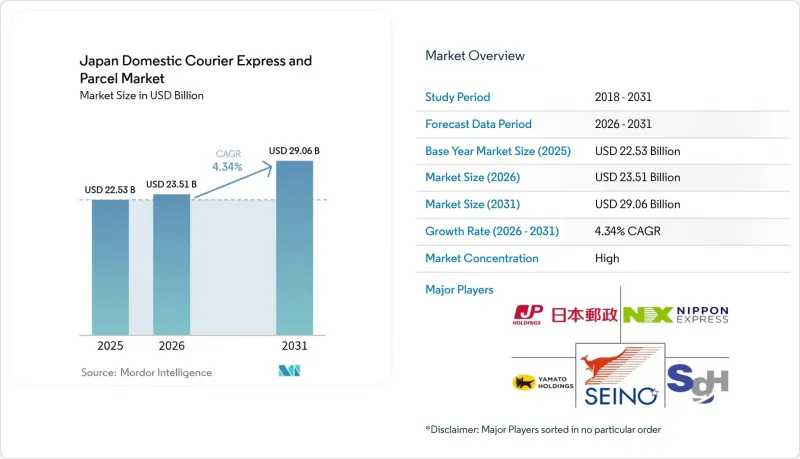
據 Mordor Intelligence 稱,2025 年日本國內宅配和小包裹快捷郵件的規模為 225.3 億美元,預計到 2031 年將從 2026 年的 235.1 億美元成長到 290.6 億美元,預測期(2026-2031 年)的複合年成長率為 4.34%。
本報告按配送速度(快遞和非快遞)、貨物重量(輕型、中型等)、終端用戶行業(電子商務、製造業、醫療保健等)、經營模式(企業對企業 (B2B) 等)以及運輸方式(陸運、空運等)進行細分。市場預測以美元計價。
日本國內宅配、快捷郵件和小包裹市場的趨勢和見解。
電子商務購物推動了 B2C(企業對消費者)小包裹量的快速成長。
預計2024年至2025年,日本電子商務商品交易總額(GMV)將從1,765億美元增加至2,014億美元,這將推動日本國內宅配市場向住宅的配送量成長。儘管由於訂單量較小、出貨頻率較高,小包裹平均重量有所下降,但樞紐處理能力的壓力卻在增加,導致都市區微型分類設施的快速部署。跨境電商平台(例如Temu)增加了海關手續的複雜性,現有承運商正透過收取清關費來從中獲利。預計2025年食品飲料的線上銷售額將達到484.6億美元,這將刺激冷藏小包裹配送路線的發展,需要額外的處理基礎設施,同時也將導致更高的運費。直播搶購活動造成了難以預測的需求高峰,迫使企業採用零工配送團隊和固定配送資源相結合的方式來應對這些激增的需求。由於亞馬遜日本和樂天等大型平台憑藉其購買力施加影響,給陸路貨運價格帶來壓力,因此快遞公司優先考慮服務可靠性和靈活的送貨時間段。
加速推廣當日送達服務和快速商務模式。
當日配送正從可選服務發展成為基本需求。 7-Eleven 的「7NOW」服務計劃到 2025 年在 2 萬家門市實現 10 億美元的銷售額。 Quickcommerce 的「暗店」將庫存放置在消費者 5 公里半徑範圍內,繞過區域配送中心,從而實現了都市區20 分鐘內的快速送達。 Lawson 和 Uber Eats 正在部署步行機器人,這些機器人可以沿著固定路線運送 30 公斤的負載容量,以緩解尖峰時段的人手不足。大阪的遠距藥事照護試點計畫允許患者當天處方箋,將用藥依從性與快速物流結合。人工智慧驅動的路線最佳化引擎將到達時間從 40 分鐘縮短到 10 分鐘,在不相應增加人員的情況下提高了資產利用率。然而,只有 10%的消費者選擇快遞,而且由於消費者願意支付更高的價格,利潤率在高階細分市場中得以維持。
人手不足,加上加班時間限制,導致配送成本上升。
日本一項於2024年實施的法規將卡車駕駛人的加班時間限制在960小時以內,該法規立即導致生產力下降,實施12個月後,仍有30%的公司報告未遵守規定。調查發現,46.8%的托運人支付更高的運費,41.2%的托運人無法招募足夠的駕駛人,導致薪資上漲和單件包裹遞送成本增加。由於業務規模的限制,小規模承運商難以承擔這些額外費用。 2025年,監管機構因車輛健康檢查不合格吊銷了2500輛日本郵政車輛的許可證,這表明執法力度將加大,對該行業的審查也將更加嚴格。政府關於分包商補償的指導方針草案可能會提高基本運費,從而可能擠壓受經濟合約(EC)約束的固定價格合約企業的利潤空間。
細分市場分析
製造業是成長最快的產業,2026年至2031年的複合年成長率將達到4.55%,這主要得益於智慧工廠的普及應用,智慧工廠正在縮小批量並提高出貨頻率。工廠直供合約要求嚴格的交貨期限和即時可視性。承運商正在將API資料整合到其現場系統中,並將其深度嵌入到補貨週期中。電子商務產業仍將保持最大佔有率,預計到2025年將佔銷售額的31.60%,主要得益於數位購物和跨境市場交易的持續擴張。
醫療保健產業雖然絕對規模相對較小,但其策略重要性日益凸顯。監管追蹤和低溫運輸要求維持了高額費率,從而保障了擁有認證設施的企業的整體獲利能力。金融服務和律師事務所繼續使用安全宅配遞送關鍵文件,儘管絕對成長仍然較為溫和。擁有傳統門市網路的零售商正在採用「門市出貨」模式,模糊了純線上履約和「線上線下履約」交付之間的界線。
快遞服務是成長最快的細分市場,預計2026年至2031年複合年成長率將達到4.98%。儘管非快遞服務仍將維持其收入領先地位,到2025年將佔據75.40%的市場佔有率,但由於消費者對有保障的送達時限的需求不斷成長,日本整體宅配市場正在向快遞升級。曾經僅限於高階客戶的「當日達」和「隔日達」服務,如今正逐漸成為主流,因為全通路零售商競相滿足消費者即時滿意的需求。對自動步行機器人和人工智慧路線最佳化的投資,正在以具有競爭力的成本縮短運輸時間,重新定義了傳統快遞和普通小包裹之間的界限。
快遞公司透過附加價值服務、溫控、嚴格的身份驗證以及深夜派送服務來支撐其高價。由於競爭對手數量有限,價格下降幅度受到抑制,從而維持了高於平均的利潤率。同時,非快遞公司則透過宅配櫃、在地化取件點和數據驅動的取件整合等創新措施,在服務水準未得到實質提升的情況下,縮短了實際送達時間。在預測期內,預計各家公司將透過建構針對不同派送緊急程度和價格區間的客製化服務方案,在日本國內宅配市場維持收入多元化。
其他好處:
- Excel格式的市場預測(ME)表
- 3個月的分析師支持
目錄
第1章:引言
- 研究假設和市場定義
- 調查範圍
第2章:調查方法
第3章執行摘要
第4章 市場狀況
- 市場概覽
- 人口統計數據
- 按經濟活動分類的GDP構成
- 按經濟活動分類的GDP成長率
- 通貨膨脹
- 經濟表現及概覽
- 電子商務產業趨勢
- 製造業的發展趨勢
- 運輸和倉儲部門的GDP
- 出口趨勢
- 進口趨勢
- 燃油價格
- 物流績效
- 基礎設施
- 法律規範
- 價值鍊和通路分析
- 市場促進因素
- 電子商務購物推動B2C小包裹量快速成長
- 當日送達服務和快速商務模式的普及速度正在加快。
- 電動車和新能源汽車的普及將降低營運成本和排放。
- 由於人口老化,對居家醫療相關宅配的需求正在增加。
- 便利商店取貨和退貨網路的擴展提高了配送效率。
- 經由成田機場和關西機場轉運的跨境小包裹數量的增加,帶動了國內包裹遞送量的成長。
- 市場限制因素
- 人手不足,加上加班時間限制,導致配送成本上升。
- 都市區堵塞費的引入導致主要城市每車道附加費增加。
- 來自零工經濟配送司機的競爭正在給當日送達領域的利潤率帶來壓力。
- 行人用的監管批准延遲,導致自動化帶來的成本節約被推遲。
- 市場上的技術創新
- 波特五力分析
第5章 市場規模與成長預測
- 按配送速度
- 表達
- 定期配送
- 按運輸重量
- 重型貨物
- 輕型物品
- 中等重量物品
- 按最終用戶行業分類
- 電子商務
- 金融服務(BFSI)
- 衛生保健
- 製造業
- 一級產業
- 批發和零售貿易(線下)
- 其他
- 按經營模式
- 企業對企業 (B2B) 交易
- 企業對消費者 (B2C)
- 個人對個人(C2C)交易
- 透過交通工具
- 路
- 航空
- 其他
第6章 競爭情勢
- 市場集中度
- 關鍵策略趨勢
- 市佔率分析
- 公司簡介
- ANA Holdings, Inc.(Including Overseas Courier Service Co., Ltd.)
- Fukuyama Transporting Co., Ltd.
- Japan Post Holdings Co., Ltd.
- Nippon Express Holdings
- Rakuten Group, Inc.
- SBS Holdings, Inc.
- Seino Holdings Co., Ltd.
- SENKO Group Holdings Co., Ltd.
- SG Holdings Co., Ltd.(Including Sagawa Express Co., Ltd.)
- Yamato Holdings Co., Ltd.
第7章 市場機會與未來展望
According to Mordor Intelligence, the Japan domestic courier express and parcel market size was valued at USD 22.53 billion in 2025 and estimated to grow from USD 23.51 billion in 2026 to reach USD 29.06 billion by 2031, at a CAGR of 4.34% during the forecast period (2026-2031).
This report is Segmented by Speed of Delivery (Express and Non-Express), by Shipment Weight (Light Weight Shipments, Medium Weight Shipments, and More), by End User Industry (E-Commerce, Manufacturing, Healthcare, and More), by Model (Business-To-Business (B2B) and More) and by Mode of Transport (Road, Air and More). The Market Forecasts are Provided in Terms of Value (USD).
Japan Domestic Courier Express And Parcel Market Trends and Insights
Rapid Growth in Business-to-Consumer (B2C) Parcel Volumes Driven by E-Commerce Purchases
E-commerce gross merchandise value (GMV) rose from USD 176.50 billion in 2024 to USD 201.40 billion in 2025, pushing the Japan domestic courier market toward denser residential delivery rounds. Smaller, more frequent orders reduce average parcel weight and strain hub capacity, prompting the rapid rollout of micro-sortation facilities inside urban boundaries. Cross-border marketplaces such as Temu add customs-clearance complexity that established carriers monetize through brokerage fees. Food and beverage online sales climbed to USD 48.46 billion in 2025, stimulating chilled-parcel lanes that command premium tariffs yet require additional handling infrastructure. Live-streaming flash sales create unpredictable peaks, leading operators to blend gig-worker fleets with fixed resources for surge coverage. Large platforms, notably Amazon Japan and Rakuten, wield buying leverage that compresses headline rates, so couriers emphasise service reliability and flexible delivery windows.
Accelerating Adoption of Same-Day Delivery Services and Quick-Commerce Models
Same-day fulfillment has shifted from an optional feature to a baseline expectation, as 7-Eleven's 7NOW service targets USD 1 billion sales through 20,000 outlets in 2025. Quick-commerce dark stores support 20-minute urban drop-offs, bypassing regional depots and placing inventory within five kilometers of consumers. Lawson and Uber Eats introduced sidewalk robots carrying 30 kg payloads on fixed routes, mitigating labor limits during peak shifts. Tele-pharmacy pilots in Osaka enable patients to receive prescriptions the same day, blending medical compliance with express logistics. Artificial-intelligence route engines shrink arrival windows from forty to ten minutes, improving asset utilization without proportional headcount growth. However, only 10% of shoppers select express tiers, and willingness to pay offsets higher cost per stop, preserving margins in premium subsegments.
Labor Shortages Intensified by Overtime Cap Inflate Delivery Costs
Japan's 2024 rule capping truck-driver overtime at 960 hours triggers immediate productivity loss, with 30% of firms still reporting non-compliance after twelve months. Surveys show 46.8% of shippers pay higher freight rates, while 41.2% cannot secure enough drivers, pushing wages up and raising per-parcel expenditure. Small haulers possess limited capacity to absorb surcharges due to scale limitations. Enforcement strength rose in 2025 when regulators revoked licenses for 2,500 Japan Post vehicles following health-check lapses, signaling tougher industry policing. Government draft guidelines on subcontractor remuneration may lift baseline freight tariffs, squeezing margins for operators tied to fixed-price e-commerce contracts.
Other drivers and restraints analyzed in the detailed report include:
- Increasing Deployment of Electric and Alternative-Fuel Vehicles Reduces Operating Costs and Emissions
- Ageing Population Drives Higher Demand for Home Healthcare Parcel Deliveries
- Price Competition From Gig-Economy Couriers Erodes Margins in Same-Day Segment
For complete list of drivers and restraints, kindly check the Table Of Contents.
Segment Analysis
Manufacturing climbs fastest at a 4.55% CAGR (2026-2031) as smart-factory rollouts shrink batch sizes and raise shipment frequency. Direct-to-plant supply contracts require tight delivery windows and real-time visibility. Carriers integrate API feeds with shop-floor systems, embedding themselves into replenishment cycles. The e-commerce sector stays the largest at 31.60% share of 2025 revenue, driven by sustained uptake of digital shopping and cross-border marketplace transactions.
Healthcare gains strategic importance despite small absolute volume. Regulatory tracking and cold-chain mandates support premium rates that cushion overall yields for operators with certified facilities. Financial services and legal firms continue to use secure courier hand-offs for critical documents, though absolute growth remains modest. Retailers with legacy store networks adopt ship-from-store schemes, blurring lines between pure digital and bricks-plus-clicks fulfillment.
Express services generated the fastest sub-segment growth, advancing at 4.98% CAGR between 2026-2031. Although Non-Express retains revenue leadership with 75.40% share in 2025, mounting customer preference for guaranteed delivery windows fuels express lane upgrades across the Japan domestic courier market. Same-day and next-day expectations once associated exclusively with premium tiers are migrating toward mainstream offerings as omnichannel retailers race to match instant-gratification benchmarks. Investments in autonomous sidewalk robots and AI routing compress transit times at competitive cost, reshaping the boundary between classic Express and standard parcels.
Express carriers leverage value-added options, temperature control, secure ID verification, and late-night slots to justify pricing premiums. The restrained competitive set limits price erosion and sustains above-average yields. Meanwhile, Non-Express networks innovate via parcel lockers, neighborhood pick-up counters, and data-driven load pooling that shorten actual arrival times without formal service-level upgrades. Over the forecast period, carriers are expected to calibrate service menus that align price points with finely segmented delivery urgency, preserving revenue diversity within the Japan domestic courier market.
Complete Report Scope:
- Speed of Delivery
- Express
- Non-Express
- Shipment Weight
- Heavy Weight Shipments
- Light Weight Shipments
- Medium Weight Shipments
- End User Industry
- E-Commerce
- Financial Services (BFSI)
- Healthcare
- Manufacturing
- Primary Industry
- Wholesale and Retail Trade (Offline)
- Others
- Model
- Business-to-Business (B2B)
- Business-to-Consumer (B2C)
- Consumer-to-Consumer (C2C)
- Mode of Transport
- Road
- Air
- Others
List of Companies Covered in this Report:
- ANA Holdings, Inc. (Including Overseas Courier Service Co., Ltd.)
- Fukuyama Transporting Co., Ltd.
- Japan Post Holdings Co., Ltd.
- Nippon Express Holdings
- Rakuten Group, Inc.
- SBS Holdings, Inc.
- Seino Holdings Co., Ltd.
- SENKO Group Holdings Co., Ltd.
- SG Holdings Co., Ltd. (Including Sagawa Express Co., Ltd.)
- Yamato Holdings Co., Ltd.
Additional Benefits:
- The market estimate (ME) sheet in Excel format
- 3 months of analyst support
TABLE OF CONTENTS
1 Introduction
- 1.1 Study Assumptions and Market Definition
- 1.2 Scope of the Study
2 Research Methodology
3 Executive Summary
4 Market Landscape
- 4.1 Market Overview
- 4.2 Demographics
- 4.3 GDP Distribution by Economic Activity
- 4.4 GDP Growth by Economic Activity
- 4.5 Inflation
- 4.6 Economic Performance and Profile
- 4.6.1 Trends in E-Commerce Industry
- 4.6.2 Trends in Manufacturing Industry
- 4.7 Transport and Storage Sector GDP
- 4.8 Export Trends
- 4.9 Import Trends
- 4.10 Fuel Price
- 4.11 Logistics Performance
- 4.12 Infrastructure
- 4.13 Regulatory Framework
- 4.14 Value Chain and Distribution Channel Analysis
- 4.15 Market Drivers
- 4.15.1 Rapid Growth in B2C Parcel Volumes Driven by E-Commerce Purchases
- 4.15.2 Accelerating Adoption of Same-Day Delivery Services and Quick-Commerce Models
- 4.15.3 Increasing Deployment of Electric and Alternative-Fuel Vehicles Reduces Operating Costs and Emissions
- 4.15.4 Ageing Population Drives Higher Demand for Home Healthcare Parcel Deliveries
- 4.15.5 Expanding Convenience-Store Pickup and Drop-Off Networks Improve Delivery Efficiency
- 4.15.6 Rising Cross-Border Small-Parcel Inflows via Narita and Kansai Airports Feed Domestic Deliveries
- 4.16 Market Restraints
- 4.16.1 Labor Shortages Intensified by Overtime Cap Inflate Delivery Costs
- 4.16.2 Introduction of Urban Congestion Pricing Increases Per-Parcel Surcharges in Major Cities
- 4.16.3 Price Competition from Gig-Economy Couriers Erodes Margins in Same-Day Segment
- 4.16.4 Delayed Regulatory Approvals for Drones and Sidewalk Robots Postpone Automation Savings
- 4.17 Technology Innovations in the Market
- 4.18 Porter's Five Forces Analysis
- 4.18.1 Threat of New Entrants
- 4.18.2 Bargaining Power of Buyers
- 4.18.3 Bargaining Power of Suppliers
- 4.18.4 Threat of Substitutes
- 4.18.5 Competitive Rivalry
5 Market Size and Growth Forecasts (Value, USD)
- 5.1 Speed of Delivery
- 5.1.1 Express
- 5.1.2 Non-Express
- 5.2 Shipment Weight
- 5.2.1 Heavy Weight Shipments
- 5.2.2 Light Weight Shipments
- 5.2.3 Medium Weight Shipments
- 5.3 End User Industry
- 5.3.1 E-Commerce
- 5.3.2 Financial Services (BFSI)
- 5.3.3 Healthcare
- 5.3.4 Manufacturing
- 5.3.5 Primary Industry
- 5.3.6 Wholesale and Retail Trade (Offline)
- 5.3.7 Others
- 5.4 Model
- 5.4.1 Business-to-Business (B2B)
- 5.4.2 Business-to-Consumer (B2C)
- 5.4.3 Consumer-to-Consumer (C2C)
- 5.5 Mode of Transport
- 5.5.1 Road
- 5.5.2 Air
- 5.5.3 Others
6 Competitive Landscape
- 6.1 Market Concentration
- 6.2 Key Strategic Moves
- 6.3 Market Share Analysis
- 6.4 Company Profiles (Includes Global Level Overview, Market Level Overview, Core Segments, Financials as Available, Strategic Information, Market Rank/Share for Key Companies, Products and Services, and Recent Developments)
- 6.4.1 ANA Holdings, Inc. (Including Overseas Courier Service Co., Ltd.)
- 6.4.2 Fukuyama Transporting Co., Ltd.
- 6.4.3 Japan Post Holdings Co., Ltd.
- 6.4.4 Nippon Express Holdings
- 6.4.5 Rakuten Group, Inc.
- 6.4.6 SBS Holdings, Inc.
- 6.4.7 Seino Holdings Co., Ltd.
- 6.4.8 SENKO Group Holdings Co., Ltd.
- 6.4.9 SG Holdings Co., Ltd. (Including Sagawa Express Co., Ltd.)
- 6.4.10 Yamato Holdings Co., Ltd.
7 Market Opportunities and Future Outlook
- 7.1 White-space and Unmet-need Assessment

 美國國際快遞小包裹宅配(CEP):市場佔有率分析、行業趨勢和統計數據以及成長預測(2026-2031 年)印度國內宅配和小包裹(CEP):市場佔有率分析、行業趨勢和統計數據以及成長預測(2026-2031 年)
 小包裹遞送市場規模、佔有率和成長分析:按服務類型、遞送速度、小包裹重量、最終用戶、運輸方式和地區分類-2026-2033年產業預測宅配、速遞和小包裹遞送 (CEP):市場佔有率分析、行業趨勢和統計數據以及成長預測 (2026-2031)
 全球宅配、包裹及小包裹市場-2026-2032年市場預測視訊串流平台:市場佔有率分析、產業趨勢與統計、成長預測(2026-2031)
 代出貨市場規模、佔有率和成長分析:按產品類型、經營模式、平台類型、供應商類型、公司規模、銷售管道、最終用戶和地區分類-2026-2033年產業預測
 快遞小包裹宅配(CEP) 市場規模、佔有率和成長分析:按服務類型、目的地、運輸方式、遞送速度、包裹重量和地區分類-2026-2033 年產業預測英國國內宅配( 小包裹):市場佔有率分析、產業趨勢與統計、成長預測(2026-2031)
 生鮮食品在地化配送市場:預測至 2034 年 -產品類型、配送模式、平台類型、訂單規模、支付方式、最終用戶和地區分類的全球分析