


 |
市場調查報告書
商品編碼
2116356
美國國際快遞小包裹宅配(CEP):市場佔有率分析、行業趨勢和統計數據以及成長預測(2026-2031 年)United States International Courier, Express And Parcel - Market Share Analysis, Industry Trends & Statistics, Growth Forecasts (2026 - 2031) |
||||||

※ 本網頁內容可能與最新版本有所差異。詳細情況請與我們聯繫。
根據 Mordor Intelligence 估計,美國國際宅配小包裹(CEP) 市場在 2026 年的價值為 556.1 億美元,高於 2025 年的 531.4 億美元,預計到 2031 年將達到 697.8 億美元。
預計從 2026 年到 2031 年,其複合年成長率將達到 4.64%。
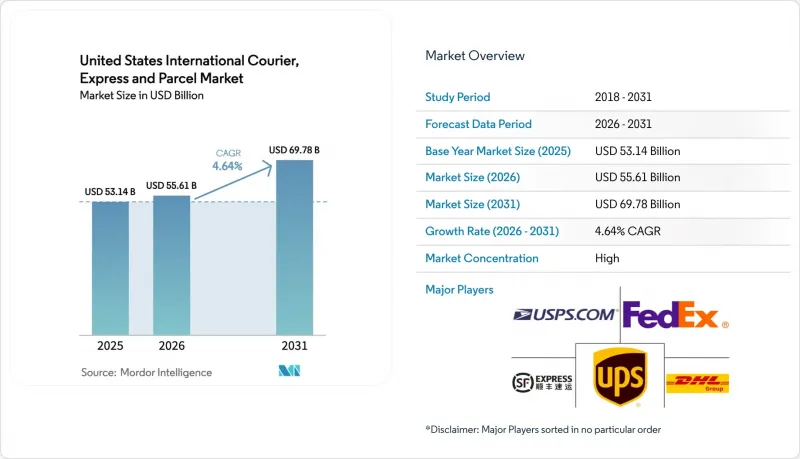
本報告按最終用戶行業(例如,電子商務、金融服務(BFSI)、醫療保健、製造業、一級產業)、配送速度(快遞和非快遞)、貨物重量(例如,重型貨物)以及經營模式(例如,企業對企業(B2B))進行細分。市場預測以美元計價。
美國國際宅配和小包裹(CEP) 市場的趨勢和見解。
受美墨加協定 (USMCA) 的推動,運往加拿大和墨西哥的中小小包裹數量增加。
美國海關與邊防安全局 (CBP) 於 2025 年 3 月實施的新規簡化了原產地證書的獲取流程,並啟用了「一攬子申報」功能,允許將多批貨物合併申報,從而減輕了交易頻繁企業的行政負擔。中小經銷商迅速拓展了跨境銷售業務,對快速、可追蹤的小包裹服務需求也隨之成長。物流整合商利用增強型資料饋送進行貨物預清關,在某些路線上將門到門運輸時間縮短了一天。在美墨加協定 (USMCA) 區域內重組零件供應鏈的汽車製造商也擴大使用宅配運輸關鍵零件,從而提高了每批貨物的平均收入。如今,企業要想在競爭中脫穎而出,關鍵在於為中小企業提供即時視覺化工具,以確保其符合海關規定。
800 美元的最低限額導致跨境直接面對消費者 (DTC) 進口激增。
美國海關與邊防安全局 (CBP) 預計到 2024 年將處理超過 10 億件微量小包裹,比 2016 年增加六倍。擬議規則一旦通過,將取消 301 條款商品的免稅地位,並要求提交更詳細的數據,預計可帶來高達 78 億美元的新關稅收入。然而,此舉也可能促使企業將業務轉向擁有完善合規體系的承運商。直接從中國出貨的平台正在擴大預通知和 SKU 級協調關稅編碼的提交範圍,從而增加了宅配業者的 IT 支出。大型整合商將這種日益繁重的文件工作視為競爭優勢,以此壓制小型競爭對手。此外,這種即將到來的轉變正迫使線上經銷商考慮近岸庫存模式,從而加速美洲內部的雙向貿易。
強制要求事先以電子方式提交 CBP(電腦輔助實踐)措施的數據,這推高了合規成本。
更嚴格的ACAS要求強制承運商在出貨前傳輸100%的貨運數據,這迫使他們投入數百萬美元進行平台升級。延遲或不準確申報的處罰增加了營運風險,尤其對於代理商網路分散的小規模宅配業者而言更是如此。整合商正透過提高貨運密度來攤銷投資成本,這加劇了成本差距,並加速了行業整合。同時,美國郵政總局(USPS)關於進口郵件的規定也促使人們轉向能夠確保資料完整性的私人公司。
細分市場分析
到2025年,電子商務將佔貨運總量的42.20%,但隨著其在富裕郵遞區號地區的滲透率趨於穩定,其成長速度正在放緩。產品類別正從電子產品擴展到美容產品、營養補充劑和愛好用品等領域,每種產品都需要獨特的合規文件,因此對宅配業者的專業能力提出了更高的要求。製造業仍然是第二大產業,受益於支援準時製組裝的多區域零件採購。對溫度敏感的藥品正在推動對配備物聯網感測器的小型主動式貨櫃運輸車的投資,這些感測器可直接與ACE入口網站通訊。
預計2026年至2031年間,批發和零售(線下)產業將以5.31%的複合年成長率(CAGR)實現最高成長,這主要得益於大型零售商對其供應商入口網站的數位化改造,以及規模更小、頻率更高的國際庫存補貨。這種業務轉型將導致更嚴格的交付配額、對延遲出貨的處罰,並促使合約條款的製定能夠提升網路可靠性。儘管銀行、金融和保險(BFSI)行業對紙本文件的絕對依賴正在下降,但由於企業選擇安全的監管鏈服務來保護機密記錄免受網路風險的影響,每次宅配卻在上升。從航太到奢侈品,相關產業持續將關鍵物品的物流外包,從而將美國國際宅配市場的範圍擴展到整個實體經濟。
到2025年,快遞服務將占美國國際宅配市場收入的67.05%,跨境電商企業優先考慮與國內標準相當的結帳承諾。需求彈性推動了高階運輸的發展,使承運商能夠實施週六取件截止和深夜取件服務。預計2026年至2031年,該細分市場的複合年成長率將達到5.88%,超過歷史成長率,這反映了跨境市場的持續擴張以及企業庫存管理向近即時補貨的轉變。非快遞服務仍保持著相當大的業務量,但在高業務量路線上,客戶正在轉向結合海運和最後一公里配送的混合服務。聯邦快遞的「網路2.0」計畫透過建立共享樞紐,展示了整合商如何在單一服務框架內整合快遞和標準貨運,從而最佳化分類時間的利用率。透過簡化中程航線的運輸能力,營運商可以將飛機重新部署到亞洲和美國之間的干線航線上,而運輸密度的增加使得引入高價準點保證成為可能。
快遞產業的競爭格局正從單純追求速度轉向以數據驅動的體驗。承運商透過將海關狀態通知整合到經銷商控制面板中來簡化客戶服務,從而減少了客戶對其貨物位置的查詢。這使得價值提案更加清晰,即使在燃油價格波動的情況下也能保持獲利。非快遞業者正在試行增值隔夜送達和碳補償包裹服務,但他們面臨著無法匹敵頂級綜合物流供應商網路覆蓋範圍的挑戰。隨著美墨之間電子商務的日趨成熟,區域快遞專家正在利用拉雷多和埃爾帕索的轉運中心來縮短幹線運輸時間,並從沿海航空門戶分銷貨物。
其他好處:
- Excel格式的市場預測(ME)表
- 3個月的分析師支持
目錄
第1章:引言
- 研究假設和市場定義
- 調查範圍
第2章:調查方法
第3章執行摘要
第4章 市場狀況
- 市場概覽
- 人口統計數據
- 按經濟活動分類的GDP構成
- 按經濟活動分類的GDP成長率
- 通貨膨脹
- 經濟表現及概覽
- 電子商務產業趨勢
- 製造業的發展趨勢
- 運輸和倉儲部門的GDP
- 出口趨勢
- 進口趨勢
- 燃油價格
- 物流績效
- 基礎設施
- 法律規範
- 價值鍊和通路分析
- 市場促進因素
- 美墨加協定增加了運往加拿大和墨西哥的小包裹數量。
- 受 800 美元最低限額的影響,跨境直接面對消費者 (DTC) 的進口激增。
- Temu 和 Shein 等「超快時尚」平台正在推動重量低於 2 公斤的小包裹運輸量激增。
- 透過無紙化貿易和 ACE/ITDS 自動化,縮短了海關清關時間。
- 由於寬體飛機貨運能力的恢復,國際航空貨運價格正在下降。
- 優先考慮 ESG 因素的合約對包含碳排放的「綠色通道」快遞產品是有利的。
- 市場限制因素
- 在社區健康計劃 (CBP) 中強制使用高級電子資料 (AED) 會增加合規成本。
- 門戶機場擁塞和航班時刻限制對時間保證服務等級協定 (SLA) 的影響
- 系統整合商徵收的尖峰時段附加費以及噴射機燃料價格的波動,給中小企業的利潤率帶來了壓力。
- 由於目的地郵政服務有缺陷,退貨率和投訴率大幅上升。
- 市場上的技術創新
- 波特五力分析
第5章 市場規模與成長預測
- 按配送速度
- 表達
- 路線
- 跨區域
- 在該地區
- 路線
- 定期配送
- 表達
- 按運輸重量
- 重型貨物
- 輕型物品
- 中等重量物品
- 按最終用戶行業分類
- 電子商務
- 金融服務(BFSI)
- 衛生保健
- 製造業
- 一級產業
- 批發和零售貿易(線下)
- 其他
- 按經營模式
- 企業對企業 (B2B) 交易
- 企業對消費者 (B2C)
- 個人對個人(C2C)交易
第6章 競爭情勢
- 市場集中度
- 關鍵策略趨勢
- 市佔率分析
- 公司簡介
- Aramex
- Averitt Express
- Canada Post Corporation(Including Purolator)
- DHL Group
- Easyship, Inc.
- FedEx
- Flexport, Inc.
- Japan Post Holdings Co., Ltd.(Including Toll Group)
- La Poste Group(Including Geopost/Asendia)
- Passport Shipping
- SF Express(KEX-SF, KEX Express US LLC)
- ShipBob, Inc.
- TFI International, Inc.(Including TForce Logistics)
- United Parcel Service of America, Inc.(UPS)
- United States Postal Service(USPS)
第7章 市場機會與未來展望
According to Mordor Intelligence, the United States international courier, express and parcel market size in 2026 is estimated at USD 55.61 billion, growing from 2025 value of USD 53.14 billion with 2031 projections showing USD 69.78 billion, growing at 4.64% CAGR over 2026-2031.
This report is Segmented by End User Industry (E-Commerce, Financial Services (BFSI), Healthcare, Manufacturing, Primary Industry, and More), by Speed of Delivery (Express and Non- Express), by Shipment Weight (Heavy Weight Shipments and More), and by Model (Business-To-Business (B2B), and More). The Market Forecasts are Provided in Terms of Value (USD).
United States International Courier, Express And Parcel Market Trends and Insights
USMCA-Driven Growth in SME Parcel Flows to Canada and Mexico
CBP regulations that took effect in March 2025 simplified origin certification, enabling blanket declarations that cover multiple shipments and lowering paperwork for frequent traders. Small and medium sellers quickly expanded cross-border catalogs, lifting demand for fast, trackable parcel services. Integrators use enhanced data feeds to pre-clear consignments and shorten door-to-door transit by up to a full day on select lanes. Automakers that reorganized component flows within the USMCA bloc have also turned to express couriers for critical parts, elevating average revenue per shipment. Competitive differentiation now hinges on real-time visibility tools that reassure SMEs about customs compliance.
Cross-Border DTC Imports Surge, Influenced by USD 800 De-Minimis Threshold
CBP processed more than 1 billion de-minimis parcels in 2024, a six-fold jump since 2016. Proposed rules to deny Section 301 goods duty-free status and mandate richer data elements may generate up to USD 7.8 billion in new duties yet could tilt business toward carriers with robust compliance infrastructure. Platforms shipping straight from China ramped up pre-advice filings and SKU-level harmonized codes, pushing courier IT spend higher. Larger integrators view the heavier documentation load as a competitive moat that squeezes smaller rivals. The looming change also nudges online sellers to explore near-shore inventory models, fostering two-way trade within the Americas.
CBP Advanced Electronic Data Mandate Raising Compliance Costs
Enhanced ACAS requirements obligate carriers to transmit 100% shipment data before wheels-up, driving multi-million-dollar platform upgrades. Penalties for late or inaccurate filings intensify operational risk, especially for smaller couriers with fragmented agent networks. Integrators amortize investment over higher shipment density, widening a cost gap that accelerates consolidation. Parallel USPS inbound mail rules reinforce a shift toward private-sector handlers able to guarantee data integrity.
Other drivers and restraints analyzed in the detailed report include:
- Ultra-Fast Fashion Platforms Propel Surge in Less Than 2 kg Parcel Shipments
- Paperless Trade and CE/ITDS Automation Reducing Clearance Time
- Gateway Airport Congestion and Slot Constraints Impacting Time-Definite SLAs
For complete list of drivers and restraints, kindly check the Table Of Contents.
Segment Analysis
E-commerce shipments captured 42.20% share in 2025, a figure that grows more modestly as penetration plateaus in affluent zip codes. Merchandise categories diversify beyond electronics into beauty, nutraceuticals, and hobby items, each with unique compliance documents that elevate the expertise premium for couriers. Manufacturing retains second position, benefiting from multi-regional component sourcing that underpins just-in-sequence assembly lines. Temperature-controlled pharmaceuticals spur investment in small active-container fleets fitted with IoT sensors that communicate directly with ACE portals.
Wholesale and retail trade (offline) posts the fastest 5.31% CAGR (2026-2031) as big-box store operators digitize supplier portals and run smaller, more frequent international restocks. Their pivot tightens delivery windows, incentivizing contract clauses that penalize late freight and elevate network reliability. BFSI reliance on physical documents declines in absolute terms, but courier spending per shipment rises as firms choose secure chain-of-custody services to protect sensitive records from cyber risk. Ancillary industries-ranging from aerospace to luxury goods-continue outsourcing critical-item logistics, extending the United States international courier market's breadth across the real economy.
Express services generated 67.05% of the United States international courier market revenue in 2025 as cross-border merchants emphasized checkout promises that mirror domestic standards. Demand elasticity favors premium transit, enabling operators to introduce Saturday cut-offs and late-night pick-ups. The segment's 5.88% CAGR between 2026-2031 outpaces historical growth, reflecting continued cross-border marketplace expansion and corporate inventory shifts toward near-real-time replenishment. Non-express offerings still carry substantial volume but confront customer migration toward ocean-plus-last-mile hybrids on heavier lanes. FedEx's Network 2.0 co-locations illustrate how integrators blend express and deferred parcels within a single service envelope, optimizing sort window utilization. Capacity rationalization on medium-haul lanes allows providers to re-deploy aircraft toward Asia-US trunk routes where density rewards higher-priced time guarantees.
Competitive positioning inside the express bracket is moving away from pure speed toward data-rich experience. Carriers embed customs status notifications into merchant dashboards, simplifying customer service by cutting "where-is-my-parcel" queries. The end result is a sharper value proposition that protects yields even as fuel indices fluctuate. Non-express players experiment with value-added evening deliveries and carbon-offset bundles but face difficulty matching the network depth of top-tier integrators. As US-Mexico e-commerce matures, regional express specialists leverage cross-dock hubs at Laredo and El Paso to shorten line-haul and divert volume from coastal air gateways.
Complete Report Scope:
- Speed of Delivery
- Express
- By Route
- Inter-Region
- Intra-Region
- By Route
- Non-Express
- Express
- Shipment Weight
- Heavy Weight Shipments
- Light Weight Shipments
- Medium Weight Shipments
- End User Industry
- E-Commerce
- Financial Services (BFSI)
- Healthcare
- Manufacturing
- Primary Industry
- Wholesale and Retail Trade (Offline)
- Others
- Model
- Business-to-Business (B2B)
- Business-to-Consumer (B2C)
- Consumer-to-Consumer (C2C)
List of Companies Covered in this Report:
- Aramex
- Averitt Express
- Canada Post Corporation (Including Purolator)
- DHL Group
- Easyship, Inc.
- FedEx
- Flexport, Inc.
- Japan Post Holdings Co., Ltd. (Including Toll Group)
- La Poste Group (Including Geopost/Asendia)
- Passport Shipping
- SF Express (KEX-SF, KEX Express US LLC)
- ShipBob, Inc.
- TFI International, Inc. (Including TForce Logistics)
- United Parcel Service of America, Inc. (UPS)
- United States Postal Service (USPS)
Additional Benefits:
- The market estimate (ME) sheet in Excel format
- 3 months of analyst support
TABLE OF CONTENTS
1 Introduction
- 1.1 Study Assumptions and Market Definition
- 1.2 Scope of the Study
2 Research Methodology
3 Executive Summary
4 Market Landscape
- 4.1 Market Overview
- 4.2 Demographics
- 4.3 GDP Distribution by Economic Activity
- 4.4 GDP Growth by Economic Activity
- 4.5 Inflation
- 4.6 Economic Performance and Profile
- 4.6.1 Trends in E-Commerce Industry
- 4.6.2 Trends in Manufacturing Industry
- 4.7 Transport and Storage Sector GDP
- 4.8 Export Trends
- 4.9 Import Trends
- 4.10 Fuel Price
- 4.11 Logistics Performance
- 4.12 Infrastructure
- 4.13 Regulatory Framework
- 4.14 Value Chain and Distribution Channel Analysis
- 4.15 Market Drivers
- 4.15.1 USMCA-Driven Growth in SME Parcel Flows to Canada and Mexico
- 4.15.2 Cross-Border DTC Imports Surge, Influenced by USD 800 De-Minimis Threshold
- 4.15.3 Ultra-Fast Fashion Platforms, Like Temu and Shein, Propel Surge in Less Than 2 kg Parcel Shipments
- 4.15.4 Paperless Trade and ACE/ITDS Automation Reducing Clearance Time
- 4.15.5 Wide-Body Belly Capacity Recovery Cutting International Air-Freight Rates
- 4.15.6 ESG-Focused Contracts Favor Carbon-Accounted "Green-Lane" Express Offerings
- 4.16 Market Restraints
- 4.16.1 CBP Advanced Electronic Data (AED) Mandate Raising Compliance Costs
- 4.16.2 Gateway Airport Congestion and Slot Constraints Impacting Time-Definite SLAs
- 4.16.3 Integrator Peak Surcharges and Jet-Fuel Volatility Compressing SME Margins
- 4.16.4 Return and Dispute Rates Surge due to Gaps in Destination Market Postal Services
- 4.17 Technology Innovations in the Market
- 4.18 Porter's Five Forces Analysis
- 4.18.1 Threat of New Entrants
- 4.18.2 Bargaining Power of Suppliers
- 4.18.3 Bargaining Power of Buyers
- 4.18.4 Threat of Substitutes
- 4.18.5 Competitive Rivalry
5 Market Size and Growth Forecasts (Value, USD)
- 5.1 Speed of Delivery
- 5.1.1 Express
- 5.1.1.1 By Route
- 5.1.1.1.1 Inter-Region
- 5.1.1.1.2 Intra-Region
- 5.1.1.1 By Route
- 5.1.2 Non-Express
- 5.1.1 Express
- 5.2 Shipment Weight
- 5.2.1 Heavy Weight Shipments
- 5.2.2 Light Weight Shipments
- 5.2.3 Medium Weight Shipments
- 5.3 End User Industry
- 5.3.1 E-Commerce
- 5.3.2 Financial Services (BFSI)
- 5.3.3 Healthcare
- 5.3.4 Manufacturing
- 5.3.5 Primary Industry
- 5.3.6 Wholesale and Retail Trade (Offline)
- 5.3.7 Others
- 5.4 Model
- 5.4.1 Business-to-Business (B2B)
- 5.4.2 Business-to-Consumer (B2C)
- 5.4.3 Consumer-to-Consumer (C2C)
6 Competitive Landscape
- 6.1 Market Concentration
- 6.2 Key Strategic Moves
- 6.3 Market Share Analysis
- 6.4 Company Profiles (Includes Global Level Overview, Market Level Overview, Core Segments, Financials as Available, Strategic Information, Market Rank/Share for Key Companies, Products and Services, and Recent Developments)
- 6.4.1 Aramex
- 6.4.2 Averitt Express
- 6.4.3 Canada Post Corporation (Including Purolator)
- 6.4.4 DHL Group
- 6.4.5 Easyship, Inc.
- 6.4.6 FedEx
- 6.4.7 Flexport, Inc.
- 6.4.8 Japan Post Holdings Co., Ltd. (Including Toll Group)
- 6.4.9 La Poste Group (Including Geopost/Asendia)
- 6.4.10 Passport Shipping
- 6.4.11 SF Express (KEX-SF, KEX Express US LLC)
- 6.4.12 ShipBob, Inc.
- 6.4.13 TFI International, Inc. (Including TForce Logistics)
- 6.4.14 United Parcel Service of America, Inc. (UPS)
- 6.4.15 United States Postal Service (USPS)
7 Market Opportunities and Future Outlook
- 7.1 White-Space and Unmet-Need Assessment

 印度國內宅配和小包裹(CEP):市場佔有率分析、行業趨勢和統計數據以及成長預測(2026-2031 年)日本國內宅配、快捷郵件和小包裹:市場佔有率分析、行業趨勢和統計數據以及成長預測(2026-2031 年)
 小包裹遞送市場規模、佔有率和成長分析:按服務類型、遞送速度、小包裹重量、最終用戶、運輸方式和地區分類-2026-2033年產業預測宅配、速遞和小包裹遞送 (CEP):市場佔有率分析、行業趨勢和統計數據以及成長預測 (2026-2031)
 全球宅配、包裹及小包裹市場-2026-2032年市場預測視訊串流平台:市場佔有率分析、產業趨勢與統計、成長預測(2026-2031)
 代出貨市場規模、佔有率和成長分析:按產品類型、經營模式、平台類型、供應商類型、公司規模、銷售管道、最終用戶和地區分類-2026-2033年產業預測
 快遞小包裹宅配(CEP) 市場規模、佔有率和成長分析:按服務類型、目的地、運輸方式、遞送速度、包裹重量和地區分類-2026-2033 年產業預測英國國內宅配( 小包裹):市場佔有率分析、產業趨勢與統計、成長預測(2026-2031)
 生鮮食品在地化配送市場:預測至 2034 年 -產品類型、配送模式、平台類型、訂單規模、支付方式、最終用戶和地區分類的全球分析