


 |
市場調查報告書
商品編碼
2116346
印度國內宅配和小包裹(CEP):市場佔有率分析、行業趨勢和統計數據以及成長預測(2026-2031 年)India Domestic Courier, Express, and Parcel (CEP) - Market Share Analysis, Industry Trends & Statistics, Growth Forecasts (2026 - 2031) |
||||||

※ 本網頁內容可能與最新版本有所差異。詳細情況請與我們聯繫。
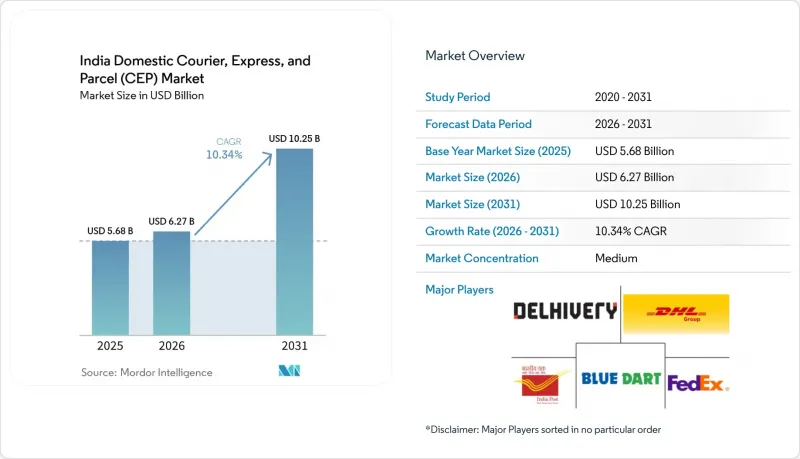
根據 Mordor Intelligence 估計,印度國內宅配、速遞和小包裹(CEP) 市場規模在 2026 年將達到 62.7 億美元,高於 2025 年的 56.8 億美元,預計到 2031 年將達到 102.5 億美元。
預計 2026 年至 2031 年的複合年成長率為 10.34%。
本報告按配送速度(快遞、非快遞)、貨物重量(重型、輕型、中型)、終端用戶行業(電子商務、銀行、金融服務和保險、醫療保健、製造業、一級產業、批發零售及其他)、經營模式(B2B、B2C、C2C)以及運輸方式(陸運、空運及其他)進行細分。市場預測以美元計價。
印度國內宅配和小包裹(CEP) 市場的趨勢和見解。
電子商務的快速發展及其向二、三線城市的滲透。
在印度國內宅配市場,小包裹量正呈現爆炸性成長。這是因為超過60%的新增線上訂單來自二、三線城市。價格親民的智慧型手機和普及的UPI支付縮短了數位化引進週期,使得小規模城市的訂單頻率在普及後的兩年內就能趕上大都會圈水平。 Quickcommerce平台總合在92個非大都會圈開展業務,但較低的訂單密度(每天350單,而大都會圈為1100單)正給配送獲利能力帶來壓力。政府的「BharatNet」和「數位印度」等項目正在為通訊基礎設施建設奠定基礎,並降低宅配業者的進入門檻。因此,各大宅配網路競相在需求成長的地區附近建立基地,這不僅促進了就業,也加劇了印度國內宅配市場的區域間競爭。
促進國家物流政策和基礎建設發展
統一物流願景旨在透過發展多模態走廊和規劃建造100個多模態物流園區,將該產業的成本降低至GDP的8-9%。專用貨運走廊和「統一物流介面平台」預計將減少15-20%的行政程序,進而提高印度國內宅配市場的透明度和處理能力。 2026會計年度11.2兆印度盧比的資本支出(其中1.5兆印度盧比為無息邦政府貸款)將加速公路、鐵路和港口的改善,縮短運輸時間。 「東部專用貨運走廊」的建成以及根據「烏丹計畫」(UDAN)擴建的120個區域機場將拓寬運輸選擇,使空運和陸運相結合的方式對時效性強的小包裹更具經濟優勢。加強連接大都會圈和內陸樞紐的網路連結預計將刺激農村地區的潛在消費,使預期的複合年成長率(CAGR)進一步提高2.1個百分點。
物流成本相對於GDP較高,且產業分散
物流營運片段化現象依然存在,90%的物流公司被歸類為非正規部門,67%的公司擁有的卡車數量少於五輛。這種結構限制了規模經濟,阻礙了技術應用,並推高了印度國內宅配市場的單一配送成本。儘管已引入商品和服務稅(GST),但各邦之間法規的細微差異導致合規要求重疊,進一步擠壓了利潤空間。地址標準的不一致導致路線變更,並推高了最後一公里配送成本。此外,不同運輸方式之間缺乏協調也阻礙了網路最佳化。這些低效率因素疊加在一起,導致市場預期複合年成長率下降約1.8個百分點。
細分市場分析
隨著都市區消費者逐漸將當日達和隔天達視為常態,預計到2031年,快遞貨運量將以11.07%的複合年成長率成長。這一趨勢推動了印度國內宅配市場對高階小包裹的需求。快速電商平台透過在主要大都會圈開設4000多家「暗店」(dark store,指線上線下混合的網店)來擴大其在快遞貨運量中的佔有率,並承諾10至30分鐘的送達時限。非快遞仍佔56.55%的市場佔有率,並且仍然佔據主導地位,尤其是在B2B製造業領域,成本效益比速度更為重要。
先進的路線最佳化引擎和預測性裝載技術使宅配能夠降低每件快捷郵件小包裹的成本,縮小與傳統非快捷郵件服務的價格差距。 Shadowfax 報告稱,即使本地配送業務量佔其總業務量的近 30%,公司仍能保持盈利,這凸顯了技術在維持利潤率方面發揮的重要作用。然而,由於二、三線城市的訂單密度較低,快遞配送時間已延長至 15-60 分鐘,並且公司引入了利用合作公司車輛的輕資產模式,以提高印度國內宅配市場的柔軟性。
到2025年,輕型包裹將佔印度國內宅配市場佔有率的71.91%。這主要得益於「行動優先」的購物習慣,這種習慣導致用戶頻繁下單,但單次訂單金額較小,而非大宗購買。基於體積重量的定價模式正促使宅配業者改進包裝演算法,以最大限度地減少包裝箱體積,從而降低空運附加費。
監管機構大力推廣可回收材料的使用,這使得永續性問題更加複雜,各大城市的公司正在試點使用可堆肥包裝袋和可重複使用的托特包。優步的「快遞員XL」服務,使用三輪和四輪車輛運輸重達750公斤的小包裹,是進軍重型貨物運輸領域的又一例證,旨在平衡整個印度國內宅配市場的車輛利用率。
其他好處:
- Excel格式的市場預測(ME)表
- 3個月的分析師支持
目錄
第1章:引言
- 研究假設和市場定義
- 調查範圍
第2章:調查方法
第3章執行摘要
第4章 市場狀況
- 市場概覽
- 市場促進因素
- 電子商務的快速成長及其對二、三線城市的滲透。
- 促進國家物流政策和基礎建設發展
- 倉儲自動化快速發展和外國直接投資的湧入
- 消費者對當日或隔日送達的需求
- D2C品牌向B2B小包裹轉型
- ONDC(Open-Network Enablement)
- 市場限制因素
- 物流成本佔GDP比例高以及市場分散
- 農村地區的基礎建設差距
- 零工工作者離職率
- 平台驅動對內部交付的依賴
- 價值供應鏈分析
- 監理情勢
- 技術展望
- 波特五力模型
第5章 市場規模與成長預測
- 按配送速度
- 表達
- 非加速
- 按運輸重量
- 重型貨物
- 輕型物品
- 中等重量物品
- 按最終用戶行業分類
- 電子商務
- 金融服務(BFSI)
- 衛生保健
- 製造業
- 一級產業
- 批發和零售貿易(線下)
- 其他
- 按經營模式
- 企業對企業 (B2B) 交易
- 企業對消費者 (B2C)
- 消費者對消費者(C2C)交易
- 透過運輸方式
- 路
- 航空
- 其他
第6章 競爭情勢
- 市場集中度
- 策略趨勢
- 市佔率分析
- 公司簡介
- India Post
- Blue Dart Express Ltd
- Delhivery Ltd
- DHL Express(India)Pvt Ltd
- FedEx Express
- DTDC Express Ltd
- Allcargo Gati Ltd
- XpressBees Logistics Pvt Ltd
- Shadowfax Technologies
- Safexpress Pvt Ltd
- Mahindra Logistics
- Aramex India
- Trackon Couriers
- Tirupati Courier
- Professional Couriers
- Bombino Express
- V-Xpress
- Airways Courier(I)Pvt. Ltd
- Overseas Air Freight
- World First International Couriers
第7章 市場機會與未來展望
According to Mordor Intelligence, the India domestic courier, express, and parcel market size in 2026 is estimated at USD 6.27 billion, growing from 2025 value of USD 5.68 billion with 2031 projections showing USD 10.25 billion, growing at 10.34% CAGR over 2026-2031.
This report is Segmented by Speed of Delivery (Express, Non-Express), Shipment Weight (Heavy Weight, Light Weight, Medium Weight), End User Industry (E-Commerce, BFSI, Healthcare, Manufacturing, Primary Industry, Wholesale and Retail Trade, Others), Model (B2B, B2C, C2C), Mode of Transport (Road, Air, Others). The Market Forecasts are Provided in Terms of Value (USD).
India Domestic Courier, Express, and Parcel (CEP) Market Trends and Insights
E-commerce boom and tier-II/III penetration
The India domestic courier market experiences a parcel-volume multiplier as tier-II and tier-III locations now generate more than 60% of new online shoppers. Smartphone affordability and ubiquitous UPI payments compress the digital adoption lifecycle, leading to order frequencies in smaller cities that mirror metro norms within two years of onboarding. Quick-commerce platforms collectively operate in 92 non-metro cities, yet lower order densities-350 parcels per day versus 1,100 in metros-pressure delivery economics. Government programs such as BharatNet and Digital India supply the connectivity backbone that lowers entry barriers for couriers. As a result, branded parcel networks race to establish spoke facilities closer to emerging demand pockets, stimulating job creation and intensifying intra-regional competition across the India domestic courier market.
National Logistics Policy and infrastructure push
A unified logistics vision aims to compress sector costs toward an 8-9% share of GDP through multimodal corridor development and 100 planned multimodal logistics parks. Dedicated freight corridors and the Unified Logistics Interface Platform promise a 15-20% cut in paperwork, bolstering transparency and throughput across the India domestic courier market. Capital expenditure of INR 11.2 trillion in FY 26, including INR 1.5 trillion in interest-free state loans, accelerates road, rail, and port upgrades that shrink transit times. The Eastern Dedicated Freight Corridor completion and expansion of 120 regional airports under the UDAN scheme widen modal choice, making it economical to blend air and surface legs for time-sensitive parcels. Enhanced knotting of metro spokes with hinterland hubs is expected to unlock latent rural consumption, lifting CAGR projections by an additional 2.1 percentage points.
High logistics cost-to-GDP and fragmentation
Operational fragmentation persists, with 90% of logistics firms in the unorganized bracket and 67% operating fleets of fewer than five trucks. This structure limits economies of scale, hinders technology uptake, and raises per-shipment costs in the India domestic courier market. State-specific regulatory nuances despite GST create duplicate compliance layers that erode margins. Inconsistent addressing standards cause delivery reroutes and elevate last-mile expenses, while poor modal integration restricts network optimization. Collectively, these inefficiencies subtract roughly 1.8 percentage points from projected market CAGR.
Other drivers and restraints analyzed in the detailed report include:
- Warehouse automation surge and FDI inflows
- Consumer demand for same- or next-day delivery
- Rural infrastructure gaps
For complete list of drivers and restraints, kindly check the Table Of Contents.
Segment Analysis
Express consignments climbed at an 11.07% CAGR through 2031 as urban consumers normalized same-day and next-day fulfillment, a trend that elevated premium parcel demand within the India domestic courier market size. Quick-commerce platforms account for a growing share of express volumes after collectively opening more than 4,000 dark stores that promise 10- to 30-minute delivery windows in primary metros. Non-express options remain dominant at 56.55% share, especially for B2B manufacturing shipments where cost efficiency outweighs rapidity.
Advanced route-optimization engines and predictive loading enable couriers to lower cost per express parcel, narrowing the historical pricing gap with non-express services. Shadowfax reports operational profitability even with hyperlocal deliveries comprising nearly 30% of its traffic, underscoring technology's role in defending margins. Nevertheless, lower order densities in tier-II and tier-III cities extend express windows to 15-60 minutes, prompting asset-light models that leverage partner fleets for flexibility across the India domestic courier market.
Light-weight shipments captured 71.91% of the India domestic courier market share in 2025, fueled by mobile-first shopping behaviors that generate frequent low-value orders rather than bulk purchases. Pricing models based on dimensional weight encourage couriers to refine packaging algorithms that minimize box volume and reduce air cargo surcharges.
Sustainability considerations add complexity as regulators push for recyclable materials, leading firms to pilot compostable pouches and reusable totes in top cities. Uber's Courier XL, which transports parcels up to 750 kg in 3- and 4-wheeler vehicles, illustrates a parallel push into heavier segments aimed at balancing vehicle utilization across the India domestic courier market.
Complete Report Scope:
- By Speed of Delivery
- Express
- Non-Express
- By Shipment Weight
- Heavy Weight Shipments
- Light Weight Shipments
- Medium Weight Shipments
- By End User Industry
- E-Commerce
- Financial Services (BFSI)
- Healthcare
- Manufacturing
- Primary Industry
- Wholesale and Retail Trade (Offline)
- Others
- By Model
- Business-to-Business (B2B)
- Business-to-Customer (B2C)
- Customer-to-Customer (C2C)
- By Mode of Transport
- Road
- Air
- Others
List of Companies Covered in this Report:
- India Post
- Blue Dart Express Ltd
- Delhivery Ltd
- DHL Express (India) Pvt Ltd
- FedEx Express
- DTDC Express Ltd
- Allcargo Gati Ltd
- XpressBees Logistics Pvt Ltd
- Shadowfax Technologies
- Safexpress Pvt Ltd
- Mahindra Logistics
- Aramex India
- Trackon Couriers
- Tirupati Courier
- Professional Couriers
- Bombino Express
- V-Xpress
- Airways Courier (I) Pvt. Ltd
- Overseas Air Freight
- World First International Couriers
Additional Benefits:
- The market estimate (ME) sheet in Excel format
- 3 months of analyst support
TABLE OF CONTENTS
1 Introduction
- 1.1 Study Assumptions and Market Definition
- 1.2 Scope of the Study
2 Research Methodology
3 Executive Summary
4 Market Landscape
- 4.1 Market Overview
- 4.2 Market Drivers
- 4.2.1 E-commerce boom and tier-II/III penetration
- 4.2.2 National Logistics Policy and infra push
- 4.2.3 Warehouse Automation Surge and Foreign Direct Investment Inflows
- 4.2.4 Consumer Demand for Same or Next-Day Delivery
- 4.2.5 D2C brands- shift to B2B parcels
- 4.2.6 ONDC Open-Network Enablement
- 4.3 Market Restraints
- 4.3.1 High logistics cost-to-GDP and fragmentation
- 4.3.2 Rural infrastructure gaps
- 4.3.3 Gig-worker attrition
- 4.3.4 Platform in-house delivery bias
- 4.4 Value / Supply-Chain Analysis
- 4.5 Regulatory Landscape
- 4.6 Technological Outlook
- 4.7 Porter's Five Forces
- 4.7.1 Threat of New Entrants
- 4.7.2 Bargaining Power of Buyers
- 4.7.3 Bargaining Power of Suppliers
- 4.7.4 Threat of Substitutes
- 4.7.5 Intensity of Competitive Rivalry
5 Market Size and Growth Forecasts
- 5.1 By Speed of Delivery
- 5.1.1 Express
- 5.1.2 Non-Express
- 5.2 By Shipment Weight
- 5.2.1 Heavy Weight Shipments
- 5.2.2 Light Weight Shipments
- 5.2.3 Medium Weight Shipments
- 5.3 By End User Industry
- 5.3.1 E-Commerce
- 5.3.2 Financial Services (BFSI)
- 5.3.3 Healthcare
- 5.3.4 Manufacturing
- 5.3.5 Primary Industry
- 5.3.6 Wholesale and Retail Trade (Offline)
- 5.3.7 Others
- 5.4 By Model
- 5.4.1 Business-to-Business (B2B)
- 5.4.2 Business-to-Customer (B2C)
- 5.4.3 Customer-to-Customer (C2C)
- 5.5 By Mode of Transport
- 5.5.1 Road
- 5.5.2 Air
- 5.5.3 Others
6 Competitive Landscape
- 6.1 Market Concentration
- 6.2 Strategic Moves
- 6.3 Market Share Analysis
- 6.4 Company Profiles (includes Global level Overview, Market level overview, Core Segments, Financials as available, Strategic Information, Market Rank/Share for key companies, Products and Services, and Recent Developments)
- 6.4.1 India Post
- 6.4.2 Blue Dart Express Ltd
- 6.4.3 Delhivery Ltd
- 6.4.4 DHL Express (India) Pvt Ltd
- 6.4.5 FedEx Express
- 6.4.6 DTDC Express Ltd
- 6.4.7 Allcargo Gati Ltd
- 6.4.8 XpressBees Logistics Pvt Ltd
- 6.4.9 Shadowfax Technologies
- 6.4.10 Safexpress Pvt Ltd
- 6.4.11 Mahindra Logistics
- 6.4.12 Aramex India
- 6.4.13 Trackon Couriers
- 6.4.14 Tirupati Courier
- 6.4.15 Professional Couriers
- 6.4.16 Bombino Express
- 6.4.17 V-Xpress
- 6.4.18 Airways Courier (I) Pvt. Ltd
- 6.4.19 Overseas Air Freight
- 6.4.20 World First International Couriers
7 Market Opportunities and Future Outlook
- 7.1 White-space and Unmet-need Assessment

 美國國際快遞小包裹宅配(CEP):市場佔有率分析、行業趨勢和統計數據以及成長預測(2026-2031 年)日本國內宅配、快捷郵件和小包裹:市場佔有率分析、行業趨勢和統計數據以及成長預測(2026-2031 年)
 小包裹遞送市場規模、佔有率和成長分析:按服務類型、遞送速度、小包裹重量、最終用戶、運輸方式和地區分類-2026-2033年產業預測宅配、速遞和小包裹遞送 (CEP):市場佔有率分析、行業趨勢和統計數據以及成長預測 (2026-2031)
 全球宅配、包裹及小包裹市場-2026-2032年市場預測視訊串流平台:市場佔有率分析、產業趨勢與統計、成長預測(2026-2031)
 代出貨市場規模、佔有率和成長分析:按產品類型、經營模式、平台類型、供應商類型、公司規模、銷售管道、最終用戶和地區分類-2026-2033年產業預測
 快遞小包裹宅配(CEP) 市場規模、佔有率和成長分析:按服務類型、目的地、運輸方式、遞送速度、包裹重量和地區分類-2026-2033 年產業預測英國國內宅配( 小包裹):市場佔有率分析、產業趨勢與統計、成長預測(2026-2031)
 生鮮食品在地化配送市場:預測至 2034 年 -產品類型、配送模式、平台類型、訂單規模、支付方式、最終用戶和地區分類的全球分析