


 |
市場調查報告書
商品編碼
2154973
歐洲淨零能耗建築:市場佔有率分析、產業趨勢與統計及成長預測(2026-2031 年)Europe Net-Zero Energy Buildings - Market Share Analysis, Industry Trends & Statistics, Growth Forecasts (2026 - 2031) |
||||||

※ 本網頁內容可能與最新版本有所差異。詳細情況請與我們聯繫。
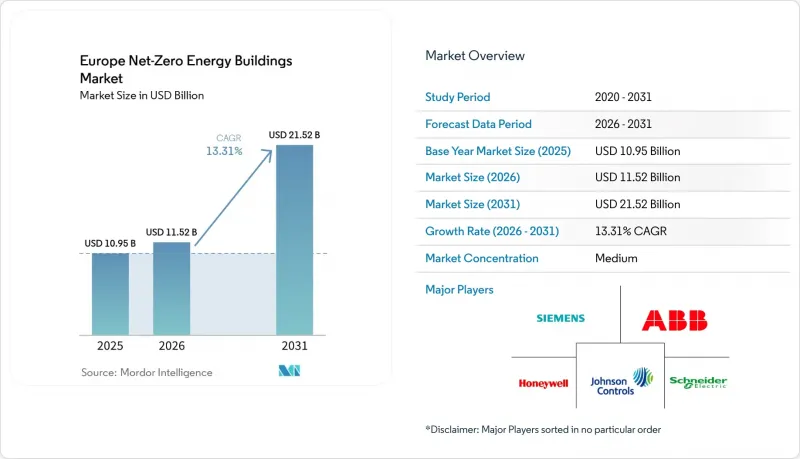
根據 Mordor Intelligence 預測,歐洲淨零能耗建築市場規模預計將在 2025 年達到 109.5 億美元,2026 年達到 115.2 億美元,到 2031 年達到 215.2 億美元,2026 年至 2031 年的複合年成長率為 13.31%。
歐洲淨零能耗建築市場的趨勢與洞察
修訂後的《能源性能指令》和零排放建築的最後期限正在加速實施。
修訂後的《建築能源性能指令》(EPBD)於2024年5月28日生效,並規定各國必須在2026年5月29日前將其納入本國法律。這一截止日期明確了提供設計、能源管理、試運行和認證服務的企業的專案流程。自2028年1月1日起,所有新建公共建築必須為零排放建築。自2030年1月1日起,所有新建建築必須符合類似標準。這些標準要求極高的能源性能,並實現場地內石化燃料零碳排放。德國提案的《建築現代化法案》在很大程度上遵循了EPBD的定義,2026年6月的一項調查概述了這個過渡的法律體制。
「改造浪潮」的資金正在推動徹底的能源維修工作。
歐洲淨零能耗建築市場依賴公共維修資金的支持,但僅靠資金無法彌補供給缺口。 2021年至2027年間,歐盟透過復甦與韌性基金(RRF)撥款超過800億歐元(880億美元),並透過凝聚政策基金撥款170億歐元(187億美元)用於提升建築能源效率。歐盟委員會也估計,到2030年,建築節能改造的年度投資需求將超過2,420億歐元(2,662億美元)。 2025年,法國在建築節能維修的國家支出達到79億歐元(87億美元)。德國2025年的住宅維修率為0.7%,但要達成氣候目標,維修率需達到2%。法國和北歐國家完全有能力應對短期內大規模維修計畫的成長。
高昂的初始投資成本和較長的投資回收期阻礙了其廣泛應用。
整棟建築的維修成本可能在每平方公尺300至500歐元(每平方公尺330至550美元)之間,而且對許多業主來說,投資回收期往往超出預期。這種壓力在自居住住宅和產權分散的住宅存量中尤其嚴重。在法國,「MaPrimeRenov」補貼計畫調整後,2022年至2024年間,住宅節能維修投資實際上下降了22%。 “Renovate Europe”呼籲設立專門的“歐盟房屋維修貸款機制”,為低利率房屋維修貸款提供擔保。該宣傳活動指出,儘管自住住宅佔歐盟住宅總量的70%,但現有金融產品的支持仍不足。缺乏標準化的融資產品降低了承包商在投資安裝設施時的確定性。
細分市場分析
到2025年,商業建築將佔歐洲淨零能耗建築市場的44.6%。企業永續發展義務和投資者報告要求使得非住宅物業的維修變得更加緊迫。德國、法國和英國的辦公和零售物業組合由於占地面積龐大,尤其容易面臨合規風險。 《歐洲建築能源性能指令》(EPBD)要求成員國到2030年改造16%的能源效率最低的非住宅建築。雖然住宅物業蘊藏著巨大的機遇,但所有權分散和資金籌措阻礙了決策的製定。採用預製外牆板進行持續維修正逐漸成為一種減少現場施工時間和降低建築成本的方法。
預計2026年至2031年間,公共設施的複合年成長率將達到14.2%。醫院、大學和公共設施的資產組合必須在規定的時間內管理規模龐大且營運複雜的資產。公共設施的最後期限是2028年1月1日,這意味著公共設施所有者比私營部門所有者擁有更短的決策時間。江森自控報告稱,透過綜合維修方案,丹麥奧爾堡大學醫院的能源消耗降低了高達80%。此類專案更青睞能夠整合設計、專案管理、試運行和建築能源管理系統的供應商。工業建築仍然是四種建築類型中規模最小的,而脫碳計畫正在推動中歐製造業的生產活動。
其他好處:
- Excel格式的市場預測(ME)表
- 3個月的分析師支持
目錄
第1章:引言
- 研究假設和市場定義
- 調查範圍
第2章:調查方法
第3章執行摘要
第4章 市場狀況
- 市場概覽
- 市場促進因素
- 修訂後的能源性能指令 (EPBD) 和零排放建築的最後期限正在加速其實施。
- 「改造浪潮」的資金正在推動大規模節能維修計畫。
- 能源成本的波動增加了對建築物能源韌性的需求。
- 綠色金融和ESG報告正在推動對淨零排放建築的投資。
- 併網建築透過需量反應創造商機。
- 經證實,節能性能可提升綠建築的租金溢價。
- 市場限制因素
- 高昂的初始投資成本和較長的投資回收期阻礙了其廣泛應用。
- 由於建築物理和維修專家短缺,該項目被延誤了。
- 整合舊有系統所面臨的挑戰正在增加效能差異的風險。
- 網路安全、資料管治和互通性風險正在阻礙智慧建築的普及。
- 價值和供應鏈分析
- 監理情勢
- 技術展望
- 市場變化和採用趨勢
- 大型淨零能耗建築項目
- 波特五力分析
第5章 市場規模與成長預測
- 依建築類型
- 住宅
- 商業
- 公共設施
- 產業
- 透過提供的服務
- 解決方案(開發新型淨零能耗建築、維修淨零能耗建築、一體化設計與施工、及智慧淨零能耗建築解決方案)
- 服務(建築和工程設計、施工服務、試運行和認證服務、諮詢服務)
- 依建築類型
- 新建工程
- 維修
- 按地區
- 英國
- 德國
- 法國
- 義大利
- 西班牙
- 其他歐洲國家
第6章 競爭情勢
- 市場集中度
- 策略趨勢
- 市佔率分析
- 公司簡介
- Siemens AG
- Schneider Electric SE
- Johnson Controls International plc
- ABB Ltd.
- Honeywell International Inc.
- Daikin Industries, Ltd.
- Carrier Global Corporation
- Trane Technologies plc
- Saint-Gobain SA
- Kingspan Group plc
- ROCKWOOL A/S
- Bosch Building Technologies
- Legrand SA
- Mitsubishi Electric Corporation
- Eaton Corporation plc
- Skanska AB
- VINCI Construction
- Bouygues Construction
- WSP Global Inc.
- Belimo Holding AG
第7章 市場機會與未來展望
According to Mordor Intelligence, the Europe Net-Zero energy buildings market size is projected to be USD 10.95 billion in 2025, USD 11.52 billion in 2026, and reach USD 21.52 billion by 2031, growing at a CAGR of 13.31% from 2026 to 2031.
Europe Net-Zero Energy Buildings Market Trends and Insights
Revised EPBD and Zero-Emission Building Deadlines Accelerate Adoption
The recast EPBD entered into force on May 28, 2024, and required national transposition by May 29, 2026. This deadline is creating a clearer project pipeline for providers of design, energy management, commissioning, and certification services. All new public buildings must be zero-emission buildings from January 1, 2028. All new buildings must meet the same standard as of January 1, 2030. The standard requires very high energy performance and no on-site fossil-fuel carbon emissions. Germany's proposed Building Modernization Act closely adopts the EPBD definition, and a June 2026 study described the transition's legal structure.
Renovation Wave Funding Drives Deep Energy Retrofit Activity
The Europe net-zero energy buildings market is supported by public renovation funding, although funding alone does not close the delivery gap. The Recovery and Resilience Facility provided more than EUR 80 billion (USD 88 billion), and Cohesion Policy Funds provided EUR 17 billion (USD 18.7 billion) to improve energy performance between 2021 and 2027. The European Commission also identified annual investment needs of more than EUR 242 billion (USD 266.2 billion) for buildings through 2030. France's state spending on building energy renovation reached EUR 7.9 billion (USD 8.7 billion) in 2025. Germany's residential renovation rate was 0.7% in 2025, compared with the 2% rate needed for climate goals. France and the Nordic countries have delivery systems better positioned to absorb a near-term increase in deep retrofit work.
High Upfront Capital Costs and Long Payback Periods Limit Adoption
Whole-building renovation can require EUR 300 to EUR 500 per square meter (USD 330 to USD 550 per square meter), extending payback periods beyond many owners' planning horizons. The pressure is most acute for owner-occupied and fragmented residential stock. Residential energy renovation investment in France fell 22% in real terms between 2022 and 2024 after changes to the MaPrimeRenov subsidy structure. Renovate Europe has called for a dedicated EU Renovation Loan Facility to support guarantees for low-interest renovation loans. The campaign noted that owner-occupied homes account for 70% of EU residences and remain poorly served by existing financial products. Without standard financing products, suppliers have less certainty to invest in installation capacity.
Other drivers and restraints analyzed in the detailed report include:
- Energy Cost Volatility Increases Demand For Building Energy Resilience
- Green Finance and ESG Reporting Support Net-Zero Building Investments
- Shortage of Building Physics and Retrofit Professionals Delays Projects
For complete list of drivers and restraints, kindly check the Table Of Contents.
Segment Analysis
Commercial buildings held 44.6% of the Europe net-zero energy buildings market share in 2025. Corporate sustainability obligations and investor reporting requirements have increased the urgency of upgrades in non-residential property. Office and retail portfolios in Germany, France, and the United Kingdom face significant compliance exposure because of their large floor areas. The EPBD requires member states to address the worst-performing 16% of non-residential buildings by 2030. Residential properties offer a large opportunity, but fragmented ownership and financing constraints slow decision-making. Serial renovation using prefabricated facade panels is emerging as a way to reduce time on site and lower delivery costs.
Institutional buildings are forecast to grow at a 14.2% CAGR from 2026 to 2031. Hospitals, universities, and public portfolios must manage large, operationally complex assets within defined deadlines. The January 1, 2028, public-building deadline gives these owners a shorter decision window than private-sector owners. Johnson Controls reported energy savings of up to 80% at Aalborg University Hospital in Denmark through an integrated retrofit approach. These projects favor suppliers that can combine design, project management, commissioning, and building energy management systems. Industrial buildings remain the smallest of the 4 building types, although decarbonization plans are supporting activity in Central European manufacturing facilities.
Complete Report Scope:
- By Building Type
- Residential
- Commercial
- Institutional
- Industrial
- By Offerings
- Solutions (New Net-Zero Energy Building Development, Net-Zero Building Retrofit, Integrated Design & Delivery and Smart Net-Zero Building Solutions)
- Services (Architectural & Engineering Design, Construction Services, Commissioning & Certification Services and Consulting Services)
- By Construction Type
- New Construction
- Renovation
- By Geography
- United Kingdom
- Germany
- France
- Italy
- Spain
- Rest of Europe
List of Companies Covered in this Report:
- Siemens AG
- Schneider Electric SE
- Johnson Controls International plc
- ABB Ltd.
- Honeywell International Inc.
- Daikin Industries, Ltd.
- Carrier Global Corporation
- Trane Technologies plc
- Saint-Gobain S.A.
- Kingspan Group plc
- ROCKWOOL A/S
- Bosch Building Technologies
- Legrand SA
- Mitsubishi Electric Corporation
- Eaton Corporation plc
- Skanska AB
- VINCI Construction
- Bouygues Construction
- WSP Global Inc.
- Belimo Holding AG
Additional Benefits:
- The market estimate (ME) sheet in Excel format
- 3 months of analyst support
TABLE OF CONTENTS
1 Introduction
- 1.1 Study Assumptions and Market Definition
- 1.2 Scope of the Study
2 Research Methodology
3 Executive Summary
4 Market Landscape
- 4.1 Market Overview
- 4.2 Market Drivers
- 4.2.1 Revised EPBD and Zero-Emission Building Deadlines Accelerate Adoption
- 4.2.2 Renovation Wave Funding Drives Deep Energy Retrofit Activity
- 4.2.3 Energy Cost Volatility Increases Demand For Building Energy Resilience
- 4.2.4 Green Finance and ESG Reporting Support Net-Zero Building Investments
- 4.2.5 Grid-Interactive Buildings Generate Demand Response Revenue Opportunities
- 4.2.6 Verified Energy Performance Increases Green Building Rental Premiums
- 4.3 Market Restraints
- 4.3.1 High Upfront Capital Costs and Long Payback Periods Limit Adoption
- 4.3.2 Shortage Of Building Physics and Retrofit Professionals Delays Projects
- 4.3.3 Legacy System Integration Challenges Increase Performance Gap Risks
- 4.3.4 Cybersecurity, Data Governance, and Interoperability Risks Hinder Smart Building Deployment
- 4.4 Value and Supply-Chain Analysis
- 4.5 Regulatory Landscape
- 4.6 Technological Outlook
- 4.7 Market Evolution and Adoption Trends
- 4.8 Key Net-Zero Energy Building Projects
- 4.9 Porter's Five Forces Analysis
- 4.9.1 Bargaining Power of Suppliers
- 4.9.2 Bargaining Power of Consumers
- 4.9.3 Threat of New Entrants
- 4.9.4 Threat of Substitutes
- 4.9.5 Intensity of Competitive Rivalry
5 Market Size & Growth Forecasts (Value, USD)
- 5.1 By Building Type
- 5.1.1 Residential
- 5.1.2 Commercial
- 5.1.3 Institutional
- 5.1.4 Industrial
- 5.2 By Offerings
- 5.2.1 Solutions (New Net-Zero Energy Building Development, Net-Zero Building Retrofit, Integrated Design & Delivery and Smart Net-Zero Building Solutions)
- 5.2.2 Services (Architectural & Engineering Design, Construction Services, Commissioning & Certification Services and Consulting Services)
- 5.3 By Construction Type
- 5.3.1 New Construction
- 5.3.2 Renovation
- 5.4 By Geography
- 5.4.1 United Kingdom
- 5.4.2 Germany
- 5.4.3 France
- 5.4.4 Italy
- 5.4.5 Spain
- 5.4.6 Rest of Europe
6 Competitive Landscape
- 6.1 Market Concentration
- 6.2 Strategic Moves
- 6.3 Market Share Analysis
- 6.4 Company Profiles (Includes Global Level Overview, Market Level Overview, Core Segments, Financials as Available, Strategic Information, Products & Services, and Recent Developments)
- 6.4.1 Siemens AG
- 6.4.2 Schneider Electric SE
- 6.4.3 Johnson Controls International plc
- 6.4.4 ABB Ltd.
- 6.4.5 Honeywell International Inc.
- 6.4.6 Daikin Industries, Ltd.
- 6.4.7 Carrier Global Corporation
- 6.4.8 Trane Technologies plc
- 6.4.9 Saint-Gobain S.A.
- 6.4.10 Kingspan Group plc
- 6.4.11 ROCKWOOL A/S
- 6.4.12 Bosch Building Technologies
- 6.4.13 Legrand SA
- 6.4.14 Mitsubishi Electric Corporation
- 6.4.15 Eaton Corporation plc
- 6.4.16 Skanska AB
- 6.4.17 VINCI Construction
- 6.4.18 Bouygues Construction
- 6.4.19 WSP Global Inc.
- 6.4.20 Belimo Holding AG
7 Market Opportunities & Future Outlook
- 7.1 White-Space and Unmet-Need Assessment

 亞太地區淨零能耗建築:市場佔有率分析、產業趨勢與統計及成長預測(2026-2031年)北美淨零能耗建築:市場佔有率分析、產業趨勢與統計及成長預測(2026-2031 年)淨零能耗建築:市場佔有率分析、產業趨勢與統計及成長預測(2026-2031 年)南美洲淨零能耗建築:市場佔有率分析、產業趨勢與統計及成長預測(2026-2031 年)中東和非洲淨零能耗建築:市場佔有率分析、行業趨勢和統計數據以及成長預測(2026-2031 年)
 淨零能耗建築市場報告:按產品、建築類型和地區分類(2026-2034 年)
 2026年全球淨零能耗建築(ZEB)市場報告
 自供電神經晶片市場分析及預測(至2035年):依類型、產品類型、技術、組件、應用、材料類型、裝置、製程、最終用戶及功能分類
 2026-2034年全球淨零能耗建築市場規模、佔有率、趨勢和成長分析報告
 全球電子百葉窗技術市場