


 |
市場調查報告書
商品編碼
2119087
亞太地區淨零能耗建築:市場佔有率分析、產業趨勢與統計及成長預測(2026-2031年)Asia-Pacific Net-Zero Energy Buildings - Market Share Analysis, Industry Trends & Statistics, Growth Forecasts (2026 - 2031) |
||||||

※ 本網頁內容可能與最新版本有所差異。詳細情況請與我們聯繫。
根據 Mordor Intelligence 預測,亞太地區淨零能耗建築市場規模預計到 2025 年將達到 130.2 億美元,到 2026 年將達到 140.3 億美元,到 2031 年將達到 304.2 億美元。
預計從 2026 年到 2031 年,其複合年成長率將達到 16.74%。
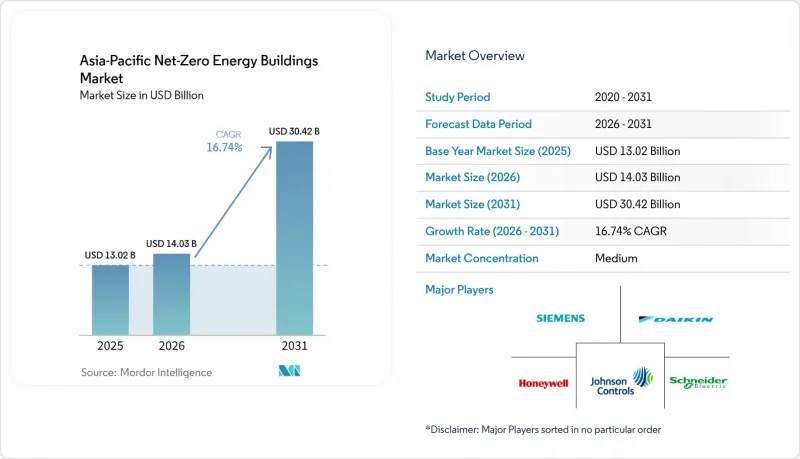
本報告按建築類型(住宅、商業、公共、工業)、產品/服務(解決方案、服務)、施工類型(新建、維修)和地區(中國、日本、印度、澳洲及其他亞太地區)進行細分。市場預測以美元計價。
亞太地區淨零能耗建築市場趨勢與洞察
強制性的淨零能耗和零能耗建築規範正在加速市場對這類建築的接受度。
強制性法規將能源性能納入核准流程,是亞太地區近零能耗建築市場的核心驅動力。日本修訂後的《建築節能法》規定,自2025年4月1日起,所有新建住宅和非住宅建築必須符合能源效率標準。該法規將「近零能耗建築性能」確立為新建非住宅建築的標準。 2025年,中國頒布了涵蓋超低能耗住宅、公共建築碳排放強度以及夏季炎熱冬季溫和地區近零能耗設計的國家級綜合標準。 2026年3月,海南省頒布了近零能耗建築技術標準,要求能耗水準至少比國家強制性標準低45%,該標準於2026年4月1日生效。由於各省和各國的具體要求不盡相同,這可能會增加在多個地區運作的開發商的設計和施工負擔,從而有利於那些能夠駕馭多種建築規範體系的開發商。
商業建築維修計劃有助於減少資產過時。
亞太地區的淨零能耗建築市場也得益於維修計劃,這些計劃旨在解決老舊商業資產無法滿足新性能標準的風險。亞太地區獲得認證的綠建築已達到20%至60%的節能效果,租金溢價高達11%,這進一步激勵了業主投資維修。日本在其2025會計年度「建築脫碳維修加速計畫」中累計144億日圓(約9,600萬美元)用於商業地產。該計劃旨在將酒店、醫院和辦公大樓等設施的初級能源消耗降低30%至40%。在香港科技大學,Schneider Electric和威立雅為李紹基商務大樓的初期維修費用提供了融資,併計劃根據實際節能效果在15年內收回投資。這種方式使得高性能維修更容易惠及那些無法直接承擔初期維修成本的業主。
前期成本高且投資回收期不確定性,限制了其在區域城市市場的普及。
高昂的前期成本仍是亞太地區淨零能耗建築市場發展的一大障礙,尤其是在建築資金籌措就緊張的地區。這個成本問題在規模較小的城市尤為突出,開發商必須權衡長期節能與眼前的資金需求。世界綠色建築委員會 (WGBC) 的一項研究表明,獲得綠色認證的建築可降低 20% 至 60% 的能耗,並獲得高達 11% 的租金溢價。然而,這些優勢並不能消除對資金籌措方案的需求,這些方案能夠將未來的節能轉化為專案啟動時的可用資金。在越南和印尼等市場,由於缺乏本地綠色金融產品,可能會減緩淨零能耗建築的普及。因此,履約合約、擔保和有針對性的公共支持對於擴大非大規模資產所有者的覆蓋範圍至關重要。
細分市場分析
到2025年,商業建築將佔亞太地區淨零能耗建築市場佔有率的45.9%。這主要得益於企業對永續發展的承諾以及對更高品質辦公空間的需求。隨著租戶在租賃協議和物業選擇中將能源性能納入考量,這一領域將從中受益。世界綠色建築委員會的研究表明,獲得認證的綠色建築可實現20%至60%的節能,租金溢價最高可達11%。這些營運和租金方面的優勢為開發商在設計階段融入淨零能耗規範提供了基礎。住宅領域在該地區仍蘊藏著巨大的機遇,因為日本和韓國正在推廣新建住宅的零能耗要求。工業設施也扮演著重要角色,因為使用者正在將建築性能與更廣泛的範圍1和範圍2減排計畫相銜接。
預計到2031年,公共設施的複合年成長率將達到18.1%,在所有建築類型中成長最高。政府設施、大學和醫院通常比私人設施更早受到公共部門相關要求的約束。 2025年,台州市啟動了第六人民醫院發燒門診大樓的建設,該大樓將成為該市首個「近零能耗」公共設施。該項目預計每年可減少3,870噸二氧化碳排放。 2026年5月,新加坡國立大學啟動了「ArCLab」項目,這是一個旨在獲得新加坡建設局綠色建築標誌鉑金級零能耗認證的歷史建築維修項目。在公共採購過程中,擁有受監管公共設施專案經驗的承包商和技術供應商往往更受青睞。
其他好處:
- Excel格式的市場預測(ME)表
- 3個月的分析師支持
目錄
第1章:引言
- 研究假設和市場定義
- 調查範圍
第2章:調查方法
第3章執行摘要
第4章 市場狀況
- 市場概覽
- 市場促進因素
- 強制性的淨零能耗和零能耗建築標準正在加速其在市場上的普及。
- 商業維修計劃可以緩解建築物資產價值的過時問題。
- 太陽能發電、儲能、熱泵和智慧控制系統的成本不斷下降,推動了它們的廣泛應用。
- 企業對檢驗的能源性能的需求正在推動淨零能耗建築的普及。
- 併網建築透過需量反應創造商機。
- 被動式設計能夠抵禦氣候變化,並支持在高溫地區建造節能建築。
- 市場限制因素
- 高昂的初始成本和不確定的投資回報限制了其在次市場的普及。
- 建築規範和可再生能源計算方法的碎片化增加了合規的複雜性。
- 由於缺乏熟練的設計師、試運行專家和操作人員,該專案進度落後於計劃。
- 使用者行為和測量方面的缺陷正在造成建築性能方面的差距。
- 價值和供應鏈分析
- 監理情勢
- 技術展望
- 市場變化和擴散趨勢
- 大型淨零能耗建築項目
- 波特五力分析
第5章 市場規模與成長預測
- 依建築類型
- 住宅
- 商業
- 公共設施
- 產業
- 透過提供的服務
- 解決方案(開發新型淨零能耗建築、維修淨零能耗建築、一體化設計與施工、及智慧淨零能耗建築解決方案)
- 服務(建築和工程設計、施工服務、試運行和認證服務、諮詢服務)
- 依建築類型
- 新建工程
- 維修
- 國家
- 中國
- 日本
- 印度
- 澳洲
- 其他亞太國家
第6章 競爭情勢
- 市場集中度
- 策略趨勢
- 市佔率分析
- 公司簡介
- Johnson Controls International plc
- Schneider Electric SE
- Siemens Aktiengesellschaft
- Daikin Industries, Ltd.
- Honeywell International Inc.
- Trane Technologies plc
- Carrier Global Corporation
- Mitsubishi Electric Corporation
- Panasonic Holdings Corporation
- ABB Ltd.
- Saint-Gobain SA
- Kingspan Group plc
- ROCKWOOL A/S
- Sika AG
- LIXIL Corporation
- AGC Inc.
- China State Construction Engineering Corporation Limited
- Larsen & Toubro Limited
- Sumitomo Forestry Co., Ltd.
- Envision Digital International Pte Ltd.
第7章 市場機會與未來展望
According to Mordor Intelligence, the Asia-Pacific net-Zero energy buildings market size is projected to be USD 13.02 billion in 2025, USD 14.03 billion in 2026, and reach USD 30.42 billion by 2031, growing at a CAGR of 16.74% from 2026 to 2031.
This report is Segmented by Building Type (Residential, Commercial, Institutional, Industrial), Offerings (Solutions, Services), Construction Type (New Construction, Renovation), and Geography (China, Japan, India, Australia, Rest of Asia-Pacific). The Market Forecasts are Provided in Terms of Value (USD).
Asia-Pacific Net-Zero Energy Buildings Market Trends and Insights
Mandatory Net-Zero and Zero-Energy Building Codes Accelerate Market Adoption
Mandatory rules are a central force in the Asia-Pacific net-zero energy buildings market because they make energy performance part of the approval process. Japan made energy-efficiency compliance mandatory for all new residential and nonresidential buildings as of April 1, 2025, under the revised Building Energy Efficiency Act. The rule established ZEB-Oriented performance as the baseline for new nonresidential construction. China issued national group standards in 2025 covering ultra-low-energy housing, public-building carbon intensity, and near-zero-energy design in hot-summer and warm-winter zones. Hainan issued a near-zero-energy building technical standard in March 2026 that requires consumption levels at least 45% below national mandatory norms, and it took effect on April 1, 2026. Different provincial and national requirements can increase the engineering workload for developers operating across multiple jurisdictions, favoring providers that can manage multiple code systems.
Commercial Retrofit Programs Reduce Building Asset Obsolescence
The Asia-Pacific net-zero energy buildings market is also supported by retrofit programs that address the risk of older commercial assets falling behind new performance expectations. Certified green buildings in Asia-Pacific reported energy savings of 20% to 60% and rental premiums of up to 11%, which strengthens the case for owners to invest in upgrades. Japan allocated JPY 14.4 billion (USD 96 million) to its FY2025 Decarbonization Building Renovation Acceleration program for commercial properties. The program targets a 30% to 40% reduction in primary energy use at facilities such as hotels, hospitals, and offices. At Hong Kong University of Science and Technology, Schneider Electric and Veolia financed the upfront retrofit costs for the Lee Shau Kee Business Building and planned to recover over 15 years from verified savings. This approach can make high-performance renovation more accessible to owners who cannot fund the initial upgrade cost directly.
High Upfront Costs and Uncertain Payback Limit Adoption in Secondary Markets
High initial costs remain a material limit on the Asia-Pacific net-zero energy buildings market, especially where construction finance is already constrained. The cost issue is most acute in secondary cities, where developers must weigh long-term energy savings against immediate capital requirements. Research by the World Green Building Council found that green-certified buildings can save 20% to 60% on energy and earn rental premiums of up to 11%. These benefits do not remove the need for financing tools that can convert future savings into capital available at the start of a project. A lack of local green-finance products can slow adoption in markets such as Vietnam and Indonesia. Performance contracts, guarantees, and targeted public support are therefore important for widening access beyond large asset owners.
Other drivers and restraints analyzed in the detailed report include:
- Declining Costs of Solar, Storage, Heat Pumps, and Smart Controls Improve Adoption
- Corporate Demand for Verified Energy Performance Drives Net-Zero Buildings
- Fragmented Building Codes and Renewable Energy Accounting Increase Compliance Complexity
For complete list of drivers and restraints, kindly check the Table Of Contents.
Segment Analysis
Commercial buildings accounted for 45.9% of the Asia-Pacific net-zero energy buildings market share in 2025, driven by corporate sustainability commitments and demand for higher-quality office space. The segment benefits when tenants consider energy performance in leasing and asset selection. Research by the World Green Building Council reported energy savings of 20% to 60% in certified green buildings and rental premiums of up to 11%. These operating and rental outcomes provide developers with a basis for including net-zero specifications at the design stage. Residential buildings remain a major part of the regional opportunity because Japan and South Korea are advancing zero-energy requirements for new homes. Industrial facilities are also relevant as occupiers align building performance with wider Scope 1 and Scope 2 emissions programs.
Institutional buildings are forecast to grow at an 18.1% CAGR through 2031, the fastest rate among building types. Government facilities, universities, and hospitals are often subject to earlier public-sector requirements than private facilities. Taizhou began construction in 2025 of a fever clinic building at the Sixth People's Hospital, described as the city's first near-zero-energy public facility. The project is expected to reduce annual carbon emissions by 3,870 metric tons. The National University of Singapore began work in May 2026 on ArCLab, a historic-building retrofit seeking BCA Green Mark Platinum Zero Energy certification. Public procurement cycles can favor contractors and technology providers that have documented performance in regulated institutional projects.
Complete Report Scope:
- By Building Type
- Residential
- Commercial
- Institutional
- Industrial
- By Offerings
- Solutions (New Net-Zero Energy Building Development, Net-Zero Building Retrofit, Integrated Design & Delivery and Smart Net-Zero Building Solutions)
- Services (Architectural & Engineering Design, Construction Services, Commissioning & Certification Services and Consulting Services)
- By Construction Type
- New Construction
- Renovation
- By Country
- China
- Japan
- India
- Australia
- Rest of Asia-Pacific
List of Companies Covered in this Report:
- Johnson Controls International plc
- Schneider Electric SE
- Siemens Aktiengesellschaft
- Daikin Industries, Ltd.
- Honeywell International Inc.
- Trane Technologies plc
- Carrier Global Corporation
- Mitsubishi Electric Corporation
- Panasonic Holdings Corporation
- ABB Ltd.
- Saint-Gobain S.A.
- Kingspan Group plc
- ROCKWOOL A/S
- Sika AG
- LIXIL Corporation
- AGC Inc.
- China State Construction Engineering Corporation Limited
- Larsen & Toubro Limited
- Sumitomo Forestry Co., Ltd.
- Envision Digital International Pte Ltd.
Additional Benefits:
- The market estimate (ME) sheet in Excel format
- 3 months of analyst support
TABLE OF CONTENTS
1 Introduction
- 1.1 Study Assumptions and Market Definition
- 1.2 Scope of the Study
2 Research Methodology
3 Executive Summary
4 Market Landscape
- 4.1 Market Overview
- 4.2 Market Drivers
- 4.2.1 Mandatory Net-Zero and Zero-Energy Building Codes Accelerate Market Adoption
- 4.2.2 Commercial Retrofit Programs Reduce Building Asset Obsolescence
- 4.2.3 Declining Costs of Solar, Storage, Heat Pumps, and Smart Controls Improve Adoption
- 4.2.4 Corporate Demand for Verified Energy Performance Drives Net-Zero Buildings
- 4.2.5 Grid-Interactive Buildings Create Demand Response Revenue Opportunities
- 4.2.6 Climate-Resilient Passive Design Supports Energy-Efficient Buildings in High-Heat Regions
- 4.3 Market Restraints
- 4.3.1 High Upfront Costs and Uncertain Payback Limit Adoption in Secondary Markets
- 4.3.2 Fragmented Building Codes and Renewable Energy Accounting Increase Compliance Complexity
- 4.3.3 Shortage of Skilled Designers, Commissioning Professionals, and Operators Delays Projects
- 4.3.4 Occupant Behavior and Incomplete Measurement Create Building Performance Gaps
- 4.4 Value and Supply-Chain Analysis
- 4.5 Regulatory Landscape
- 4.6 Technological Outlook
- 4.7 Market Evolution and Adoption Trends
- 4.8 Key Net-Zero Energy Building Projects
- 4.9 Porter's Five Forces Analysis
- 4.9.1 Bargaining Power of Suppliers
- 4.9.2 Bargaining Power of Consumers
- 4.9.3 Threat of New Entrants
- 4.9.4 Threat of Substitutes
- 4.9.5 Intensity of Competitive Rivalry
5 Market Size & Growth Forecasts (Value, USD)
- 5.1 By Building Type
- 5.1.1 Residential
- 5.1.2 Commercial
- 5.1.3 Institutional
- 5.1.4 Industrial
- 5.2 By Offerings
- 5.2.1 Solutions (New Net-Zero Energy Building Development, Net-Zero Building Retrofit, Integrated Design & Delivery and Smart Net-Zero Building Solutions)
- 5.2.2 Services (Architectural & Engineering Design, Construction Services, Commissioning & Certification Services and Consulting Services)
- 5.3 By Construction Type
- 5.3.1 New Construction
- 5.3.2 Renovation
- 5.4 By Country
- 5.4.1 China
- 5.4.2 Japan
- 5.4.3 India
- 5.4.4 Australia
- 5.4.5 Rest of Asia-Pacific
6 Competitive Landscape
- 6.1 Market Concentration
- 6.2 Strategic Moves
- 6.3 Market Share Analysis
- 6.4 Company Profiles (Includes Global Level Overview, Market Level Overview, Core Segments, Financials as Available, Strategic Information, Products & Services, and Recent Developments)
- 6.4.1 Johnson Controls International plc
- 6.4.2 Schneider Electric SE
- 6.4.3 Siemens Aktiengesellschaft
- 6.4.4 Daikin Industries, Ltd.
- 6.4.5 Honeywell International Inc.
- 6.4.6 Trane Technologies plc
- 6.4.7 Carrier Global Corporation
- 6.4.8 Mitsubishi Electric Corporation
- 6.4.9 Panasonic Holdings Corporation
- 6.4.10 ABB Ltd.
- 6.4.11 Saint-Gobain S.A.
- 6.4.12 Kingspan Group plc
- 6.4.13 ROCKWOOL A/S
- 6.4.14 Sika AG
- 6.4.15 LIXIL Corporation
- 6.4.16 AGC Inc.
- 6.4.17 China State Construction Engineering Corporation Limited
- 6.4.18 Larsen & Toubro Limited
- 6.4.19 Sumitomo Forestry Co., Ltd.
- 6.4.20 Envision Digital International Pte Ltd.
7 Market Opportunities & Future Outlook
- 7.1 White-Space and Unmet-Need Assessment

 北美淨零能耗建築:市場佔有率分析、產業趨勢與統計及成長預測(2026-2031 年)淨零能耗建築:市場佔有率分析、產業趨勢與統計及成長預測(2026-2031 年)南美洲淨零能耗建築:市場佔有率分析、產業趨勢與統計及成長預測(2026-2031 年)中東和非洲淨零能耗建築:市場佔有率分析、行業趨勢和統計數據以及成長預測(2026-2031 年)
 淨零能耗建築市場-2026-2032年全球市場預測
 全球淨零能耗住宅市場規模、佔有率、趨勢和成長分析報告(2026-2034年)
 電子百葉窗技術市場-全球產業規模、佔有率、趨勢、機會、預測:依技術、百葉窗類型、應用、地區和競爭格局分類,2021-2031年
 2034年淨零排放諮詢市場預測:按服務類型、合約模式、組織規模、最終用戶和地區分類的全球分析
 淨零能耗建築市場報告:按產品、建築類型和地區分類(2026-2034 年)
 2026年全球淨零能耗建築(ZEB)市場報告