


 |
市場調查報告書
商品編碼
2118862
中東和非洲淨零能耗建築:市場佔有率分析、行業趨勢和統計數據以及成長預測(2026-2031 年)Middle East and Africa Net-Zero Energy Buildings - Market Share Analysis, Industry Trends & Statistics, Growth Forecasts (2026 - 2031) |
||||||

※ 本網頁內容可能與最新版本有所差異。詳細情況請與我們聯繫。
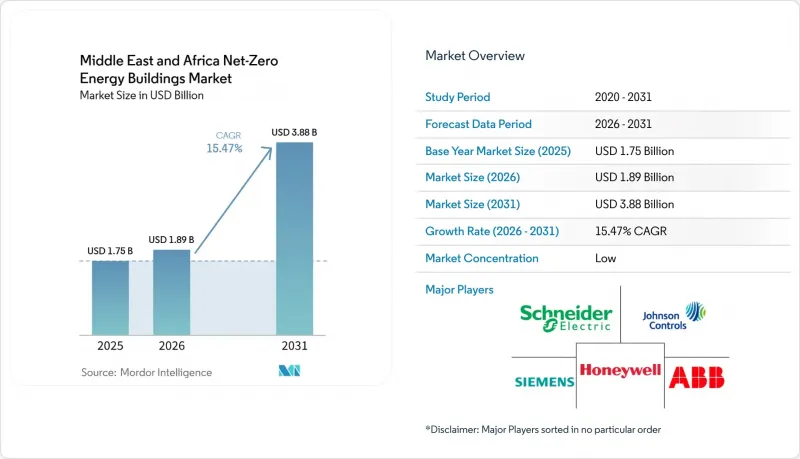
根據 Mordor Intelligence 預測,中東和非洲的淨零能耗建築市場規模將從 2025 年的 17.5 億美元和 2026 年的 18.9 億美元成長到 2031 年的 38.8 億美元,2026 年至 2031 年的年複合成長率(CAGR)為 15.47%。
本報告按建築類型(住宅、商業、公共、工業)、產品/服務(解決方案、服務)、施工類型(新建、維修)和地區(阿拉伯聯合大公國、沙烏地阿拉伯、南非、埃及等)進行細分。市場預測以美元計價。
中東和非洲淨零能耗建築市場的趨勢和洞察
各國強制性的淨零排放和綠建築標準正加速其實施。
在中東和非洲,監管義務是淨零能耗建築市場需求的直接來源。杜拜強制要求新建建築必須符合Al Safat銀級標準,並將永續性文件與批准和竣工流程掛鉤。沙烏地阿拉伯已將永續性要求納入其建築標準和評估框架,使這項措施超越了先導計畫階段。肯亞公佈了2026年至2040年的國家建築和施工脫碳藍圖,其中包括2030年新建公共建築的最低能源效率標準。南非的《氣候變遷法案》及其配套的碳稅率提高,為減少建築排放提供了更明確的經濟基礎。這些措施使業主、設計師和供應商有充分的理由在專案早期階段就專注於能源性能問題。
太陽能發電、儲能和智慧暖通空調系統的成本不斷下降,提高了專案的可行性。
降低技術成本正在提升中東和非洲淨零能耗建築市場的商業價值。一項針對高溫氣候下維修的同行評審研究表明,在沙烏地阿拉伯,將建築圍護結構維修與光伏(PV)系統相結合,可將建築圍護結構的投資回收期縮短至三年。該研究還表明,綜合維修方案可將能源需求降低至接近零能耗建築的基準值。透過提升暖氣、通風和空調(HVAC)系統的控制性能,可以減少日常運作中的能源浪費。較短的投資回收期使得現有建築的維修成為那些無法重建建築的業主更具經濟可行性的選擇。這種轉變正在將中東和非洲的淨零能耗建築市場拓展到新建案之外。
高昂的初始投資成本限制了其廣泛應用。
高昂的前期成本持續限制中東和非洲的淨零能耗建築市場。南非的一項研究表明,淨零能耗建築的建造成本可能比傳統建築高出5%至10%。預計到2024年,南非的借貸成本將達到15%,這可能會延長節能和可再生能源投資的回收期。阿卜杜拉國王石油研究中心的一項調查發現,在海灣國家137名受訪者中,20.4%的人認為高昂的前期成本是建築節能的一大障礙。調查也顯示,住宅建築是維修難度最高的領域。為了推進這些項目,制定長期資金籌措方案和對能源績效合約進行適當的評估仍然至關重要。
細分市場分析
2025年,商業建築在中東和非洲的淨零能耗建築市場中佔48.20%。這反映了沿岸地區城市中心辦公大樓、飯店、零售設施和大規模綜合用途開發案的集中度。開發商正在積極響應認證要求和租戶對更可靠能源效能的需求。施耐德電機位於杜拜的NEST總部於2025年獲得了LEED(能源與環境設計先鋒獎)ID+C鉑金級認證,年能耗降低了37%。該案例表明,商業辦公大樓可以作為建築控制和現場發電的標竿項目。此外,商業不動產所有者可以利用檢驗的營運數據來支援其環境、社會和管治(ESG)資訊揭露。
預計到2031年,公共基礎設施將以16.30%的複合年成長率高速成長。公共機構、大學、醫院和校園管理大規模的資產組合,並可在多個設施間制定通用標準。西門子與阿拉伯聯合大公國先進技術學院已就一項為期五年的智慧校園框架達成一致,該框架涵蓋能源、水、廢棄物和清潔交通系統。此類協議鼓勵持續交付技術和服務,而非一次性設備訂單。在南非和埃及,由於電力供應不穩定,建築業主優先考慮提高能源自給自足能力,住宅領域的需求正在擴大。隨著製造商在新工廠中採用高性能設計,工業設施的目標市場也不斷擴大。
其他好處:
- Excel格式的市場預測(ME)表
- 3個月的分析師支持
目錄
第1章:引言
- 研究假設和市場定義
- 調查範圍
第2章:調查方法
第3章執行摘要
第4章 市場狀況
- 市場概覽
- 市場促進因素
- 各國強制性的淨零排放和綠建築標準正加速市場採用。
- 與公用事業成本和電網可靠性相關的問題正在推動對節能建築的需求。
- 太陽能發電、儲能和智慧空調系統的成本不斷下降,提高了這些項目的可行性。
- 綠色金融和認證獎勵正在推動對淨零排放建築的投資。
- 以空調為主要負載的建築物,其維修工程的投資回收率較高。
- 建立建築物的能源性能數據有助於獲得綠色融資。
- 市場限制因素
- 由於淨零能耗建築需要大量的初始投資,因此其廣泛應用受到限制。
- 由於淨零能耗建築領域的專家短缺,該專案被延誤了。
- 獎勵的差異和對投資績效的監管不足是導致投資報酬率下降的原因。
- 極端高溫、缺水以及可再生能源的波動對建築性能構成了挑戰。
- 價值和供應鏈分析
- 監理情勢
- 技術展望
- 市場變化和擴散趨勢
- 大型淨零能耗建築項目
- 波特五力分析
第5章 市場規模與成長預測
- 依建築類型
- 住宅
- 商業
- 民眾
- 產業
- 報價
- 解決方案(開發新型淨零能耗建築、維修淨零能耗建築、一體化設計與施工、智慧淨零能耗建築解決方案)
- 服務(建築和工程設計、施工服務、試運行和認證服務、諮詢服務)
- 依建築類型
- 新建工程
- 維修
- 國家
- 阿拉伯聯合大公國
- 沙烏地阿拉伯
- 南非
- 埃及
- 其他中東和非洲國家
第6章 競爭情勢
- 市場集中度
- 策略趨勢
- 市佔率分析
- 公司簡介
- Johnson Controls International plc
- Schneider Electric SE
- Siemens AG
- Honeywell International Inc.
- ABB Ltd.
- Daikin Industries, Ltd.
- Trane Technologies plc
- Carrier Global Corporation
- Mitsubishi Electric Corporation
- Saint-Gobain SA
- Kingspan Group plc
- ROCKWOOL A/S
- Bosch Building Technologies
- Legrand SA
- ENGIE SA
- Masdar
- ACCIONA, SA
- Al-Futtaim Engineering and Technologies
- ELSEWEDY ELECTRIC
- Dalkia
第7章 市場機會與未來展望
According to Mordor Intelligence, the Middle East and Africa net-Zero energy buildings market size is projected to expand from USD 1.75 billion in 2025 and USD 1.89 billion in 2026 to USD 3.88 billion by 2031, registering a CAGR of 15.47% between 2026 to 2031.
This report is Segmented by Building Type (Residential, Commercial, Institutional, and Industrial), by Offerings (Solutions and Services), by Construction Type (New Construction and Renovation), and by Geography (United Arab Emirates, Saudi Arabia, South Africa, Egypt, and More). The Market Forecasts are Provided in Terms of Value (USD).
Middle East and Africa Net-Zero Energy Buildings Market Trends and Insights
National Net-Zero Mandates and Green Building Codes Accelerate Adoption
Regulatory mandates are a direct source of demand for the Middle East and Africa net-zero energy buildings market. Dubai requires its Al Sa'fat Silver baseline for new building permits, linking sustainability documentation to approval and completion processes. Saudi Arabia has embedded sustainability requirements into its building code and assessment framework, moving the subject beyond pilot projects. Kenya launched its National Buildings and Construction Decarbonization Roadmap for 2026 to 2040, including minimum energy performance standards for new public buildings by 2030. South Africa's Climate Change Act and its higher carbon tax rate created a clearer financial reason to reduce building emissions. These measures give building owners, designers, and suppliers clearer reasons to address energy performance earlier in a project.
Declining Costs of Solar, Storage, and Smart HVAC Systems Improve Project Viability
Lower technology costs are improving the business case for the Middle East and Africa net-zero energy buildings market. A peer-reviewed study of hot-climate retrofits found that envelope upgrades combined with photovoltaic (PV) systems could yield a 3-year payback for the envelope component in Saudi Arabia. The same source showed that combined retrofit packages can bring energy demand close to the thresholds for near-zero energy buildings. Better controls for heating, ventilation, and air conditioning, or HVAC, systems can reduce waste during daily operation. Shorter payback periods make upgrades to existing buildings more financially credible for owners who cannot replace their properties. This shift broadens the Middle East and Africa net-zero energy buildings market beyond new construction pipelines.
High Upfront Capital Requirements Limit Adoption
High upfront costs continue to constrain the Middle East and Africa net-zero energy buildings market. Net-zero buildings can cost 5% to 10% more to construct than conventional buildings, according to research on South Africa. South African borrowing costs reached 15% in 2024, potentially lengthening the payback periods for efficiency and renewable energy investments. A King Abdullah Petroleum Studies and Research Center survey found that 20.4% of 137 respondents identified high initial cost as a barrier to energy conservation in Gulf buildings. The survey also identified residential buildings as the most difficult segment to retrofit. Longer financing structures and better evaluation of energy performance contracts remain important for advancing projects.
Other drivers and restraints analyzed in the detailed report include:
- Utility Costs and Grid Reliability Challenges Increase Demand for Energy-Efficient Buildings
- Green Finance and Certification Incentives Support Building Investments
- Shortage of Specialized Professionals Delays Project Delivery
For complete list of drivers and restraints, kindly check the Table Of Contents.
Segment Analysis
Commercial buildings held 48.20% of the Middle East and Africa net-zero energy buildings market share in 2025. Their position reflects the concentration of offices, hotels, retail properties, and large mixed-use developments in Gulf urban centers. Developers are responding to certification requirements and to tenant requests for more credible energy performance. Schneider Electric's NEST headquarters in Dubai achieved a 37% reduction in annual energy use and Leadership in Energy and Environmental Design, or LEED, ID+C Platinum certification in 2025. The example shows how a commercial office can serve as a visible reference project for building controls and on-site generation. Commercial owners can also use verified operating data to support environmental, social, and governance disclosures.
Institutional buildings are forecast to post the fastest CAGR of 16.30% through 2031. Public agencies, universities, hospitals, and campuses control larger portfolios and can set common standards across multiple facilities. Siemens and the United Arab Emirates Higher Colleges of Technology agreed on a 5-year Smart Campus Framework that covers energy, water, waste, and clean mobility systems. Such agreements support recurring technology and services rather than a single equipment order. Residential demand is growing in South Africa and Egypt because building owners value greater self-sufficiency during unreliable power supply. Industrial facilities also widen the addressable base when manufacturers use high-performance designs for new plants.
Complete Report Scope:
- By Building Type
- Residential
- Commercial
- Institutional
- Industrial
- By Offerings
- Solutions (New Net-Zero Energy Building Development, Net-Zero Building Retrofit, Integrated Design & Delivery and Smart Net-Zero Building Solutions)
- Services (Architectural & Engineering Design, Construction Services, Commissioning & Certification Services and Consulting Services)
- By Construction Type
- New Construction
- Renovation
- By Country
- United Arab Emirates
- Saudi Arabia
- South Africa
- Egypt
- Rest of Middle East and Africa
List of Companies Covered in this Report:
- Johnson Controls International plc
- Schneider Electric SE
- Siemens AG
- Honeywell International Inc.
- ABB Ltd.
- Daikin Industries, Ltd.
- Trane Technologies plc
- Carrier Global Corporation
- Mitsubishi Electric Corporation
- Saint-Gobain S.A.
- Kingspan Group plc
- ROCKWOOL A/S
- Bosch Building Technologies
- Legrand SA
- ENGIE SA
- Masdar
- ACCIONA, S.A.
- Al-Futtaim Engineering and Technologies
- ELSEWEDY ELECTRIC
- Dalkia
Additional Benefits:
- The market estimate (ME) sheet in Excel format
- 3 months of analyst support
TABLE OF CONTENTS
1 Introduction
- 1.1 Study Assumptions and Market Definition
- 1.2 Scope of the Study
2 Research Methodology
3 Executive Summary
4 Market Landscape
- 4.1 Market Overview
- 4.2 Market Drivers
- 4.2.1 National Net-Zero Mandates and Green Building Codes Accelerate Market Adoption
- 4.2.2 Utility Cost and Grid Reliability Challenges Increase Demand for Energy-Efficient Buildings
- 4.2.3 Declining Costs of Solar, Storage, and Smart HVAC Systems Improve Project Viability
- 4.2.4 Green Finance and Certification Incentives Support Net-Zero Building Investments
- 4.2.5 Cooling-Dominant Building Loads Enhance Retrofit Payback Potential
- 4.2.6 Building Energy Performance Data Improves Access to Green Financing
- 4.3 Market Restraints
- 4.3.1 High Upfront Capital Requirements Limit Net-Zero Building Adoption
- 4.3.2 Shortage of Specialized Net-Zero Building Professionals Delays Project Delivery
- 4.3.3 Split Incentives and Weak Operational Performance Monitoring Reduce Investment Returns
- 4.3.4 Extreme Heat, Water Stress, and Renewable Energy Variability Challenge Building Performance
- 4.4 Value and Supply-Chain Analysis
- 4.5 Regulatory Landscape
- 4.6 Technological Outlook
- 4.7 Market Evolution and Adoption Trends
- 4.8 Key Net-Zero Energy Building Projects
- 4.9 Porter's Five Forces Analysis
- 4.9.1 Bargaining Power of Suppliers
- 4.9.2 Bargaining Power of Consumers
- 4.9.3 Threat of New Entrants
- 4.9.4 Threat of Substitutes
- 4.9.5 Intensity of Competitive Rivalry
5 Market Size & Growth Forecasts (Value, USD)
- 5.1 By Building Type
- 5.1.1 Residential
- 5.1.2 Commercial
- 5.1.3 Institutional
- 5.1.4 Industrial
- 5.2 By Offerings
- 5.2.1 Solutions (New Net-Zero Energy Building Development, Net-Zero Building Retrofit, Integrated Design & Delivery and Smart Net-Zero Building Solutions)
- 5.2.2 Services (Architectural & Engineering Design, Construction Services, Commissioning & Certification Services and Consulting Services)
- 5.3 By Construction Type
- 5.3.1 New Construction
- 5.3.2 Renovation
- 5.4 By Country
- 5.4.1 United Arab Emirates
- 5.4.2 Saudi Arabia
- 5.4.3 South Africa
- 5.4.4 Egypt
- 5.4.5 Rest of Middle East and Africa
6 Competitive Landscape
- 6.1 Market Concentration
- 6.2 Strategic Moves
- 6.3 Market Share Analysis
- 6.4 Company Profiles (Includes Global Level Overview, Market Level Overview, Core Segments, Financials as Available, Strategic Information, Products & Services, and Recent Developments)
- 6.4.1 Johnson Controls International plc
- 6.4.2 Schneider Electric SE
- 6.4.3 Siemens AG
- 6.4.4 Honeywell International Inc.
- 6.4.5 ABB Ltd.
- 6.4.6 Daikin Industries, Ltd.
- 6.4.7 Trane Technologies plc
- 6.4.8 Carrier Global Corporation
- 6.4.9 Mitsubishi Electric Corporation
- 6.4.10 Saint-Gobain S.A.
- 6.4.11 Kingspan Group plc
- 6.4.12 ROCKWOOL A/S
- 6.4.13 Bosch Building Technologies
- 6.4.14 Legrand SA
- 6.4.15 ENGIE SA
- 6.4.16 Masdar
- 6.4.17 ACCIONA, S.A.
- 6.4.18 Al-Futtaim Engineering and Technologies
- 6.4.19 ELSEWEDY ELECTRIC
- 6.4.20 Dalkia
7 Market Opportunities & Future Outlook
- 7.1 White-Space and Unmet-Need Assessment

 亞太地區淨零能耗建築:市場佔有率分析、產業趨勢與統計及成長預測(2026-2031年)北美淨零能耗建築:市場佔有率分析、產業趨勢與統計及成長預測(2026-2031 年)淨零能耗建築:市場佔有率分析、產業趨勢與統計及成長預測(2026-2031 年)南美洲淨零能耗建築:市場佔有率分析、產業趨勢與統計及成長預測(2026-2031 年)
 淨零能耗建築市場-2026-2032年全球市場預測
 全球淨零能耗住宅市場規模、佔有率、趨勢和成長分析報告(2026-2034年)
 電子百葉窗技術市場-全球產業規模、佔有率、趨勢、機會、預測:依技術、百葉窗類型、應用、地區和競爭格局分類,2021-2031年
 2034年淨零排放諮詢市場預測:按服務類型、合約模式、組織規模、最終用戶和地區分類的全球分析
 淨零能耗建築市場報告:按產品、建築類型和地區分類(2026-2034 年)
 2026年全球淨零能耗建築(ZEB)市場報告