


 |
市場調查報告書
商品編碼
2118958
南美洲淨零能耗建築:市場佔有率分析、產業趨勢與統計及成長預測(2026-2031 年)South America Net-Zero Energy Buildings - Market Share Analysis, Industry Trends & Statistics, Growth Forecasts (2026 - 2031) |
||||||

※ 本網頁內容可能與最新版本有所差異。詳細情況請與我們聯繫。
預計南美淨零能耗建築市場將從 2025 年的 5.3 億美元成長到 2026 年的 6.1 億美元,然後在 2031 年達到 13.1 億美元,2026 年至 2031 年的複合年成長率為 16.52%。
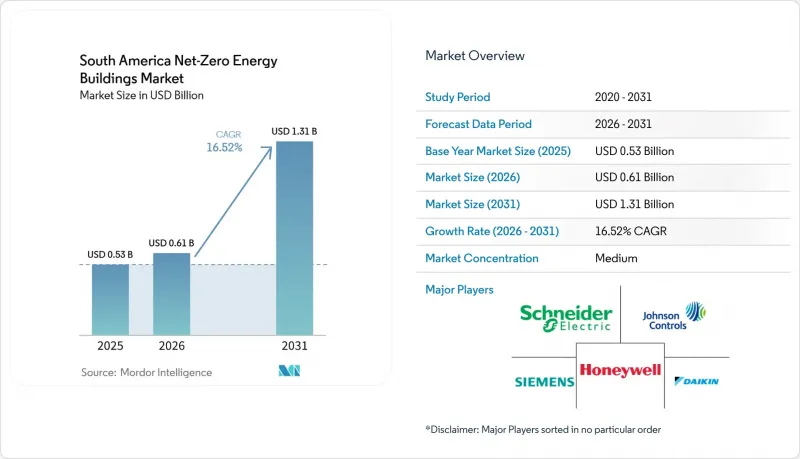
本報告按建築類型(住宅、商業、公共和工業建築)、產品/服務(解決方案和服務)、施工類型(新建和維修)以及國家(巴西、阿根廷、哥倫比亞、智利和其他南美國家)進行細分。市場預測以美元計價。
南美淨零能耗建築市場的趨勢與洞察
能源性能法規和綠色認證正在推動淨零能耗建築的普及。
巴西能源效率總司 (CGIEE) 第 4/2025 號決議規定了新建建築的最低能源效率要求,並將合規性與建築許可證的發放時間掛鉤。聯邦公共建築必須從 2027 年起達到 ENCE A 級能源評級,並在 2035 年之前達到近零能耗建築標準。而私人建築則必須從 2030 年起達到 C 級能源效率標準。巴西礦業和能源部表示,這項措施到 2040 年將節省 1,700 萬兆瓦時的能源,並降低 5 億美元的電力成本。這個時間表使開發商有時間調整設計,同時也使投資者和產品供應商對未來的最低能源效率標準更加可預測。哥倫比亞 2025 年第 0194 號決議認可「卓越能源效率設計 (EDGE)」認證為一種合規途徑,提高了該認證在計畫核准中的重要性。到2026年,哥倫比亞已建成超過36.4萬套獲得EDGE認證的住宅,涉及1282個項目,總建築面積達2540萬平方公尺。這些措施使得南美洲淨零能耗建築市場從自願認證到可衡量的性能評估的路徑更加清晰。
企業脫碳目標正在推動對永續建築的需求。
企業租戶和資產所有者在位置和資產組合管理中越來越重視能源績效。西門子的一份報告顯示,57%的受訪公司計劃在未來一年內增加對能源效率的投資,55%增加對智慧建築技術的投資,54%增加對建築電氣化的投資。在巴西,綠色認證在房地產基金策略和重點商業區的租賃決策中變得越來越重要。這種需求推動了商業建築的發展,使業主能夠在降低營運成本的同時,擁有更強的環保記錄,以滿足租戶的報告要求。這也凸顯了當建築必須展現實際性能而非僅僅體現設計意圖時,性能驗證、認證和諮詢服務的必要性。因此,南美淨零能耗建築市場對能夠幫助業主將既定目標轉化為檢驗結果的服務供應商有著巨大的需求,尤其是在租賃和融資協議中需要提供能源效率證明的情況下。
高昂的初始成本和有限的綠色融資阻礙了市場普及。
高昂的初始成本仍然是一大障礙,尤其對於大都會圈以外的私人開發人員更是如此。西門子的一項調查發現,60%的受訪商業房地產主管認為脫碳成本過高,而只有33%的人認為他們擁有充足的資金籌措管道。高昂的當地利率和有限的綠色金融產品使得在實現節能之前難以獲得設備和設計改造所需的資金。世界綠建築委員會(WGBC)的一項調查發現,68%的美洲受訪者認為缺乏金融產品是推廣應用的主要障礙。這造成了投資期間看似獲利的項目與從一開始就能獲得建設資金的項目之間存在著實際差距。國際金融公司(IFC)將「能源即服務(EaaS)」模式定位為一種將資本支出轉變為與保證節能掛鉤的支付方式。在這些機制得到更廣泛的應用之前,南美洲的淨零能耗建築市場可能仍將集中在那些擁有雄厚資金基礎或獲得公共資金的項目上。
細分市場分析
2025年,商業建築佔南美洲淨零能耗建築市場的44.70%。這一地位得益於各公司在主要辦公區開展的環保舉措、租賃協議要求以及綠色認證活動。在聖保羅,機構投資者和跨國租戶越來越重視獲得認證的空間,將其視為提升投資組合品質和吸引租戶的關鍵因素。 2025年6月,全球零能耗建築網路(Global Network for Zero)為一家巴西律師事務所的辦公室頒發了認證,顯示營運淨零能耗認證正在向普通商業房地產推廣。當節能、租金設定和合規要求協調一致時,商業房地產所有者可以更容易證明其投資的合理性。因此,這一領域在南美洲淨零能耗建築產業中佔據核心地位。
預計到2031年,公共設施的複合年成長率將達到17.40%,在所有建築類型中成長最高。公共法規和對高韌性設施的需求正在推動醫院、大學和公共設施的需求成長。巴西的「PROCEL Energia Zero」計畫在2025年撥款1,750萬美元,用於促進包括醫療和教育機構在內的公共設施的零能耗維修。位於庫里蒂巴的Oncopediatrico Herastino醫院於2024年獲得LEED零能耗認證,成為該地區醫療設施的標竿。隨著私人住宅被納入巴西未來的性能標準,住宅領域的需求也預計將成長。另一方面,由於維修的複雜性以及業主和租戶之間往往未能充分共享能源投資收益,工業地產的進展相對緩慢。
其他好處:
- Excel格式的市場預測(ME)表
- 3個月的分析師支持
目錄
第1章:引言
- 研究假設和市場定義
- 調查範圍
第2章:調查方法
第3章執行摘要
第4章 市場狀況
- 市場概覽
- 市場促進因素
- 能源性能法規和綠色認證正在推動淨零能耗建築的普及。
- 企業脫碳目標正在推動對永續建築的需求。
- 分散式太陽能發電成本的降低和智慧控制系統的普及提高了該專案的可行性。
- 電網可靠性和氣候風險的增加,使得人們對節能型建築的需求日益成長。
- 績效融資和綠色租賃正在推動淨零投資。
- 地方層級的淨零排放示範計畫正在加速市場發展。
- 市場限制因素
- 高昂的初始成本和有限的綠色融資阻礙了其在市場上的廣泛應用。
- 監管執法不一致和缺乏營運數據加劇了合規方面的挑戰。
- 對進口高性能建築材料的依賴推高了專案成本。
- 對現有建築維修缺乏一致的獎勵,延緩了淨零排放目標的實現。
- 價值和供應鏈分析
- 監理情勢
- 技術展望
- 市場變化和採用趨勢
- 大型淨零能耗建築項目
- 波特五力分析
第5章 市場規模與成長預測
- 依建築類型
- 住宅
- 商業的
- 公共設施
- 產業
- 透過提供的服務
- 解決方案(開發新型淨零能耗建築、維修淨零能耗建築、一體化設計與施工、及智慧淨零能耗建築解決方案)
- 服務(建築和工程設計、施工服務、試運行和認證服務、諮詢服務)
- 依建築類型
- 新建工程
- 維修
- 國家
- 巴西
- 阿根廷
- 哥倫比亞
- 智利
- 其他南美國家
第6章 競爭情勢
- 市場集中度
- 策略趨勢
- 市佔率分析
- 公司簡介
- Schneider Electric SE
- Johnson Controls International plc
- Siemens AG
- Honeywell International Inc.
- Daikin Industries, Ltd.
- Trane Technologies plc
- Carrier Global Corporation
- Mitsubishi Electric Corporation
- Panasonic Holdings Corporation
- ABB Ltd.
- Saint-Gobain
- Kingspan Group plc
- ROCKWOOL A/S
- Sika AG
- Legrand SA
- Bosch Building Technologies
- Belimo Holding AG
- Skanska AB
- Lendlease Group
- WSP Global Inc.
第7章 市場機會與未來展望
According to Mordor Intelligence, the South America net-Zero energy buildings market size is expected to grow from USD 0.53 billion in 2025 to USD 0.61 billion in 2026 and is forecast to reach USD 1.31 billion by 2031 at 16.52% CAGR over 2026-2031.
This report is Segmented by Building Type (Residential, Commercial, Institutional, and Industrial), by Offerings (Solutions and Services), by Construction Type (New Construction and Renovation), and by Country (Brazil, Argentina, Colombia, Chile, and Rest of South America). The Market Forecasts are Provided in Terms of Value (USD).
South America Net-Zero Energy Buildings Market Trends and Insights
Energy Performance Regulations and Green Certification Drive Net-Zero Building Adoption
Brazil's CGIEE Resolution No. 4/2025 set minimum energy performance requirements for new buildings and linked compliance to the timing of construction permits. Federal public buildings must reach the ENCE Level A rating from 2027 and a near-zero energy building standard by 2035, while private buildings must meet Level C from 2030. The Ministry of Mines and Energy stated that the measure could save 17 million megawatt-hours and avoid USD 0.5 billion in electricity costs by 2040. That timetable gives developers time to adjust designs, while making future minimum performance more predictable for investors and product suppliers. Colombia's Resolution 0194 of 2025 recognizes Excellence in Design for Greater Efficiencies (EDGE) as a compliance route, making certification more relevant to project approval. Colombia had more than 364,000 EDGE-certified housing units across 25.4 million square meters and 1,282 projects by 2026. These measures give the South America net-zero energy buildings market a clearer path from voluntary certification to measured performance.
Corporate Decarbonization Goals Increase Demand for Sustainable Buildings
Corporate tenants and asset owners are making energy performance a more visible part of site selection and portfolio management. Siemens reported that 57% of surveyed organizations planned to increase investment in energy efficiency, 55% in smart building technologies, and 54% in building electrification within the following year. In Brazil, green certifications are increasingly relevant to real estate fund strategy and to leasing decisions in major business districts. This demand supports commercial buildings, where owners can combine lower operating costs with stronger environmental credentials and respond to tenant reporting requirements. It also underscores the need for commissioning, certification, and advisory services when a building must demonstrate actual performance rather than design intent. The South America net-zero energy buildings market, therefore, has room for service providers that can help owners convert stated targets into verified results, particularly where a lease or financing agreement requires evidence of energy savings.
High Upfront Costs and Limited Green Financing Restrict Market Adoption
Upfront cost remains a major barrier, particularly for private developers outside large urban centers. Siemens found that 60% of commercial real estate executives surveyed considered decarbonization too expensive, while 33% reported adequate access to financing. High local interest rates and limited green finance products make it harder to fund equipment and design changes before energy savings are realized. The World Green Building Council found that 68% of respondents in the Americas cited the lack of financial products as a primary barrier to adoption. This creates a practical gap between a project that looks viable over its operating life and one that can secure construction funding at the outset. The International Finance Corporation identifies Energy-as-a-Service models as a way to shift capital spending toward payments tied to guaranteed savings. Until such structures become more common, the South America net-zero energy buildings market will remain concentrated in projects with stronger balance sheets or public support.
Other drivers and restraints analyzed in the detailed report include:
- Declining Costs of Distributed Solar and Smart Controls Improve Project Viability
- Grid Reliability and Climate Risks Increase Demand for Energy-Resilient Buildings
- Fragmented Regulatory Enforcement and Limited Operational Data Increase Compliance Challenges
For complete list of drivers and restraints, kindly check the Table Of Contents.
Segment Analysis
Commercial buildings accounted for 44.70% of the South America net-zero energy buildings market in 2025. Corporate environmental commitments, lease requirements, and green certification activity in prime office districts supported this position. In Sao Paulo, institutional investors and multinational occupiers have made certified space more relevant to portfolio quality and tenant attraction. The Global Network for Zero certified a Brazilian law firm office in June 2025, showing that operational net-zero recognition is reaching standard commercial settings. Commercial owners can more readily justify investments when energy savings, rental positioning, and compliance needs align. This makes the segment central to the South America net-zero energy buildings industry.
Institutional buildings are forecast to expand at a 17.40% CAGR through 2031, the fastest rate among building types. Public mandates and the need for resilient facilities support demand from hospitals, universities, and public buildings. Brazil's PROCEL Energia Zero program committed USD 17.5 million in 2025 for zero-energy retrofits of public facilities, including health and education buildings. The Hospital Oncopediatrico Erastinho in Curitiba received LEED Zero Energy certification in 2024, which provided a regional benchmark for health facilities. Residential demand should also increase as private housing is included in Brazil's future performance framework. Industrial properties are less advanced because retrofits are complex, and landlords and tenants often do not share the benefits of energy investments.
Complete Report Scope:
- By Building Type
- Residential
- Commercial
- Institutional
- Industrial
- By Offerings
- Solutions (New Net-Zero Energy Building Development, Net-Zero Building Retrofit, Integrated Design & Delivery and Smart Net-Zero Building Solutions)
- Services (Architectural & Engineering Design, Construction Services, Commissioning & Certification Services and Consulting Services)
- By Construction Type
- New Construction
- Renovation
- By Country
- Brazil
- Argentina
- Colombia
- Chile
- Rest of South America
List of Companies Covered in this Report:
- Schneider Electric SE
- Johnson Controls International plc
- Siemens AG
- Honeywell International Inc.
- Daikin Industries, Ltd.
- Trane Technologies plc
- Carrier Global Corporation
- Mitsubishi Electric Corporation
- Panasonic Holdings Corporation
- ABB Ltd.
- Saint-Gobain
- Kingspan Group plc
- ROCKWOOL A/S
- Sika AG
- Legrand SA
- Bosch Building Technologies
- Belimo Holding AG
- Skanska AB
- Lendlease Group
- WSP Global Inc.
Additional Benefits:
- The market estimate (ME) sheet in Excel format
- 3 months of analyst support
TABLE OF CONTENTS
1 Introduction
- 1.1 Study Assumptions and Market Definition
- 1.2 Scope of the Study
2 Research Methodology
3 Executive Summary
4 Market Landscape
- 4.1 Market Overview
- 4.2 Market Drivers
- 4.2.1 Energy Performance Regulations and Green Certification Drive Net-Zero Building Adoption
- 4.2.2 Corporate Decarbonization Goals Increase Demand for Sustainable Buildings
- 4.2.3 Declining Costs of Distributed Solar and Smart Controls Improve Project Viability
- 4.2.4 Grid Reliability and Climate Risks Increase Demand for Energy-Resilient Buildings
- 4.2.5 Performance-Linked Finance and Green Leases Support Net-Zero Investments
- 4.2.6 Local Net-Zero Demonstration Projects Accelerate Market Development
- 4.3 Market Restraints
- 4.3.1 High Upfront Costs and Limited Green Financing Restrict Market Adoption
- 4.3.2 Fragmented Regulatory Enforcement and Limited Operational Data Increase Compliance Challenges
- 4.3.3 Dependence on Imported High-Performance Building Components Raises Project Costs
- 4.3.4 Split Incentives in Existing Building Retrofits Slow Net-Zero Adoption
- 4.4 Value and Supply-Chain Analysis
- 4.5 Regulatory Landscape
- 4.6 Technological Outlook
- 4.7 Market Evolution and Adoption Trends
- 4.8 Key Net-Zero Energy Building Projects
- 4.9 Porter's Five Forces Analysis
- 4.9.1 Bargaining Power of Suppliers
- 4.9.2 Bargaining Power of Consumers
- 4.9.3 Threat of New Entrants
- 4.9.4 Threat of Substitutes
- 4.9.5 Intensity of Competitive Rivalry
5 Market Size & Growth Forecasts (Value, USD)
- 5.1 By Building Type
- 5.1.1 Residential
- 5.1.2 Commercial
- 5.1.3 Institutional
- 5.1.4 Industrial
- 5.2 By Offerings
- 5.2.1 Solutions (New Net-Zero Energy Building Development, Net-Zero Building Retrofit, Integrated Design & Delivery and Smart Net-Zero Building Solutions)
- 5.2.2 Services (Architectural & Engineering Design, Construction Services, Commissioning & Certification Services and Consulting Services)
- 5.3 By Construction Type
- 5.3.1 New Construction
- 5.3.2 Renovation
- 5.4 By Country
- 5.4.1 Brazil
- 5.4.2 Argentina
- 5.4.3 Colombia
- 5.4.4 Chile
- 5.4.5 Rest of South America
6 Competitive Landscape
- 6.1 Market Concentration
- 6.2 Strategic Moves
- 6.3 Market Share Analysis
- 6.4 Company Profiles (Includes Global Level Overview, Market Level Overview, Core Segments, Financials as Available, Strategic Information, Products & Services, and Recent Developments)
- 6.4.1 Schneider Electric SE
- 6.4.2 Johnson Controls International plc
- 6.4.3 Siemens AG
- 6.4.4 Honeywell International Inc.
- 6.4.5 Daikin Industries, Ltd.
- 6.4.6 Trane Technologies plc
- 6.4.7 Carrier Global Corporation
- 6.4.8 Mitsubishi Electric Corporation
- 6.4.9 Panasonic Holdings Corporation
- 6.4.10 ABB Ltd.
- 6.4.11 Saint-Gobain
- 6.4.12 Kingspan Group plc
- 6.4.13 ROCKWOOL A/S
- 6.4.14 Sika AG
- 6.4.15 Legrand SA
- 6.4.16 Bosch Building Technologies
- 6.4.17 Belimo Holding AG
- 6.4.18 Skanska AB
- 6.4.19 Lendlease Group
- 6.4.20 WSP Global Inc.
7 Market Opportunities & Future Outlook
- 7.1 White-Space and Unmet-Need Assessment

 亞太地區淨零能耗建築:市場佔有率分析、產業趨勢與統計及成長預測(2026-2031年)北美淨零能耗建築:市場佔有率分析、產業趨勢與統計及成長預測(2026-2031 年)淨零能耗建築:市場佔有率分析、產業趨勢與統計及成長預測(2026-2031 年)中東和非洲淨零能耗建築:市場佔有率分析、行業趨勢和統計數據以及成長預測(2026-2031 年)
 淨零能耗建築市場-2026-2032年全球市場預測
 全球淨零能耗住宅市場規模、佔有率、趨勢和成長分析報告(2026-2034年)
 電子百葉窗技術市場-全球產業規模、佔有率、趨勢、機會、預測:依技術、百葉窗類型、應用、地區和競爭格局分類,2021-2031年
 2034年淨零排放諮詢市場預測:按服務類型、合約模式、組織規模、最終用戶和地區分類的全球分析
 淨零能耗建築市場報告:按產品、建築類型和地區分類(2026-2034 年)
 2026年全球淨零能耗建築(ZEB)市場報告