


 |
市場調查報告書
商品編碼
2119084
北美淨零能耗建築:市場佔有率分析、產業趨勢與統計及成長預測(2026-2031 年)North America Net-Zero Energy Buildings - Market Share Analysis, Industry Trends & Statistics, Growth Forecasts (2026 - 2031) |
||||||

※ 本網頁內容可能與最新版本有所差異。詳細情況請與我們聯繫。
根據 Mordor Intelligence 預測,北美淨零能耗建築市場規模將從 2025 年的 88.4 億美元成長到 2026 年的 93.5 億美元,到 2031 年將達到 170.7 億美元,2026 年至 2031 年的複合年成長率為 12.79%。
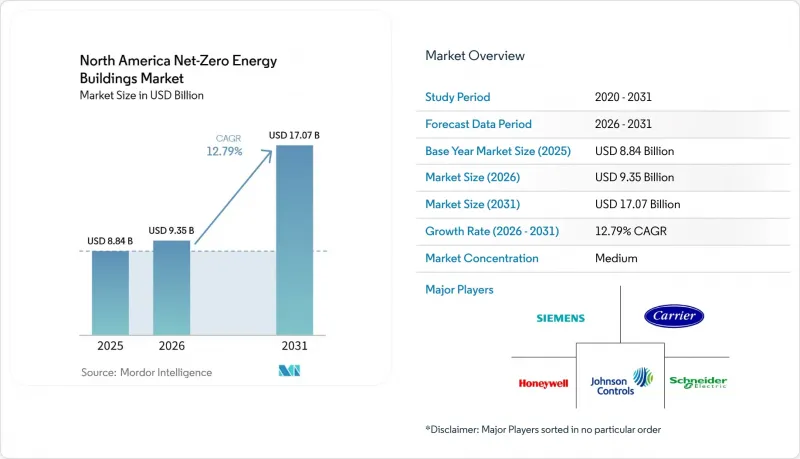
本報告按建築類型(住宅、商業、公共、工業)、產品/服務(解決方案、服務)、施工類型(新建、維修)和地區(美國、加拿大、墨西哥)進行細分。市場預測以美元計價。
北美淨零能耗建築市場的趨勢與洞察
嚴格的能源標準和淨零排放目標
在北美淨零能耗建築市場,能源標準不斷提高業主必須達到的性能水準。加拿大的《2025年國家建築能源標準》引入了溫室氣體排放性能等級和能源使用路徑,為每個省份提供了通用路徑。此標準的架構允許各省在維持通用技術方向的同時,自行設定實施進度。在美國,修訂後的能源標準和省級建築性能法規更加重視高效機械設備、建築圍護結構維修以及專案設計中的測量方法。在多個司法管轄區開展業務的開發商需要為不同的實施進度和不同的文件要求做好準備。這使得那些在跨省和跨州的標準合規、工程和性能驗證擁有能力的公司更具優勢。
獎勵大規模節能維修
在北美淨零能耗建築市場,財政獎勵促進了維修項目的發展,尤其是大規模商業和公共建築的翻新。美國聯邦框架鼓勵業主在計劃進行設備升級的同時評估能源效率,而不是將節能工作視為一個獨立的專案。獎勵計劃也增加了對能源建模和認證的需求,因為業主需要準備必要的文件才能獲得支援。公共採購使供應商能夠累積低碳建築材料、先進控制系統和性能檢驗的經驗。一些聯邦獎勵的調整計畫於2026年6月及以後實施,可能會加速一些正在進行的計畫。此外,來自各州、公共產業和私營部門的穩定資金籌措計劃對於維持未來的翻新活動將變得更加重要。
初始投資成本高,投資回收期長
建築維修通常需要同時進行建築外圍護結構改造、機械設備更換、電氣系統維修以及控制系統安裝。這導致北美淨零能耗建築市場的初始成本較高。在寒冷氣候地區,由於需要大規模的隔熱和氣密措施,這一趨勢尤其明顯。有些業主可能不願意批准投資回收期長於典型資本規劃週期的項目。小規模商業房地產的業主可能缺乏有效利用複雜獎勵和資金籌措方案所需的人員。基於物業的清潔能源(PACE)貸款和公共產業公司貸款可能有所幫助,但其可用性因地區而異。因此,與擁有類似建築需求的小規模業主相比,大規模機構和企業物業組合的推進速度可能更快。
細分市場分析
到2025年,商業建築將佔北美淨零能耗建築市場的46.8%,主要得益於辦公大樓、物流設施和零售空間的維修。入駐這些物業的企業越來越傾向於在租賃協議和採購過程中要求提供碳排放數據和能源性能認證。預計到2031年,機構自有建築的複合年成長率將達到13.9%,在所有建築類型中成長最高。醫院、大學和政府機構通常營運週期長,且有公共承諾支持大規模的資本投資項目。 2025年12月,加州大學爾灣分校醫療中心(UCI Health)在加州爾灣開設了一家全電動急診醫院,該醫院利用了現場太陽能和可再生能源。該計畫表明,即使是能源密集型醫療機構也可以採用全電動設計。
由於產權分散和專案層面技術支援有限,住宅仍面臨挑戰。在墨西哥,工業需求不斷成長,與近岸外包相關的建築必須滿足跨國租戶的要求。北美淨零能耗建築業也受益於透過公共採購制定的可重複使用的供應商和承包商規範。位於不列顛哥倫比亞省的庫奇坎地區醫院於2025年獲得了加拿大綠色建築委員會的「零碳建築設計標準」認證。此類專案為正在考慮電氣化和低碳設計的醫療機構業主提供了寶貴的範例。在所有類型的建築中,最永續的機會在於那些將營運目標與長期維護和檢驗相結合的項目。
其他好處:
- Excel格式的市場預測(ME)表
- 3個月的分析師支持
目錄
第1章:引言
- 研究假設和市場定義
- 調查範圍
第2章:調查方法
第3章執行摘要
第4章 市場趨勢與分析
- 市場概覽
- 市場促進因素
- 嚴格的能源標準和淨零排放目標
- 獎勵大規模節能維修
- 暖氣和冷氣的電氣化
- 企業投資組合脫碳
- 併網建築需量反應
- 寒冷氣候下外殼結構與熱泵的創新
- 市場限制因素
- 初始投資成本高,投資回收期長
- 熟練勞動力和試運行能力短缺
- 各州、各省、各市的法規有差異。
- 與互通性、網路安全和效能檢驗。
- 價值和供應鏈分析
- 監理情勢
- 技術展望
- 市場變化和擴散趨勢
- 大型淨零能耗建築項目
- 波特五力分析
第5章 市場規模與成長預測
- 依建築類型
- 住宅
- 商業
- 公共設施
- 產業
- 透過提供的服務
- 解決方案(開發新型淨零能耗建築、維修淨零能耗建築、一體化設計與施工、及智慧淨零能耗建築解決方案)
- 服務(建築和工程設計、施工服務、試運行和認證服務、諮詢服務)
- 依建築類型
- 新建工程
- 維修
- 國家
- 美國
- 加拿大
- 墨西哥
第6章 競爭情勢
- 市場集中度
- 策略趨勢
- 市佔率分析
- 公司簡介
- Johnson Controls International plc
- Schneider Electric SE
- Siemens AG
- Honeywell International Inc.
- Carrier Global Corporation
- Trane Technologies plc
- Daikin Industries Ltd.
- Mitsubishi Electric Corporation
- ABB Ltd.
- Eaton Corporation plc
- Legrand SA
- Robert Bosch GmbH
- Saint-Gobain
- Kingspan Group plc
- ROCKWOOL A/S
- Owens Corning
- Lutron Electronics Co., Inc.
- Signify NV
- Canadian Solar Inc.
- Integrated Environmental Solutions Ltd.
第7章 市場機會與未來展望
According to Mordor Intelligence, the North America net-Zero energy buildings market size is expected to grow from USD 8.84 billion in 2025 to USD 9.35 billion in 2026 and is forecast to reach USD 17.07 billion by 2031 at 12.79% CAGR over 2026-2031.
This report is Segmented by Building Type (Residential, Commercial, Institutional, Industrial), Offerings (Solutions, Services), Construction Type (New Construction, Renovation), and Geography (United States, Canada, Mexico). The Market Forecasts are Provided in Terms of Value (USD).
North America Net-Zero Energy Buildings Market Trends and Insights
Stringent Energy Codes and Net-Zero Performance Targets
Energy codes are raising the level of building performance that owners must meet in the North American net-zero energy buildings market. Canada's National Energy Code of Canada for Buildings 2025 introduced operational greenhouse gas performance tiers and energy-use pathways, giving provinces a common route toward lower-carbon construction. The code structure allows provinces to set their own adoption pace while preserving a common technical direction. In the United States, updated energy codes and state building performance rules are making high-efficiency mechanical systems, envelope upgrades, and measurement practices more central to project design. Developers that operate in several jurisdictions must plan for uneven adoption schedules and different documentation requirements. This favors firms with capabilities in code, engineering, and commissioning across multiple states and provinces.
Deep Energy Retrofit Incentives
Financial incentives have supported the retrofit pipeline in the North America net-zero energy buildings market, especially for large commercial and institutional properties. The U.S. federal framework has encouraged owners to assess energy upgrades alongside planned capital replacements, rather than treating efficiency work as a separate project. Incentive programs also increase demand for energy modeling and certification because owners need documentation to qualify for support. Public procurement has helped suppliers build experience with low-carbon materials, advanced controls, and performance verification. The scheduled change to some federal incentives after June 2026 may bring forward projects already under development. It also makes stable state, utility, and private financing programs more important for maintaining future renovation activity.
High Upfront Capital Costs and Long Payback Periods
Whole-building retrofits can require envelope work, mechanical replacement, electrical upgrades, and controls at the same time. This creates a high initial cost for the North America net-zero energy buildings market, particularly where cold-climate upgrades require extensive insulation and air-sealing measures. Some owners have difficulty approving projects with payback periods longer than their usual capital planning cycle. Smaller commercial owners also may not have the staff to navigate complex incentive and financing programs. Property Assessed Clean Energy financing and utility financing can help, but their availability differs by jurisdiction. As a result, large institutions and corporate portfolios can move sooner than smaller owners with similar building needs.
Other drivers and restraints analyzed in the detailed report include:
- Electrification of Space Heating and Cooling
- Corporate Portfolio Decarbonization
- Skilled Labor and Commissioning Capacity Shortages
For complete list of drivers and restraints, kindly check the Table Of Contents.
Segment Analysis
Commercial buildings held 46.8% of the North America net-zero energy buildings market in 2025, supported by office, logistics, and retail retrofit activity. Corporate occupiers in these properties are increasingly asking for carbon data and energy performance evidence as part of leasing and procurement. Institutional buildings are forecast to expand at a 13.9% CAGR through 2031, the fastest rate among building types. Hospitals, universities, and government facilities often have long operating lives and public commitments that support major capital programs. UCI Health opened its all-electric acute care hospital in Irvine, California, in December 2025, using on-site solar and renewable grid electricity. The project shows that a high-energy-use healthcare facility can adopt an all-electric design.
Residential buildings remain harder to address because ownership is fragmented and project-level technical support is limited. Industrial demand is growing in Mexico, where nearshoring-related construction must meet the requirements of multinational tenants. The North America net-zero energy buildings industry also benefits when institutional procurement creates repeatable specifications for suppliers and contractors. Cowichan District Hospital in British Columbia earned the Canada Green Building Council's Zero Carbon Building Design Standard certification in 2025. Such projects provide reference points for healthcare owners assessing electrification and low-carbon design. Across building types, the most durable opportunity lies in projects that pair operational targets with long-term maintenance and verification.
Complete Report Scope:
- By Building Type
- Residential
- Commercial
- Institutional
- Industrial
- By Offerings
- Solutions (New Net-Zero Energy Building Development, Net-Zero Building Retrofit, Integrated Design & Delivery and Smart Net-Zero Building Solutions)
- Services (Architectural & Engineering Design, Construction Services, Commissioning & Certification Services and Consulting Services)
- By Construction Type
- New Construction
- Renovation
- By Country
- United States
- Canada
- Mexico
List of Companies Covered in this Report:
- Johnson Controls International plc
- Schneider Electric SE
- Siemens AG
- Honeywell International Inc.
- Carrier Global Corporation
- Trane Technologies plc
- Daikin Industries Ltd.
- Mitsubishi Electric Corporation
- ABB Ltd.
- Eaton Corporation plc
- Legrand SA
- Robert Bosch GmbH
- Saint-Gobain
- Kingspan Group plc
- ROCKWOOL A/S
- Owens Corning
- Lutron Electronics Co., Inc.
- Signify N.V.
- Canadian Solar Inc.
- Integrated Environmental Solutions Ltd.
Additional Benefits:
- The market estimate (ME) sheet in Excel format
- 3 months of analyst support
TABLE OF CONTENTS
1 Introduction
- 1.1 Study Assumptions and Market Definition
- 1.2 Scope of the Study
2 Research Methodology
3 Executive Summary
4 Market Insights and Dynamics
- 4.1 Market Overview
- 4.2 Market Drivers
- 4.2.1 Stringent Energy Codes and Net-Zero Performance Targets
- 4.2.2 Deep Energy Retrofit Incentives
- 4.2.3 Electrification of Space Heating and Cooling
- 4.2.4 Corporate Portfolio Decarbonization
- 4.2.5 Grid-Interactive Building Demand Response
- 4.2.6 Cold-Climate Envelope and Heat Pump Innovation
- 4.3 Market Restraints
- 4.3.1 High Upfront Capital Costs and Long Payback Periods
- 4.3.2 Skilled Labor and Commissioning Capacity Shortages
- 4.3.3 Fragmented State, Provincial, and Municipal Regulations
- 4.3.4 Interoperability, Cybersecurity, and Performance Verification Risks
- 4.4 Value and Supply-Chain Analysis
- 4.5 Regulatory Landscape
- 4.6 Technological Outlook
- 4.7 Market Evolution and Adoption Trends
- 4.8 Key Net-Zero Energy Building Projects
- 4.9 Porter's Five Forces Analysis
- 4.9.1 Bargaining Power of Suppliers
- 4.9.2 Bargaining Power of Consumers
- 4.9.3 Threat of New Entrants
- 4.9.4 Threat of Substitutes
- 4.9.5 Intensity of Competitive Rivalry
5 Market Size & Growth Forecasts (Value, USD)
- 5.1 By Building Type
- 5.1.1 Residential
- 5.1.2 Commercial
- 5.1.3 Institutional
- 5.1.4 Industrial
- 5.2 By Offerings
- 5.2.1 Solutions (New Net-Zero Energy Building Development, Net-Zero Building Retrofit, Integrated Design & Delivery and Smart Net-Zero Building Solutions)
- 5.2.2 Services (Architectural & Engineering Design, Construction Services, Commissioning & Certification Services and Consulting Services)
- 5.3 By Construction Type
- 5.3.1 New Construction
- 5.3.2 Renovation
- 5.4 By Country
- 5.4.1 United States
- 5.4.2 Canada
- 5.4.3 Mexico
6 Competitive Landscape
- 6.1 Market Concentration
- 6.2 Strategic Moves
- 6.3 Market Share Analysis
- 6.4 Company Profiles (Includes Global Level Overview, Market Level Overview, Core Segments, Financials as Available, Strategic Information, Products & Services, and Recent Developments)
- 6.4.1 Johnson Controls International plc
- 6.4.2 Schneider Electric SE
- 6.4.3 Siemens AG
- 6.4.4 Honeywell International Inc.
- 6.4.5 Carrier Global Corporation
- 6.4.6 Trane Technologies plc
- 6.4.7 Daikin Industries Ltd.
- 6.4.8 Mitsubishi Electric Corporation
- 6.4.9 ABB Ltd.
- 6.4.10 Eaton Corporation plc
- 6.4.11 Legrand SA
- 6.4.12 Robert Bosch GmbH
- 6.4.13 Saint-Gobain
- 6.4.14 Kingspan Group plc
- 6.4.15 ROCKWOOL A/S
- 6.4.16 Owens Corning
- 6.4.17 Lutron Electronics Co., Inc.
- 6.4.18 Signify N.V.
- 6.4.19 Canadian Solar Inc.
- 6.4.20 Integrated Environmental Solutions Ltd.
7 Market Opportunities & Future Outlook
- 7.1 White-Space and Unmet-Need Assessment

 亞太地區淨零能耗建築:市場佔有率分析、產業趨勢與統計及成長預測(2026-2031年)淨零能耗建築:市場佔有率分析、產業趨勢與統計及成長預測(2026-2031 年)南美洲淨零能耗建築:市場佔有率分析、產業趨勢與統計及成長預測(2026-2031 年)中東和非洲淨零能耗建築:市場佔有率分析、行業趨勢和統計數據以及成長預測(2026-2031 年)
 淨零能耗建築市場-2026-2032年全球市場預測
 全球淨零能耗住宅市場規模、佔有率、趨勢和成長分析報告(2026-2034年)
 電子百葉窗技術市場-全球產業規模、佔有率、趨勢、機會、預測:依技術、百葉窗類型、應用、地區和競爭格局分類,2021-2031年
 2034年淨零排放諮詢市場預測:按服務類型、合約模式、組織規模、最終用戶和地區分類的全球分析
 淨零能耗建築市場報告:按產品、建築類型和地區分類(2026-2034 年)
 2026年全球淨零能耗建築(ZEB)市場報告